

2026 Guide to Data Science: Skills Strategies & Courses
Explore the 2026 data science guide covering essential skills, learning strategies, and courses needed to build a strong foundation and succeed in data science.
Understanding Data Science
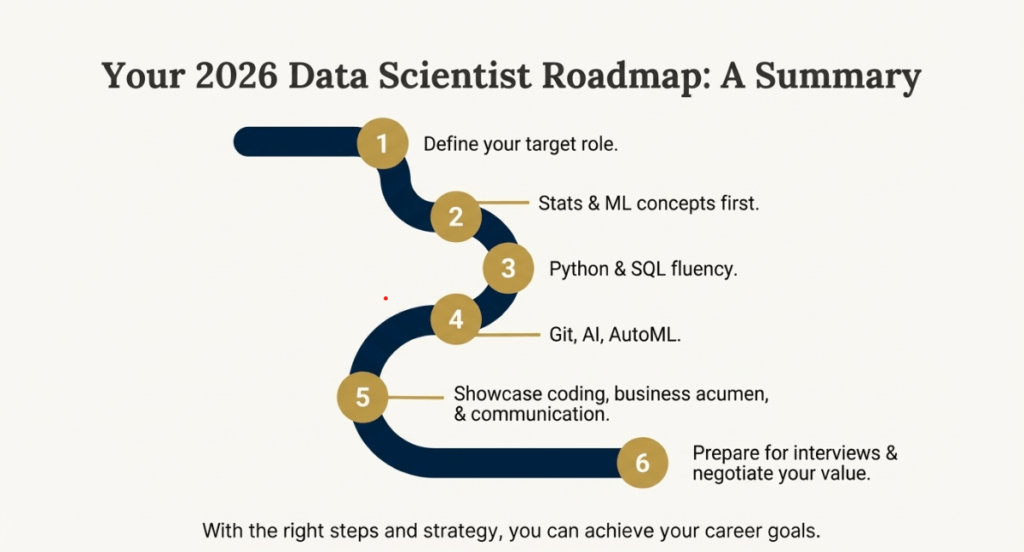
By 2026, data science is expected to become an even more important part of business strategies across all industries. A data scientist is a professional who works with data to uncover deep insights, develop predictive models, and help organizations solve complex problems using advanced analytics and machine learning techniques.Here is a reference road map that learners can adapt.
While the term was first coined in 2008, it has since expanded into a “big family” of roles. AI engineers, machine learning engineers, mathematicians, statisticians, and product analysts are just a few of the specializations that make up this new career path. Understanding the landscape is the first step in navigating the field, as different roles require different focuses based on the specific needs of companies such as Google or Meta.
Essential Skills for Data Scientists in 2026
To succeed in this rapidly changing field, you must master a variety of mathematical foundations, technical tools, and professional soft skills.
1. Math and Statistics (The Foundation)
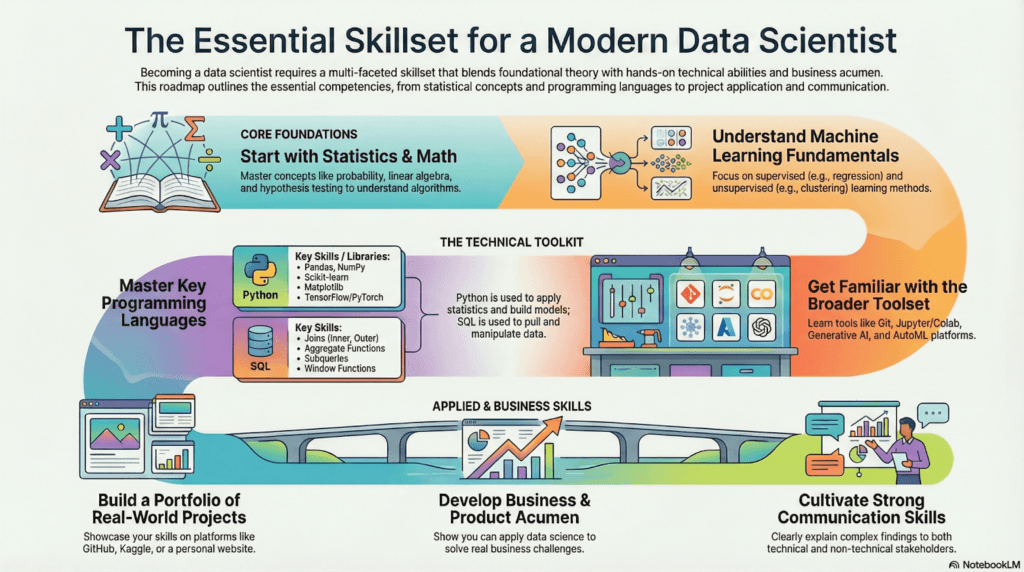
Mathematics and statistics are the “core” of data science, and coding is simply a tool for applying them.
-
- Mathematics: A solid foundation in probability, linear algebra, and calculus is required to truly comprehend how algorithms and data models work.
-
- Descriptive statistics include measures of central tendency (mean, median, and mode), variability (standard deviation and variance), and graphical summaries like histograms and bar plots.
-
- Inferential statistics include hypothesis testing, probability distributions, sampling, and time series analysis.
-
- Advanced Techniques: Expertise in multivariate analysis, experiment design, survival analysis, and resampling techniques is essential for those looking to stand out.
2. Machine Learning Fundamentals
Machine learning is the engine that powers predictive analytics. Mastery includes two main categories:
-
- Supervised learning entails learning to construct models using linear regression, logistic regression, decision trees, random forests, and neural networks.
-
- Unsupervised learning focuses on techniques such as K-means clustering, Principal Component Analysis (PCA) for dimensionality reduction, and anomaly detection.
-
- Toolkits: Getting hands-on experience with libraries like Scikit-learn for general machine learning and TensorFlow or PyTorch for deep learning models is essential.
3. Programming and Database Management
Coding is the practical application of statistical knowledge.
-
- Python and R remain the top languages. Python is particularly valued for its versatile libraries, which include NumPy for numerical operations, Pandas for data manipulation, and Matplotlib for data visualisation.
-
- SQL (Structured Query Language) is used extensively by data scientists to extract and manipulate data prior to statistical analysis. Be comfortable with joins (inner, outer, and left), aggregate functions, subqueries, and advanced window and analytics operations.
4. Data Engineering and ML Operations
The demand for data management tools grows in tandem with data volumes.
-
- Big Data and Cloud Computing: Before working with large datasets, students should be familiar with big data platforms and cloud computing.
-
- MLOps Tools: To scale machine learning solutions, students should be familiar with machine learning lifecycle management tools such as MLflow and Kubeflow.
5. Development and workflow tools
A professional development environment is necessary for effective data science.
-
- Notebooks: Gaining experience with Jupyter and Google Colab for interactive coding.
-
- Version Control: Because students will be working in collaborative environments with frequent code reviews, use Git to push, pull, and review code.
6. Soft skills: Communication and business sense.
Technical prowess alone is insufficient in today’s job market.
-
- Business and Product Understanding: Show an understanding of the product life cycle and how data science fits into a business roadmap.
-
- A successful data scientist must communicate in both technical and non-technical languages, translating complex business challenges into data-driven solutions.
The Rise of Generative AI, AutoML, and Hybrid Roles
With the onset of 2026, several emerging trends are reshaping the data science landscape.
-
- Generative AI as a Tutor and Tool: Tools such as ChatGPT are now regarded as “custom tutors” for explaining complex concepts such as PCA in simple terms. Furthermore, data scientists are expected to incorporate generative AI into their daily workflows for writing code and performing preliminary data analysis.
-
- Automated Machine Learning (AutoML): Many businesses are adopting “plug and play” solutions. Data scientists must now focus on data schema and problem-solving methods rather than creating each model from scratch, as AutoML tools handle the routine aspects of model selection.
-
- Salary Negotiation Mastery: Aside from technical skills, there is a renewed emphasis on the professional skill of negotiation. According to research, understanding the components of compensation (base salary, RSUs, and signing bonuses) can result in significantly higher offers, sometimes increasing a package by up to $100,000.
Machine Learning (ML) and Generative AI (GenAI) are the fundamental pillars of modern data science, and mastering them is critical for anyone seeking to comprehend how today’s digital landscape works. Machine learning is a branch of artificial intelligence that focuses on creating systems that can learn from data to identify patterns and make decisions with little human intervention. Generative AI, a subset of machine learning, extends these patterns to generate entirely new content, such as text, images, or code.
WhiteScholars’ Data Science Course: From a Beginner to an Expert
WhiteScholars Academy offers a six-month intensive data science course in Hyderabad that takes students from fundamental knowledge to industry readiness. The program is designed to help even beginners achieve mastery by combining expert guidance, practical application, and prestigious certifications.
Expert Mentoring and Curriculum A data scientist with 10+ years of experience in top-tier companies teaches the course to help students gain a deep understanding of complex topics such as ML and AI. This ensures that students not only learn theory but also get industry-specific training that is relevant and immediately useful. The learning journey is also supported by:
-
- 180 hours of learning are available in offline, online, and live recorded sessions.
-
- Mastery of essential tools such as Python, SQL, Power BI, and Tableau.
-
- Weekly assignments are designed to reinforce learning and keep students ahead of industry trends.
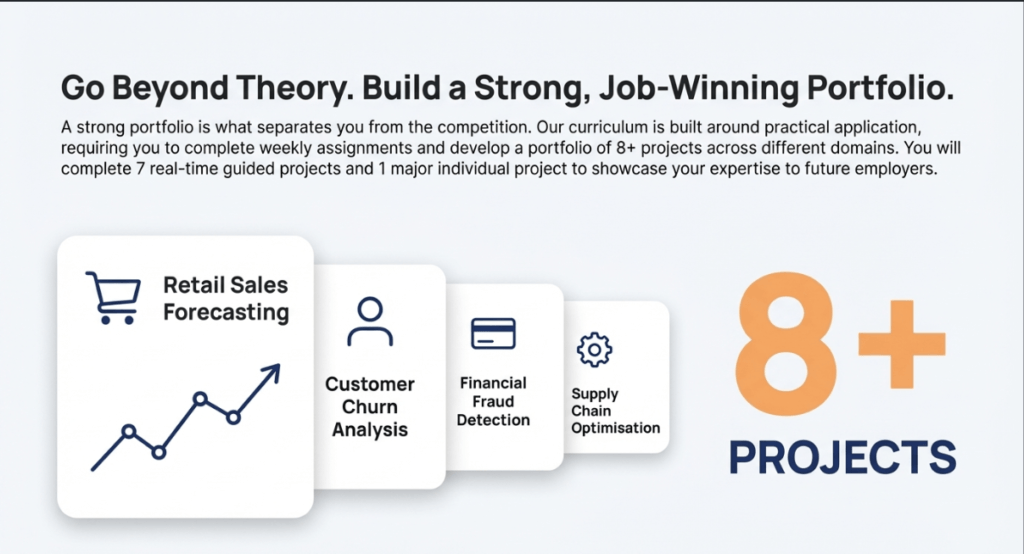
Building a professional portfolio mastery is demonstrated through application. WhiteScholars helps students build a strong portfolio by requiring them to complete eight projects in various domains. For those on the Data Analytics track, this includes 7+ real-time projects and one individual project. These projects enable students to demonstrate their ability to solve “real-world” problems, which is a key component of the WhiteScholars mission.
Industry validation and career launch Professional recognition is an important step in the transition from student to master. The course is delivered in collaboration with Microsoft and NASSCOM, and students will receive certificates from both organizations upon completion.
To ensure a successful transition into the workforce, WhiteScholars offers:
-
- Guaranteed Certifications
-
- Guaranteed interview opportunities, leading directly to employment.
The program provides individuals with the skills required to thrive in an ever-changing world by combining personalized and impactful training with high-level corporate exposure.
Building a Portfolio and Securing a Role
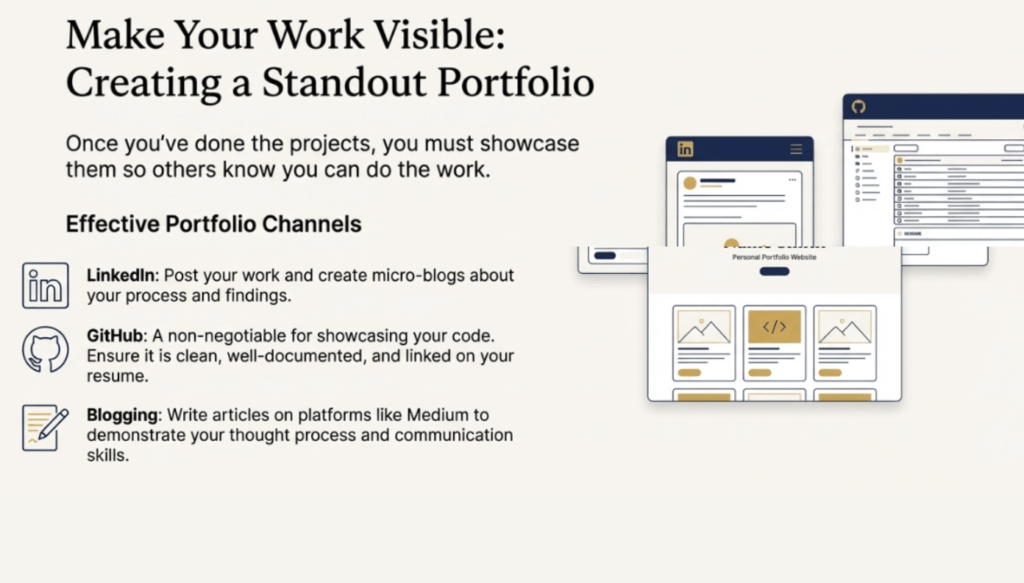
Once students have learned skills, they must demonstrate them. This entails developing real-world projects with platforms like Kaggle or personal data, such as credit card spending patterns. These projects should be showcased in a comprehensive portfolio that includes a personal website, a GitHub profile, micro-blogs on Medium, and a professional LinkedIn presence.
Finally, interviewing is a separate skill set from data science itself. Success necessitates timed practice, mastery of case studies, and the use of platforms such as LeetCode or Stratascratch to hone coding and statistical skills.
The 2026 Data Science Family: Exploring Roles and Specialisations
In the current and future job markets leading up to 2026, data science is viewed as a “big family” of diverse roles rather than a single position. While these roles are data-driven, they differ in their focus, the tools they prioritize, and how they contribute to a company’s overall strategy.
The Diverse Roles within the Data Science Landscape
The following roles represent the primary specializations in the data science space:
Data Scientist: This is a broad role in which the professional works with data to discover deep insights, create predictive models, and solve complex problems using advanced analytics and machine learning. Unlike other roles that may begin with coding, a data scientist’s work is primarily based on statistics and mathematics.
Product Analyst: This is a hybrid role that falls somewhere between data scientist and data analyst. Product analysts anticipate significant growth beyond 2025. Their primary focus is on business and product understanding, specifically how data-driven insights contribute to the product life cycle and the company’s product strategy.
A data analyst typically focuses on data manipulation and visualization, whereas a data scientist focuses on predictive modeling and advanced statistics. This role’s learning path frequently begins with mastering coding and SQL to extract and interpret existing data sets.
Machine Learning (ML) and AI Engineers: These are specialized roles in the family that work on the technical development and scaling of machine learning models. They frequently use MLOps tools such as MLflow or Kubeflow to ensure that models can run at scale within an organization.
Data Engineer: As data volumes increase, data engineers are in charge of the infrastructure and tools required to manage them. They are SQL, big data platform, and cloud computing experts who ensure that scientists and analysts can access and use clean data.
Mathematicians and statisticians: These professionals lay the theoretical groundwork for the field. They concentrate on the methods, probability distributions, and experimental designs that ensure data models are scientifically valid.
Conclusion
In order to master advanced AI tools and business strategy by 2026, one must first master foundational mathematics. It is a field that requires continuous learning, especially with the incorporation of generative AI and MLOps into standard workflows. Students can succeed in this highly competitive field by building a strong portfolio and honing both technical and “human” skills like communication and negotiation. Ultimately, learner’s ability to apply these skills through real-world projects and refine your interview and negotiation techniques will be the deciding factors in securing a high-value role in this evolving industry
FREQUENTLY ASKED QUESTIONS
1. What is the best way to start a data science career in 2026?
Instead of jumping right into coding, build a strong foundation in math and statistics. To truly understand how algorithms and data models work, start with fundamental concepts like probability, linear algebra, and calculus. Take a structured data science course that incorporates generative AI, such as the White Scholars Data Science Course.
Once the theoretical foundation has been established, begin learning programming languages such as Python or R. It is also critical to research the data science landscape to determine which specific role, such as product analyst or AI engineer, best fits your goals.
2. Which programming and database skills are deemed essential?
Python and SQL are the two most important languages for a data scientist to learn in the current and future markets. Python is renowned for its robust libraries, which include Pandas for manipulation, NumPy for numerical operations, and Matplotlib for visualisation.
SQL is also important because it is used to extract and manipulate data before statistical analysis can begin. Concentrate on understanding joins, aggregate functions, and advanced window functions. Furthermore, proficiency with developer tools such as Jupyter, Google Colab, and Git is required for collaborative work environments.
3. How should I begin learning machine learning?
To be successful in 2026, you must understand both supervised and unsupervised learning techniques. Linear regression, decision trees, and neural networks are important supervised methods, whereas unsupervised learning focuses on K-means clustering and Principal Component Analysis (PCA).
Hands-on experience with tools such as Scikit-learn and TensorFlow is required for developing and deploying these models. Understanding how to scale these solutions with MLOps tools such as MLflow is becoming increasingly important for high-level positions.
4. How does generative AI integrate into the data science workflow?
Generative AI tools, like ChatGPT, are now regarded as essential “custom tutors” capable of explaining complex concepts like PCA in simple, understandable terms. Beyond learning, data scientists are expected to use these tools in their daily professional tasks, such as writing code or conducting preliminary data analysis.
They can also be used to generate project ideas or organize data-driven solutions to specific business problems. While these tools can increase productivity significantly, it is important to understand your data schema and problem-solving techniques before using them effectively. The integration of AI enables more efficient and sophisticated data handling.
5. How do I stand out to recruiters and get a high-paying job offer?
Standing out requires more than just technical expertise; create a comprehensive portfolio that includes a personal website, a GitHub profile, and micro-blogs on platforms such as LinkedIn. Your projects should demonstrate a combination of coding skills, business acumen, and effective communication.
Furthermore, recognize that interviewing is a distinct skill set that necessitates practice using case studies and platforms like LeetCode. Understanding the components of total compensation, like RSUs and signing bonuses, can result in significantly higher final offers.
