

Agentic AI In Action: Marketing, Healthcare, And Finance In 2026
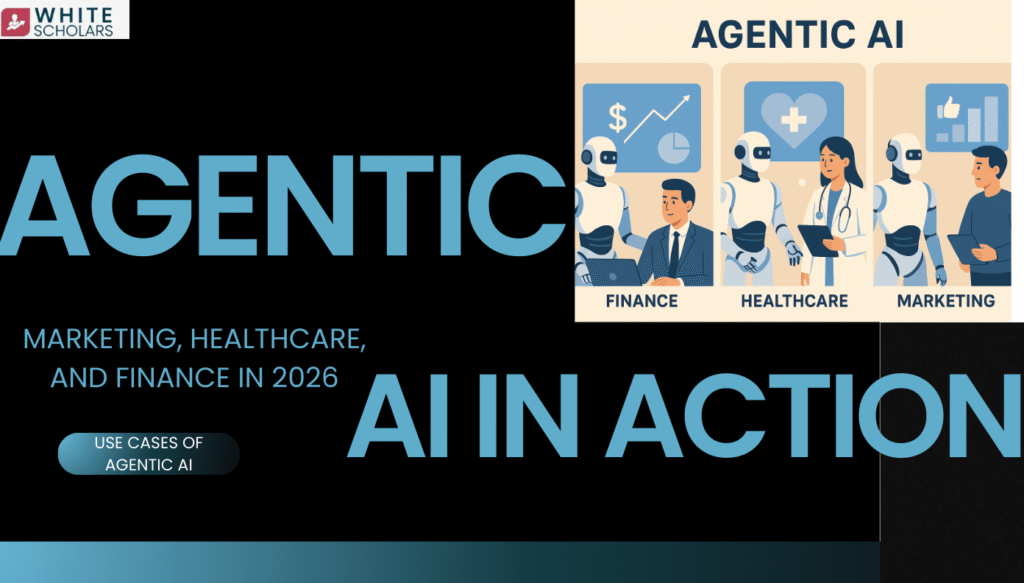
Table of Contents
Artificial intelligence is currently shaped by two distinct but interconnected approaches: generative AI and agentic AI. Let’s learn what agentic AI is and how it will rule 2026 in finance, marketing, and healthcare.
What is Agentic AI?
While many are familiar with generative AI, such as chatbots and image generators, it is agentic AI that promises to unlock a new level of autonomous function and complexity.
Agentic AI systems are fundamentally proactive systems. Unlike generative AI, which is fundamentally reactive and waits for a user prompt to generate content (such as text, images, or code), agentic AI takes action.
Generative AI is primarily a sophisticated pattern-matching machine that uses statistical relationships learnt from massive datasets to predict what content to display next based on the prompt. However, the work of generative AI ends at content generation; it does not take further steps without human input.
By contrast, an agentic system is designed to pursue complex goals through a series of autonomous actions. This capability is rooted in a specific life cycle that the agent follows:
- Perception: The agent first perceives or assesses its environment.
- Decision-Making: Based on this perception, it determines what action to take.
- Execution: It then performs the chosen action.
- Learning/Feedback: After execution, the agent learns from the output, completing the cycle and preparing for the next step.
This entire process occurs with minimal human intervention.
A defining characteristic of agentic AI is its emphasis on multi-step reasoning and planning. When presented with a complex objective (a broader goal rather than a simple task), the agent uses reasoning to break it down.
This mirrors how humans tackle difficult problems. For example, when organising a conference, an agent uses an internal dialogue powered by its reasoning engine to determine sequential steps: first, understand the requirements (size, budget), then research venues, then check availability, and so on.
Crucially, Large Language Models (LLMs) serve as the common foundation and reasoning engine for these agents. LLMs provide the agent with cognitive capabilities, often employing a technique known as chain of thought reasoning. This allows the agent to essentially “think through” the problem space before committing to an action.
In its simplest definition, agentic AI is an AI system that can make decisions and take actions on its own to achieve a complex goal without needing detailed instructions at every single step. These systems must possess:
- Goal-Oriented Planning: Focusing on complex goals, not just simple, single-turn tasks.
- Autonomous Decision Making: The system performs actions (like sending an email or creating a meeting invite) without being manually directed by a human to click specific buttons.
- Access to Tools: Integration with external tools (via APIs) such as Outlook, HR management systems, search engines, or inventory systems is necessary for execution.
- Knowledge and Memory: They have access to data (like PDF files or databases) and maintain context or memory during conversations.
Why Agentic AI is a Game Changer
Agentic AI represents a fundamental shift from human-curated generation to autonomous execution, making it a game changer in several key ways.
The ability to commit to and execute a series of actions autonomously transforms AI from a sophisticated suggestion engine into an intelligent collaborator capable of managing complex, ongoing scenarios.
Generative AI requires a human to review, refine, and direct the process at every step; the AI generates possibilities, but the human curates them. Agentic AI, however, thrives in scenarios consisting of multi-step processes that require ongoing management.
The introduction of autonomous agency changes the nature of human interaction with AI. For example, a simple chatbot that answers policy questions from a PDF is a workflow; it is reactive. A tool-augmented chatbot that can pull an employee’s remaining leave days and even submit a leave request via an HR API is an improvement, but it is still reactive.
The game changes when the system is given a goal, such as “Onboard the new intern starting next Monday.” This necessitates multi-step planning and autonomous decision-making, in which the agent determines the order of actions, such as scheduling a welcome meeting, creating a profile in the HR system, or creating a ticket for Wi-Fi credentials, and executes them independently.
This autonomy, powered by sophisticated chain-of-thought reasoning, means that businesses and individuals can delegate broad, complex, and time-consuming administrative or technical objectives, rather than merely delegating simple, discrete tasks.
Looking ahead, the most powerful AI systems are expected to be these intelligent collaborators that inherently understand when to explore options through generation and when to commit to a course of action through agentic execution.
Top Use Cases of Agentic AI
The key opportunities and most important use cases for AI agents right now fall into three main categories: developer services (coding), customer experience, and business operations.
Aside from these categories, specialised complex assistants are also proving extremely useful.
1. Developer and Coding Agents
There is a significant focus and energy surrounding developer-facing AI agentic work, often referred to as coding co-pilots or coding platforms.
Detailed Use Case Description:
These agents do more than just suggest the next line of code; they are designed to carry out complex development plans. When an agentic coding system is given a goal, such as creating a specific type of application (for example, a React Native app similar to a popular task management tool), it will first define the required features.
It then performs multi-step planning, which includes writing code and executing that code, identifying bugs, debugging, resolving issues, and iterating the process until the objective is met. Examples of platforms focused on this agentic approach include systems like Cursor and Devon.
In essence, the agent manages the entire development lifecycle for a given component or small application Based on the broad goal specified, act as an automated project manager and executor.
The game-changing nature of coding agents lies in their ability to handle entire feature implementations without human oversight beyond the initial prompt. This shifts the developer’s responsibilities from writing and debugging routine code to supervising the agent’s overall strategy and integrating completed modules.
This use case relies heavily on integrating the LLM reasoning core with tools like version control systems (e.g., Git), testing frameworks, and deployment pipelines. In the future, specialised coding agents will work in parallel; for example, one agent will focus on front-end UI design and another on back-end API development, all reporting back to a central orchestrator agent.
2. Customer Experience (CX) Agents
Agentic AI in customer experience aims to elevate traditional customer support interactions, making them significantly more realistic and engaging than standard chatbots.
Detailed Use Case Description:
While standard chatbots are already commonplace, the challenge has been to go beyond reactive Q&A and provide genuine, goal-oriented tasks in addition to answering questions. For example, a customer interaction could progress from answering a question about an order (simple Q&A) to autonomously monitoring a delivery status across multiple carrier platforms, detecting an anomaly, proactively notifying the customer, and re-routing the shipment, all while utilising multi-step planning and external tool access.
This level of proactive service ensures that the user does not immediately attempt to bypass the bot and contact a human agent.
The core advancement here is the shift to proactive problem resolution. Instead of waiting for a customer to complain about a missed delivery, an Using real-time data, the agentic system identifies the problem, initiates a remediation plan (e.g., escalating to a logistics partner, generating a compensation voucher, sending a personalised apology), and keeps the customer informed, demonstrating autonomy.
Ethical considerations are paramount in this domain, requiring strict grounding in company policies and robust testing to ensure the agents do not take actions (like issuing refunds or changing contracts) outside defined parameters.
3. Operations and Security Agents
The operations space, which includes IT operations and security operations, is an ideal application for AI agents because it frequently involves the “needle in a haystack problem”, or the challenge of synthesising massive amounts of data and managing a flood of alerts.
Detailed Use Case Description:
Large amounts of data are generated during operations, resulting in numerous alerts that human staff struggle to prioritise. An agentic system excels at synthesising this information. The AI agent, which is grounded in specific company policies and operational procedures, can analyse all incoming data, determine which alerts require immediate attention, and present only the top three to five critical issues.
Furthermore, the agent does not just flag the problem; it also uses its reasoning capabilities to articulate the problem clearly and propose several ways to remediate the issue, essentially providing actionable intelligence for IT or security staff. This elevates the function from simple data aggregation (a workflow) to sophisticated, policy-driven prioritisation and remediation planning.
A security operations agent, for instance, might detect suspicious login activity. A reactive system generates an alert.
An agentic system, however, will follow a defined playbook: cross-reference the IP address against known threat lists, check the user’s recent access history (memory), lock the account temporarily (action), initiate a multi-factor authentication request to the user’s phone (tool integration), and only then notify a human analyst with a summary of the incident, the steps already taken, and a recommendation for final resolution (e.g., permanent account review). This level of autonomous triage dramatically reduces response time and analyst workload.
4. Specialized Professional Assistants
Agentic AI is exceptionally powerful when deployed as an assistant to handle detailed, multi-step professional or personal goals, such as HR functions, financial analysis, or complex purchasing.
- HR and Onboarding Agents
An agentic HR system moves far beyond being a basic RAG (Retrieval Augmented Generation) chatbot. When an HR team gives the agent a goal, such as “Onboard the new intern joining next Monday,” the agent immediately begins multi-step planning and execution.
Steps required include scheduling a welcome meeting (using Outlook integration), writing a detailed description for the meeting (generation capability from the LLM), creating the intern’s profile in the HR management system (API integration), generating a ticket in the IT help desk for necessary credentials (Wi-Fi, email, and Slack access), and ordering a laptop via the inventory management system.
The system autonomously manages these sequential, dependent tasks, demonstrating high-level goal-oriented planning.
- Financial/Equity Research Analysts
Agentic systems can significantly augment complex research tasks that require synthesising diverse data sources. An equity research analyst can delegate the complex goal of writing a comprehensive report on a specific company (e.g., Nvidia). The agent, using frameworks for multi-step reasoning, will determine the necessary steps: gathering company information, collecting analyst recommendations, and sourcing recent news.
The agent uses tools like Yahoo Finance or DuckDuckGo search to execute these data collection steps and then uses its generative capabilities to compile the findings into a comprehensive report, structuring the content with key statistics and analysis points without being explicitly told where to place each section.
- Travel and Personal Shopping Agents
In the consumer space, agents manage complex, dynamic scenarios like trip planning or monitoring market conditions. A personal shopping agent, given a product to purchase, actively hunts for availability across multiple e-commerce platforms. It continually monitors price fluctuations, manages the checkout process when the price hits a target, and coordinates the final delivery. This is done largely on its own, with human input only when absolutely necessary.
Similarly, a travel assistant can be given a complex travel goal, such as “Book a 7-day trip to London in May where the weather is sunny for at least 4 days, within a specific budget.” This necessitates multistage planning and integration with specialised tools. The agent will first create a detailed plan, then execute it step by step, coordinating information from APIs like an AccuWeather API (for weather constraints) and an Expedia API (for flight and accommodation booking).
Agentic AI is fundamentally interconnected with data science through its core infrastructure (the Large Language Model, or LLM) and its practical application in synthesising and acting upon vast amounts of information.
The relationship can be understood in two main aspects: how the AI is built and how the AI operates.
1. Data Science Provides the Foundation
The cognitive engine that allows agentic AI to function is rooted in processes integral to data science, specifically in the creation of generative models:
- Core Engine: Agentic AI systems often share a common foundation with generative AI, namely Large Language Models (LLMs). These LLMs serve as the “reasoning engine” that powers the agent’s decision-making.
- Pattern Matching from Data: Generative AI models are essentially sophisticated pattern-matching machines. They learn statistical relationships (such as relationships between words or pixels) from massive data sets during their training phase.
- Cognitive Function: This training, which involves the statistical analysis and patterning of data, provides the LLM with the ability to “think” using techniques like chain of thought reasoning. This learnt capability enables the agent to divide a complex task into smaller logical steps. As a result, the fundamental intelligence that drives an agentic system stems directly from massive-scale data analysis and patterning.
2. Agentic AI is an execution layer for data-intensive tasks.
Once operational, the agentic AI system applies its data-derived reasoning capabilities to autonomously manage real-world, data-heavy problems:
- Agentic AI is particularly useful in data-rich environments, such as IT or security operations, where employees frequently face the “needle in the haystack problem”. The agent’s function is to autonomously synthesize all of that data and, based on established policies, determine the most critical alerts or issues. This elevates the system from mere data aggregation to policy-driven prioritisation and action.
- Accessing and Using Knowledge: In order to achieve complex goals, agentic systems must be able to access specific knowledge while also maintaining context. This knowledge is stored as data, often in the form of PDF files or databases. The agent uses its LLM reasoning engine to pull information from these sources and integrate it into its multi-step planning.
- Data-Driven Research: Specialised professional agents, such as those assisting equity research analysts, autonomously execute tasks that rely entirely on external data collection. When tasked with generating a report on a company (e.g., Nvidia), the agent’s multi-step reasoning leads it to specific data collection steps, such as gathering company information, analyst recommendations, and recent news, before compiling the final report.
In summary, data science methodologies are responsible for creating the statistically intelligent LLM that serves as the agent’s brain, and agentic AI systems use that brain to autonomously navigate, synthesize, and act on the complex data environments of the real world.
Data Scientist Course Hyderabad
Data science enables agentic AIs by combining machine learning, automated tasks, and smart choices to create systems that do more than help; they act on their own. With 2026 getting closer, fields like healthcare, marketing, or banking will lean into this tech to team up with people, boosting speed, fresh ideas, and sharper teamwork.
If you are a student, now is the time to prepare, and starting at the White Scholars Training Institute in Hyderabad makes sense. This Data Scientist Course in Hyderabad is notable for its structured teaching style, which includes distinct stages in the data science and generative AI course in Hyderabad, as well as solid coaching focused on real-world skills.
Learners grow confident via live projects that match actual job hurdles, while talk practice and fake interview drills chip away at fear of speaking up and sharpening how they present themselves. On top of that, job guidance helps students land their first real-world position. Basically, if Agentic AI is where work is headed, White Scholars is what gets learners ready giving them tools and self-assurance while opening doors so they can succeed in what’s coming
Final Thought
Agents can automate entire business processes and manage complex personal goals by combining the cognitive strength of large language models for complex planning and reasoning with the ability to take tangible actions via tool integration.
The future of AI is not purely generative or purely agentic; it is a collaborative integration in which the agent knows when to generate possibilities and when to commit decisively to an autonomous course of action, thereby increasing efficiency and transforming productivity across all industries.
FAQ’s:
1. What is agentic AI, and why is it important in 2026?
A. Agentic AI refers to systems that act independently toward goals, making decisions without constant human input. It is expected to revolutionise industries in 2026 by increasing speed, personalisation, and autonomy.
2. How is agentic AI transforming healthcare?
A. Agentic AI assists doctors by analysing patient data, recommending diagnoses, and even assisting with robotic surgeries. It reduces manual tasks and enhances precision in treatment planning.
3. What role does agentic AI play in finance?
A. In finance, agentic AI automates fraud detection, risk analysis, and trading decisions. It monitors markets in real time and acts faster than human analysts, improving accuracy and profitability.
4. How does agentic AI improve marketing strategies?
A. Agentic AI personalises campaigns, forecasts customer behaviour, and adjusts content dynamically. It enables marketers to deliver the right message to the right audience at the perfect time.
5. Why should students learn agentic AI now, and where can they start?
A. Learning agentic AI now prepares students for high-demand roles across industries. Institutes like White Scholars in Hyderabad offer hands-on training in data science and generative AI, helping learners build real-world skills and confidence to work with agentic systems.
