

How to Build Your Digital Marketing Business Step by Step
Learn how to build a digital marketing business from scratch with simple steps to attract clients and grow revenue.
What is digital marketing?
Digital marketing is defined as the strategy, practice, or act of promoting a specific brand or product through digital channels. These digital channels most commonly include social media platforms like Instagram, Facebook, and Pinterest, as well as search engines such as Google.
It is important to distinguish between digital marketing and the sale of digital products; while they are not the same, digital marketing skills are essential to successfully sell digital products. Effectively, digital marketing is the strategy used to help customers find products in the digital space.
Where Digital Marketing is Used and the Development of Modern Business
In today’s world, digital marketing connects businesses and consumers across multiple platforms and industries. It is used on social media to establish an online presence, on search engines to increase visibility, and in email campaigns to engage leads and customers. It is also widely used in the digital product industry, where products such as Canva templates, online courses, ebooks, and printable wall art are advertised.
The development of businesses in today’s world has shifted significantly toward passive income models. Unlike traditional employment, which often requires individuals to trade their time for a set hourly or yearly salary, digital marketing for digital products enables a “build it once, sell it forever” strategy. This model is revolutionary because it removes the natural limit on earnings imposed by the number of hours in a day.
Businesses today, from small independent creators to large corporations, are focusing more than ever on enhancing their online visibility and engaging customers through internet marketing to achieve financial freedom and scale without the need for significant upfront capital, such as that required for real estate.
How to Start Digital Marketing: Follow these 4 Phases
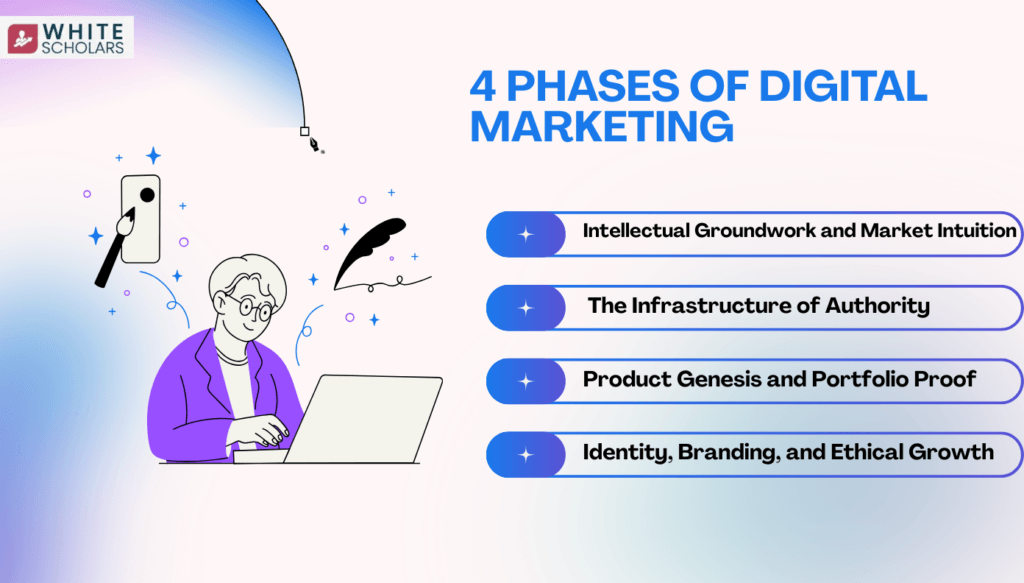
Phase I: Intellectual Groundwork and Market Intuition
Instead of simply “picking a niche”, you must begin by identifying natural demand. This involves a deep dive into the digital landscape to understand the specific problems people are already trying to solve.
• Solving Real-World Problems: Look for “time-poverty” in specific industries. For example, teachers are often overwhelmed with “wearing 10 different hats,” making them a prime audience for digital tools like lesson plans and worksheets that save them preparation time.
• The Competitive Advantage of Experience: Leverage your personal history. If you have experience in healthcare, real estate, or education, you possess a competitive advantage over those who do not understand the nuances of that field.
• Beyond the “Resell” Trap: Avoid the common misconception that digital marketing is about buying a course to resell that same course. This is often an artificial demand, a pyramid scheme where people are sold the dream of getting rich rather than a functional tool.
Phase II: The Infrastructure of Authority
Once you’ve identified a problem to solve, you need to create a structure that promotes long-term visibility. This moves beyond a basic business plan into the creation of a digital ecosystem.
• Strategic Blueprinting: Define your mission, vision, and core values clearly. Your business must stand on a foundation of transparency and integrity, particularly in an industry often marred by “gatekeeping”.
• The Power of Specialisation: Modern businesses thrive when they are seen as specialists rather than generalists. Whether you focus on SEO (Search Engine Optimisation), social media management, or content marketing, being an “expert” in the minutiae of your service makes you more trustworthy to potential clients.
• Assembling the Team: Scale your business by integrating specialists such as SEO copywriters, data analysts, and client relations managers.
Phase III: Product Genesis and Portfolio Proof
You cannot sell a strategy if you haven’t proven it works. In this phase, you transition from theory to tangible evidence.
• The Build-Once Model: Focus on creating digital tools (templates, ebooks, or planners) that require no physical inventory or shipping. For instance, a “Weather Lesson Plan” bundle can be created once in Canva and sold indefinitely.
• Case Study Creation: If you have no clients, become your own client. Start a blog or a personal project, apply SEO and social media strategies, and document the growth in traffic and engagement. This serves as a “live demonstration” of your ability to drive results.
• Inclusive Design: When creating products, small details make you stand out. Using dyslexia-friendly fonts or inclusive imagery ensures your products serve a wider audience, increasing their value.
Phase IV: Identity, Branding, and Ethical Growth
Branding is the essence of your business and the “promise of value” you bring to your clients. It is not just a logo; it is the emotional response your business evokes.
• Authentic Networking: Do not rely on “cold DMs” or “door-to-door” digital salesmanship, which is unsustainable and often ineffective. Instead, attend webinars and conferences to build genuine partnerships with complementary firms, such as video production or PPC agencies.
• The Unique Value Proposition (UVP): You must identify what makes you distinct. This could be a specific niche specialisation, innovative methodologies, or exceptional customer service.
• Client-Centricity: Success is measured by the lasting impact and transformative results you deliver for your clients. A data-driven approach, providing regular analytics and reporting, ensures informed decision-making and builds long-term trust.
What Makes a Digital Marketer Stand Out
To stand out in a competitive market, avoid the “digital marketing trap.” Many newcomers fall for “get rich quick” schemes, in which they pay for expensive courses that only teach them how to resell the same course. This generates artificial demand and is commonly known as a pyramid scheme.
To truly stand out, you must:
- Focus on Natural Demand: Create or promote products that solve real problems in people’s everyday lives. For example, teachers always need lesson plans and worksheets to save time.
- Provide a Unique Value Proposition (UVP): Determine your agency’s distinct strengths, such as innovative methodologies or a particular niche specialisation.
- Be Client-Centric: Maintain open lines of communication and provide exceptional customer service to build long-term trust and word-of-mouth referrals.
- Embrace Transparency: Avoid “gatekeeping” and share behind-the-scenes insights or results to build authority and trust with your audience.
Essential Skills for Digital Marketing
To be successful in this field, you must have both technical and strategic skills.
- Content Creation and Design: Ability to use platforms like Canva to create high-quality digital tools, such as templates or worksheets.
- Search Engine Optimisation (SEO): Understanding how to conduct keyword research and optimise content so that it appears high in search engine results pages.
- Data analysis entails monitoring campaigns and analysing performance metrics in order to make informed decisions and achieve optimal results.
- Social Media Management: The skill of creating, curating, and scheduling content across various platforms like TikTok, LinkedIn, and Instagram to maintain an effective online presence.
- Strategy development entails analysing market trends and competition to create a tailored roadmap for a client’s success.
- Problem-Solving: Identifying specific problems within an industry and creating digital products
White scholars Academy
If you’re looking for a digital marketing course in Hyderabad, White Scholars is the best option. It is well-known for its excellent training programme, which includes one-on-one mentoring, hybrid learning (offline and online), placement assistance, and much more. The White Scholars Training Institute in Hyderabad provides structured training to help students achieve their goals by explaining real-world projects and certifications.
White Scholars Academy is an excellent choice for students interested in pursuing a career in digital marketing because it combines hybrid learning, strong mentorship, and placement assistance with a truly practical focus. Beyond structured classes, students gain hands-on experience through live projects, case studies, and real-world campaign analysis, ensuring they develop industry-ready skills.
With an updated curriculum that covers SEO, social media, analytics, and paid ads, as well as guidance from experienced mentors, students graduate confident, skilled, and ready to succeed in the digital world.
Course Link: Best Advanced AI Digital Marketing Training in Hyderabad
Compare passive income digital products to predatory pyramid schemes.
A legitimate passive income model based on digital products differs significantly from a predatory pyramid scheme. While both operate within the digital space, their foundations, methods of growth, and sustainability differ significantly.
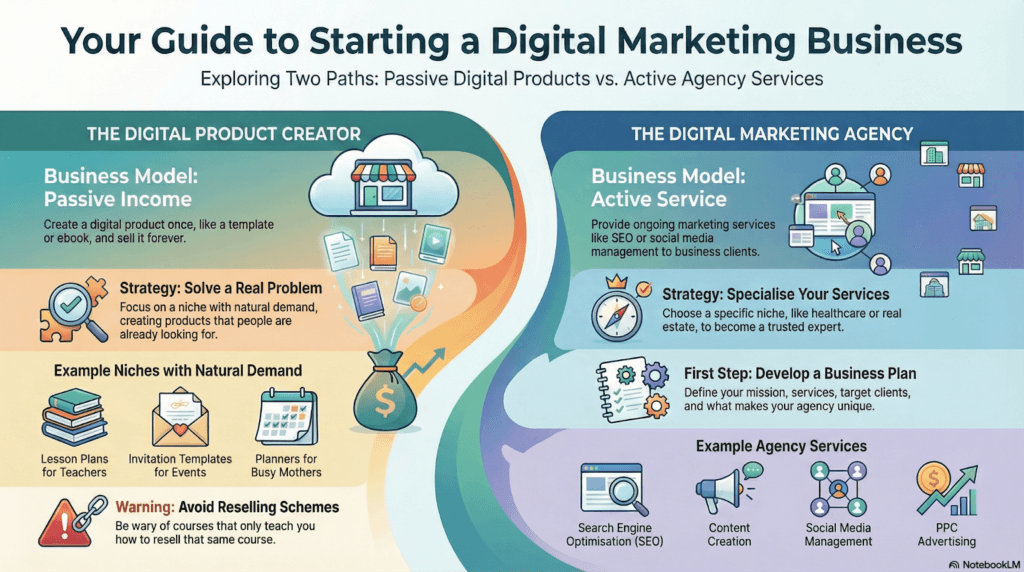
1. Source of Demand: Natural vs. Artificial
The most fundamental difference is why the customer purchases the product.
Passive Income Digital Products
These are built on natural demand.They act as digital tools that solve real-world problems for specific groups, such as teachers needing lesson plans to save time or mothers looking for organisational planners. Because these products address existing needs, the creator does not need to “convince” anyone to buy them; customers are already actively searching for these solutions online.
Predatory Pyramid Schemes
These rely on artificially created demand. Instead of solving a problem, the “product” is frequently a high-priced course (often costing more than $500) that simply teaches the buyer how to resell the course to others. The “demand” is created through social media hype, which frequently includes real or fabricated income screenshots to entice beginners into a cycle of reselling the same instruction manual.
2. Marketing Strategy: Searchable Utility vs. Aggressive Persuasion
The strategy used to reach customers differentiates a sustainable business from an unsustainable “trap.”
Passive Income Model
Successful digital marketers use digital marketing as a strategy to help customers find their products. For example, by using SEO and platforms like Etsy, a seller can remain “fully anonymous” and still generate consistent revenue without ever having to DM a potential customer.
The work is done upfront, creating the template and uploading it, and then it compounds over time as a “build it once, sell it forever” model.
Pyramid Scheme Model
If a strategy requires a person to consistently reach out to others, post incessantly on threads, or “anonymously DM” people to convince them to buy, it is no longer passive.
This approach is deemed unsustainable because there are only so many people one can message in a day, and it fails to achieve true financial freedom.
3. Value and Sustainability
The long-term viability of these models depends on the value provided to the end-user.
Legitimate Digital Products
These provide lasting value through utility. Examples include Canva templates, ebooks, printable wall art, and real estate graphics. Because these are tools for specific niches, they avoid the “oversaturation” found in the general digital marketing niche.
Predatory Schemes
These are often “scams” that target beginners who do not know any better. They create an “oversaturated” market where thousands of people are trying to sell the exact same course to each other. Eventually, the circle breaks because the course does nothing but teach the buyer how to sell the course they just purchased.
Comparison Summary
| Feature | Passive Income Digital Products | Predatory Pyramid Schemes |
| Primary Goal | Solving a problem or providing a tool. | Reselling the same course for a profit. |
| Demand Type | Natural demand in specific niches. | Hype generates artificial demand. |
| An effort model | Build once and sell indefinitely, compounding over time. | Continued “door-to-door” digital sales efforts. |
| The barrier to entry | Low, typically just a platform subscription. | Frequently high; requires the purchase of expensive courses. |
| Sustainability | High; meets a recurring market need. | Low; the market rapidly becomes saturated. |
What specific roles make up the ideal digital marketing business team?
When building a digital marketing business, assembling a strong team of experts is vital, as they serve as the backbone of the company and are responsible for delivering exceptional results and maintaining client relationships.
The specific roles that comprise this dream team include
• SEO Spe improve a website’s organic search ranking and visibility on results pages through keyword research and on-page optimisation.
• SEO Copywriter: This role is responsible for crafting written content that is specifically designed to rank well on search engines while remaining engaging for the reader.
• Content Creator: These individuals produce high-quality material, such as blog posts, articles, explainer videos, and infographics, to inform and attract the target audience. In the context of digital products, they may also design tools like Canva templates or worksheets.
• Social Media Manager: This role involves managing and promoting brands on platforms like Instagram, Facebook, and LinkedIn, which includes curating content, engaging with followers, and running paid advertising campaigns.
• Analytics and Data Analyst: These specialists monitor client campaigns and analyse performance metrics, providing the data-driven insights necessary for informed decision-making and ongoing strategy optimisation.
• Client Relations Manager: building long-term trust and providing exceptional service. Trust and exceptional service, serving as the primary point of contact to ensure that the client’s requirements and expectations are met.
A full-service or specialised agency may also include PPC advertising experts who manage paid media, email marketing specialists who generate leads and engage customers, and influencer marketing experts who connect brands with relevant creators.
Specialising the team’s expertise in a specific area, such as healthcare or education, can boost their effectiveness by allowing them to navigate industry-specific regulations and challenges.
Detailed Case Study: Creating a Digital Product
When starting, you might choose the education niche because teachers are constantly looking for time-saving resources. Using a platform like Canva, you can create a “Weather Lesson Plan” worksheet.
The The process entails determining the appropriate dimensions, using inclusive fonts (such as dyslexia-friendly ones), and incorporating interactive elements such as colouring pages and reading comprehension exercises.
Bundling various themes, such as rainy, snowy, and stormy days, increases the product’s value. This practical application of digital marketing skills allows you to meet a natural demand without needing to “cold DM” potential customers.
Conclusion
Digital marketing has evolved from a simple promotional tool into a sophisticated engine for financial independence and business growth. By leveraging digital channels such as search engines and social media, individuals and agencies can connect with audiences globally, moving away from the traditional model of trading time for money.
The key to success in this modern landscape lies in authenticity and problem-solving. Rather than participating in oversaturated “resell” schemes, the most successful marketers identify niches with natural demand, such as education or event planning, and provide tangible value through digital tools.
Starting a business in this sector requires a disciplined approach, beginning with market research and progressing through niche selection, portfolio building, and strategic networking. Ultimately, a digital marketing business thrives not just on revenue but on the lasting relationships nurtured and the transformative results delivered to clients.
Digital marketing is like a bridge; it connects the unique solutions you create to the people who are already standing on the other side, looking for exactly what you have to offer.
FREQUENTLY ASKED QUESTIONS
1. What is the first step in starting a digital marketing business?
The first step is to learn the fundamentals of digital marketing, such as SEO, social media, content, and advertising. Once you understand these, you can begin providing services to small businesses and freelancers.
2. Will I need a lot of money to start a digital marketing business?
No, you do not need a large investment. To get started, you only need a laptop, an internet connection, and a few simple tools. Most platforms provide free or low-cost resources.
3. How long does it take to expand a digital marketing business?
It is dependent on your effort and consistency. With consistent practice, networking, and delivering good results, you can see results in 6 to 12 months.
4. Why should students select White Scholars Academy for digital marketing training?
White Scholars Academy provides hands-on projects, mentoring, hybrid learning, and job placement assistance. Students gain practical skills and confidence that will allow them to start their own businesses or find work in the industry.
5. What services can I provide as a beginner in digital marketing?
You can begin with social media management, SEO, content creation, and running basic ad campaigns. As your experience grows, you can move into analytics, strategy, and consulting.
