

AI vs Machine Learning vs Data Science Explained
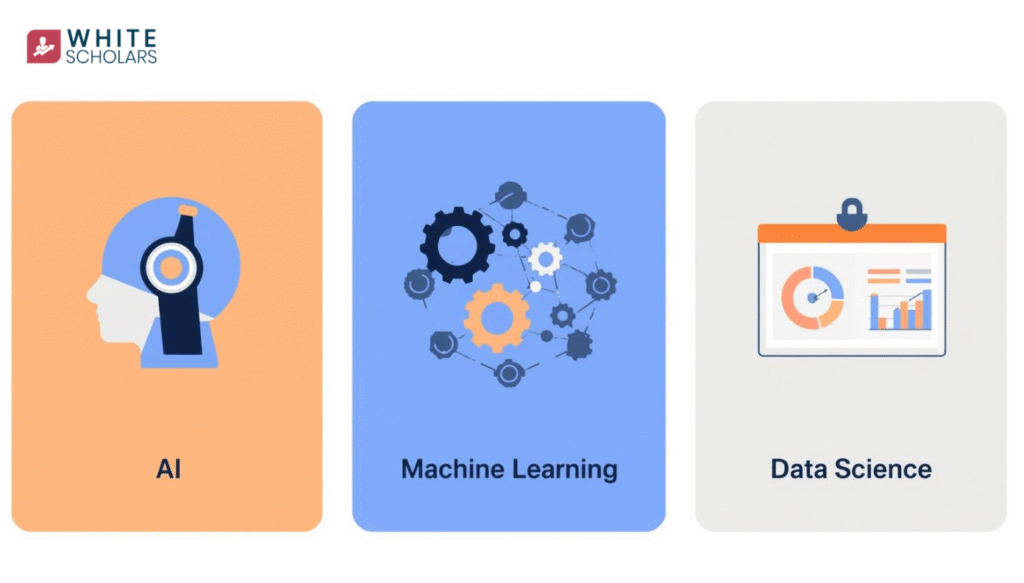
Table of Contents
Explore the key differences between AI vs ML vs Data Science with easy explanations, simple processes, and real-world insights anyone can understand.
Artificial Intelligence
Let’s start with Artificial Intelligence. In 1951, Alan Turing, one of the founders of modern computing, predicted that by the end of the 20th century, it would be possible to program a machine to answer questions in such a way that it would be “extremely difficult to guess whether the answers are being given by a man or by the machine.”
One of the most authoritative and widely cited definitions of artificial intelligence (AI)
The capability of a computer program or a machine to perform tasks or reasoning processes that we would normally associate with human intelligence, such as learning, reasoning, and problem-solving.
The broad categories and scope of AI research as outlined are
1. Natural Language Processing (NLP)
2. Knowledge representation
3. Reasoning and problem-solving
4. Planning and decision-making
5. Perception
6. Social Intelligence
7. General Intelligence (or Artificial General Intelligence)
8. Learning (or Machine Learning)
1. Natural Language Processing (NLP):
Natural Language Processing (NLP) is the part of Artificial Intelligence that deals with language
What NLP is all about: teaching computers to understand and use human language in a way that feels natural to us.
This can be chatbots on websites or digital assistants like Siri and Alexa, or the use of LLMs like ChatGPT, Claude, Gemini, and others. NLP has been instrumental to many of the AI transformations in recent years.
2. Knowledge Representation (KR)
Knowledge Representation is like a brain’s library, or a place where an AI stores what it knows in an organized way so it can recall, reason, and make decisions. It’s what turns data into actionable information. Without it, a machine might see the world, but it wouldn’t really know what anything means.
Earlier NLP efforts relied on knowledge representation to make sense of the texts, although modern NLPs rely less on KRs. But they are still relevant.
So how does KR actually work? It usually involves building structured representations like graphs, ontologies, or rules that capture relationships between concepts. For example, a knowledge graph might link Paris → is the capital of → France, or water → freezes at → 0°C. These relationships help computers reason about the world logically, fill in gaps, and make inferences.
But what is the essence of having patterns and connections to information if we can’t reason or make decisions with them? Hence, that’s where reasoning comes in.
3. Reasoning and problem-solving
Reasoning, as we know, involves a cognitive system, like our brain, analyzing available data and making inferences or conclusions based on that information. AI has become remarkably good at this and has surpassed humans because it reasons at a much faster speed than the most humans do.
Reasoning is heavily the use of probabilistic models to think around or solve problems.
4. Planning and decision-making
It is the sub-discipline that involves the artificial agent being able to outline a set relevant actions in an environment within a given context. So whether it’s faced with playing a game or self-driving in a roadwith alternating street lights, busy pedestrians moving in multiple directions, and somebody’s dog chasing a balloon into the incoming vehicle — planning and decision making is how the AI knows what call to make and how to navigate its way around complexities.
Speaking of autonomous vehicles navigating itself on a road, perception becomes important.
5. Perception
An autonomous vehicle needs to be able to perceive the world around it to be able to navigate itself around. When we humans speak of perception, we refer to ability to see, hear, touch, smell and speak.
An autonomous vehicle also needs to be able to perceive the world around it as best as possible. It needs to be able to see the road, remember the dog chasing the balloon into road in front the incoming vehicle? Visual perception for AI is achieved through cameras.
It also needs to be able to hear cars screeching nearby or horns blaring, and that can be achieved using microphones. It also needs to be able to perform actions within its environment like turn left, or right, or slow down or move faster, etc., which is basically robotics.
6. Social Intelligence
This is the concept of AI being observant of human emotions, this may be through the person’s choice of words, statements made and how positive or negative they are (sentiment analysis).
There are also Computer vision technologies that will try to detect the emotion on a human’s face.
7. General Intelligence
General Intelligence: Artificial General Intelligence, or AGI, is the big goal everyone’s aiming for. It’s the idea of creating an AI that’s not just great at one thing, like writing text or recognizing faces, but great at everything. In other words, it would be just as capable as humans across all kinds of cognitive tasks.
There’s also another concept that often comes up in these conversations, Artificial Superintelligence, or ASI. That’s the next level up. It’s an AI that doesn’t just match human intelligence but surpasses it in every possible way. Basically, a kind of superhuman intelligence. If there is to be an intelligence ranking from the bottom up, there’s AI, then AGI, then ASI.
Take Tesla’s Optimus robot, for example. Unlike Siri, which mainly responds to voice commands, Optimus can see, move, and perform physical tasks like walking or picking up objects. It uses several AI systems working together for vision, motion, and decision-making.
While Siri uses AI to talk, Optimus uses AI to think and act, making it a step closer to AGI, though still far from human-level understanding.
8. Learning (or Machine Learning)
This is one of the main points we’re looking at in this article. learning or machine learning, is arguably the most interesting and powerful sub-discipline of artificial intelligence. It’s pretty much the capacity of machines to learn from data, usually to identify patterns, make predictions and use the learning for whatever was the actual intention of the researcher.
What is Machine Learning?
Machine Learning comes under Artificial Intelligence. Machine Learning enables the computer to understand the pattern from the data and make decisions.
In traditional programming, programmers provide code for all possible conditions. In Machine Learning, the system learns from the past data.
Suppose we have a firm with data on the old customers. Age, purchase details, website behavior, and leaving the services come in the past data.
Machine Learning can analyze this past data and learn some patterns to predict which customers might leave the services.
Data Science
Data Science is the field that extracts meaningful insights and knowledge from data using a combination of statistics, programming, domain expertise, and storytelling
What Does a Data Scientist Actually Do?
Say Aha wants to figure out why a large number of subscribers are suddenly canceling their memberships in a certain state or any specific location. Here’s what a data scientist could do:
Step 1: Understanding the Problem
First, they talk to the business team. What exactly are we trying to solve? Is it about content? Price? User experience? This is crucial because you can have all the data in the world, but if you’re answering the wrong question, it’s useless.
Step 2: Gathering and Cleaning Data
This is where data scientists spend about 60–80% of their time (yes, really). They collect data from different sources: user activity logs, subscription records, customer support tickets, maybe even social media sentiment. Then comes the unglamorous part: cleaning it. Dealing with missing values, fixing inconsistent formats, and removing duplicates. It’s like doing dishes before cooking; nobody loves it, but it’s essential.
Step 3: Exploring the Data
This is where the detective work happens. They create visualizations, calculate statistics, look for patterns. Maybe they notice that users who watch less than 5 hours a month are 3x more likely to cancel. Or that cancellations spike right after price increases. This exploration phase often reveals insights before any fancy algorithms even come into play.
Step 4: Building Models (Sometimes)
Not every data science project needs machine learning. Sometimes a well-crafted SQL query and a clear visualization solve the problem. But when prediction is needed, that’s when ML comes in. They might build a model to predict which users are at risk of canceling in the next 30 days.
Step 5: Communicating Results
A data scientist to tell a story with the data and insights. It involves creating dashboards, writing reports, presenting to executives whenever needed, and convincing them why your insights matter and what the best course of action is, given your findings.
Bringing it all together: AI vs ML vs Data Science
Let’s use a clear and simple example to show how AI, ML, and Data Science differ in practice.
A Machine Learning Engineer building the next generation of AI models, a Data Scientist uncovering insights that shape business strategy, or an AI specialist in robotics or NLP, you’re part of an incredibly exciting time in technology.
Don’t get paralyzed by the hype or the seemingly infinite things to learn. AI, ML, and Data Science are tools to solve problems. The most successful people in this field aren’t the ones who know every algorithm or the latest framework, they’re the ones who can identify real problems and use these tools effectively to solve them.
Right between your curiosity and your career, a structured Data Science course by WhiteScholars bridges this gap by teaching you how to turn raw data into insights and real-world solutions. The program in Hyderabad covers Python, SQL, Machine Learning, Tableau/Power BI, and even Generative AI, with a curriculum designed with industry experts, hands‑on projects, and placement-focused support.
So, start learning, build things, and don’t be afraid to adjust course as you discover what truly excites you. The field is vast, the opportunities are real, and your journey is just beginning.
Data Science Course in Hyderabad at WhiteScholars
For graduates willing to go deeper into AI algorithms and machine learning, a data science course in Hyderabad through WhiteScholars can be the next step after foundational analytics skills. This typically adds supervised and unsupervised learning, model evaluation, feature engineering, and possibly deep learning basics, framed around real-world problems.
With this path you can,
-
- Work toward roles like junior data scientist, ML engineer trainee, or applied AI analyst, which require both coding skills and understanding of business use cases.
-
- Position yourself for long-term growth, as data science remains one of the highest-paying and fastest-growing segments in the engineering job market in India through 2026 and beyond.
FAQ’s
Q1: What is the difference between Artificial Intelligence (AI), Machine Learning (ML), and Data Science?
AI is the broadest field aiming to create intelligent machines capable of tasks like reasoning and perception. ML, a subset of AI, enables systems to learn patterns from data without explicit programming, while Data Science combines statistics, ML, and domain knowledge to extract actionable business insights from data.
Q2: What are the main subfields of Artificial Intelligence mentioned in the article?
The eight key areas are Natural Language Processing (NLP), Knowledge Representation, Reasoning and Problem-Solving, Planning and Decision-Making, Perception, Social Intelligence, General Intelligence (AGI), and Learning (Machine Learning). These cover everything from chatbots to robotics like Tesla’s Optimus.
Q3: How does Machine Learning work, and what are its main types?
ML algorithms analyze data to identify patterns and build models for predictions, such as stock price forecasting from historical data. Types include supervised learning (with labeled data), unsupervised learning (finding hidden patterns), and reinforcement learning (trial-and-error feedback).
Q4: What are the key steps a Data Scientist follows to solve a business problem?
Data scientists start by understanding the problem and gathering/cleaning data (60-80% of the time), then explore patterns via visualizations, build ML models if needed, and communicate insights through dashboards and stories to drive decisions, like analyzing subscription cancellations.
Q5: How can beginners in Hyderabad start a career in Data Science or AI/ML?
Enroll in structured courses like the WhiteScholars Data Science program covering Python, SQL, ML, Tableau, and Generative AI, with hands-on projects and placement support. Focus on real problems over hype to land roles like Junior Data Scientist, leveraging Hyderabad’s growing tech scene.
