

Content Writing’s Impact on Digital Marketing and Businesses
A strategic approach to content writing clearly shows its impact on business growth. Let’s examine how it contributes to this growth.
The Foundation and Evolution of Content Writing
Content writing is the strategic process of creating, publishing, and distributing valuable and relevant content, which includes articles, videos, and podcasts, to attract and engage a specific target audience. Its primary purpose is to build brand awareness, generate leads, and drive revenue.
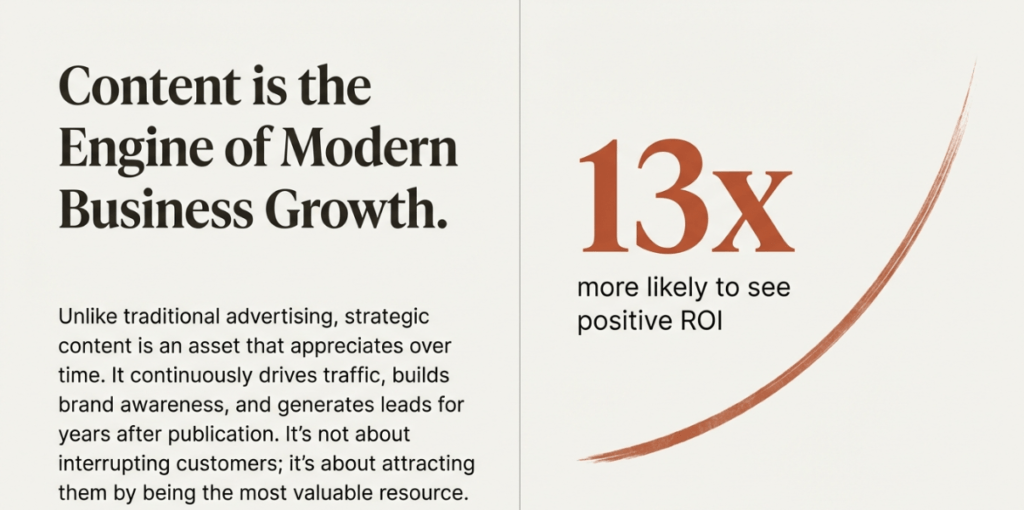
Historically, marketing relied heavily on interruption tactics like media buying or social media ads. However, content creation has become a key component of inbound marketing. Unlike a one-off press release or a fleeting Facebook ad, high-quality written content can continue to deliver a high ROI for years after publication.
Modern content writing is focused on solving audience problems and establishing authority, with marketers who prioritize blogging seeing a 13 times higher return on investment.
A Strategic Framework for Content Marketing
The strategic approach in content writing involves:
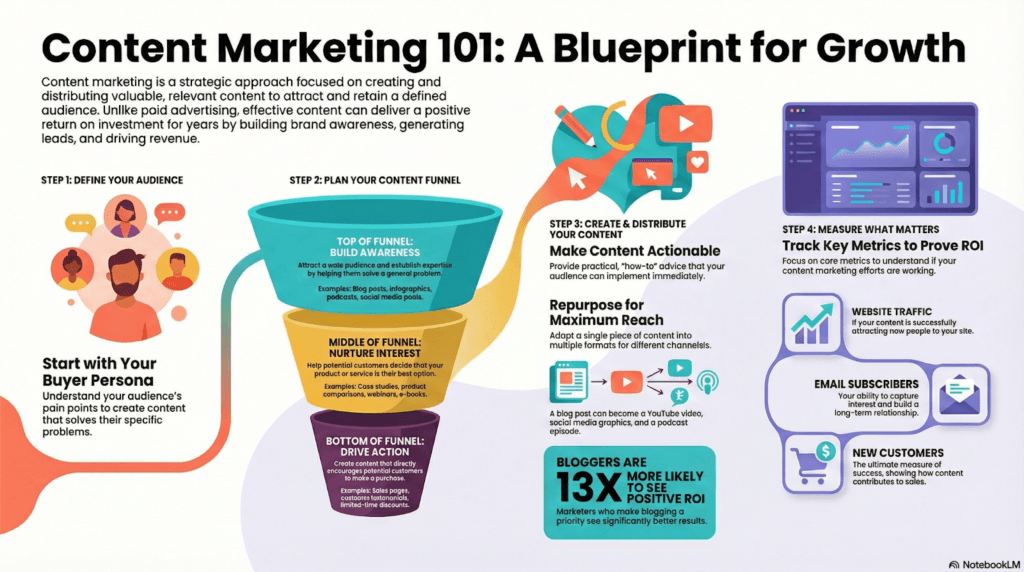
1. Define Your Audience
Identifying your target audience by creating a clearly defined buyer persona or “customer avatar” is the foundational first step for any campaign. This ensures every piece of content, from the chosen topics to the publishing format, is tailored specifically to solve your audience’s unique problems.
2. Plan Your Content Funnel
Map your content to the buyer journey by creating specific materials for the awareness, consideration, and action stages of the marketing funnel. This strategic flow nurtures visitors from initial discovery toward a final purchase decision while establishing your brand as a trusted industry expert.
3. Create and Distribute Your Content
Produce high-quality, actionable content such as engaging blog posts and videos that provide tangible solutions to your audience’s most burning problems. Maximize your efforts by repurposing this material across various channels like email newsletters and social media to ensure it reaches a wider audience.
4. Measure What Matters
Track success using essential metrics like website traffic, email subscriber growth, and new customer conversions to identify which strategies are delivering a return. Since digital attribution is often complex, directly asking customers which content influenced their purchase decision provides the most accurate and actionable insights.
The Infrastructure of a Digital Business
Building a successful business begins with a robust online presence, which requires a combination of intuitive design and functional tools. Creating a website should involve intuitive design features or the use of diverse website templates, of which over 900 options exist to suit various industries.
For those seeking speed, AI website builders can generate a site in a very short timeframe.
Beyond basic aesthetics, businesses must choose tools that are specifically tailored to their operations. eCommerce platforms are essential for running and growing online stores, while scheduling software helps manage staff, clients, and appointments efficiently.
Specialist sectors like restaurants require specific features to manage menus, orders, and reservations, whereas creatives might opt for an online portfolio to showcase their work. To establish a professional identity, registering a unique domain name and securing reliable web hosting are foundational steps.
Operational Management and Security
Managing a growing enterprise involves more than just customer-facing features; it requires backend stability. Enterprise-grade security is vital for protecting site data, while payment solutions allow for the seamless management of online transactions. To maintain control over operations at all times, a mobile app can be used to run the business on the move.
Relationship management is another pillar of growth that is frequently handled by a CRM system to help build and maintain customer relationships. This is supplemented by website analytics, which provide actionable data and insights into site performance. For larger entities, Wix Studio offers tailored solutions for agencies, freelancers, and enterprises to deliver high-quality client websites at scale.
Additionally, developers can build bespoke apps and sites, while AI features offer new ways to create and expand.
Fundamental Principles of Content Marketing
Content marketing is defined as a strategic approach focused on creating and distributing valuable, relevant content, such as articles, videos, and podcasts, to attract and retain a specific audience. The ultimate objective is to drive brand awareness, lead generation, and revenue.
Unlike traditional media buying, content is a form of inbound marketing that provides long-term value, continuing to drive traffic for years after its initial publication. One of the most critical steps in this process is defining the target audience. Without a clear buyer persona, marketing efforts often struggle.
A well-defined audience informs the topics covered and the formats used, such as choosing between advanced technical guides for professionals or simplified content for beginners. Tools like “Make My Persona” can help create a customer avatar to ensure all team members understand who they are serving.
The Marketing Funnel
A successful marketing strategy involves creating content for different stages of the buyer journey, also known as the marketing funnel. The goal is to move individuals from initial awareness to a final purchase.
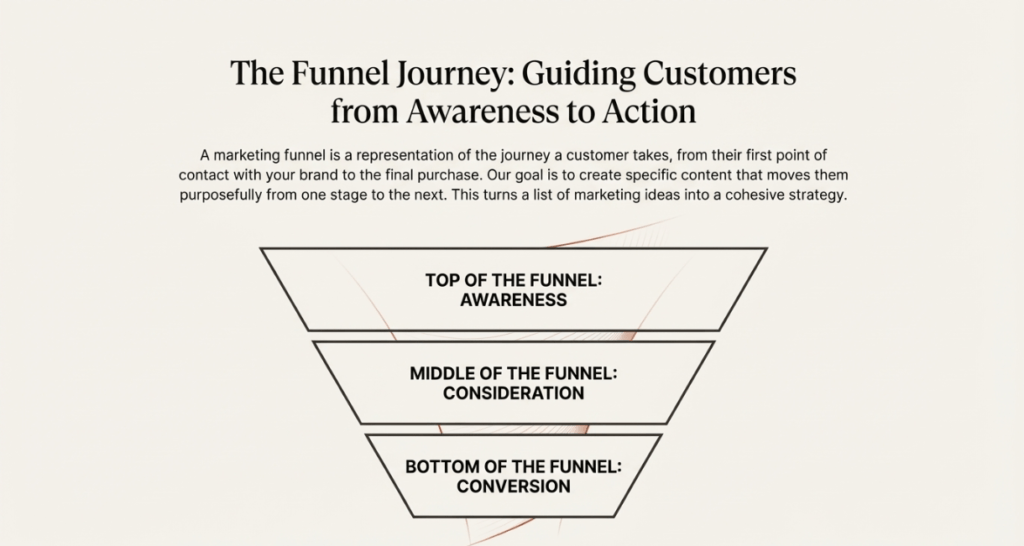
1. Top of the funnel (awareness and branding):
This stage focuses on educating the audience and solving their immediate problems rather than immediate conversion. It builds brand loyalty, with 62% of consumers agreeing that online content fosters this connection. Common formats include blog posts, YouTube videos, and infographics.
2. Middle of the Funnel (Interest):
Here, the focus shifts to the consideration stage, where the customer is deciding which option is best for them. Content should demonstrate why a specific product or service is the right choice through case studies, product demos, and email newsletters.
3. Bottom of the Funnel (Action):
The final stage is engineered for conversion. Content is designed to push people to buy, utilizing sales pages, webinars, and customer testimonials.
Creative Content Strategies for Engagement
To gain a competitive edge, businesses should use a variety of content formats.
-
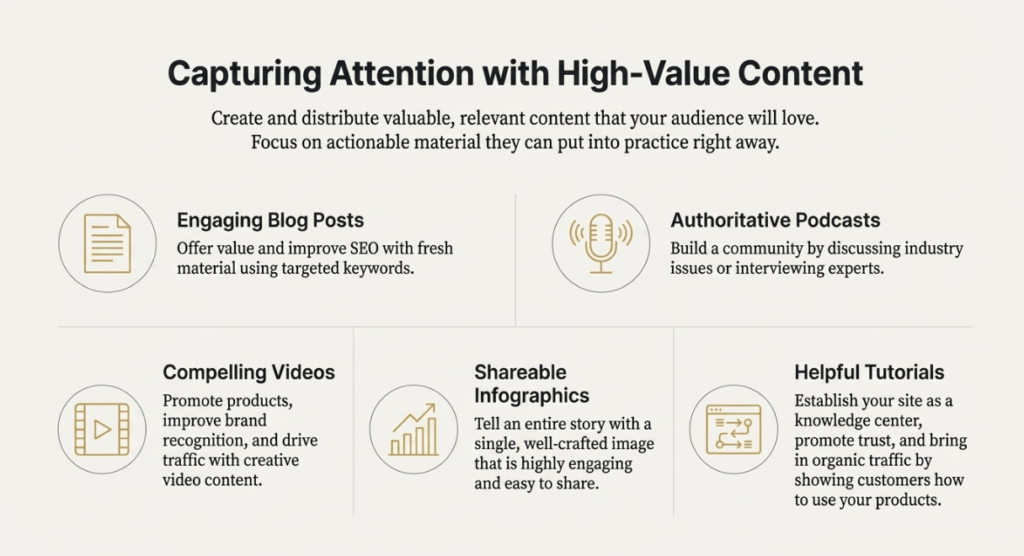
- Engaging Blog Posts: Updating a blog with fresh material provides value, builds brand authority, and improves SEO through targeted keywords.
-
- Podcasting: This is a powerful tool for community building and discussing industry-specific issues or interviewing experts.
-
- Visual Storytelling: Infographics can tell a story through a single image, while videos can promote new products and drive landing page traffic.
-
- Tutorials establish a website’s knowledge base and foster trust, whereas product reviews assist customers in making informed decisions.
-
- Cultural Content: Memes can make a brand memorable by tapping into emotions and humor, provided they align with brand values.
-
- Professional Expertise: Publishing case studies and white papers demonstrates high-level expertise and helps educate customers on complex subjects.
Social Media Marketing Tactics
Social media is a vital tool for direct communication and brand promotion. Writing compelling posts is the basic foundation of this, but businesses should also offer an inside look at their daily operations via stories to build human connection.
Live streaming is frequently prioritized by platform algorithms and enables real-time interaction with followers. The strategic use of hashtags can boost visibility, and creating branded hashtags allows a company to establish its own tone online.
Businesses can boost engagement by launching challenges, forming community groups, or soliciting feedback through polls. Collaborating with other brands and commenting on their content can also help to increase exposure and reach.
Lead Magnets and Incentives
To attract new leads, businesses can offer various incentives:
• Freebies and Competitions
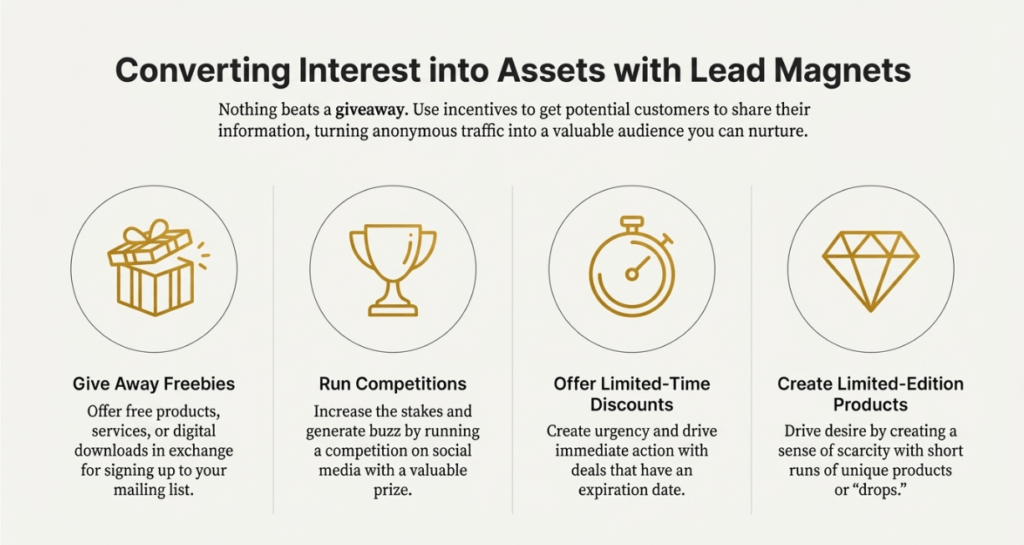
Giving away products or services in exchange for information (like email sign-ups) is highly effective.
• Limited-Time Offers
Discounts create a sense of urgency, while limited-edition products or drops create scarcity that drives demand.
Advanced Communication and Collaboration
Maintaining relationships with existing clients is just as important as finding new ones. Using a mailing list for newsletters and product announcements is the most direct form of communication. For broader news, press releases can be sent to media outlets to generate buzz.
-
- Events and webinars allow brands to gather partners and clients in one space (physical or online) to share knowledge and tighten ties. Furthermore, client testimonials serve as social proof, helping unfamiliar customers trust a brand.
-
- Collaborative efforts can also yield significant results
- Joint Products: Partnering with another brand to create a unique item can generate significant buzz.
-
- Local Networking: Working with local businesses appeals to the 49% of consumers who value local convenience.
-
- Sponsorships and Guest Posts: Sponsoring events or writing guest posts for other publications helps reach specific target audiences.
Advertising and Strategic Growth
When organic traffic is insufficient, paid advertising is an option. This includes online ads, billboard advertising for local businesses, and influencer marketing, where brands partner with individuals who have large, relevant followings.
Strategic management also necessitates mastering the elevator pitch in order to quickly explain the business to anyone. Simplifying the marketing funnel ensures fewer steps for the customer to purchase, while marketing automation can handle repetitive tasks like email replies, freeing up time for brainstorming.
Search Engine and AI Optimization
Modern marketing requires a deep understanding of SEO (Search Engine Optimization). This involves technical SEO, on-page optimization (focusing on user experience and intent), and link building to increase website authority.
With the rise of artificial intelligence, brands must now consider Generative Engine Optimization (GEO) and Answer Engine Optimization (AEO) to ensure they are cited by AI tools and LLMs (Large Language Models). Using an LLMs.txt file and tracking AI visibility are becoming standard practices.
Semrush and Ahrefs are popular tools for keyword research, competitor analysis, and backlink auditing to help maintain high rankings.
Scaling Content and Measuring Success
To grow consistently, businesses must systematize their processes. Content templates enable marketers to create high-quality content without reinventing the wheel. Scaling also involves building a team consisting of SEO strategists, writers, designers, and editors to handle the complexity of frequent publishing.
Success should be measured using four key metrics:
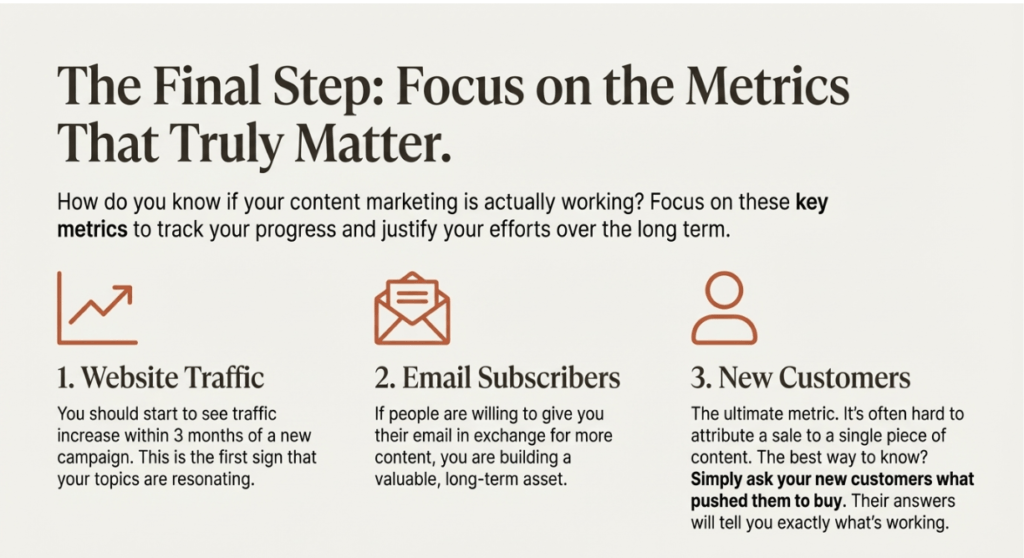
1. Website traffic should increase within three months of launching a new campaign.
2. Email Subscribers: This metric indicates how well the content is capturing an audience for future communication.
3. New Customers: While attribution can be messy and complicated due to multi-channel journeys, asking customers why they bought can clarify which content is working.
4. Brand Mentions: Monitoring how frequently a brand is mentioned in searches or by AI tools.
The WhiteScholars Practical Approach to Content Strategy
The AI-Powered Digital Marketing course in Hyderabad at WhiteScholars Academy includes an integrated, practical framework for teaching content writing. Rather than focusing on theory alone, the curriculum emphasizes creative copywriting through specialist workshops designed to sharpen both technical and creative skills.
The digital marketing training involves:
-
- Real-World Application: Students launch live campaigns for partnered companies like Country Delight and Blinkit, focusing on authentic storytelling and visually appealing content to drive engagement.
-
- SEO and Strategy: Training includes crafting SEO-optimized content and personalized email marketing strategies to maximize ROI and improve search rankings.
-
- Platform-Specific Writing: Learners practice creating engaging posts for Instagram, Facebook, and LinkedIn, as well as optimizing YouTube descriptions and headlines.
-
- Tool Integration: Students leverage tools like Canva to complement their writing with visual elements, such as thumbnails and ad creatives.
Final Thoughts
Content writing drives business expansion by delivering valuable, relevant material that builds authority and trust. A successful strategy integrates diverse formats, from podcasts to case studies, by targeting every stage of the marketing funnel. Establishing a professional digital infrastructure with intuitive design, payment solutions, and SEO tools is foundational for securing long-term ROI.
Modern marketers must also optimize for AI visibility to ensure brand citations in evolving search platforms. By systematizing production and monitoring metrics like traffic, businesses scale effectively, turning visitors into loyal customers. Content remains an essential asset, providing value for years.
Frequently asked questions
1. What exactly is content writing, and how does it benefit my business long-term?
Content writing is a strategic approach involving the creation and distribution of valuable, relevant material like articles, videos, and podcasts to engage a target audience. Unlike traditional ads, it is a form of inbound marketing that delivers cumulative value, driving traffic and leads for years after publication.
Businesses that prioritise blogging are 13 times more likely to achieve a positive ROI. It ultimately serves to build brand awareness, establish authority, and increase overall revenue.
2. How do I determine which topics will be most effective for my audience?
You must first define a clear buyer persona to ensure your topics resonate with your specific target audience. Researching your audience’s pain points and “burning problems” on platforms like Reddit or niche forums provides a goldmine of practical ideas.
Additionally, performing keyword research helps identify the specific issues your audience is actively searching for on Google. Focus on creating actionable, how-to content that provides tangible solutions to these identified problems.
3. What is the “marketing funnel,” and why should my content be mapped to it?
The marketing funnel represents the customer journey from initial awareness to the final purchase. Top-of-funnel content focuses on educating and building brand loyalty, whereas middle-of-funnel content assists customers during the consideration stage.
Bottom-of-the-funnel content, such as testimonials and webinars, is engineered specifically to drive conversions. Mapping content this way ensures you provide the right information at the exact time a customer needs it.
4. How can I produce high-quality content consistently without burning out?
The key to consistency is to use content templates, which enable you to fill in the blanks rather than reinventing the wheel. As you grow, scaling with a dedicated team, including SEO strategists, writers, and editors, helps manage the complexity of frequent publishing.
It is more important to stick to a consistent schedule, such as once a month, than to publish high volumes sporadically. Systematizing your promotion through email newsletters also ensures your content reaches your audience reliably.
5. What metrics should I track to determine whether my content strategy is effective?
You should focus on four key metrics:
website traffic, email subscribers, new customers, and brand mentions. Traffic typically starts to show positive movement within three months of a new campaign. An increasing email list is a vital sign that your content is successfully capturing and retaining an audience for future nurturing. Because customer journeys are often “messy,” asking customers directly what influenced their purchase is often the best way to attribute sales to specific content.
