

E-Commerce and Quick Commerce Boost Digital Marketing Growth
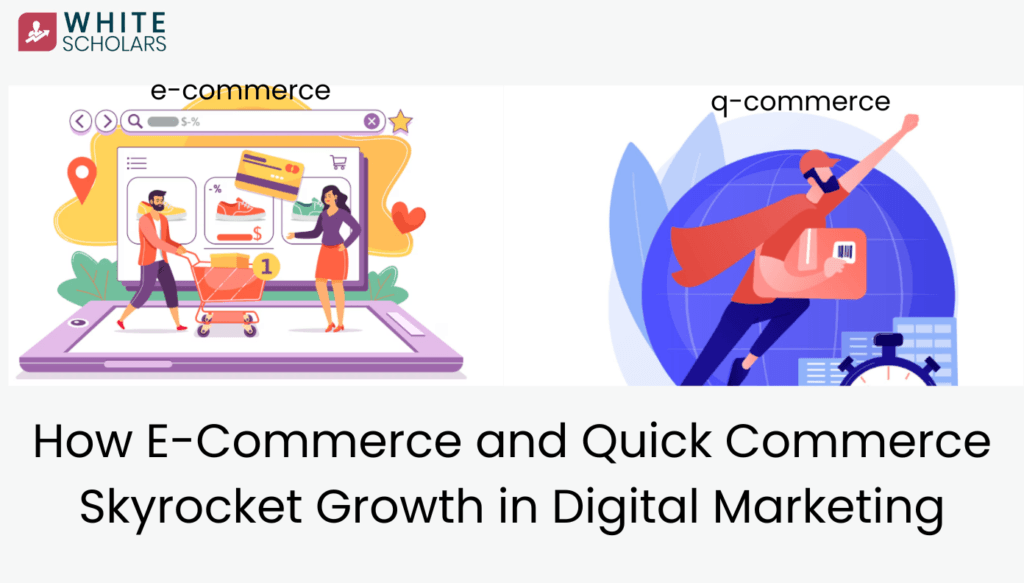
Exploring e-commerce and quick commerce definitions and factors driving their demand, highlighting their impact on digital marketing growth.
The Foundations of Modern Retail: E-Commerce and Quick Commerce
In the current landscape, digital marketing serves as the primary engine driving two distinct but related retail models: e-commerce and quick commerce. E-commerce, short for electronic commerce, represents the established foundation of digital retail, enabling the buying and selling of goods and services over the internet without the constraints of geography or time.
It has evolved since the 1990s into a multi-trillion-dollar industry, allowing customers to browse large selections and make purchases with just a few clicks.
On the other hand, quick commerce (q-commerce) is considered the next generation of e-commerce, specifically engineered to satisfy the modern consumer’s demand for speed and instant gratification.
While traditional e-commerce focuses on variety and global accessibility, q-commerce prioritises ultra-fast delivery, often reaching the customer’s doorstep within 10 to 30 minutes. This model relies on hyperlocal logistics and micro-warehousing to bridge the gap between order placement and delivery in a way traditional models cannot.
The Demand for E-Commerce and Quick Commerce
The demand for these models has reached unprecedented heights as consumer expectations have shifted to a world where everything is instant. In a digital economy where streaming and booking services are immediate, waiting several days for a physical product can feel outdated to some consumers.
Consequently, strategies must now account for this “on-demand” mindset to maintain customer engagement and loyalty. Businesses are increasingly turning to digital retail models because they provide scalability and accessibility at a lower cost than traditional brick-and-mortar setups.
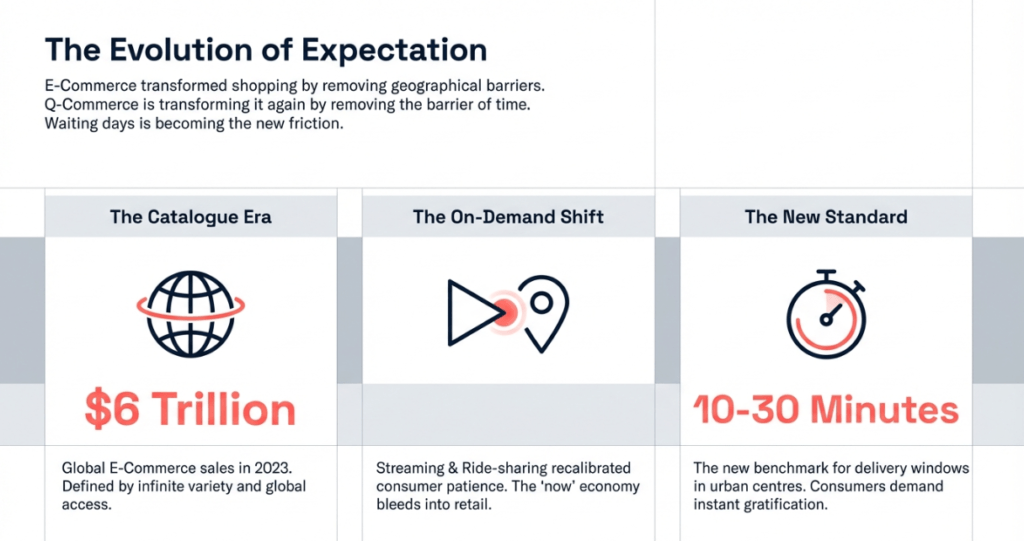
With global e-commerce sales exceeding $6 trillion in 2023, the potential for market reach is massive, prompting brands to invest heavily to capture a share of this growing pie. Furthermore, the rise of q-commerce has created a new competitive frontier where speed is a primary marketing differentiator, forcing even established giants to rethink their delivery promises and logistics networks.
The Architecture of Digital Retail: Understanding E-Commerce Mechanics
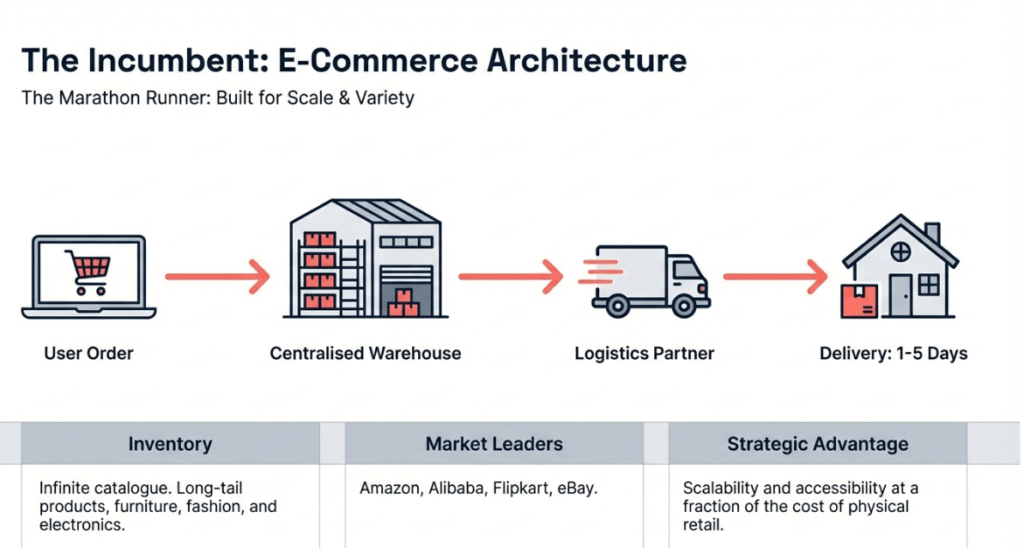
E-commerce is defined as the foundational process of conducting transactions over the internet. It serves as a bridge between businesses and consumers, leveraging technology to streamline the entire shopping journey from discovery to post-sale support.
Key Features of E-Commerce Platforms:
- 24/7 Accessibility: Unlike physical stores, e-commerce platforms allow for constant shopping, removing all time-based limitations for the consumer.
- Global Market Reach: Businesses can utilize digital marketing to sell across international borders without needing a physical office or shop in every location.
- Scalable Infrastructure: Through the use of cloud platforms, AI, and automation, e-commerce businesses can handle massive spikes in demand efficiently.
- Secure Payment Integration: Modern e-commerce relies on robust gateways to ensure that transactions, whether via credit cards, wallets, or UPI, are seamless and safe.
- Analytics and Consumer Insights: Data-driven marketing enables businesses to monitor user behaviour and optimise campaigns to increase conversion rates.
Businesses often rely on Amazon Product Listing Services to optimize product visibility and conversions within this process. Real-world giants such as Amazon, Alibaba, and Flipkart show how this model can be scaled to cover everything from electronics to fashion on a global scale.
The Hyperlocal Evolution: How Quick Commerce Redefines Speed
Quick commerce, or q-commerce, represents a significant shift in marketing strategy by focusing on the “micro-moment” of consumer need. It operates through hyperlocal models, using strategically placed dark stores or micro-warehouses located near urban population centers.
Operational Pillars of Q-Commerce:
- Ultra-Fast Fulfillment: The benchmark for success in q-commerce is delivery within 10 to 30 minutes, which creates a new standard for convenience.
- Mobile-First Design: Most q-commerce platforms focus on highly intuitive apps that facilitate one-click ordering for busy urban users.
- Real-Time Inventory Management: To prevent order cancellations, these platforms use sophisticated tech to provide instant stock updates.
- AI-Driven Logistics: Q-commerce heavily relies on artificial intelligence (AI) for route optimisation and demand forecasting, ensuring that delivery riders reach customers quickly.
Leading examples like Zepto, Blinkit, and Getir have pioneered this model, focusing primarily on high-demand categories such as groceries, medicines, and daily essentials.
This model is essentially an extension of the on-demand economy, merging traditional retail with rapid-response logistics.
Comparative Strategic Analysis: E-Commerce vs Quick Commerce
For any professional involved in marketing, understanding the distinctions between these two models is vital for resource allocation and brand positioning.
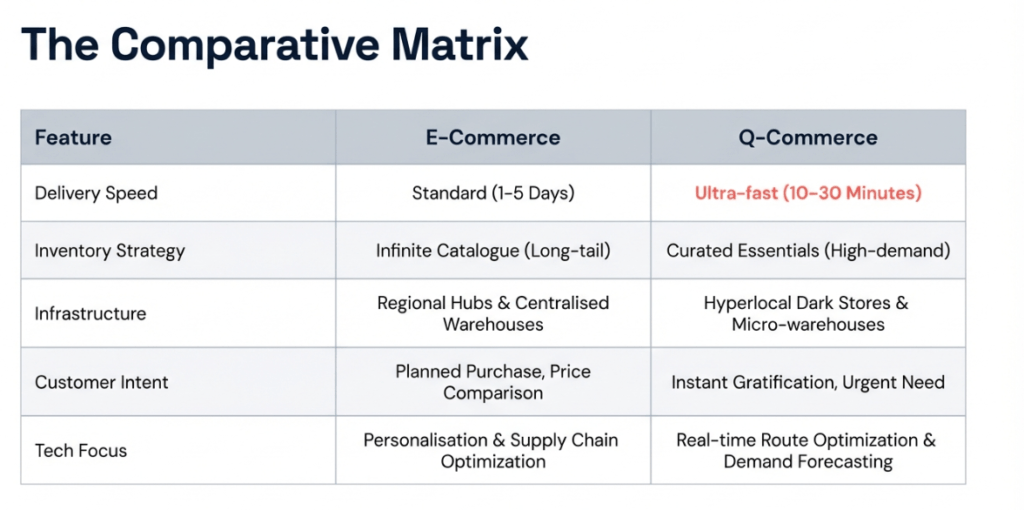
- Delivery Speed: E-commerce usually operates on a 1-5 day timeline, whereas q-commerce promises minutes.
- Product Catalogs: E-commerce offers a wide variety, including electronics and furniture; q-commerce focuses on a limited range of daily essentials.
- Infrastructure: E-commerce uses large, centralized distribution centers, while q-commerce relies on a network of small, local dark stores.
- Consumer Expectations: In e-commerce, customers seek price comparisons and variety, whereas in q-commerce, they value speed and immediacy.
- Profit Margins: E-commerce typically enjoys broader margins through larger order values, while q-commerce operates on thinner margins and requires high order volumes.
Ultimately, e-commerce is about availability and choice, while q-commerce is defined by speed and convenience. Both are essential components of a modern ecosystem, catering to different shopping mindsets: planned purchases versus instant needs.
Leveraging Scalability: The Business Benefits of Traditional E-Commerce
E-commerce remains a dominant force because of its inherent sustainability and its ability to empower businesses of all sizes.
- Global Expansion: allows a local brand to reach a global audience effortlessly, breaking all geographical barriers.
- Cost Efficiency: Running a digital shopfront is significantly cheaper than maintaining physical retail locations, as it reduces overheads through automation and centralised logistics.
- Business Model Flexibility: E-commerce supports various structures, including B2B, B2C, D2C, and subscription models, allowing companies to adapt as market trends change.
- Continuous Sales: The 24/7 nature of e-commerce ensures that businesses can generate revenue around the clock, improving overall customer satisfaction.
Building Loyalty through Immediacy: The Advantages of Q-Commerce
In the fast-paced urban environment, q-commerce offers unique advantages that traditional models struggle to match.
- Instant Gratification: By meeting urgent needs in minutes, q-commerce creates a level of customer satisfaction that fosters intense brand loyalty.
- Trust through Reliability: When a brand consistently delivers essential items like medicine or groceries quickly, it builds a deep sense of trust with the consumer.
- Optimized for Mobile Users: The mobile-centric nature of q-commerce aligns perfectly with the habits of modern consumers who prefer ordering via apps while on the move.
- Focus on Essentials: By dominating the market for everyday items, q-commerce brands become a daily part of the consumer’s life, leading to high repeat-purchase rates.
The Disruption Factor: How Q-Commerce Impacts E-Commerce Strategies
The rise of q-commerce has not just created a new niche; it has fundamentally altered the landscape for traditional e-commerce players.
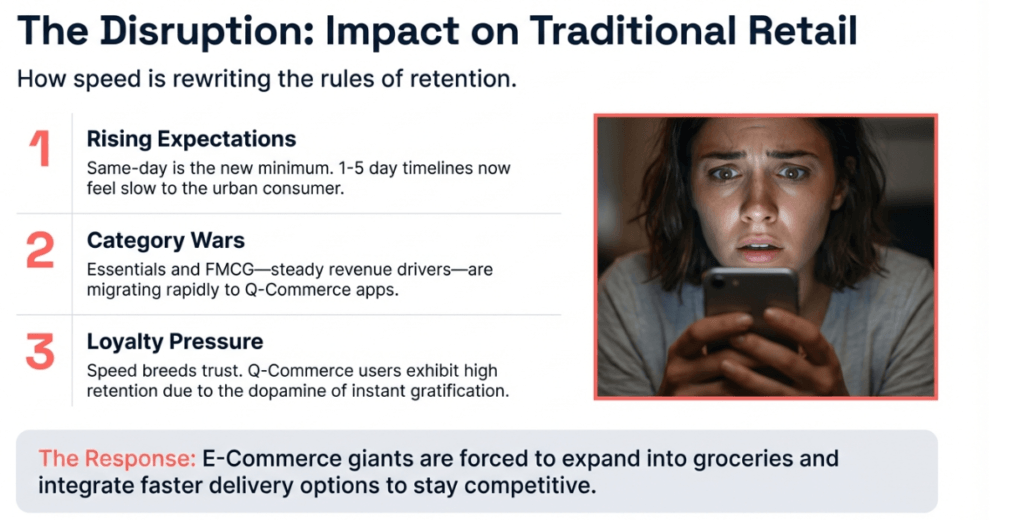
- Elevated Delivery Standards: Because of q-commerce, consumers now expect faster shipping from all online platforms, pushing traditional retailers to offer same-day or next-day options.
- Increased Competition for Essentials: Traditional e-commerce giants are seeing their market share in the FMCG and grocery sectors challenged by instant-delivery apps, forcing them to innovate.
- Hybrid Operational Shifts: Many e-commerce businesses are now adopting hybrid models, incorporating small distribution hubs in cities to compete with hyperlocal players.
- Technology Acceleration: To keep pace, e-commerce firms are investing more in AI-driven demand forecasting and last-mile logistics, technologies that were initially perfected by q-commerce startups.
Challenges in the High-Speed Retail Environment
Q-commerce, in particular, suffers from higher operational costs and thin profit margins due to the intensive logistics required for 10-minute deliveries.
For traditional e-commerce, the challenge lies in customer retention. When consumers become accustomed to instant availability, they may perceive 3-day delivery as a service failure.
To stay relevant, e-commerce brands must focus on value-added services like personalisation, flexible returns, and exclusive loyalty programs.
Strategic Selection: Choosing the Right Model for Your Business
Choosing between e-commerce and q-commerce is an important business decision that should be guided by specific objectives and resources.
- Choose e-commerce if: Your goal is global reach, cost-efficient scalability, and a wide variety of non-urgent products like electronics, fashion, or furniture.
- Choose Quick Commerce if you are targeting urban customers who value speed, and your inventory consists of fast-moving essentials like food and groceries.
Many successful businesses are now adopting a hybrid strategy, utilising traditional e-commerce for long-term growth and q-commerce for specific regions or high-demand product categories.
Opportunities for Growth in the New Digital Era
The evolution of retail has opened several new avenues for innovation.
- Expansion into Hybrid Fulfillment: By combining local dark stores with large warehouses, brands can offer a tiered delivery system that caters to both planned and urgent needs.
- Niche Market Leadership: Traditional e-commerce can focus on premium segments like luxury goods and customized furniture, where the shopping experience and product variety are more important than delivery speed.
- Advanced Personalization: Using vast amounts of consumer data, e-commerce platforms can offer highly targeted promotions and subscription models that q-commerce platforms, with their smaller inventories, may find difficult to replicate.
- Global Trade Expansion: E-commerce remains the superior model for cross-border trade, allowing businesses to tap into international markets with relatively low overhead.
The Future Landscape: Integration and Innovation
The future of retail is not a battle of one model replacing the other; instead, they are expected to coexist and complement each other. Q-commerce will likely dominate impulse and essential purchases, while e-commerce will continue to be the go-to for high-value and non-urgent items.
We can expect to see an increase in “phygital” strategies, which integrate physical and digital assets via dark stores and hybrid apps. AI and automation will continue to improve both models, resulting in predictive stocking for q-commerce and deep personalization for e-commerce.
Ultimately, the winner in this evolving landscape will be the consumer, who will have the freedom to choose between maximum variety and maximum speed depending on their immediate needs.
E-Commerce and Q-Commerce Strategies at WhiteScholars Academy
WhiteScholars Academy in Hyderabad provides a hands-on curriculum that distinguishes between traditional e-commerce and the emerging Q-commerce (Quick Commerce) sector through real-world projects with partners like Amazon and Nasscom.
Learners at the digital marketing course at White Scholars apply these concepts by making critical decisions on audience targeting and budget allocation for live campaigns, ensuring they can drive growth in fast-paced digital environments.
Final Thoughts
The evolution of online retail shows that success is now inextricably linked to a balance of variety and speed. Traditional e-commerce remains the cornerstone for global reach and scalability, offering consumers an unmatched catalogue of goods with the convenience of 24/7 shopping.
However, the rise of quick commerce (q-commerce) has redefined the benchmark for convenience, meeting the modern demand for “instant gratification” with 10-to-30-minute deliveries.
For businesses to truly skyrocket, they must recognize that these models are not mutually exclusive. Instead, the future lies in hybrid strategies and “phygital” integration, where AI-driven logistics and micro-fulfillment centers allow brands to offer both standard and express services.
Challenges like thin margins in q-commerce and delivery expectation gaps in e-commerce require robust technical foundations. Ultimately, the winner in this digital landscape is the consumer, who now enjoys the freedom to choose between maximum variety and lightning-fast speed.
Frequently asked questions
1. What is the primary difference between e-commerce and quick commerce?
E-commerce focuses on providing a wide range of products with delivery timelines typically ranging from a few days to a week. In contrast, Quick Commerce (Q-commerce) prioritizes ultra-fast delivery, often within 10 to 30 minutes, specifically for essential items like groceries, snacks, and medicine.
2. Is traditional e-commerce becoming outdated because of quick commerce?
Not entirely, as traditional e-commerce remains dominant for products that do not require immediate delivery, such as electronics, fashion, and furniture. Both models are expected to coexist and complement each other, with Q-commerce catering to impulse needs while e-commerce remains the foundation for planned, high-value purchases.
3. Which model is more profitable for a business to adopt?
Profitability depends on the specific goals; e-commerce generally offers higher margins due to bulk deliveries and diverse categories, whereas Q-commerce requires more investment in logistics and dark stores. However, Q-commerce can drive higher customer loyalty and repeat purchases, which are essential for long-term success.
4. Can a business successfully integrate both models using a hybrid approach?
Yes, many businesses adopt a hybrid strategy by offering standard delivery for a vast catalogue (e-commerce) while enabling instant delivery for essentials (q-commerce). This “phygital” approach allows a brand to achieve global reach while also meeting the modern consumer’s demand for instant gratification in local markets.
5. What product categories are best suited for the quick commerce model?
Quick commerce is most effective for fast-moving consumer goods (FMCG) and daily essentials, where speed is critical to customer satisfaction. This includes categories such as groceries, fresh food, beverages, pharmacy products, and household items that urban consumers often require on very short notice.
