

Social Media Trends and Innovations Set to Shape 2026
Discover 2026 social media trends and how AI-powered technology is reshaping content, engagement, and the future of digital platforms.
The rise of social media has changed how we connect and interact. Today, platforms are not just for sharing updates; they help us discover new interests and products. Users actively search for information, making social media a key player in decision-making.
As we look ahead, understanding these trends is crucial for businesses aiming to engage effectively with their audience. Key influences include the shift from passive consumption to active engagement, where social media is integral to the entire buying process.
We must first examine how we got here and the potent forces, particularly artificial intelligence, that are currently changing the rules of engagement in order to understand where we are headed in terms of social media trends in 2026.
The Evolution of the Social Experience
Social media has undergone a dramatic transformation in the last ten years. Social media platforms were essentially digital living rooms at first, used for interpersonal communication and passive scrolling. This direct line of communication has completely collapsed.
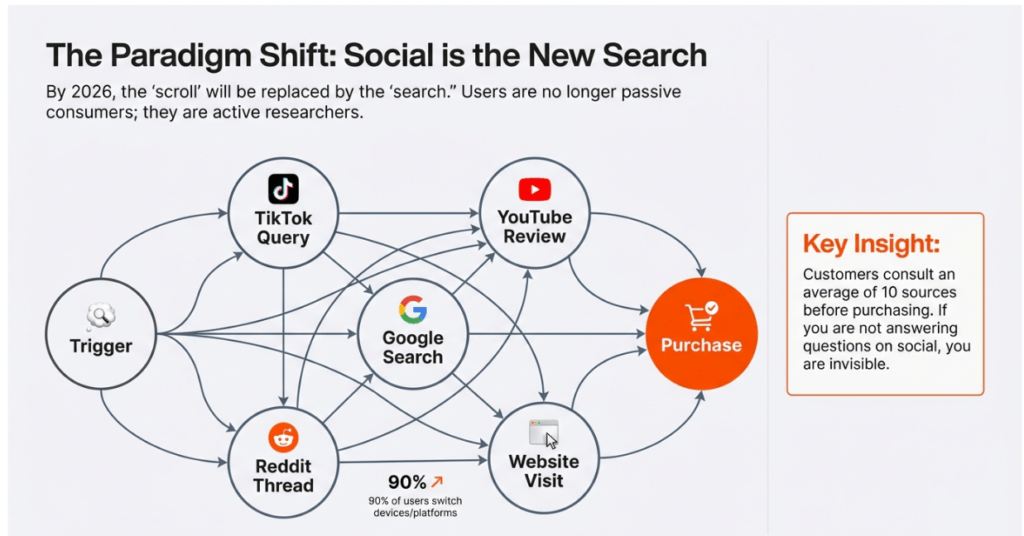
How social media has evolved over the years:
Platforms used to be groups where users followed friends and relatives. They have developed into discovery engines in the modern era. The “follow” model has been replaced by the “interest” model. Users no longer just wait for content to appear; they actively use social channels to search, compare, and research. This evolution has turned platforms like TikTok and Instagram into competitors for traditional search engines like Google.
This evolution moved through three distinct phases:
the Connection Phase (Facebook/MySpace),
the Broadcast Phase (Twitter/Instagram),
the current Utility Phase, where social media serves a functional role in daily tasks.
It is observed that 90% of customers now switch between various devices and platforms to complete online tasks.
Influencing the Current Market
The influence of social media trends on the current market is absolute. It now covers the entire funnel rather than just the top of it. Customers now consult an average of 10 sources before making a purchase, and many of these touchpoints occur within social ecosystems.
Key market influences include:
- Search Everywhere Optimisation: Brands are no longer just optimising for Google. They are now focusing on visibility across Instagram, TikTok, YouTube, and even AI tools like ChatGPT.
- Social Search: For many, especially younger generations, the research process starts on social media rather than a browser. For a consumer, a brand is essentially nonexistent if it does not show up in these initial social searches.
- The Trust Layer: Market influence has shifted from polished brand ads to creators who speak plainly and share real experiences. This trust layer is now a primary driver of buying decisions.
What is driving the demand?
What is causing this drastic change in behaviour and demand? Artificial intelligence is the primary driver, but it is supported by a fundamental shift in how people value their time.
AI as a Catalyst: AI and Large Language Models (LLMs) are now the gatekeepers of what users see. By summarising data and elevating excellent content that aligns with user intent, it is tightening the discovery loop.
- Content Filtering: Algorithms are no longer rewarding volume alone. Rather, they place more emphasis on usefulness, structure, and clarity.
- AI-Assisted Workflows: Marketers are using AI to brainstorm, draft, and repurpose content, allowing for a level of consistency that was previously impossible.
- Generative Search: search optimisation is a crucial area of focus for 2026 since tools are now displaying brand content within conversational interfaces.
Beyond this , the demand is driven by a loneliness economy where users seek micro-communities. As the big internet feels more automated, users are retreating into smaller, niche social spaces (like Discord or specific Reddit threads) to find human signals amidst the noise.
The Platform Landscape: Growth and Features
The big players in the social space are no longer just apps; they are multi-functional ecosystems. Their user bases continue to grow because they have successfully integrated utility into entertainment.
Leading Apps and Their Trajectories:
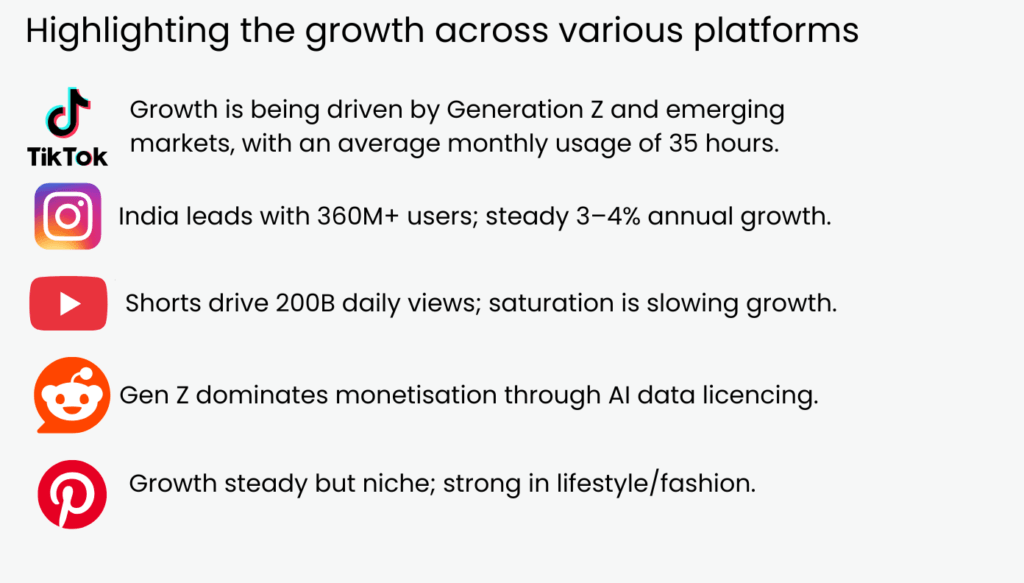
- TikTok & Instagram: These have transitioned into primary research tools. Their capacity to offer concise, visual responses to challenging queries is what propels their user growth.
- YouTube: This platform has solidified its position as a primary research destination. It serves the middle of the buying journey, where users watch long-form tutorials and breakdowns to build trust.
- Reddit: Increasingly used for authentic user takes and real-world experiences that feel less planned than traditional platforms.
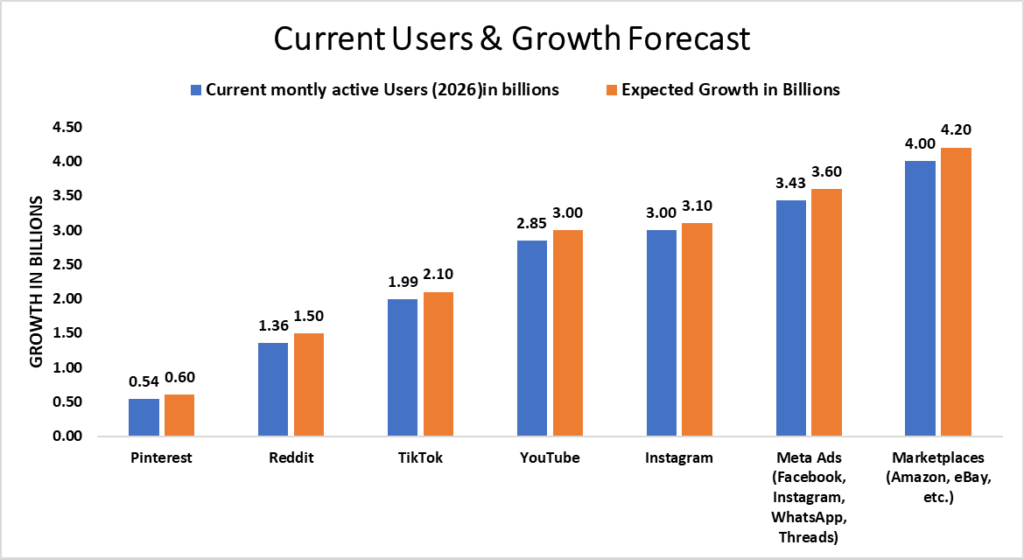
The below column chart describes the most used social media apps , with their current users and what the projected growth is in the future.
Who is responsible for this growth on these platforms, then? Let’s understand what the reason for this is.
Evolution of Social Platforms and Advertising (Current to 2026)
The social media landscape is transitioning from platforms focused on scrolling to powerful discovery engines.
Below is a table detailing the evolution of major platforms and the social media advertising landscape.
| Social Platform | Current Usage & Stats | Starting Features (Early Era) | Advances Over the Years | Expected Future Advancements (2026) |
| TikTok & Instagram | Used as search engines to find real experiences and quick breakdowns. Short-form video is now a research format. | used primarily for simple connections and passive “scrolling”. | Integrated social search bars: Creators became the trust layer, replacing brand ads. | AI will summarise content to highlight the clearest answers and shift towards “Search Everywhere Optimisation”. |
| YouTube | A primary research destination for step-by-step guides and product breakdowns. | Video sharing for entertainment; long-form content. | Became a driver of trust and high-intent traffic through educational tutorials. | AI will shorten the discovery loop by condensing long-form tutorials into concise insights. |
| Meta (Facebook/Instagram) Ads | Users consult an average of 10 sources before buying; 90% switch between platforms. | Linear paths to conversion and standard display advertisements. | Implementation of Meta Advantage+ shopping campaigns for higher ROI. | Seamless social commerce with frictionless checkout and conversational AI tools. |
| Used for authentic recommendations and real user takes. | Niche community threads and text-based updates. | Transitioned into a key source for “social proof” that carries more weight than ads. | AI models (LLMs) will analyse and present community conversations in search results. | |
| Pinterest & Marketplaces | Part of “Search Everywhere Optimisation”, in which brands aim for organic visibility. | Visual bookmarking and simple product listings. | Optimisation of presence across diverse e-commerce platforms to maximise revenue. | Predictive models will better define customer journeys to make touchpoints more personalised. |
Key Insights on Content and Technology
Current Usage Trends and Statistics The modern consumer no longer follows a linear path. Research shows that customers consult an average of 10 sources, and 90% of them switch between various devices and platforms before completing a task.
Furthermore, social search is overtaking traditional search for early-stage research; users now type questions directly into TikTok or YouTube instead of Google. Advancements in Advertising Strategy Advertising has shifted from high-volume posting to structured, searchable content.
Levi’s, for example, saw a 38% increase in ad performance after implementing Meta Advantage+ Shopping campaigns that optimised ad delivery efficiency. Brands are also shifting away from “vanity metrics” (likes and follower counts) and towards community and social proof.
The Role of AI in 2026
By 2026, AI-assisted content workflows will be the standard for marketers to ensure consistency. It will prioritise content based on clarity, structure, and usefulness rather than sheer volume. This means that visibility will depend on AI search optimisation, ensuring a brand’s content is surfaced by conversational and generative tools.
Evolving Features: To keep up with social media trends in 2026, platforms have introduced features that mirror search engine functionality:
- Advanced Social Search Bars: Designed to handle natural language queries rather than simply hashtags.
- Short-Form Video as Research: Features that allow for 30-second “teaching moments” rather than just entertainment.
- Seamless Social Commerce: Frictionless checkout systems and “Meta Advantage+” shopping campaigns are making the transition from “seeing” to “buying” instantaneous.
- Structured Content Tools: Algorithms now reward content that uses clear hooks, organised ideas, and helpful descriptions.
Looking Toward 2026 and the Future
As we approach 2026, the distinction between social media and the internet will become increasingly blurred. The sources suggest several definitive shifts that will define the future of digital marketing.
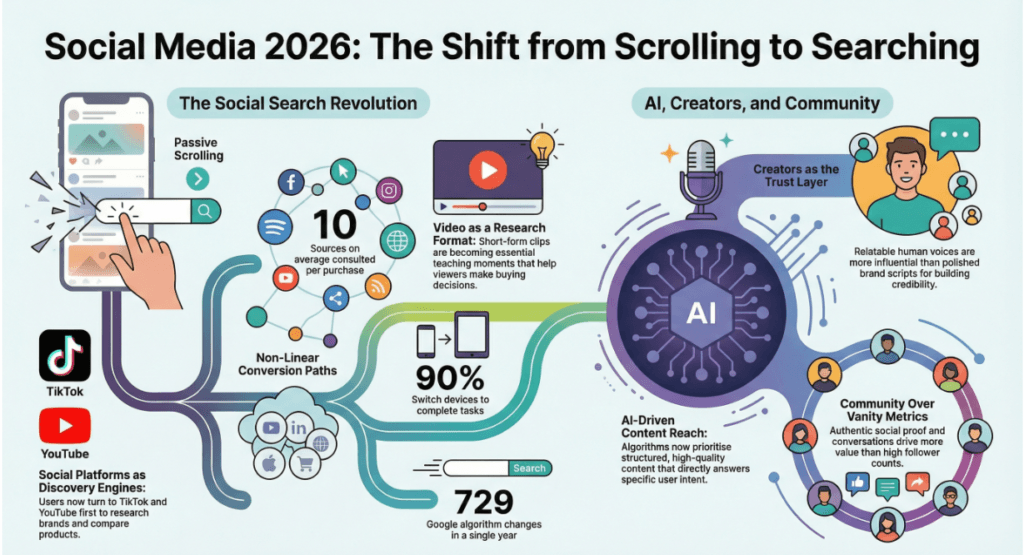
1. Generational Fragmentation: One-size-fits-all content strategies will become obsolete. Younger users treat social media as a search tool, while older users may still use it for connection and updates. Brands will need to produce multi-platform, multi-format content, short explainer videos for some and in-depth educational guides for others.
2. The Death of Vanity Metrics: Follower counts and likes are losing their value. In 2026, the market will value community and social proof. Real conversations in comment threads and mentions from trusted creators will carry more weight than a million passive followers.
3. Intent-Based Content: The most successful brands will be those that treat every post as an answer to a user’s need. This requires a shift from broadcasting to answering. Content that solves a problem will travel further than content that is merely polished.
4. The Rise of “Search Everywhere”: In the future, a brand’s visibility will depend on its ability to surface in conversational tools and social search bars simultaneously. This “Search Everywhere” approach ensures that whether a user asks a chatbot or scrolls through TikTok, the brand remains visible.
5. Seamless Integration of Workflows: AI will not just be a tool for creation but for strategy and optimisation. Predictive models and advanced analytics dashboards will become standard for helping teams make real-time decisions.
Key Mechanisms of AI-Driven Visibility
By 2026, Artificial Intelligence will fundamentally redefine content visibility by acting as a sophisticated filter that prioritises substance and utility over volume. Rather than rewarding frequent posting or “empty” engagement, large language models (LLMs) will evaluate content for clarity, structure, and utility.
- Content Summarisation and Elevation: AI is expected to “tighten the loop” of social discovery by summarising information and elevating high-quality answers to the top of user feeds. This means that visibility will become increasingly dependent on how efficiently models can parse and present content as a solution.
- Alignment with User Intent: Reach will be dictated by how closely content matches the intent of the searcher. Brands that create content mirroring the specific questions and phrases users type into social search bars, such as on TikTok or YouTube.
- The Reward for Structure: Algorithms in 2026 will heavily favour structured, searchable content. Visibility will be a “competitive advantage” for those who use strong hooks, organised ideas, and clear language, as these elements enable AI to instantly categorise and match messages to relevant audiences.
- Conversational Presence: A major shift will involve search optimisation. which ensures a brand’s content surfaces not just in feeds but within conversational and generative tools across various platforms.
Strategic Shifts for Visibility
AI-assisted workflows, used for brainstorming, drafting, and repurposing, will become the industry standard for maintaining the consistency and strategic alignment required to stay visible. Furthermore, because social platforms are evolving into “discovery engines”, visibility will depend on showing up early in the research journey, often before a user ever reaches a traditional search engine like Google.
This shift mirrors the “SGE” (Search Generative Experience) trend seen in traditional search, where the platform provides the answer directly. For social media, this means that “mentions” within an AI-generated summary may eventually replace direct clicks to a profile as a metric for visibility.
Ultimately, the brands that win the visibility race in 2026 will be those that treat every post as a direct answer to a user need, allowing the AI-driven platforms to handle the heavy lifting of distribution.
Conclusion
The future of social media trends in 2026 will depend on who provides the most value rather than who shouts the loudest. We are entering an era where social platforms are discovery engines, AI is the curator of quality, and authenticity is the only currency that matters.
Brands that win will be those that build for communities, not feeds. They will focus on intent, structure, and genuine human connection. As the digital landscape becomes more complex, the most successful strategy remains remarkably simple: be helpful, be clear, and be where your audience is already looking.
The opportunity for growth is limitless, but it requires a willingness to stop chasing the algorithms of yesterday and start building for the way people actually use the internet today.
Frequently asked questions
What is the future of social media in 2026?
Social platforms are becoming discovery tools where users compare brands before using search engines. AI will enhance visibility by promoting clear, useful content over excessive posting. Success hinges on engaging users during their research phase in social feeds.
What social media trends should you be aware of in 2026?
Emerging trends highlight social search, AI-driven content planning, and a move towards trust in creators. Algorithms will focus on clear, searchable content that delivers quick answers instead of irrelevant metrics. Moreover, generational differences are leading to diverse content strategies.
How important is short-form video in 2026?
Short-form video is crucial, evolving from entertainment to a practical research tool. Clear explanations and engaging language are essential to influence users and guide their decisions.
How can brands leverage social commerce?
Brands can enhance social commerce by ensuring easy checkout on the platform. Success comes from using strong visuals, authentic customer testimonials, and creator content to build trust. Clear and helpful responses can motivate users to finalise purchases within the app
