

Market Analysis in Digital Marketing: Strategies for Success

Discover how market analysis evaluates business performance, uncovers competition, and guides smarter strategies in digital marketing.
What is market analysis?
Market analysis is a systematic process for examining, interpreting, and comprehending the various complexities that define a particular market segment within an industry. It involves an in-depth assessment of variables that influence a company’s performance, providing vital insights to guide strategic business decisions.
Essentially, market analysis is like solving a large puzzle to learn everything about the environment where you intend to offer goods or services, focusing on who the buyers are, what competitors are doing, and what consumers prefer.
Market Analysis: Benefits and Examples
Market analysis serves as the foundation for marketing optimisation. By conducting regular analyses, businesses can highlight areas for improvement and identify which digital strategies are successfully reaching their audience.
This ensures that marketing resources are used efficiently, resulting in more impactful outreach. Specific benefits include:
- Targeting and Personalisation: Understanding the target market’s demographics and psychographics allows businesses to tailor digital content and advertisements to specific customer needs.
- Trend Identification: It helps digital marketers spot emerging industry trends before competitors do, allowing for proactive campaign adjustments.
- Monitoring Performance: It provides key performance indicators (KPIs) to measure the success of digital campaigns against industry standards.
Example of Market Analysis:
Consider a company in the online education industry. Through market analysis, the business might identify a market gap (a specific need not being met by existing brands). For instance, they might discover through surveys or social media listening that learners are interested in a niche topic that no current courses cover.
By identifying this gap, the company can develop a targeted digital course and use specific marketing messaging that appeals to that segment’s unique challenges and aspirations.
Statistics on Businesses and Market Analysis
Conducting a market analysis is an essential measure for both established and new businesses to maintain a competitive edge. Businesses should use statistical data from external professional bodies to inform their own analysis.
The demand for marketing analysis has been rapidly increasing because it provides companies with all of the statistical information they require.
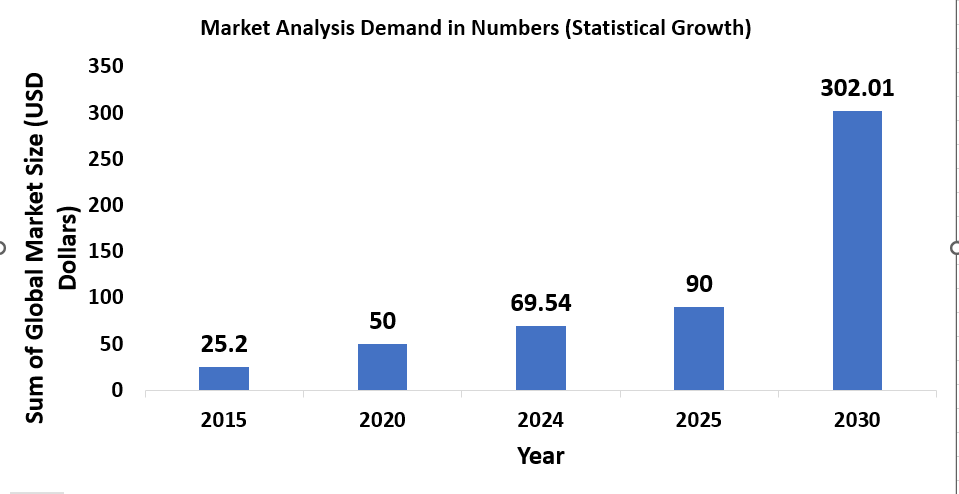
The above Market Analysis Demand in Numbers (Statistical Growth) column chart illustrates a sharp upward trend in global market size from 2015 to 2030. Starting at $25.2 billion in 2015, the market doubled by 2020 to $50 billion, then rose to $69.54 billion in 2024. A significant jump is seen in 2025 at $90 billion, resulting in a projected $302.01 billion by 2030.
This exponential growth highlights increasing global demand and expanding market opportunities. The data suggests a robust and accelerating economic trajectory, making it a compelling indicator for investors, analysts, and businesses planning long-term strategies.
Comprehensive Guide to Market Analysis Topics
The following sections provide a detailed breakdown of market analysis, organized for clarity and ease of understanding.
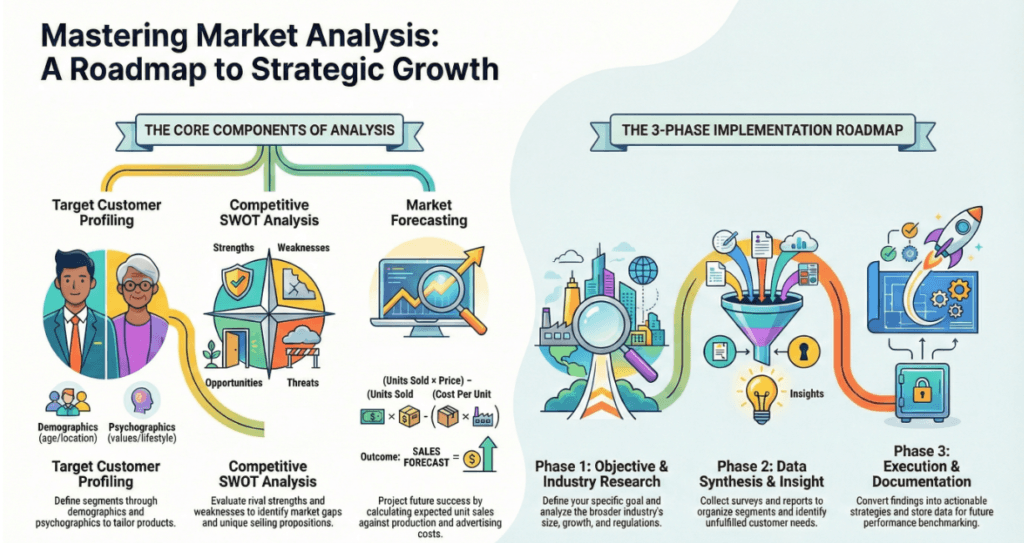
1. Core Components: What Market Analysis Includes
A thorough market analysis consists of several critical components that provide a comprehensive view of the business environment:
- Industry Overview: This involves understanding the broader landscape, including the size of the industry, its growth rate, and significant historical developments. It looks at trends to see where the industry is heading.
- Target Customer Analysis: Businesses define their “ideal customer” through three lenses:
- Demographics: Age, gender, location, occupation, and education.
- Psychographics: Lifestyle, values, personality traits, and beliefs.
- Behavioral Traits: Buying patterns, brand loyalty, and specific needs.
- Competitive Analysis: This evaluates the strengths, weaknesses, opportunities, and threats (SWOT) of competitors. It helps a business find ways to differentiate itself.
- Market Forecast: This involves predicting future market trends, changes in consumer behavior, and technological advancements to help with long-term strategic planning.
- Regulatory Environment: An assessment of the laws and regulations governing the industry to ensure compliance and understand market entry requirements.
- Internal SWOT Analysis: A self-assessment of the business’s own internal strengths and weaknesses against external opportunities and threats.
2. The Importance of Conducting Market Analysis
Market analysis is crucial because it evaluates a business both qualitatively (feelings and values) and quantitatively (numbers and sizes).
- Customer-Centric Approach: It puts the customer first by figuring out exactly what they want, allowing a business to stand out by meeting specific needs.
- Self-Reflection: It forces companies to look inward and define why they do what they do, which is vital for effective branding.
- Unique Selling Proposition (USP): It helps a business identify its “unique selling proposition”—the specific factor (like price, quality, or service) that makes it better than the competition.
3. Key Benefits of Market Analysis
Running a market analysis provides several strategic advantages:
- Risk Reduction: By identifying potential problems early, businesses can take preventative steps to lower uncertainty.
- Revenue Projections: Analysis of market demand and customer behavior allows for more accurate financial planning and income forecasts.
- Learning from the Past: It provides data to help businesses understand why past mistakes happened, preventing them from being repeated.
- New Opportunities: It helps find new market segments and directions for the business to pivot toward.
4. Potential Drawbacks and Limitations
While beneficial, market analysis has challenges, mostly related to resources:
- Expense: It can be costly to hire professionals or purchase advanced analytical tools.
- Time-Consuming: The process can divert attention away from daily business operations.
- Staffing Needs: It often requires specialised skills, which may necessitate hiring extra staff or outsourcing the work.
- Narrow Focus: If based only on limited surveys, the analysis might not capture the needs of the entire customer base.
5. Market Analysis vs. Other Analytical Methods
It is important to distinguish market analysis from related terms:
| Basis | Market Analysis | Conjoint Analysis | Sentiment Analysis |
| Scope | Broad; covers industry, trends, and competition. | Narrow; focuses on how customers value specific product features. | Qualitative: assesses customer feelings and opinions. |
| Methodology | Industry reports and surveys. | Product testing and trade-off scenarios. | Analysis of text from social media or reviews. |
| Purpose | Informing broad business strategy. | Optimizing product features and pricing. | Brand management and reputation monitoring. |
| Output | Comprehensive industry insights. | Prioritized list of preferred features. | Emotional insights (positive/negative). |
6. How to Conduct a Market Analysis (Step-by-Step)
The detailed process for performing a market assessment:
- Identify Your Objective: Clearly define why you are doing the analysis (e.g., to find new markets or gauge competition).
- Industry Research: Study industry reports and market studies to understand growth trends and disruptions.
- Determine Target Customers: Create “personas” or customer profiles that represent your ideal buyers.
- Investigate Competition: Perform SWOT analyses on competitors to understand their value propositions.
- Identify Market Gaps: Look for needs that are currently not being filled by existing brands.
- Identify Barriers to Entry: Consider factors that might prevent success, such as high start-up costs, patents, or legal requirements.
- Analyze and Implement: Organise the data into a coherent report and convert the findings into actionable business changes.
- Store for Future Use: Keep the research to track changes over time and stay proactive.
7. Writing the Market Analysis for a Business Plan
When presenting a market analysis to investors or stakeholders, it should be well-written and include:
- Executive Summary: A snapshot of key findings, market size, and trends.
- Market Entry Strategy: A plan for overcoming barriers like high costs or strong competitor loyalty.
- Sales and Distribution: An explanation of how the product will be sold (e.g., retail vs. online).
- Pricing Strategy: How your prices align with customer expectations and competitor rates.
- Sales Forecast: A quantification of expected sales using the formula (Number of units to sell x Price per unit) – (Cost per unit x Number of units).
- Risks and Mitigation: A list of potential threats and the strategies to manage them.
By following these steps and understanding these components, businesses can move beyond surface-level data to achieve long-term success and stay ahead of the competition.
Final Thoughts
Market analysis serves as the essential architectural blueprint for any robust digital marketing strategy. By systematically examining industry variables, customer psychographics, and the competitive landscape, businesses transform raw data into a narrative of opportunity.
It is no longer enough to simply produce a product; a brand must understand the “why” behind its existence in order to connect with modern consumers emotionally.
Through the identification of market gaps, digital marketers can pivot their offerings to meet unfulfilled needs, ensuring that their campaigns are not just noise but solutions. Furthermore, integrating marketing optimisation tools ensures that resources are directed toward strategies that yield the highest return on investment.
While the process requires significant time and financial investment, the alternative, operating in a vacuum of uncertainty, poses a far greater risk to business longevity. Ultimately, a well-executed market analysis empowers a company to transition from reactive to proactive, setting performance standards that lead to predictable growth and a sustainable competitive edge.
Frequently Asked Questions (FAQs)
1. What is the difference between market research and marketing analytics?
Market research is the broad process of gathering information about a target market and its customers’ needs to market products more effectively. Marketing analytics is the study of metrics from specific efforts, such as social media engagement, to increase the return on investment.
2. How do you identify a “market gap” within an industry?
A market gap represents a consumer need that is currently not being filled by existing brands. You can identify these by asking consumers directly what they cannot find, evaluating where competitors’ products fall short, or observing how external factors like new laws or social changes create new demands.
3. What is the specific formula used for a market sales forecast?
To quantify a forecast, you use the formula: (Number of units to sell x Price for each unit) – (Cost per unit x Number of units). This process allows a business to estimate future sales over specific increments of time, such as six months or a year, to help secure funding or make business decisions.
4. Is a SWOT analysis the same thing as a market analysis?
No; while a market analysis evaluates the viability of a business idea within a specific market, a SWOT analysis is a self-assessment tool. It specifically identifies internal strengths and weaknesses alongside external opportunities and threats to provide a realistic view of a business’s positioning.
5. What are the primary barriers to entry when entering a new market?
Barriers to entry include high startup costs for technology and product development, legal requirements, and the amount top competitors spend on advertising to earn customer’s loyalty. Identifying these allows a business to devise a strategy to present their offerings as better alternatives in terms of value and price.
