

Master AI Search: New Techniques for Better Rankings
Enhance the image of your business with AI search. Let’s learn how to master AI search and look at different techniques for better rankings.
Why master AI Search?
The landscape of digital discovery is undergoing a radical shift as artificial intelligence reshapes how consumers interact with information. Traditional search engine results pages (SERPs) are being supplemented and, in some cases, replaced by generative AI responses that synthesise data into direct answers.
To remain visible in this new environment, brands must move beyond traditional SEO and adopt a coordinated strategy that ensures they are both mentioned and cited by large language models (LLMs).
Mentions and Citations
In the age of AI search, visibility is defined by two distinct but related metrics: mentions and citations.
When a user queries a platform like ChatGPT or Google AI Mode, the system generates a response that often names specific brands as recommendations. These are mentions. Simultaneously, the AI provides links or sources to back up its claims, which are citations.
A significant challenge currently facing businesses is that most only achieve one of these two forms of visibility. According to recent data, only a small fraction of companies are successfully seen (mentioned) and trusted (cited) simultaneously.
The Seen & Trusted (S&T) Framework is designed to bridge this gap, allowing brands to multiply their visibility and conversion rates across platforms like Perplexity, ChatGPT, and Google.
Why Artificial Intelligence Search Transcends Traditional SEO
While SEO remains a foundational necessity, AI search platforms do not rely solely on website rankings to determine who to recommend. Instead, these systems mine a massive variety of external signals, including:
- Customer reviews on platforms like G2, Capterra, or Yelp.
- Community discussions on Reddit, Stack Overflow, and Discord.
- Third-party news coverage and analyst reports.
- Technical documentation and support forums.
- Social proof from platforms like LinkedIn and Instagram.
Because these signals are scattered across various digital touchpoints, AI visibility cannot be the responsibility of the SEO team alone.
It requires synchronised efforts from product teams (to ensure feature transparency), customer success (to drive detailed reviews), PR (to secure third-party mentions), and support teams (to manage forum sentiment).
Strategy 1: Winning the Sentiment Battle to Get Seen
Getting “seen” involves appearing in the body of an AI’s answer, even if the user does not click through to a source. However, because AI characterises brands (e.g., “expensive but reliable”), this is a battle for positive sentiment.
Cultivating Substantial Review Profiles
AI systems value detailed reviews more than many short ones. One thorough review that describes a specific use case or onboarding process gives an LLM the information it needs to mention a brand.
Platforms like Capterra India are particularly influential for B2B SaaS, as they provide structured data on features, pricing, and comparisons that AI models can easily ingest. For other sectors, platforms like Amazon (ecommerce), Yelp, or Google Reviews (local business) are critical.
Brands should implement review strategies that:
- Prompt for details: Ask customers specific questions about features rather than general satisfaction.
- Incentivise quality: reward reviews that exceed a certain word count to ensure AI-friendly content.
- Prioritise engagement: respond to all reviews, as AI views vendor engagement as a trust signal.
Engaging in Authentic Community Dialogue
Forums like Reddit and Quora are among the most cited sources for AI search platforms. Brands like Tally have successfully turned AI search into their primary acquisition channel by consistently answering user questions and sharing knowledge on these platforms.
Authenticity is paramount here; AI can detect purely promotional language. Brands should focus on addressing misconceptions, sharing product roadmaps honestly, and even answering questions where their product isn’t the primary solution.
Leveraging Social Proof and User-Generated Content
User-generated content (UGC) serves as training data for AI. When users document their workflows or share “before-and-after” cases on social media, they create a feedback loop that AI systems amplify.
Companies maintain high visibility in AI responses because their customers promote the brand’s ethical practices across third-party platforms. Strategies to encourage this include designing “sharable” experiences (like Spotify Wrapped) or partnering with micro-influencers for authentic storytelling.
Securing Placement in “Best Of” Curations
Comparison articles from trusted sites like Forbes and TechRadar are key sources for AI product suggestions. For example, Garmin often appears in “best GPS watch” lists, making it a frequent recommendation by ChatGPT. To get featured, brands should give journalists easy-to-use press kits and updates before yearly list changes.
Strategy 2: Mastering the Authority Game to Be “Trusted”
Being “trusted” means earning a citation link, which signifies that the AI views your brand as a primary source of truth.
Technical Optimisation for LLM
AI platforms can only cite what they can parse. This requires a return to technical excellence:
- Semantic HTML: Use native tags (tables, lists, headers) instead of custom code that hides meaning.
- Eliminate JavaScript Dependencies: AI crawlers often struggle to read content that only loads after a script fires.
- Clean Core Web Vitals: Fast-loading, stable pages are more likely to be surfaced in AI answers.
Maintaining Accuracy in Public Knowledge Bases
AI systems rely heavily on Wikipedia and Google’s Knowledge Graph to validate facts. Outdated information here leads to inaccurate AI responses, which damages brand trust. Brands should audit their Wikipedia entries quarterly and ensure their Wikidata and Organization schema are current to feed accurate signals into the Knowledge Graph.
The Role of Price Transparency
Hiding pricing behind “Contact Sales” forms creates a vacuum that AI fills with speculative, often negative, data from Reddit or LinkedIn. Transparent pricing—including tier breakdowns and feature comparisons—provides reliable data points that AI can cite, helping a brand qualify for “best budget” or “value-based” queries.
Expanding Informational Documentation
Support centres and help docs are frequently cited because they provide direct, step-by-step solutions to user problems. By creating dedicated pages for specific integrations and troubleshooting guides, brands can become the “default source” for technical queries in their industry. It is essential that these pages use HowTo and FAQ schema to help AI identify the content’s structure.
Producing Original, Citable Research
Unique data is a citation magnet. By publishing annual surveys, benchmark studies, or threat reports (like SentinelOne), brands provide the evidence AI needs to support its answers. When major news outlets cover this original research, it creates a “compound effect” where AI notices the widespread authority and prioritises the brand as a trusted source.
Start your digital marketing journey today with WhiteScholars AI-Powered Digital Marketing Course: you’re only one click away
The Integrated SEO and AI Toolkit
To implement these strategies, marketers can leverage a variety of tools and foundational SEO concepts mentioned in the sources:
- Visibility and Audit Tools: Use LLM Visibility Tools to monitor brand presence in AI answers and SEO checkers or site audits to ensure technical health.
- Keyword and Competitive Research: Tools like the Semrush Keyword Magic Tool or Competitor Analysis features help identify the “sentiment battle” landscape.
- Authority and Backlink Monitoring: Backlink Checkers and Website Authority Checkers are essential for tracking the third-party signals that build AI trust.
- Core SEO Foundations: Strategies such as internal linking, schema markup, on-page optimisation, and building pillar pages remain vital to ensuring the “Official Site” is ready for AI crawling.
The Startup Blueprint for AI Visibility: Implementing the Seen & Trusted Framework
To succeed in the modern digital landscape, a startup must look beyond traditional search engine rankings and focus on how generative AI platforms like ChatGPT, Perplexity, and Google AI Mode perceive its brand.
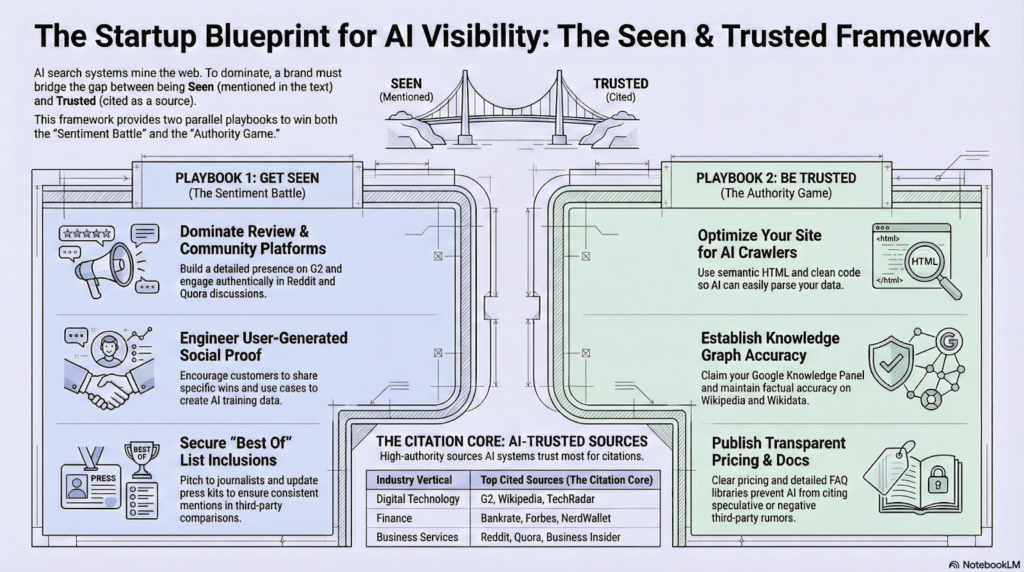
The following step-by-step strategy is designed to help a new business navigate the Seen & Trusted (S&T) Framework, ensuring that the brand is both mentioned in AI responses and cited as an authoritative source.
Step 1: Baseline Assessment and Technical Audit
Before launching new campaigns, a startup must understand its current standing within AI ecosystems.
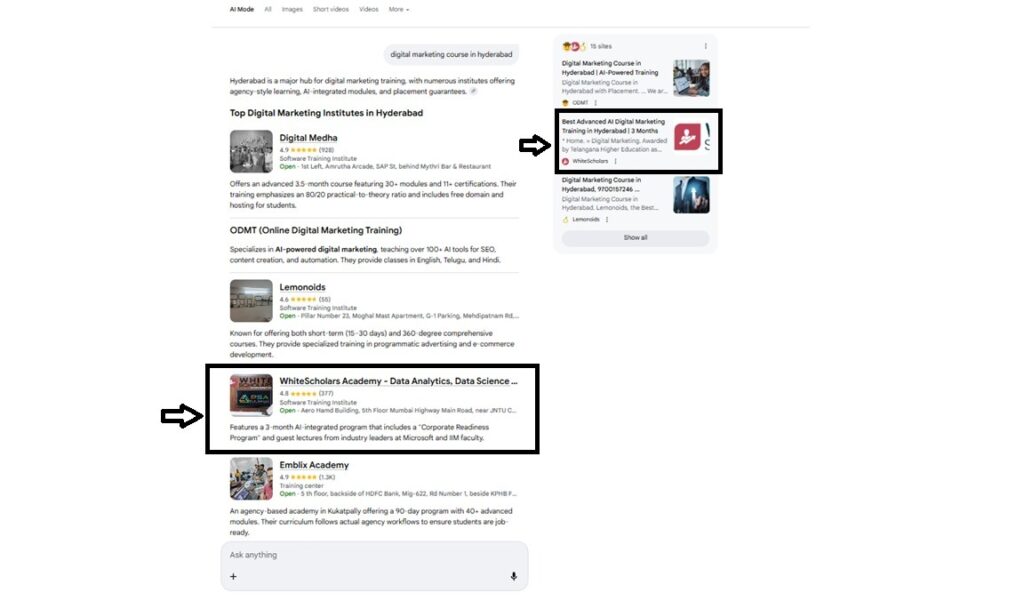
- Audit Current Visibility: Use tools like ChatGPT and Google AI Mode to test queries related to your brand, product category, and the specific problems your startup solves.
Here, while searching for the best digital marketing course in Hyderabad, the White Scholars Training Institute showed up at the third position.
- Identify Gaps: Determine if your brand is being “seen” (mentioned in the text) or “trusted” (included in the source citations).
- Evaluate Technical Health: AI platforms cannot cite content they cannot crawl; therefore, you must ensure your site uses semantic HTML (native tags like <table> and <ul>) instead of complex custom layouts.
- Optimise Site Performance: Ensure your website passes Core Web Vitals, as top-cited sites are typically fast-loading and stable.
- Eliminate Obstacles: Remove heavy JavaScript dependencies that prevent AI crawlers from reading your main content on the initial load.
Step 2: Developing a Substantive Review Ecosystem
For a startup, early reviews are critical, but they must provide “substance” to be useful for AI training data.
- Target Industry-Specific Platforms: Focus on G2 and Capterra for B2B SaaS, Amazon for e-commerce, or Yelp and Google Reviews for local services.
- Prioritise Detail Over Volume: AI systems value a single review explaining a specific use case or feature more than numerous generic “great product” ratings.
- Implement High-Quality Prompts: When asking for feedback, provide templates that encourage customers to discuss specific outcomes, such as how an API saved development time.
- Provide Depth: Consider offering rewards specifically for reviews that exceed a certain word count to ensure the content is “AI-friendly”.
- Demonstrate Engagement: Ensure your team responds to every review, as AI recognises vendor engagement as a vital trust signal.
Step 3: Engaging in Organic Community Dialogue
Community platforms like Reddit, Quora, and Stack Overflow are among the most cited sources for AI search engines.
- Adopt a Human-Centric Approach: Avoid promotional language; instead, treat forums as extensions of your customer support or knowledge-sharing efforts.
- Address Misconceptions: Actively correct misinformation about your category or product to prevent AI from learning incorrect data.
- Participate Beyond Self-Promotion: Answer user questions even when your product is not the immediate solution, as this builds broader contextual authority.
- Leverage Founder Presence: Having founders or product teams answer technical or niche questions directly can create the authentic engagement AI systems prioritise.
Step 4: Cultivating Social Proof and User Content
User-generated content (UGC) creates a feedback loop that AI systems amplify as training data.
- Encourage Public Case Studies: Prompt users to document their workflows or “before-and-after” results on platforms like LinkedIn or Instagram.
- Design Sharable Experiences: Create features or digital milestones that users naturally want to share, similar to the “Spotify Wrapped” model.
- Partner with Micro-Influencers: Use authentic storytellers to share product tips and reviews in their own voice, rather than through scripted advertisements.
- Foster Advocacy: Focus on turning customers into evangelists who will mention your brand in independent discussions across the web.
Step 5: Securing Placement in “Best Of” Curations
Third-party validation in comparison articles acts as a major source for AI product recommendations.
- Create a Press Kit: Build a dedicated page on your site with high-resolution images, pricing, and technical specs to make a journalist’s job easier.
- Target Authoritative Publications: Aim for mentions in sites like Forbes, TechRadar, or NerdWallet, which are frequently cited by AI as “Citation Core” sources.
- Practice Category Expansion: Look for lists beyond your immediate niche; for example, a fitness app might aim for “best wellness tools” as well as “top workout apps”.
- Sync Information Across Sites: Ensure that specs and features are consistent across all independent reviews to reinforce AI trust through repetition.
Step 6: Establishing Factual Authority via Knowledge Bases
AI systems rely on public data sources like Wikipedia and Google’s Knowledge Graph to validate facts.
- Maintain Wikidata Entries: It is often easier for a startup to create a Wikidata entry than a full Wikipedia page; use neutral language and cite credible third-party sources.
- Claim Your Knowledge Panel: Search for your startup’s name on Google and verify your identity to “claim” the existing panel and manage its data.
- Utilise Organization Schema: Add or improve structured data on your homepage to feed Google the facts it needs for the Knowledge Graph.
- Audit for Accuracy: Regularly check that leadership names, product details, and revenue ranges are current across these public platforms.
Step 7: Implementing Transparent Pricing and Information
Hiding pricing can lead to negative sentiment, as AI systems may rely on speculative, critical data from forums.
- Publish Clear Tiers: Include feature comparisons, user caps, and annual versus monthly pricing options directly on your site.
- Avoid “Contact Sales” Vacuums: If pricing is hidden, AI will often quote Reddit complaints or make assumptions about your brand being “expensive”.
- Qualify for Value Queries: Transparent pricing allows your brand to be included in AI responses for “best budget” or “cost-effective” searches.
Step 8: Building Comprehensive Knowledge Assets
Technical documentation and FAQs are “citation goldmines” because they provide clear, step-by-step solutions.
- Create Problem-Specific Pages: Instead of a single FAQ, build dedicated pages for specific integrations or troubleshooting tasks.
- Use Static HTML: Ensure all support documentation is easily crawlable and not hidden behind tabs or login screens.
- Apply HowTo Schema: Use structured data markup on help articles to assist AI in identifying the content as a direct solution.
Step 9: Producing Original, Citable Research
Unique data gives AI systems evidence they cannot find elsewhere, making your brand a primary source.
- Leverage Proprietary Data: Use internal insights to create annual industry reports or benchmark studies.
- Focus on Methodology: Ensure your research has a significant sample size and includes clear findings in bullet points for easy AI extraction.
- Promote for Backlinks: When news outlets cover your original research, it creates a compound effect that builds authority in the eyes of AI.
Step 10: Cross-Functional Execution and Monitoring
AI visibility is not just the responsibility of the SEO team; it requires coordination across the entire startup.
- Eliminate Barriers: Coordinate between Customer Success (reviews), Product pricing transparency, PR (media lists), and support (documentation).
- Run Parallel Campaigns: Work on “getting seen” through sentiment-building and “being trusted” through technical authority simultaneously.
- Track Monthly Changes: AI visibility shifts rapidly, so you must monitor your mentions and citations regularly and adjust your strategy based on competitor movements.
Final Thoughts
Achieving dominance in AI search is not a one-time task but a process of continuous auditing and adaptation. Brands should start by establishing a baseline visibility in ChatGPT and Google AI Mode. From there, they must run parallel campaigns:
one focused on sentiment (reviews, community, PR) and another on authority (technical site health, pricing transparency, original research). Because AI visibility shifts rapidly, monthly monitoring is required to identify imbalances, such as having strong mentions but weak citations, and adjust the strategy accordingly.
Now is a great time for companies to improve their AI visibility, as few brands have successfully managed both mentions and citations, allowing nimble businesses to surpass larger competitors.
Frequently asked questions
1. How can a brand improve its visibility in AI search responses?
To improve visibility, brands should implement the Seen & Trusted Framework, which focuses on winning both mentions in AI answers and citations as a source. This requires cross-departmental coordination to synchronise signals from reviews, community forums, and technical site optimisations.
2. What is the difference between being “seen” and being “trusted” in AI search?
Being “seen” means your brand is mentioned within the text of an AI’s generated answer, while being “trusted” means being listed as a source link. Achieving both simultaneously is essential to multiplying brand trust and conversions across platforms like ChatGPT and Google AI Mode.
3. Why is community engagement on platforms like Reddit important for AI ranking?
AI systems frequently mine Reddit and Quora because these platforms provide authentic, unfiltered conversations that shape how AI understands and recommends products. Brands that engage helpfully in these communities provide the context and sentiment AI needs to recommend them.
4. How does transparent pricing affect a brand’s performance in AI search?
Hiding pricing can lead AI to cite speculative or negative data from third-party forums, whereas transparent pricing provides reliable facts that AI can trust. This transparency allows a brand to be included in value-based queries, such as “best budget” or “cost-effective” options.
5. What technical steps are necessary to ensure AI can cite a website?
Websites must use semantic HTML and ensure key information is visible on the initial load without relying on JavaScript, which AI crawlers may skip. Additionally, passing Core Web Vitals and using schema markup for FAQs are critical for being recognised as an authoritative citation.
To learn more, check out WhiteScholars AI-Powered Digital Marketing course.
