

Don’t write blogs in 2026 unless you know these five steps

Before you write your next blog in 2026, make sure you understand these five essential steps that help your content rank better, attract the right audience, and drive real results.
The new phase of blogging: 2026
While 2026 has been a great start for all the emerging technologies and fields, blogging is one of the main fields that has a whole new phase.
Let’s understand what blogging is.
Blogging is a digital platform for sharing expertise in a specific field, like arts, courses, etc., to build trust and authority with a dedicated audience.
It requires managing a unique domain and hosting while adhering to a consistent posting schedule and SEO to ensure the site remains visible and relevant to search engines.
Earlier it was essential for businesses to maintain a blog that articulates their intended message to society regarding the products or services they offer.
Given the emergence of new technologies and the continuous evolution of various sectors striving to establish their identity and brand in the marketplace, it is not just about writing blogs but also increasing the search rankings, SEO (search engine optimisation) and much more.
In this blog let us explore what all the factors are to be considered before writing a blog.
Factors involved in blogging
- Domain & Hosting: Selecting a unique web address and securing digital storage space to house your blog’s content.
- Niche Selection: Choosing a specific topic you are passionate and knowledgeable about to establish authority and attract a targeted audience
- Consistency: Maintaining a regular posting schedule to keep audiences engaged and signal to search engines that your site is active.
- SEO & Keywords: Using research tools to optimise content, ensuring your blog ranks higher and is easily discoverable.
- Promotion (Digital Marketing) : Leveraging social media platforms like Pinterest and LinkedIn to drive traffic and expand your reach.
- Making money: Generating revenue through strategies like affiliate marketing, sponsored content, or selling digital products.
The role of content writing in driving traffic
Content writing plays a pivotal role in company success by driving organic traffic, building trust, and generating leads. Here are some recent stats that highlight its impact across industries:
Role of Content Writing in Company Success
| Metric | Insight |
| Global Content Marketing Revenue | Expected to exceed $107 billion by 2026 |
| Lead Generation | Content marketing generates 3x more leads than traditional marketing |
| Adoption | Over 4 in 5 marketers use content marketing |
| ROI | 68% of businesses report higher ROI from content marketing |
| Budget Growth | 46% of B2B marketers plan to increase content budgets |
Company-Level Examples
- HubSpot: Their blog drives millions of monthly visits, with inbound content being the backbone of their customer acquisition strategy.
- Shopify: Content marketing (guides, blogs, case studies) has helped them dominate SEO, bringing in consistent organic traffic from entrepreneurs.
- Buffer: Built its early growth almost entirely through transparent, high-quality blog posts, which attracted a loyal audience and boosted brand trust.
- Adobe: Uses thought-leadership content to position itself as an authority, driving traffic and enterprise leads.
How to write a blog in 2026
To successfully write and launch a blog in 2026, you must begin with a strong technical and strategic foundation.
First, select a unique domain name that reflects your content and secure reliable web hosting from providers like Bluehost or SiteGround. This serves as your digital address and the space where your content is stored.
Niche Selection and Content Strategy Choosing the right niche is paramount; it should be a subject you are both passionate about and knowledgeable in, such as culinary arts, travel, or personal finance.
This expertise allows you to produce trustworthy, authoritative content that attracts a dedicated audience. To maintain growth, develop a consistent posting schedule, whether daily or weekly, and use a content calendar to plan your posts in advance.
Regular updates signal to search engines that your site is active and relevant, which significantly improves your visibility and ranking.
SEO and Strategic Promotion Driving traffic to your blog requires mastering search engine optimisation (SEO). Use tools like Semrush or Google Keyword Planner to identify relevant keywords and integrate them into your content, titles, and meta descriptions.
Furthermore, promote your blog across social media platforms tailored to your niche. Pinterest is highly effective for visual topics, while LinkedIn is an invaluable hub for professional networking and sharing business strategies. Integrating YouTube video content can also provide a rich, multi-platform experience for your readers.
Monetization and Long-Term Success As your blog grows, you can generate income through affiliate marketing, earning commissions by naturally linking to products within your posts. Other avenues include sponsored content, selling digital products like ebooks and courses, or offering premium memberships.
For your first month, focus on setting up a WordPress blog, enrolling in a blogging course, and writing high-quality content consistently to establish your authority in your chosen niche.
Want to learn more about how to increase the traffic to your website? Then start your journey with the WhiteScholars AI-powered Digital Marketing Course.
5 steps to follow while writing a blog in 2026:
To successfully write and launch a blog in 2026, follow these five essential steps.
When writing a blog, you should keep several strategic and technical factors in mind to ensure long-term success and audience engagement:
- Passion and Expertise: Your chosen niche should be a subject you are both passionate about and knowledgeable in. Passion prevents the blogging process from feeling like a chore, while expertise allows you to produce informative and trustworthy content that establishes you as an authority.
- Consistency and Frequency: Maintaining a consistent posting schedule, whether daily, weekly, or bi-weekly, is the cornerstone of audience growth. Regular updates signal to search engines that your site is active, which improves your visibility and ranking. Using a content calendar can help you plan ahead and maintain a steady flow of content.
- Balance of Quality and Quantity: While posting often is important, you must aim to create a schedule that is manageable for you without sacrificing the quality of your posts. High-quality, valuable content is what ultimately builds your audience and improves SEO.
- SEO and Keyword Integration: To drive traffic, you must perform keyword research using tools like Google Keyword Planner or Semrush. These keywords should be naturally incorporated into your content, titles, and meta descriptions to make it easier for readers to find you through search engines.
- Platform and Design: Utilising a flexible platform like WordPress is recommended because it offers various themes and plugins that help you design your site and optimise it for search engines.
- Promotion and Outreach: Promotion is key to expanding your reach. You should leverage social media platforms that match your niche, such as Pinterest for visual content or LinkedIn for professional insights. Integrating YouTube video content can also provide a richer, multi-platform experience for your readers.
- Authenticity in Monetisation: If you plan to earn income, ensure that any affiliate marketing or sponsored content resonates with your blog’s niche. This maintains your authenticity and trust with your audience, which is essential for driving sales through referrals.
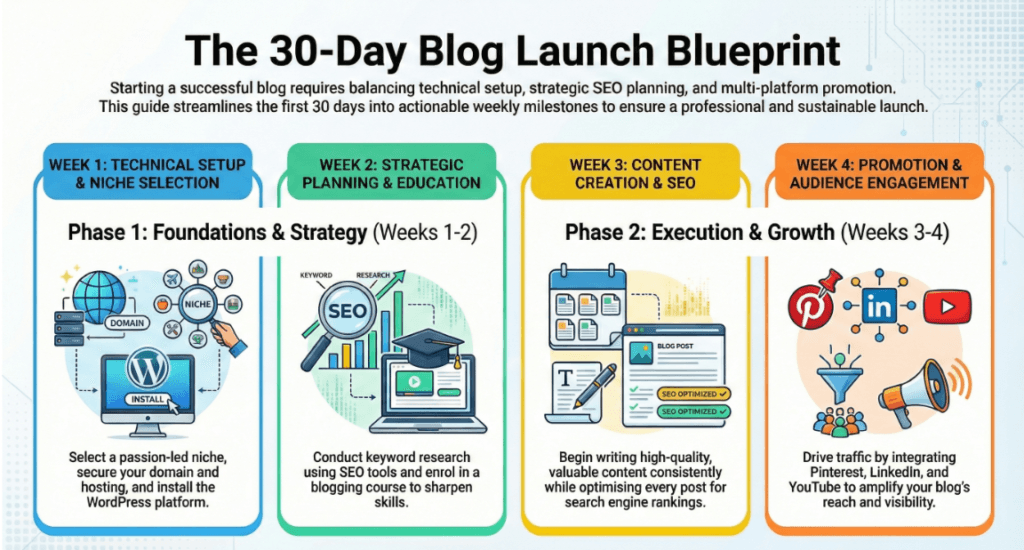
First-month plan for writing a blog:
Here is a structured 30-day plan to launch your blog and establish a strong foundation for success:
Week 1: Foundation and Technical Setup
- Days 1 to 3: stream selection: identify a topic that aligns with both your passion and expertise. This ensures your content is trustworthy and that you remain committed to the project long-term.
- Days 4 to 5: Domain and Hosting: Choose a unique, memorable domain name that reflects your domain. Secure reliable hosting through providers like Bluehost or SiteGround to store your blog’s data.
- Days 6 to 7: Platform Setup: Start a WordPress blog. Explore its themes and plugins to design your site and enhance its functionality for both users and search engines.
Week 2: Strategic Planning and Education
- Days 8 to 10: Keyword Research: Use tools like Google Keyword Planner or Semrush to find relevant keywords. This is essential for improving your search engine ranking and helping readers find your content.
- Days 11 to 12: Content Strategy: Develop a content calendar. Decide on a realistic posting frequency, whether daily or weekly, to signal to search engines that your site is active and relevant.
- Days 13 to 14: Skill Building: Enroll in a blogging course. Utilize free or paid resources to learn the “ins and outs” of SEO, content creation, and future monetisation strategies.
Week 3: Content Creation and SEO
- Days 15 to 19: High-Quality Writing: Begin writing valuable, informative posts consistently. Focus on quality over quantity to build authority within your chosen niche.
- Days 20 to 21: On-Page SEO: Optimize your existing posts by naturally incorporating your researched keywords into titles, content, and meta descriptions.
Week 4: Promotion and Audience Engagement
- Days 22–25: Pinterest Launch: Create a Pinterest account specifically for your blog. Design engaging pins and optimise them with keywords to drive visual search traffic back to your site.
- Days 26–28: Professional Networking: Leverage LinkedIn to share insights and network with other professionals in your industry.
- Days 29–30: Multi-Platform Integration: Consider creating YouTube video content that complements your blog posts to provide a richer experience for your audience.
Final thoughts
Starting a blog is a journey that requires a blend of creativity and strategic planning to achieve long-term success. First, grounding your blog in a niche where you possess both passion and expertise ensures you remain committed while establishing yourself as a trustworthy authority.
Second, consistency is the cornerstone of growth; maintaining a regular posting schedule signals to search engines that your site is active and relevant. Third, technical excellence through SEO and keyword research is essential for discoverability, making it easier for readers to find your content.
Fourth, leverage social media platforms like Pinterest and LinkedIn to amplify your reach beyond search engines. Finally, approach blogging as a business by exploring monetisation strategies like affiliate marketing and digital products.
With dedication and a focus on high-quality content, your blog can become a profitable digital venture.
Frequently asked questions
1. How much can a blogger realistically earn?
Successful bloggers can earn a significant income of over $50,000 a year. This is achieved through various monetisation avenues such as affiliate marketing, sponsored content, and the sale of digital or physical products like e-books.
2. What are the primary technical requirements to start?
The first steps involve selecting a unique domain name and securing reliable web hosting to store your blog’s data. Additionally, using a flexible platform like WordPress allows you to utilise themes and plugins that optimise your site for search engines.
3. Why is choosing a specific niche so important?
Selecting a specific niche ensures you are creating targeted content that attracts and retains a dedicated audience. By focusing on an area where you have expertise and passion, you produce informative content that establishes you as a trustworthy authority figure.
4. How does SEO help a blog grow?
SEO and keyword research are essential for driving traffic by helping your blog rank higher in search results. By incorporating relevant keywords into your titles and meta descriptions, you make it significantly easier for potential readers to discover your content.
5. What should I focus on during my first month of blogging?
In your first month, you should prioritise setting up your WordPress blog, starting a Pinterest account for promotion, and enrolling in a blogging course. Most importantly, you must start writing consistently to build your audience and establish your niche authority.
