
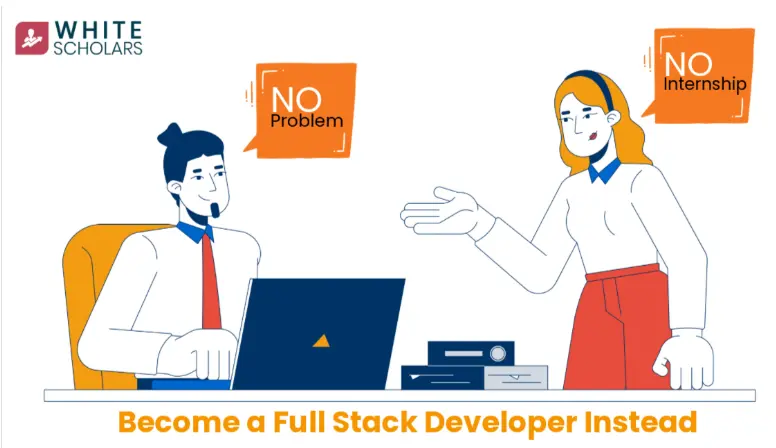
No Internships? No Problem: Become a Full Stack Developer Instead
College internship gap? Learn Full Stack development with a 6-month roadmap and build the skills needed to start your developer career.
Introduction
Imagine this. You are in college, scrolling through job postings or chatting with friends. Everyone talks about internships. They share stories of big companies and real-world experience. But what if you did not land one? What if your internship period feels empty? Do not worry. That free time is your golden opportunity. Instead of waiting for internships, dive into full stack development.
It builds a rock-solid foundation for your future. Full stack developers earn high salaries right after college. By the time you graduate, you will stand complete and ready for top jobs.
This article shows you exactly how to turn idle months into a powerhouse skill set. No prior experience needed. In this article, we break it down step by step. You learn what full stack means. You see the high demand and pay. Most importantly, you get a clear roadmap. Use your college free time wisely. Build skills that last a lifetime.
Why Full Stack Development Beats Waiting for Internships
Colleges often schedule breaks or semesters for internships, usually in the third or final year. If you lack connections or experience, those periods feel empty. Flip the script. Treat them as full stack bootcamps. You have 2 to 6 months of pure focus. No classes, no exams. Just you and code.
College life often pushes you toward internships for resume boosts. But what if you skip them and focus on skills that matter more in your longterm?Not that internships are not important, they too help but doing this has even more scope for your future growth.
That independence makes you stand out. Peers in internships might envy your skills. You graduate not just with a degree, but with job-ready expertise.
Why Full Stack Development Fits Perfect
Internships teach company processes, but they rarely give deep coding skills. Many end up in boring tasks like data entry. Full stack learning gives real power. You code, deploy, and see results instantly.
High demand drives high pay. In India, fresh full stack graduates earn 6 to 12 lakhs per year at startups like Zoho or Flipkart. Experienced ones hit 20 lakhs plus. Globally, roles at Google or Meta pay even more. Your college free time lets you master this without office politics.
Think of it like this: internships are rentals. Full stack skills are ownership. You build a personal portfolio that lasts forever. Employers check GitHub repos more than internship certificates. By graduation, you compete with seniors who have years of experience. No internships? No problem. You become the complete package.
The Perfect Timing: Use Your College Internship Break Wisely
Start simple. Dedicate mornings to learning basics. Afternoons for building projects. Evenings for debugging and deploying. Track progress weekly. In one month, grasp the front-end. Next month, tackle the back-end. By break end, deploy live apps. This rhythm builds habits that stick.
Peers in internships might envy your skills. You graduate not just with a degree, but with job-ready expertise.
What is Full Stack Development? A Simple Breakdown
Full stack development means you handle both the front-end and back-end of websites and apps. You create user interfaces that look great and servers that run smoothly behind the scenes. Companies love this versatility. A full stack developer can build entire projects alone.
Full stack means the whole technology stack.
- Front-end is what users see: buttons, forms, animations.
- Back-end handles logic: data storage, user login, payments.
- Database connects everything.
Example :
Picture building a food delivery app. Front-end shows menus and maps. Back-end processes orders and tracks drivers. Database stores user details. You do it all as a full stack dev.
Key parts:
- Front-end: HTML for structure, CSS for style, JavaScript for interactivity.
- Back-end: Node.js, Python (Django/Flask), or Java for server logic.
- Database: MongoDB (flexible) or MySQL (structured).
- Tools: Git for version control, React for advanced front-end, Heroku for free hosting.
No need to master everything at once. Start with the front-end. It feels rewarding fast. Then layer on the back-end. This path completes you by college end.
Step-by-Step Roadmap: From Zero to Full Stack Hero in College Time
Follow this 6-month plan. Adjust based on your break length. Aim for 4-6 hours daily. Consistency wins.
Phase 1: Foundations (Weeks 1-4)
Goal: Grasp basics. Build confidence.
- Week 1: HTML & CSS
Create layouts. Practice flexbox, grid.
Build a personal portfolio page.
- Week 2: JavaScript Basics
Variables, loops, functions.
Add interactivity. Make a to-do list app.
- Week 3: Advanced JavaScript
DOM manipulation.
Fetch API for data.
- Week 4: Responsive Design
Use Bootstrap or Tailwind CSS.
Make sites mobile-friendly.
Project: Simple landing page for a fake startup. Deploy on GitHub Pages. Share on LinkedIn.
Phase 2: Front End Mastery (Weeks 5-8)
Goal: Modern UI/UX.
- Learn React.js. It rules front end jobs.
- Components, state, props.
- Hooks like useState, useEffect.
- Build a weather app pulling real API data.
Project: E-commerce product page. Add cart functionality. Responsive across devices.
Phase 3: Back End Basics (Weeks 9-12)
Goal: Server-side power.
- Node.js + Express.js.
- Routes, middleware.
- REST APIs.
- Postman to test endpoints.
Database: MongoDB. Learn CRUD operations (Create, Read, Update, Delete).
Project: Simple API for a blog. Endpoints for posts and users.
Phase 4: Databases and Authentication (Weeks 13-16)
Goal: Real app features.
- MySQL or PostgreSQL for relational data.
- For non relational data use NoSQL.
- Password hashing for security.
Integrate with the front end. Use React + Node.
Project: Full blog app. Users register, post articles, and comment.
Phase 5: Deployment and Tools (Weeks 17-20)
Goal: Production-ready.
- Git and GitHub. Version control.
- Deploy front end on Vercel/Netlify.
- Back end on Render or Railway (free tiers).
- Environment variables for secrets.
Add testing with Jest. Optimize performance.
Project: Deploy your blog live. Custom domain via Namecheap (cheap).
Phase 6: Advanced Projects and Polish (Months 5-6)
Build portfolio killers.
- Social media clone (Twitter-like). Features: posts, likes, follows.
- Task manager with teams. Real-time updates via Socket.io.
- E-commerce site. Stripe payments (test mode).
- Chat app. Full real-time.
Document each. README files explain tech stack, challenges, demos.
By the end, 5+ projects. GitHub shines. Resume pops.
Real-World Projects to Build Your Portfolio
Projects prove skills. Employers check GitHub first. Aim for 5 diverse ones.
Project 1: Personal Portfolio
Showcase skills. Sections for about, projects, contact. React + Tailwind. Deploy live.
Project 2: Todo App with Auth
Local storage first. Then back end sync. User accounts. Priority levels.
Project 3: Movie Search App
TMDB API. Search, favorites, details. Responsive grid.
Project 4: Full E-commerce
Products, cart, checkout. Fake payments. Admin dashboard.
Project 5: Real-Time Chat
Socket.io. Rooms, private messages. Mobile-friendly.
Bonus: Open Source Contribution
Find beginner issues on GitHub. Fix bugs. Add to resume.
Each project teaches. The first one is simple. The last one is complex. Track in Notion or Trello.
The High-Paying Future Waiting for You
Full stack demand explodes. India’s IT sector grows 8% yearly. Startups need versatile developers. Big tech hires freshers with projects.
Salary breakdown:
- Fresher: ₹5-10 LPA (Bangalore, Hyderabad hubs).
- 1-year exp: ₹12-18 LPA.
- Remote US jobs: $60k+ via Upwork.
Your college journey positions you perfectly. No gaps in my resume. Instead, “Built 5 full stack apps, 1k GitHub stars.”
Freelance too. Charge ₹10k for small sites on Fiverr. Build side income.
Success Stories: College Students Who Did It
- Meet Rohan from IIT Delhi. No internships. Spent summers on MERN stack. Built a freelance marketplace. Landed Flipkart offer at ₹14 LPA.
- Priya, VIT Vellore. Learned through youtube. Portfolio got her Zoho remote role.
Indian stats: 70% full stack jobs go to self-taught or project-based candidates (Naukri.com data).
You are next. Same path, your story.
Make It Happen Today
No internships mean freedom. Grab it. Start with HTML today. Follow the roadmap. In 6 months, learn till you graduate completely. High-paying jobs await.
Accelerate with WhiteScholars Training in Hyderabad
Living in Hyderabad or Need Assistance with this path? Supercharge your journey with structured options. Enroll in WhiteScholars academy Hyderabad, WhiteScholars full stack developer course offers hands-on guidance alongside self-learning. A full stack developer course in Hyderabad fits perfectly into your college schedule, often with flexible timings and affordable fees. Focused on MERN stack, the top choice for modern apps, MERN stack combines MongoDB, Express, React, and Node.js for seamless full stack builds. Become a MERN stack developer through a MERN full stack course, and land jobs faster. They help you with placement support. Pair this with your projects for unbeatable results. Your path to a complete full stack career starts now.
Frequently Asked Questions (FAQs)
1. Can I really learn full stack development without any prior coding experience?
Yes, the 6-month roadmap starts from absolute basics like HTML and CSS, designed for complete beginners. Dedicate 4-6 hours daily, follow free resources like freeCodeCamp, and build projects weekly. Many success stories like Priya from VIT Vellore started with YouTube and landed Zoho roles.
2. How much time do I need daily to follow this roadmap during college breaks?
Aim for 4-6 hours per day: mornings for learning theory, afternoons for hands-on coding, evenings for debugging. This fits perfectly into 2-6 month internship breaks with no classes. Track weekly progress to stay motivated and adjust based on your schedule.
3. What is the MERN stack, and why is it recommended in the article?
The MERN stack is MongoDB (database), Express.js (back-end), React (front-end), and Node.js (server). It’s beginner-friendly, uses JavaScript throughout, and powers apps like Netflix. The roadmap emphasizes it for high job demand, especially in Hyderabad courses like WhiteScholars.
4. Will building projects alone be enough for job placements without internships?
Absolutely—employers prioritize GitHub portfolios over internship certificates. Build 5+ diverse projects like e-commerce sites or chat apps, deploy them live, and contribute to open source. Indian stats show 70% of full stack jobs go to project-based candidates, leading to ₹5-10 LPA freshers’ salaries.
5. Are there good full stack courses in Hyderabad to supplement self-learning?
Yes, options like WhiteScholars full stack developer course in Hyderabad provide hands-on MERN training with placement support. They offer flexible timings for college students, affordable fees, and real-world projects.
