

Generative AI: Part 3 — The Ultimate Guide to Machine Learning
Table of Contents
Dive into the third blog of our Generative AI series: your Ultimate learning guide to conquering Machine Learning essentials and beyond.
Welcome Back !!
In our previous two blogs (Blog-1, Blog-2), we laid the groundwork for understanding Artificial Intelligence. In the first post, we explored its core concepts, capabilities, and various forms. The second one took us deeper into the different types of AI, how it processes information, and how it compares to human intelligence. Now, it’s time to take the next step in our journey by diving into the world of Machine Learning. Let’s get started!
Machine Learning (ML) is one of the most revolutionary technologies of the 21st century . From recommending products on Amazon to enabling self-driving cars , ML is changing the way we live, work, and think.
Machine Learning is a branch of Artificial Intelligence (AI) that enables systems to learn and improve from experience without being explicitly programmed.
In this blog, we’ll dive deep into:
- What is Machine Learning
- Types of Machine Learning
- Core principles behind them
- When to use which type
Introduction
Machine learning is one of the most transformative technologies of our time. At its core, it refers to computer algorithms that automatically improve through experience. Considered a subset of artificial intelligence (AI), machine learning enables systems to make decisions or predictions without being explicitly programmed.
Machine learning process by analyzing sample data, commonly known as training data, machine learning models develop mathematical functions that improve their performance over time. This ability to learn from data makes machine learning essential in many modern industries and research areas.
Let’s break down how machine learning works and explore its different types.
How Machine Learning Works
In traditional programming, we write code that takes inputs and produces outputs based on fixed rules. In classical machine learning, however, the system learns those rules by analyzing data.
Machine learning relies on algorithms and models to uncover patterns, make predictions, and continuously evolve to become more accurate and efficient. These models adjust themselves automatically as they process more data, improving accuracy and efficiency.
Categories of Machine Learning
Machine learning is broadly classified into three main types:
- Supervised Learning
- Unsupervised learning
- Reinforcement learning
Each type serves a different purpose depending on the nature of the data and the desired outcome.
Supervised Learning
In supervised learning, the model is trained using labeled data, which means each training example includes an input and its correct output. The goal is for the algorithm to learn the mapping from inputs to outputs so it can predict outcomes for new, unseen data.
Let’s take the same example where we enabled the robot to identify a vegetable.
When we trained our robot by showing pictures of vegetables, we labelled each picture with the name of the vegetable. So, we acted as a teacher to him. We first told him what a tomato or a carrot looks like and then only he was able to identify them.
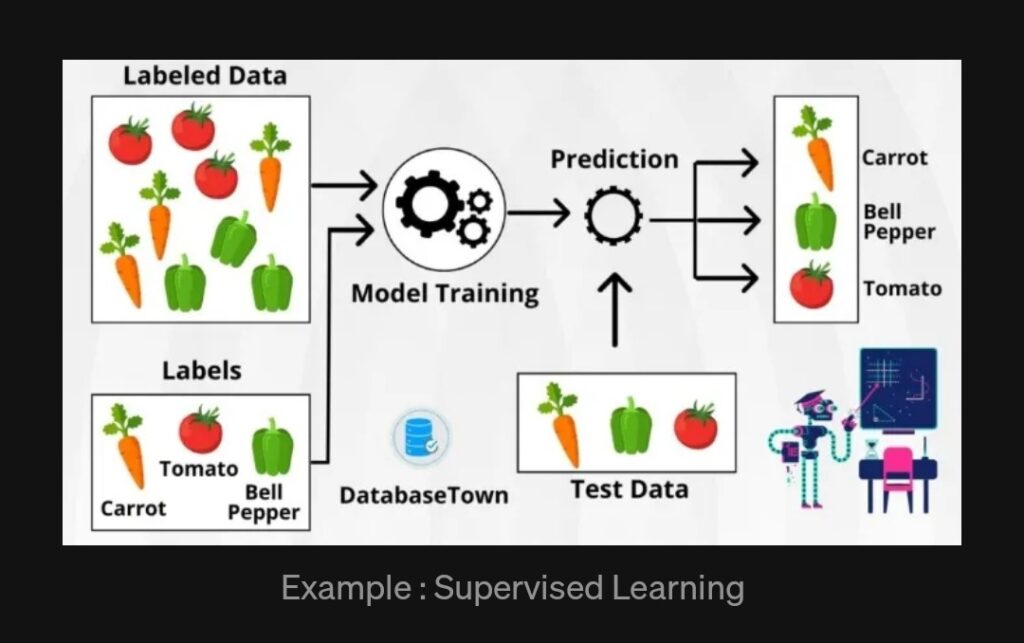
In Machine Learning we call this Supervised Learning.
Real-life Examples of Supervised Learning
- Email Spam Filtering
- Image Classification
- Facial Recognition
- Financial Fraud Detection
- Speech Recognition
Types of Supervised Learning
Classification
Used when the output variable is a category or class (such as spam or not spam). The model learns to assign a class label to input data.
Use cases:
- Predicting the sentiment of a post or text (sentiment analysis)
- Determining whether a tumor is benign or malignant
- Assessing risk in loan applications
Regression
Used when the output variable is a continuous value (such as predicting house prices). The model estimates relationships between inputs and numerical outcomes.
Use cases:
- Predicting stock prices
- Sales forecasting (used by companies like Amazon and Walmart)
- Route optimization (used by airlines and ride-sharing companies like Uber)
Unsupervised Learning
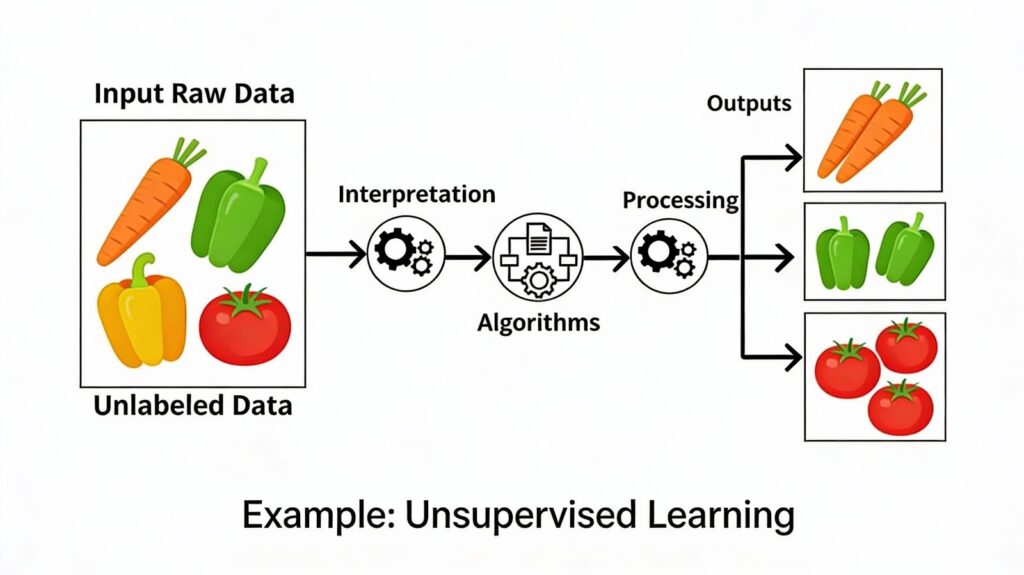
Unsupervised learning does not rely on labeled data. Instead, it explores input data to discover hidden patterns or structures without predefined outcomes. This approach is useful when we are unsure what to look for in the data.
Let’s take a proper machine learning example. Imagine we showed lots of pictures of tomatoes, carrots, capcicums etc. without any label to our robot and told him — “I’m not going to tell you which one is which. Go explore and figure it out”.
The robot starts to look at these vegetables, noticing things such as their shape, size, and how their colour varies. It doesn’t know their names yet, but it’s trying to find patterns and differences on its own.
After exploring, the robot might notice that:
- Some vegetables are typically long, tapered cone shaped with pointed tip (carrot)
- Some vegetables have round spherical and oval shaped with shiny outer layer (tomato)
- Some vegetables are large, blocky with four lobes and a stem at end (capsicum)
It figures out these categories without you telling it directly.
In the end, the robot might not know the names of the vegetables, but it can say that “These vegetables are similar in some ways, and those are different in other ways.” — This is Unsupervised Learning.
Real-life Examples of Unsupervised Learning
- Clustering Customer Segmentation
- Anomaly Detection in Cybersecurity
- Recommendation Systems
Types of Unsupervised Learning
Clustering
Groups similar data points together. For example, customer segmentation in marketing is often done using clustering algorithms.
Dimensionality Reduction
Reduces the number of input variables or features while preserving important information. This helps in visualizing high-dimensional data and improving model performance.
Association Mining
Identifies interesting relationships between variables in large datasets. A classic example is market basket analysis, which finds products that are frequently bought together.
Reinforcement Learning
Reinforcement learning (RL) is a type of machine learning where an agent learns by interacting with its environment. It receives rewards or penalties based on the actions it takes, and its goal is to maximize the cumulative reward over time.
Similarly, Reinforcement Learning is:
- Training a computer to make decisions
- By rewarding good choices and punishing bad ones
- Just as you might train a dog with treats for learning tricks
Reinforcement learning is often used in scenarios where there is no labeled data available, The agent explores different strategies, learns from outcomes, and adjusts its behavior accordingly. RL is widely used in areas such as game playing, robotics, and autonomous systems.
Use cases:
- Waymo, a subsidiary of Alphabet Inc., uses reinforcement learning for decision-making in self-driving cars.
- Tesla applies similar techniques to train its autonomous driving systems.
We have explored three major types of machine learning, including supervised learning, unsupervised learning, and reinforcement learning. Each of these types has its own unique strengths and limitations, and practical applications in various domains.
By understanding these types of machine learning, we can choose the right algorithm for the task at hand and achieve more accurate and efficient results.
As machine learning continues to advance, it opens up new opportunities for innovation and discovery across various industries., as there is still so much to discover in the exciting world of machine learning!
Other Types of ML
The ML field is rapidly developing, so the taxonomy of ML is constantly evolving / expanding. Although the three types we discussed cover a lot of breadth within the ML world, there are other types that are emerging, with their own set of application areas, data requirements, and modeling techniques. This section will cover some other types of ML (note: it will not be exhaustive).
Semi-supervised learning:
This type of ML combines unlabeled datasets with labeled datasets. Unlabeled datasets are difficult to work with and the number of techniques is limited. We can convert an unlabeled dataset into a label dataset and enter the world of supervised learning if we label our data.
However, that can be expensive and time-intensive, rendering it infeasible. This is where semi-supervised ML steps in, it tries to combine some labeled data points to improve the results when working with unlabeled data.
Often, semi-supervised learning arises when we have a dataset with partial labels or we spend some resources to label some reasonable / feasible portion of an unlabeled dataset.
Multimodal learning
This refers to machine learning where the data contains different modalities. For example, the dataset has text, audio, image, sensor data, and demographic features, all of which are different modalities of information.
The information and data from an image are vastly different from a text or sensor, an image is 2-dimensional, captures information in space, and is typically several thousands of numbers / pixels of information whereas text / sensors are much smaller in size and have a sequential / time ordering.
Currently, we have established methods for working with each modality separately, but combining modalities introduces new challenges and model considerations, which is why it’s considered its own type of ML.
In terms of where it fits in with the supervised, unsupervised, and RL domains, it spans across all three. With multimodal, you can have the dataset be labeled, unlabeled, or generated via sequential decision making.
Federated learning:
This refers to machine learning where the model can train on device without needing to separately store the data itself. Traditionally, in ML, the data is stored in a database that the model pulls from.
Once the data is in the database, the ML model can (re-)trained from it. In the federated learning context, instead of storing the device data in a separate database, the data stays on the device. The model will be sent via the cloud to the device, from where it will access the data on device, and train on the device.
After training, the model is sent back via the cloud to be used elsewhere. With federated learning, the user’s data stays with the user and never leaves the device, ensuring greater user data privacy and security. Some of the challenges of federated learning are limited computation on devices. Similar to multimodal, federated learning can span the supervised, unsupervised, and reinforcement learning domains.
Summary
Thank you for reading today’s blog on types of ML. I hope it has provided you with a better understanding of the various types of ML and their applications.I encourage you to further research these types to enhance your knowledge.
Moving forward, in our next blog, we will delve into Deep Learning which is a subset of Machine Learning (ML is again a subset of AI). An advanced subcategory of machine learning, wherein multilayered neural networks are used to identify complex patterns.
A message from WhiteScholars
Hey, we are team WhiteScholars here. We wanted to take a moment to thank you for reading until the end and for being a part of this blog series.
Did you know that our team run these publications as a volunteer effort to empower learners, share practical insights in emerging technologies, and create a growing community of knowledge seekers
If you want to show some love, please take a moment to check us on instagram, linkden. You can also explore more learning resources on our website WhiteScholars.
Read the Previous Part below,
FAQ’s
What is Machine Learning, and how does it differ from traditional programming?
Machine Learning is a branch of AI that enables systems to learn and improve from experience without explicit programming, by analyzing training data to develop mathematical functions and uncover patterns.
What are the three main types of Machine Learning, and when should each be used?
The main types are Supervised Learning (for labeled data and predictions like spam filtering), Unsupervised Learning (for finding hidden patterns in unlabeled data like customer segmentation), and Reinforcement Learning (for decision-making via rewards, like self-driving cars).
Can you explain Supervised Learning with a real-world example?
In Supervised Learning, models train on labeled data to map inputs to outputs; for instance, labeling vegetable images (e.g., tomato, carrot) teaches a system to
classify them, similar to email spam detection or facial recognition.
What is Unsupervised Learning, and how does the vegetable robot example illustrate it?
Unsupervised Learning discovers patterns in unlabeled data; the robot example shows it grouping vegetables by shape, size, and color (e.g., carrots as long/tapered) without names, like in anomaly detection or recommendation systems.
What are some emerging types of Machine Learning beyond the main three?
Emerging types include Semi-supervised Learning (mixing labeled/unlabeled data for efficiency), Multimodal Learning (handling diverse data like text/images/audio), and Federated Learning (training on-device for privacy, without central data storage).