

Is SEO dead in 2026? Or did users just rename it?
SEO has many new names like AEO, GEO, and LLMO. Is SEO dead? No, it has evolved. Let’s explore the new rules for 2026 in this blog.
Integration of SEO
The digital landscape has undergone a seismic shift. As we navigate through 2026, the traditional definitions of search engine optimisation (SEO) are being challenged and redefined.
This guide explores the evolution of search fundamentals, the emergence of AI-driven optimisation, and the critical shift toward Search Everywhere Optimisation. By understanding these concepts, learners can move from being merely visible to being the preferred choice for consumers across the entire internet.
The Core Fundamentals: Is SEO Dead?
The question “Is SEO dead?” has become a recurring theme in the digital marketing world. However, the reality, as seen through the lens of technical search experts, is that SEO hasn’t died; it has simply evolved and, in many cases, been rebranded.
New terms like AEO (Answer Engine Optimisation), GEO (Generative Engine Optimisation), and LLMO (Large Language Model Optimisation) are surfacing everywhere, causing confusion for both beginners and experts.
Despite these new names, search engines still operate on the same five core technical pillars. If a website fails in these initial stages, it will never achieve a ranking, regardless of what optimisation term you use.
The Five Pillars of Search Engine Processing
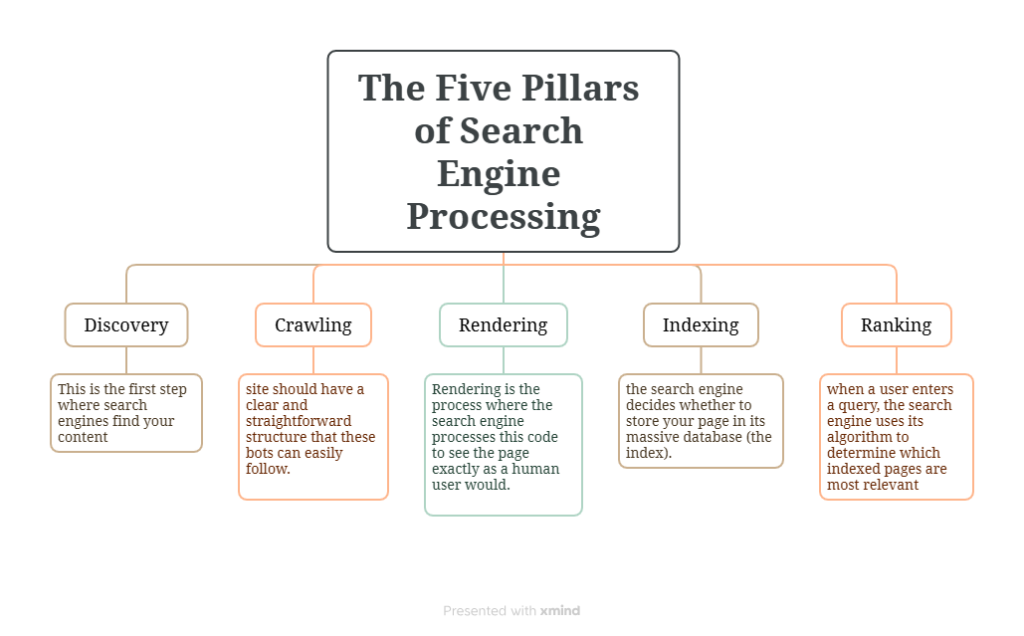
- Discovery: This is the first step where search engines find your content. If a search engine doesn’t know your page exists, it cannot proceed further.
- Crawling: After finding your site, automated systems come to analyse your code and content. For effective crawling, your site should have a clear and straightforward structure that these systems can easily follow.
- Rendering: Modern websites often use complex code (like JavaScript). Rendering is the process where the search engine processes this code to see the page exactly as a human user would.
- Indexing: After rendering, the search engine decides whether to store your page in its massive database (the index). Only indexed pages can appear in search results.
- Ranking: Finally, when a user enters a query, the search engine uses its algorithm to determine which indexed pages are most relevant and authoritative, placing them in a specific order.
The fundamental truth is that even AI-driven platforms like ChatGPT, Gemini, and Perplexity rely on these same foundations. They require structured content, context, authority, and relevance to provide answers.
Learners cannot optimise for AI if they do not first understand these basic mechanics of how search works.
Decoding New Search Terminology
As search technology advances, several new acronyms have entered the lexicon. While they may sound intimidating, they are largely “renamed concepts” rooted in traditional SEO skills.
- AEO (Answer Engine Optimisation): This focuses on optimising content so that it can be easily pulled by “answer engines” (like Alexa, Siri, or the featured snippets on Google) to provide a direct answer to a user’s question.
- GEO (Generative Engine Optimisation): This involves preparing content to be cited and used by generative AI models (like ChatGPT or Gemini) when they generate long-form responses for users.
- LLMO (Large Language Model Optimisation): Similar to GEO, this specifically targets how large language models perceive and categorise your brand’s data.
- AI SEO: An umbrella term for using AI tools to enhance SEO or optimising specifically for the AI-driven features of search engines.
These aren’t entirely new skills; they’re simply the application of SEO principles, like authority and relevance, to emerging search platforms.
The Shift in Consumer Behaviour: From Searching to Deciding
One of the most significant changes in 2026 is that consumers are no longer searching in the traditional sense. In the past, a user would go to Google, type in a keyword, and look at a list of 10 blue links.
Today, the journey is far more fragmented and happens in the weirdest places.
People are making decisions based on:
- TikTok comments.
- Reddit threads.
- Answers from ChatGPT.
- Amazon reviews.
- Short YouTube clips.
Consumers are no longer following a linear path or a simple “marketing funnel”. Instead, the modern journey is a constellation of micro-decisions that often happen simultaneously. A consumer might see a product on TikTok, check its validity on Reddit, ask ChatGPT for alternatives, and then buy it on Amazon, all within minutes and without ever visiting the brand’s actual website.
Which is why learning SEO with proper training is required to understand better. To gain this technical expertise, learn the digital marketing course powered by AI from WhiteScholars in Hyderabad.
The “Google Trap” and the 73% Reality
Many businesses are currently stuck in what is called the “Google Trap”. They spend all their resources chasing page-one rankings on Google, obsessing over metadata and backlinks. While Google is still massive, handling roughly 13.7 billion searches a day, that only accounts for about 27% of all search activity on the internet.
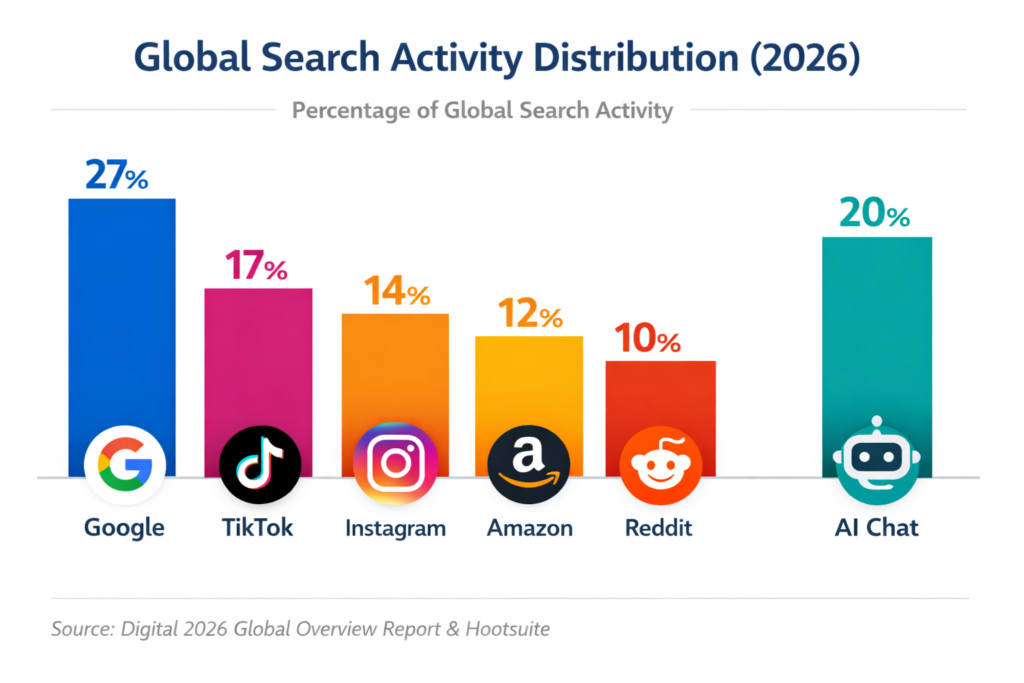
The remaining 73% of search activity is scattered across other platforms like Instagram, TikTok, Amazon, Reddit, and AI chat interfaces.
If you are only winning at Google, you are essentially invisible to nearly three-quarters of the search market. While your traffic might look good on paper, your sales may remain stagnant because you are missing the moments where customers actually make their final buying decisions.
Search Everywhere Optimisation (SEO 2.0)
The solution to the “Google Trap” is a new strategy called “Search Everywhere Optimisation”. This approach acknowledges that SEO isn’t just about Google anymore; it’s about every platform where a decision is made.
- Traditional SEO: Focused on getting found on Google.
- Search Everywhere Optimisation: Focused on getting chosen across the entire internet.
This strategy involves designing your content and brand presence to appear wherever your customers are validating their choices. It’s not about posting high volumes of content everywhere but about having a strategic presence where it matters most.
For example, if someone asks an AI for a recommendation, your brand needs to be in that response; if they check Reddit for “honest opinions”, your company needs to be mentioned.
The Psychology of Different Platforms
To succeed in search engine optimisation, learners must understand that every platform is a different “decision engine” with its own unique psychology and algorithm. They cannot simply copy and paste the same content everywhere.
- TikTok: Driven by emotions and novelty. Users want to feel something immediately; they aren’t looking for deep thought.
- YouTube: Focused on retention and expertise. Users come here to learn, evaluate, and see proof of authority.
- ChatGPT/AI Models: Driven by citations and semantic clarity. These models value factual, authoritative information over flashy visuals or emotional hooks.
- Amazon: Powered by social proof and trust. Descriptions matter less than the actual experiences shared in user reviews.
- Instagram: Centred on aspirational identity. People are looking for a lifestyle or a version of themselves they want to become.
- Reddit: Demands raw authenticity. Any hint of traditional “marketing speak” is often rejected. Users want honest, unfiltered opinions from real people.
Matching your content to the specific “decision code” of each platform is the only way to convert visibility into actual sales.
Visibility vs. Validation
A critical distinction in modern SEO is the difference between visibility and validation.
- Visibility is simply showing up. It’s having a TikTok account and ranking for a keyword.
- Validation is being mentioned and trusted by others. It is when someone references your brand in their own video or when an AI cites your website as a reliable source.
In an AI-driven world, validation is more important than ever. AI doesn’t “scroll” through results; it summarises.
It builds those summaries based on who is mentioned most frequently and trusted the fastest across the “validation network” (Reddit, Amazon, podcasts, and news articles). If your websites aren’t part of this conversation, you don’t exist in the AI’s decision-making process.
The RICE Framework: How to Prioritize
Success doesn’t require a presence on every platform. Most businesses should concentrate on a maximum of two or three platforms. To determine where to focus, the RICE framework can be utilised:
- Reach (R): How many people are searching on this platform daily?
- Impact (I): What is the potential business impact (sales/leads) of this platform?
- Confidence (C): How likely is success on this platform?
- Ease (E): How straightforward is it for the team to create content for this platform?
By scoring each of these from 1 to 10 and multiplying them by the Reach number, it is possible to identify where strategic presence will yield the highest returns.
The Role of Zero-Click Searches and E-E-A-T
To further understand the future of search, we must look at two additional concepts that are becoming central to the 2026 landscape: zero-click searches and the intensified importance of E-E-A-T.
The Rise of Zero-Click Searches
A “Zero-Click Search” occurs when a search engine or AI provides the answer directly on the results page, meaning the user never clicks through to a website. As AI Overviews (AIOs) and LLMs become the primary way people interact with the web, the number of clicks to individual websites is expected to decline.
In this environment, your goal shifts. You are no longer just fighting for traffic; you are fighting for brand impression. Even if the user doesn’t visit your site, seeing your brand cited as the expert source by an AI model builds the “validation” mentioned earlier.
This means your content must be highly “extractable”, meaning it is structured in a way that AI can easily pull facts and credit your brand.
E-E-A-T in the Age of AI
Google and other search platforms use a framework called E-E-A-T to evaluate content:
- Experience: Does the content show first-hand, real-world experience?
- Expertise: Is the author a known expert in the field?
- Authoritativeness: Is the website a go-to source for this topic?
- Trustworthiness: Is the information accurate, safe, and reliable?
As AI models begin to pull from “everywhere” to provide answers, E-E-A-T becomes the filter. AI models are trained to avoid “hallucinations” (making things up) by prioritising high trust signals.
Therefore, the “Search Everywhere” strategy actually feeds your E-E-A-T. When you are mentioned on Reddit (Experience), cited in a scientific paper (Expertise), and reviewed on Amazon (Trust), search engines and AI models view you as a high-quality entity, ensuring you remain visible in their summaries.
Conclusion: Breaking the Old Rules
The truth of the matter is that most of your competitors are still stuck in the “Google Trap”, fighting yesterday’s battles with yesterday’s rules.
By focusing on the 73% of search activity happening outside traditional engines, prioritising validation over simple visibility, and tailoring your message to the specific psychology of each platform, you can gain a massive competitive advantage.
Start by picking one platform outside of Google where your customers already hang out. Focus on earning their trust and building a network of validation there before expanding.
In a world where AI is increasingly making choices for humans, being the most trusted brand is the only way to stay visible.
Frequently Asked Questions
1. Is SEO dead in 2026?
No, SEO is not dead; it has simply evolved and been renamed to terms like AEO, GEO, and AI SEO. The core technical foundations, discovery, crawling, rendering, indexing, and ranking, remain essential for any content to be found by either traditional engines or AI models.
2. What is the “Google Trap”?
The Google Trap describes a situation where businesses focus exclusively on Google rankings, which only represent 27% of total search activity. This causes them to miss the other 73% of activity happening on platforms like TikTok, Reddit, and ChatGPT where consumers actually make buying decisions.
3. How does “Search Everywhere Optimisation” differ from traditional SEO?
Traditional SEO is primarily about being found on Google through keywords and rankings. In contrast, Search Everywhere Optimisation is about being chosen across the entire internet by building a strategic presence on every platform where customers discover and validate products.
4. What is the difference between visibility and validation?
Visibility is simply showing up, such as having a TikTok account or a Google ranking. Validation is being trusted and mentioned by others, which is critical because AI models prioritise and summarise brands that are frequently cited and trusted across the “validation network”.
5. How do I choose which platforms to focus on?
Use the RICE framework (Reach, Impact, Confidence, and Ease) to prioritise your efforts. Instead of trying to be everywhere, most businesses should focus on the two or three platforms where they can build the most trust and have the highest impact on consumer decisions.
