

From Insights to Integrity: Ethics in Action
Learn why ethics in data analytics matters, key principles, real examples, tools, and career guidance for beginners entering the analytics field.
Introduction
Data is called the “new oil,” but unlike oil, it is linked to real people and their lives. Whether it is a small business or a multinational company, the decision is now made based on the insights that have been gained from large datasets. While it is a great time for individuals who are looking to start their careers in data analytics, there is a great responsibility that comes with using information in a fair, safe, and transparent way. Not all insights have to be taken without considering how the data was collected and if it is privacy-friendly.
Ethics in data analytics are based on trust and value. For individuals who are starting their careers in this field, it is important to learn about ethics in data analytics, as responsible analysts not only analyze numbers but also protect the people behind the numbers.
Data analytics ethics is no longer a choice. It is a necessity. Whether it is healthcare data, banking information, or social media analysis, data-driven decisions can impact millions of people. In this blog, you will learn why data ethics is important, the ethics involved in data analysis, the challenges faced by data analysts, and how freshers can create an ethical career in this booming sector.
Data Analysis and Ethics: It’s Everybody’s Business!
Data ethics is not the concern of data scientists alone. It also involves managers, developers, analysts, and even business owners. Every time data is collected, cleaned, analyzed, or shared, ethical considerations are involved.
For example, consider a business that collects the location information of customers without clearly informing them. Even if the outcome of the analysis leads to better marketing outcomes, trust may be damaged. Unethical behavior could result in legal consequences and loss of reputation.
In data analytics training courses, students are trained in technical skills. But ethics ensures that these skills are used for good. Every choice that is made using data has the potential to affect pricing decisions, recruitment decisions, healthcare approvals, or loan approvals. That is why you should cultivate awareness from the start of your career.
Why Ethical Thinking Should Start Early
Freshers entering the analytics field must:
- Understanding data privacy regulations: Data privacy regulations such as GDPR or the DPDP Act in India are formulated to safeguard personal data. It is essential for analysts to understand what data can be gathered, how it should be stored, and when consent is required. This helps avoid legal problems and establishes trust with users.
- Develop skills in responsible reporting: Responsible reporting involves reporting results truthfully without camouflaging negative results. Data should not be manipulated to meet expectations. Proper labeling, accurate graphing, and honest explanations enable decision-makers to grasp the actual situation and avoid misleading inferences.
- Avoid result manipulation: Result manipulation to show better results can lead to short-term benefits but will cause long-term damage. Manipulating filters, removing outliers arbitrarily, or changing calculations arbitrarily will damage credibility. Honest analysts will always document changes and justify their logic for analysis.
- Question biased datasets: Biased data can cause biased results. If the past data is biased or discriminatory, then future forecasts will also follow the same pattern. Analysts need to examine representation, sample size, and data sources very carefully to avoid bias and make balanced decisions.
Establishing good habits from the beginning will help to build credibility in the long run.
The Importance of Ethical Data Use
Ethical data use builds trust. According to surveys, over 70% of consumers say they stop engaging with companies that misuse personal data. Trust directly impacts brand value and business growth.
Ethical analytics ensures:
- Data is collected with consent: Personal data should only be collected after explicit consent has been obtained from the users. Users should understand why their data is being collected and how it will be used.
- Data is stored securely: Data should be stored in a secure manner using secure databases, encryption, and access controls. This will ensure that the data is not accessed, leaked, or misused by unauthorized individuals.
- Analysis is unbiased: The analysis process should be unbiased and free from personal and systemic biases. The datasets should be analyzed carefully to ensure that there is no discrimination or unfair conclusion.
- Results are presented honestly: Results should be presented honestly without suppressing negative results. The results and dashboards should represent the actual data so that the decision-makers can rely on the results.
For example, if a healthcare dashboard suppresses negative results to show better results, decisions made from the dashboard can negatively affect patients. This is a clear example of how effective honest reporting is.
Institutes providing data analytics coaching institute programs should stress the importance of ethics along with tools such as Excel, SQL, Power BI, Python, and Tableau.
Tools That Support Ethical Practices
- SQL for honest database querying: SQL assists analysts in querying and processing data from databases in an honest and correct manner. Access control and data processing assist in honest processing of sensitive data.
- Data processing using Python: Python assists analysts in honest data processing. Well-organized code assists in making the entire analysis process honest and easy to verify.
- Reporting using Power BI and Tableau: Power BI and Tableau assist analysts in honest reporting. Correct usage of the tools assists in honest reporting and representation of correct data trends and insights without concealing important information.
- Excel for validation checks: Excel assists analysts in performing validation checks on data. The tool helps analysts check data for errors, duplicates, and inconsistencies using simple formulas and filters to validate the accuracy of the data before analysis.
- R programming for statistical honesty: R programming is commonly used for statistical modeling and analysis. The tool’s strong statistical libraries help ensure that all calculations and forecasts are made on honest mathematical foundations.
Using the tools correctly helps to create clean and honest insights.
Ethical Data Analytics and Its Principles
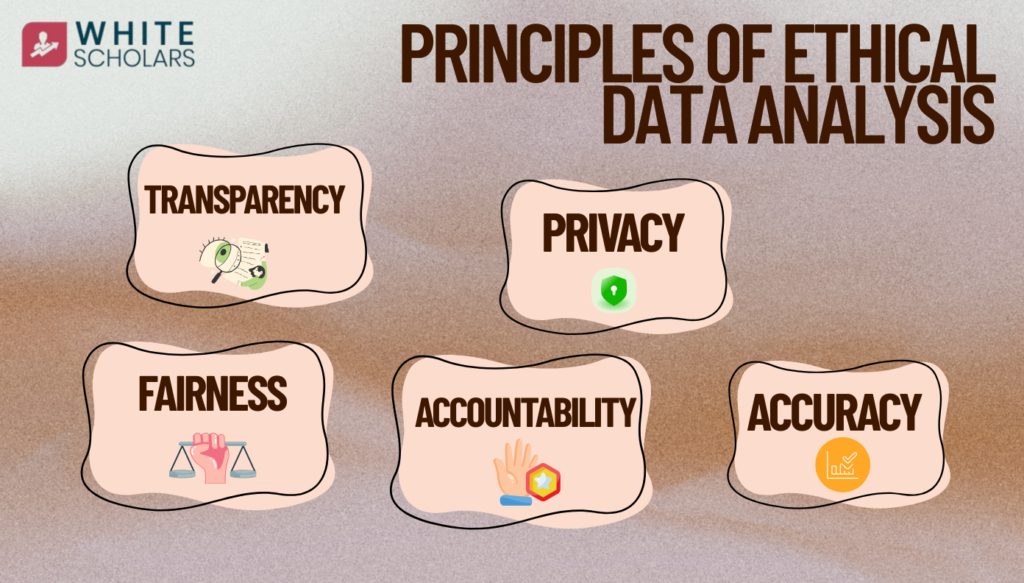
Ethical data analysis has some principles that guide it. These principles assist the analyst in determining what is right and what is potentially risky.
Key Principles of Ethical Data Analysis
- Transparency: Users must be informed about the use of their data.
- Privacy: Sensitive data must be handled carefully.
- Fairness: The model should not discriminate on the basis of gender, race, or income.
- Accountability: The analyst is responsible for the results.
- Accuracy: The results should accurately represent the findings.
For example, predictive models used in recruitment should not discriminate against candidates. Data bias can lead to discrimination.
Data Integrity in Data Analytics
Data integrity refers to the requirement that the data must be accurate, consistent, and reliable. If the data is inaccurate, then the results obtained will be erroneous.
In real-world projects, data analysts perform the following tasks:
- Data Cleaning: Data cleaning is the process of preparing data for analysis by correcting errors and eliminating inconsistencies. The process ensures that the data is accurate, complete, and ready for analysis to obtain reliable results.
- Validation Checks: Validation checks are used to validate the data and ensure that it meets the correct formats, rules, and logical constraints. This task is critical in detecting erroneous data before analysis.
- Removing Duplicates: Duplicate data is referred to as repeated data entries that may be misleading and create confusion. Removing duplicates ensures that the data is counted only once for accurate reporting.
- Handling Missing Values: Missing values are referred to as information that is not recorded in the data. The values are either imputed using the correct method or removed carefully to avoid obtaining misleading results.
- Outlier Detection: Outliers are data points that are very different from the other data points. Analysis of outliers can help identify if the outliers are errors or valuable exceptions.
Technologies such as SQL constraints, Python validation scripts, and Excel audits are used to ensure integrity.
If integrity is not considered, then business decisions will be weak. This is why every data analyst course in hyderabad needs to teach good data validation techniques.
Common Ethical Challenges in Data Analytics
Even experienced professionals are faced with ethical issues.
Some of the common issues faced by professionals are
- Biased data
- Data breaches
- Manipulated KPIs
- Pressure from management to display positive results
- Unauthorized data sharing
For instance, a company may pressure analysts to manipulate reporting data in order to attract investors. Ethical professionals should not give in to such pressure.
How to Avoid Ethical Mistakes
- Document All Data Transformations: All data transformations should be documented. This assists in creating transparency and understanding the final outcome.
- Compare Results with Colleagues: Comparing results with colleagues assists in identifying errors and missed information. This assists in improving accuracy and confidence in the results.
- Compliance with Guidelines: Data analysis should always be conducted in accordance with legal and organizational guidelines. This assists in safeguarding the analyst and the organization from risks.
- Do Not Conceal Negative Results: All results, whether negative or positive, should be communicated with transparency. This assists in creating trust and confidence in decision-making.
- Stay Updated on Privacy Laws: Privacy laws and data policies keep changing. This assists in ensuring that data is handled responsibly and ethically in every project.
High ethical standards assist in safeguarding the analyst and the organization.
Future Trends in Ethics of Data Analytics
As artificial intelligence and machine learning grow, ethical responsibility increases. Automated systems are making decisions about loans, insurance, and recruitment.
Future trends include:
- Explainable AI Models: These models are designed to give a proper explanation of how a certain decision is made. Instead of hiding the process, these models help to understand why a certain prediction or outcome was achieved.
- Strong Data Protection Laws: Governments are implementing strong laws to protect personal data. These laws make sure that organizations are responsible and transparent in handling, storing, and using data.
- Ethical AI Auditing: These audits are conducted on a regular basis to determine if AI systems follow ethical standards. This test examines fairness, transparency, accuracy, and compliance with laws.
- Bias Detection Tools: These tools identify any type of unfair bias or discrimination in datasets and also in algorithms. These tools make sure that the outcome is well-rounded and does not favor or discriminate against any particular group.
- Responsible AI Frameworks: These are systematic guidelines that help to develop and implement AI systems in an ethical way. Such frameworks focus on accountability, fairness, privacy, and overall societal impacts.
Students studying a data analytics course should be aware of these developing needs. The demand for ethical analysts will only continue to grow as more businesses turn to automation.
How Freshers Can Build an Ethical Career
If you are starting on your data analytics journey, here are some areas to concentrate on:
- Learning tools such as SQL, Excel, Python, Power BI, and Tableau
- Understanding statistics and probability
- Learning to report in a transparent manner
- Developing a truthful project portfolio
- Enrolling in a structured data analytics training program
When looking for the best data analytics coaching institute in cities like Hyderabad, Bangalore, Chennai, etc., make sure that the institute teaches not only technical knowledge but also the importance of ethics.
Remember, Companies prefer employees they can trust.
Conclusion
Being ethical in data analytics is not just a secondary topic. It is the cornerstone of ethical decision-making. Data has the power to influence the lives of the people, businesses, and society. This power should be used carefully.
As a beginner, technical skills will open doors for you, but having ethical thinking will give you long-term success. If you are serious about pursuing a career in this field, make sure to learn responsibly, be honest, and develop integrity in every project you handle.
A successful career in data analytics is not just about numbers. It is about trust.
FAQs
1. Why is ethics a consideration in data analytics?
Ethics help in the responsible and fair use of data. Without ethics, decisions may affect people or communities negatively. It also helps in preventing organizations from facing legal issues and reputation damage.
2. What are the ethical considerations in data analytics?
The most important ones are transparency, privacy, fairness, accountability, and accuracy. These help data analysts in using and reporting data responsibly.
3. How can freshers learn ethical data handling?
By pursuing data analytics courses that include privacy laws, data handling, and ethical reporting.
4. What are the tools used in ethical data handling?
The most common ones are SQL, Python, Excel, Power BI, Tableau, and R. These tools help in handling and analyzing data responsibly and accurately.
5. Is ethics a part of a data analyst course in hyderabad?
Yes, because businesses require ethical analysts. Many new institutes in Hyderabad are including ethics in their courses.
