

How Startups are Using AI for Data Analysis to Scale Faster
Discover how startups use AI for data analysis to scale faster and why learning data analytics in Hyderabad can boost your career growth.
Introduction
Have you ever wondered how small startups can become million-dollar companies in a few years? It is not just about funding or marketing. In most cases, it is about how intelligently data is being used.
Nowadays, startups are generating enormous amounts of data from apps, websites, ads, and customer interactions. It is reported that over 80% of fast-growing startups use AI-powered analytics to make faster and smarter decisions. Artificial Intelligence is no longer the domain of big companies. Even startups are using AI to analyze data and understand customers, improve products, and minimize costs.
In this blog, you will learn how startups are using AI tools, what skills are required, which technologies are used, and how freshers can prepare themselves for this rapidly growing industry. If you are planning to take a data analytics course, this blog will help you to understand why the demand is growing so rapidly.
How AI Helps Startups Make Faster Decisions
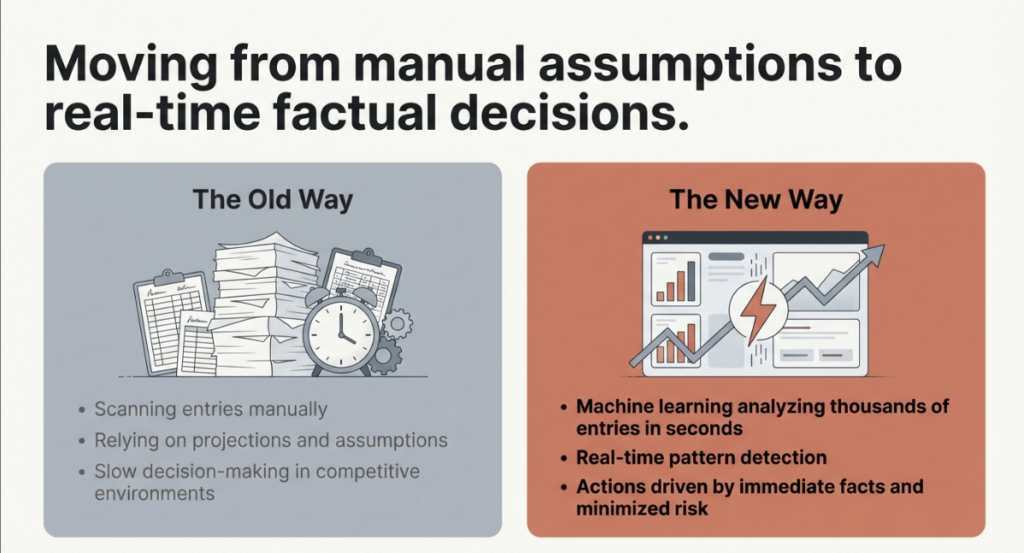
Startups function in highly competitive environments. They cannot afford to make decisions slowly. AI-based data analytics allows the quick and correct detection of patterns. Rather than scanning spreadsheets manually, computers can analyze thousands of entries in seconds.
Take the example of an e-commerce startup. An AI algorithm can analyze customer behavior. Products that are expected to sell better can be detected. Pricing plans can be modified according to purchase patterns. Marketing plans can be optimized by analyzing which advertisements produce better results.
Since decisions are made in real-time, the risk factor is minimized. Business decisions are made according to facts, not projections. This is one of the most significant reasons why AI-based data analytics is becoming a necessity.
Real-Life Example:
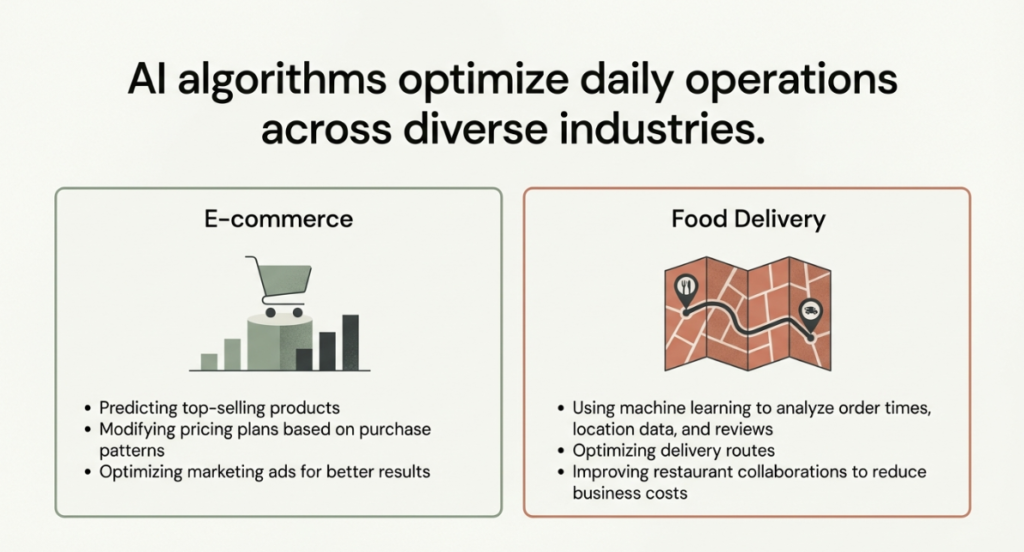
A food delivery startup can analyze order times, location information, and customer reviews through machine learning algorithms. According to this analysis, delivery routes can be optimized and restaurant collaborations can be improved. This leads to increased customer satisfaction and reduced business costs.
Understanding Data Analytics
Data analytics refers to the process of gathering, cleaning, and analyzing data to extract valuable insights. For startups, data analytics helps in understanding customer behavior, sales, and business performance. Rather than making decisions based on assumptions, decisions are made based on facts and figures.
When data is analyzed in the right way, then insights are developed. These insights show what is working and what is not working. By using Excel, SQL, Python, and Power BI, startups are able to track their progress and make the right decisions. Data analytics helps in converting raw data into valuable business insights.
AI in Customer Understanding and Personalization
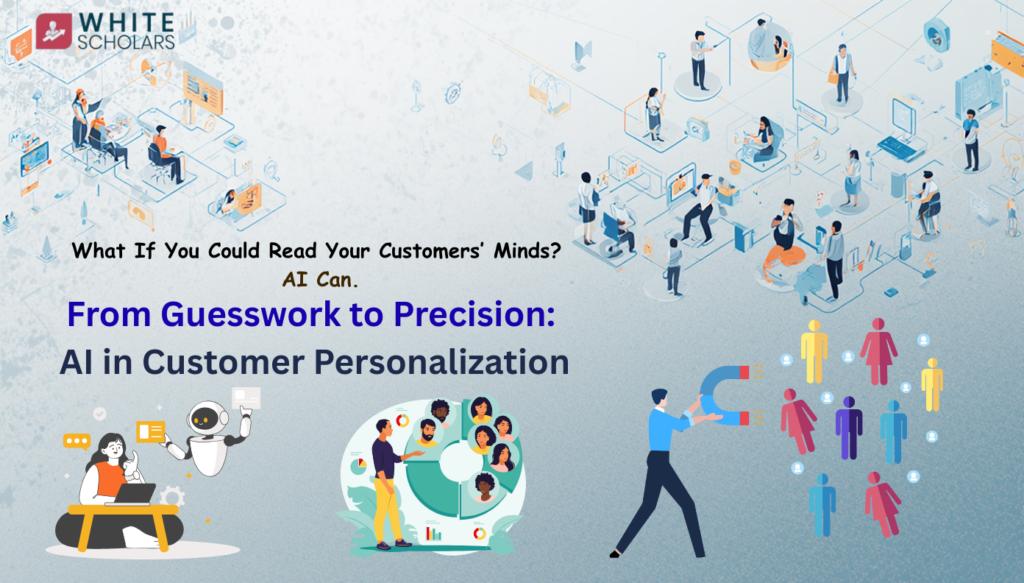
One major advantage startups gain from AI is deep customer understanding. Data collected from websites, mobile apps, and social media platforms is processed using advanced techniques. Patterns in customer preferences are recognized automatically.
Instead of sending the same message to everyone, personalized recommendations are created. For instance, streaming platforms suggest content based on viewing history. Online stores recommend products based on past purchases.
This level of personalization increases engagement and improves retention. When customers feel understood, they are more likely to return. For startups, this directly supports growth and long-term success.
In Hyderabad, where the tech ecosystem is expanding rapidly, many learners are enrolling in data analytics training programs to understand how such systems work. The combination of AI and analytics is opening strong career opportunities.
One of the biggest benefits that startups can receive from AI is customer understanding. Data collected from websites, mobile applications, and social media sites is analyzed with advanced methods. Insights about customer behavior are automatically identified.
Instead of sending the same message to all, personalized messages are designed. For example, streaming services recommend content based on viewing history. Online shopping sites recommend products based on previous purchases.
This level of personalization increases engagement and improves retention. When customers feel understood, they are more likely to come back. For startups, this is directly beneficial for growth and success.
AI Data Analysis Tools That Can Help Startups Scale Faster
The AI tool helps to get faster and smarter analysis of data. Rather than manually analyzing huge amounts of data, machine learning algorithms are capable of automatically analyzing the data. The use of tools such as Python libraries, predictive analytics software, and automated dashboards helps startups to make quick decisions.
The tools have the ability to forecast sales, detect risks, and offer suggestions for improvement. Using AI tools, small teams are able to handle huge amounts of data. This helps startups to grow without having to spend huge amounts of money.
Tools and Methods Used
The following tools and methods are used to provide this level of personalization:
- Python for developing machine learning models
- R programming for statistical analysis
- SQL for managing structured databases
- Power BI and Tableau for data visualization
- Excel for data validation and rapid analysis
- TensorFlow and Scikit-learn for developing AI models
These tools provide the basis for contemporary data analytics coaching institutes.
AI Data Analysis Tools That Can Help Startups Scale Faster
The AI tools make data analysis faster and smarter. Instead of depending on manual data analysis, machine learning algorithms can automatically identify patterns. Software such as Python libraries, predictive analytics software, and automated reporting software allows startups to make fast decisions.
The software can predict sales, identify potential risks, and offer suggestions for improvement. Using AI, a small number of people can efficiently process a massive amount of data. This reduces expenses, minimizes mistakes, and maximizes productivity, allowing startups to expand without significantly increasing costs.
Operational Efficiency Through AI Automation
Startups often work with limited resources. Manual processes can slow growth. AI-based data analysis automates repetitive tasks and improves efficiency.
For example, chatbots use Natural Language Processing (NLP) to answer customer queries instantly. Fraud detection systems monitor unusual transactions automatically. Inventory management systems predict demand using time-series forecasting techniques.
This automation allows teams to focus on strategy rather than routine work. Costs are controlled while performance improves.
From a learner’s perspective, understanding these technologies is highly valuable. A data analyst course in Hyderabad usually covers essential skills such as data cleaning, regression analysis, predictive modeling, and dashboard creation. These skills are directly applied in startup environments.
Startups operate with limited budgets. Manual analysis can slow down the growth. AI-assisted data analysis automates repetitive activities and maximizes efficiency.
Consider the following example: Chatbots rely on Natural Language Processing (NLP) to respond to customer inquiries immediately. Fraud detection systems automatically track suspicious transactions. Inventory management systems predict demand using time-series forecasting algorithms.
This allows teams to concentrate on planning, not manual tasks. Expenses are managed, and performance is enhanced.
From the learner’s point of view, knowledge of these technologies is extremely useful. A data analyst training program in tech hub cities like Hyderabad, Bangalore, and Mumbai, etc., typically provides learners with basic knowledge in areas such as data preprocessing, regression analysis, predictive modeling, and dashboard development. This knowledge is directly applicable in a startup environment.
Skills Required for Freshers
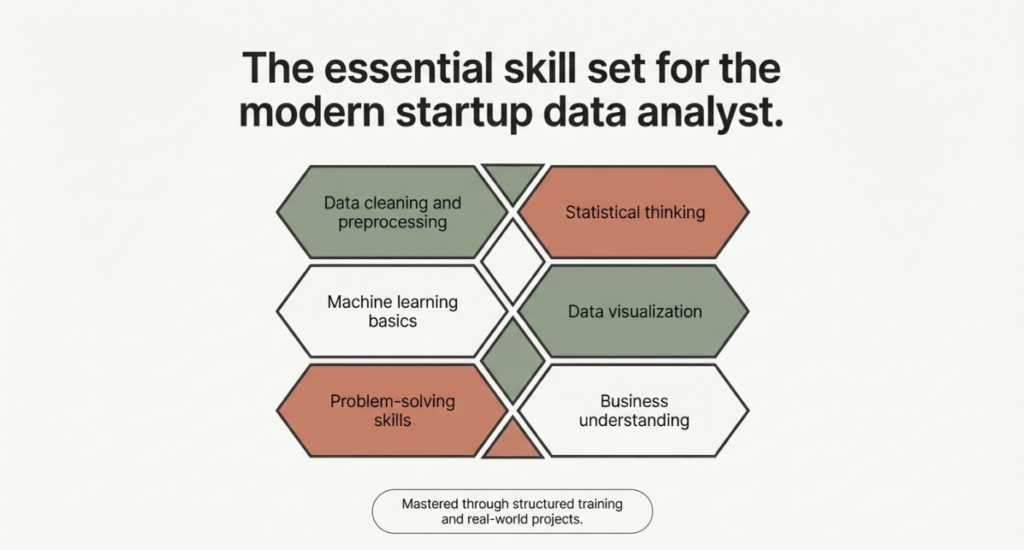
For using AI in data analysis, the following skills are needed:
- Data cleaning and preprocessing
- Statistical thinking
- Machine learning basics
- Data visualization
- Problem-solving skills
- Business understanding
These skills are learned through structured data analytics training programs combined with real-world projects.
Scale to New Heights with AI Tools for Startup Data Analysis
Scaling a startup requires effective planning, not just hard work. AI tools help entrepreneurs in understanding future possibilities. With the help of predictive analytics and data visualization software, growth trends can be observed on a real-time basis.
AI tools can identify high-selling products, profitable regions, and marketing channels that offer higher returns. With continuous monitoring and automated analysis, startups can easily shift their strategies. This leads to rapid growth, more revenue, and ultimate success.
How Freshers Can Prepare for AI-Driven Analytics Careers
The requirement for AI analytics professionals is rising steadily. Reports show that analytics-related jobs are among the most popular emerging jobs in the world.
If you are a fresher, it is important to have some practical skills. Pursuing a data analytics course and Learning about SQL, Python, Power BI, Excel, and machine learning can give you confidence to work in any startup.
The tech environment in Hyderabad is growing rapidly. Startups and IT companies are looking for talented analysts. Having a strong background in data analytics and knowledge about AI can be very helpful in getting a job.
Bonus Tips for Career Growth
- Work on real-world projects
- Create a portfolio on GitHub
- Take part in hackathons
- Learn to explain insights effectively
- Keep yourself updated with AI trends
It is important to keep learning continuously in order to grow in this area.
The Role of Data Integrity and Ethical AI.
While Startups focus more on speed, they should also focus on achieving the appropriate data. AI systems should be developed in a way that prevents biased decisions. Data privacy laws should be followed strictly.
Data accuracy for collection, storage, and reporting is important. Inaccurate data can cause incorrect insights, further causing startups to make wrong business decisions.
Startups that maintain ethics can develop better trust with their customers. Freshers in this industry should educate themselves on compliance, data governance, and responsible AI frameworks.
Challenges and Considerations
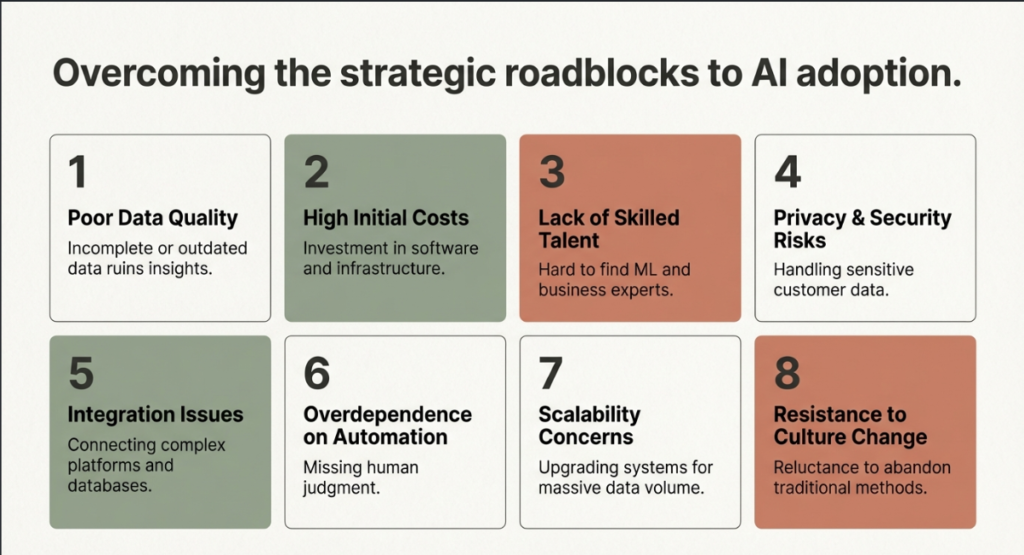
- Poor Data Quality
Incomplete, incorrect, or outdated data can make the startups to take wrong decisions. Clean and accurate data is essential before applying any analysis.
- High Initial Costs
Implementing AI tools and analytics platforms may require investment in software, infrastructure, and skilled professionals.
- Lack of Skilled Talent
Finding experts who get data analytics while also understanding machine learning alongside business strategy can be a challenging factor for any new company.
- Data Privacy and Security Risks
Handling customer data involves high security systems and data privacy laws.
- Integration Issues
Connecting different tools, databases, and platforms may involve technical complexities and time-consuming processes.
- Overdependence on Automation
Depending only on AI without human judgment can sometimes result in incorrect insights.
- Scalability Concerns
With the increase in the volume of data, there is a requirement to upgrade the system to efficiently handle the increased volume of data.
- Resistance to Data-Driven Culture
Organizations may resist adopting a data-driven culture and may not agree to change their traditional approach to decision-making.
Conclusion
Startups are scaling faster than ever because decisions are being guided by AI-powered data analysis. From customer personalization to operational efficiency, intelligent systems are transforming how businesses grow. For freshers, this creates a powerful career opportunity.
By learning essential tools, understanding data integrity, and practicing real-world projects, a strong career path can be built. If you are serious about entering this field, structured data analytics training can help you gain the required skills and confidence. The future belongs to professionals who can turn data into meaningful decisions.
Startups are growing very fast in a way that has never been seen before because the data analysis to make decisions is now done using AI. Whether it is personalization or efficiency, AI is changing the way businesses scale. For freshers, this is an incredible opportunity.
To build a great career, you need to learn the necessary tools and understand data integrity. With practice projects, you can build a great career. If you are serious about pursuing a career in this domain, you can enroll for data analytics training to acquire the necessary skills and confidence. Remember, this future is for those who can convert data into valuable decisions.
FAQ’s
1. How does AI assist in faster growth for startups?
AI assists startups in quickly analyzing a massive amount of data. It helps in recognizing patterns and trends, which in turn leads to better decision-making.
2. What are the skills required for AI-based data analytics?
Skills in SQL, Python, statistics, and data visualization are required. Problem-solving skills and knowledge of business concepts are also required.
3. Is data analytics a promising field for freshers?
Yes, it has high job demand and good growth opportunities in terms of salary. Freshers can confidently pursue this field with proper training and practice.
4. Why is Hyderabad gaining popularity for learning data analytics?
Hyderabad has a well-developed IT infrastructure and a rising number of startups. Many institutions offer well-structured data analytics coaching institute programs with hands-on experience.
5. What are the tools used in AI-based data analysis?
Common tools used in AI-based data analysis are Python, R, SQL, Power BI, Tableau, Excel, TensorFlow, and machine learning libraries.
