

From Sales Executive to Digital Marketing: Is It Possible?

We will explore whether a sales executive can successfully transition to digital marketing and what skills and growth opportunities are needed.
Can a sales executive become a digital marketer?
Absolutely! Transitioning from a sales executive to a digital marketer is not only possible but also a natural progression for many. The skills they have learned in sales, such as understanding customer needs, effective communication, and persuasive techniques, are incredibly valuable in the digital marketing realm.
As we approach 2026, it’s important to recognise that the landscape of digital marketing has evolved significantly. It’s no longer just about creating posts on social media platforms. Instead, the role has transformed into a multifaceted position that encompasses various disciplines, including content creation, data analysis, SEO, and digital advertising.
To thrive in this environment, sales executives will need a clear and structured plan to develop the necessary skills and knowledge. To help sales executives navigate this transition, here’s a detailed guide on how to move from being a sales executive to becoming a digital marketing leader by 2026. This guide will be organised into key focus areas that will provide sales professionals with a roadmap for their journey.
By understanding these areas and actively working on them, sales executives can build a strong foundation in digital marketing that leverages their existing sales expertise while also expanding their skill set to meet the demands of this dynamic field.
1. Understanding the Broad Landscape of 2026
In the past, people often used the term ‘digital marketing’ as a catch-all phrase that was so general it became almost meaningless. To succeed in 2026, sales executives must stop thinking of digital marketing as a single task.
It is like being a general contractor in construction. Just as a contractor needs to understand plumbing, roofing, and electrical work, a digital marketer must understand several different disciplines or techniques to be effective.
In the role of a sales executive, the hustle of closing deals is familiar. In digital marketing, this hustle shifts toward managing a variety of technical and creative channels to bring leads to the business automatically. The first step is to realise that it’s not just about posting content; it’s about building a digital ecosystem.
2. Building a Technical Foundation: The Digital Hub
In 2026, the website remains the “Hub” of all branded content and digital marketing efforts. A sales executive transitioning to this role must develop a deep technical understanding of how this hub works.
What to focus on:
- UX and UI Design: Sales executives don’t need to be coders, but they must understand UX (User Experience) strategy and UI (User Interface) design. This means understanding how a user moves through a website. In sales, they know the path to a yes. In digital marketing, that path is the user interface.
- Web Development Basics: Sales professionals should understand the technical side of how websites are built and maintained so they can speak the language of developers.
- Ancillary Software: Sales executives must become proficient in tools like email service providers (for example, Mailchimp or HubSpot). These tools allow them to automate the “follow-up” process that they currently do manually in sales.
3. Mastering Modern Search and Social Platforms
By 2026, the way people find information has become highly fragmented. A digital marketer must understand the various platforms and the specific types of content they require.
Search Engine Strategies: Sales executives must master the two primary forms of search marketing:
- SEO (Search Engine Optimisation): This is about optimising a brand’s web presence so it is found “organically” (for free) when someone searches for a product or service.
SEM (Search Engine Marketing): This involves paid campaigns and ad management. For sales executives, SEM is familiar because it involves “buying” the attention of potential customers, much like traditional lead generation. Social Media Diversity: Every platform cannot be treated the same.
A deep understanding of Facebook, Instagram, TikTok, YouTube, and LinkedIn is essential. Each has different types of content and, more importantly, different types of audiences. In 2026, sales executives must know which “room” their customers are hanging out in and how to talk to them there.
4. Leveraging Business Skills: Thinking Like an Owner
One of the biggest advantages a sales executive has is business acumen. Many digital marketers focus only on the “creative” side, but a truly elite digital marketer thinks like a business owner.
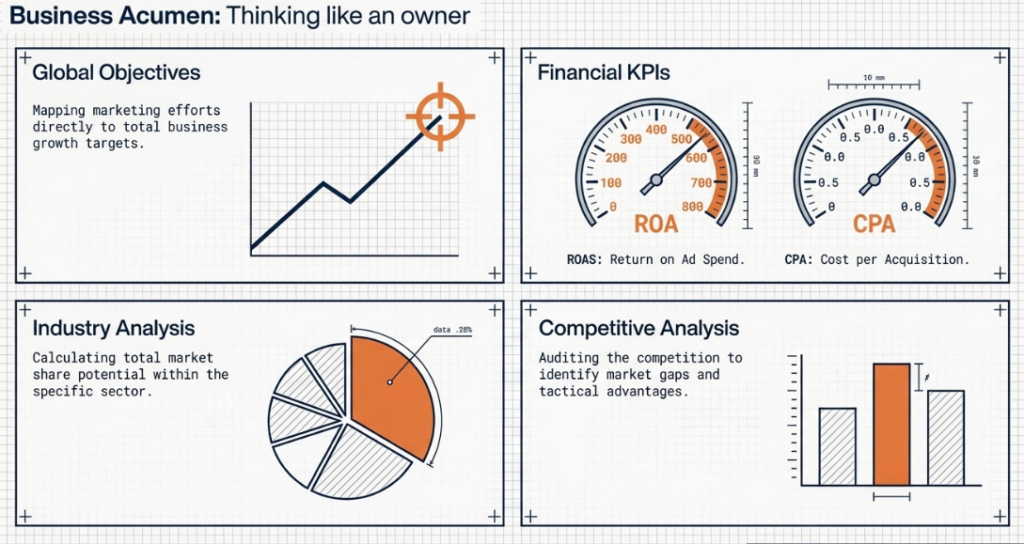
Key areas of focus for 2026:
- Global Business Objectives: Align every marketing campaign with what the business is actually trying to accomplish.
- KPIs (Key Performance Indicators): Define what success looks like. These are the “measures of success” for efforts.
- Financial Metrics: Become comfortable with terms like ‘ROAS’ (Return on Ad Spend) and ‘Cost per Acquisition’. In sales, the focus is on commission; in digital marketing, the focus is on the profit the business makes for every dollar spent on ads.
- Industry and Competitive Analysis: Analyse the market, determine the “market share potential”, and perform a “competitive analysis” to see what the competition is doing.
To focus on these objectives and understand how digital marketing works in the real world, enrol in the best digital marketing course in Hyderabad powered by AI from WhiteScholars.
5. Developing Brand Voice and Messaging
In sales, personal voice is used to persuade. In digital marketing, a brand voice must be developed. This is where the transition from individual selling to “mass selling” through content occurs.
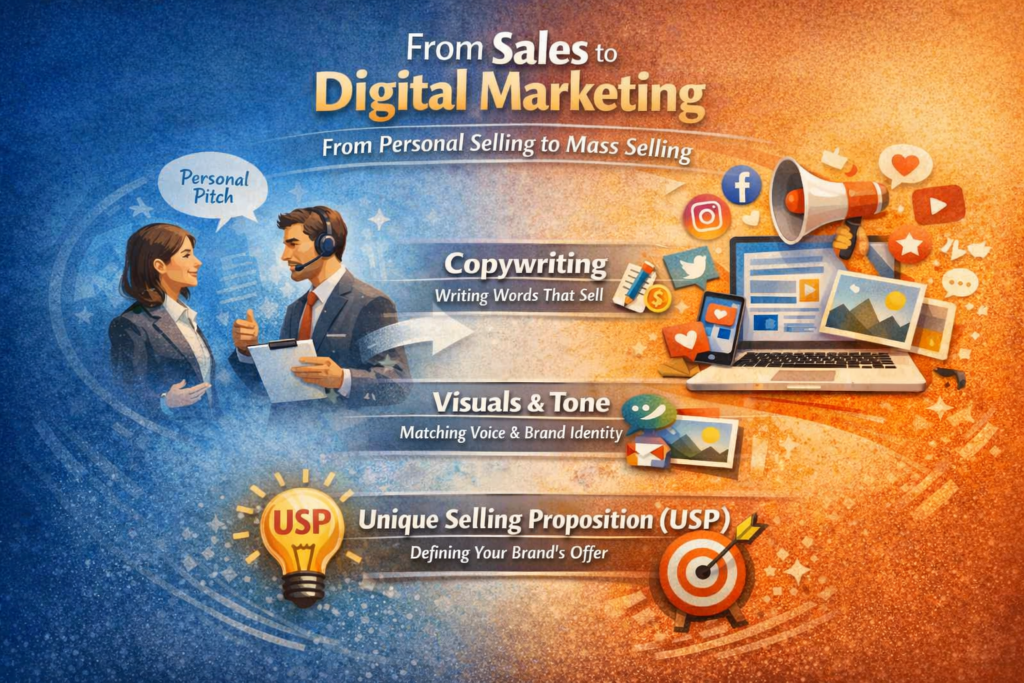
- What to focus on: Copywriting: Learning to write words that sell (copy) is essential.
- Visuals and Tone: It is crucial to ensure that the “voice” and “tone” of the messaging match the brand’s identity.
- Unique Selling Proposition (USP): The brand’s “angle” or “offer” must be identified and communicated clearly to the audience.
As a sales executive, the reasons why the product is better than the rest are already known; now it is necessary to learn to communicate that through digital media instead of a phone call.
6. Planning the Strategy
The most important step for a sales executive is moving from “doing tasks” to “creating a strategy”. A digital marketer takes the technical tools, the business goals, and the brand messaging and combines them into one plan.
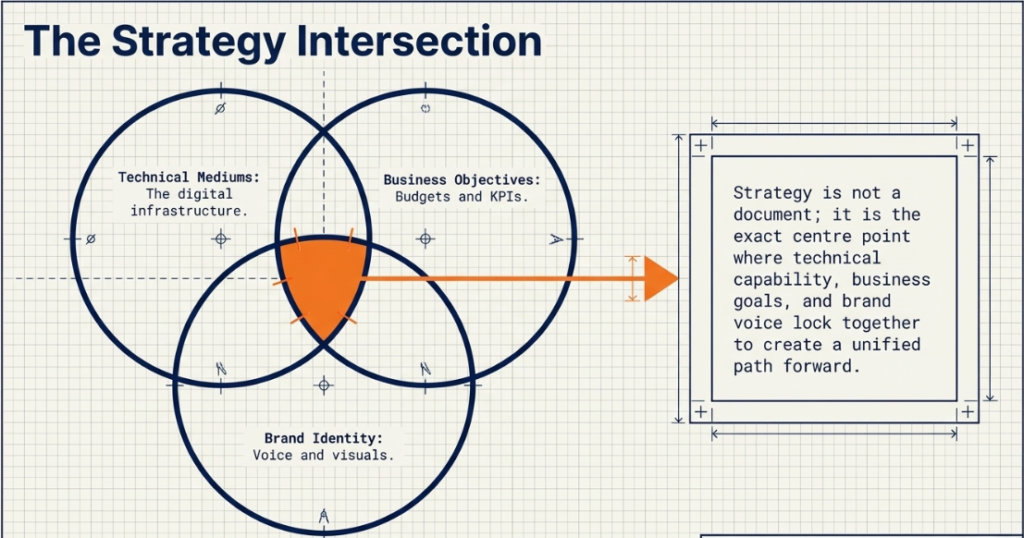
In 2026, a successful strategy must be simple. Sales executives need to write a plan that the business owner can understand and agree to. This strategy defines where the “goalposts” are so that everyone knows when a campaign has won.
Without a strategy, sales executives are just “doing digital marketing” in a separate environment, which rarely leads to success.
7. Leading the “Toolbox” (Leadership)
As sales executives transition, they may feel tempted to handle every task on their own. However, it’s important to avoid being a multi-tool.
While a multi-tool can perform many functions, it does them all inadequately; instead, strive to be the leader of a toolbox. A toolbox consists of specialised tools (people) who excel at one specific task.
Sales executives’ role as a leader in 2026:
- Sales executives will likely oversee a team of specialists, such as graphic designers, videographers, photographers, and content writers.
- Even if they are a “one-person show” initially, they must eventually transition into a digital marketing director role. Their job is to oversee the “creative fulfilment” and ensure the strategy is being executed correctly by the specialists.
Sales-Digital Marketer Hybrid in 2026
Transitioning from a sales executive to a digital marketer by the year 2026 requires a significant evolution from being merely a “closer” to becoming a strategist and a leader in the digital marketing landscape.
This transformation involves a deep focus on acquiring technical knowledge related to websites and software, developing strong business acumen that includes understanding key performance indicators (KPIs) and return on ad spend (ROAS), and crafting effective brand messaging that encompasses both copy and visuals.
By integrating these elements, a cohesive and effective marketing strategy can be established. Moreover, it is essential to lead a team of specialists instead of attempting to manage every task individually, which often leads to subpar results.
Embracing the role of a leader means recognising the value of a diverse team where each member excels in their specific area of expertise. This approach embodies the concept of the “ideal digital marketing avatar”.
The journey of transitioning into a digital marketing role not only leverages existing knowledge about customer desires but also enables the application of this understanding on a much larger scale, utilising the advanced digital tools that are emerging in the future. This strategic shift is crucial for achieving success in the evolving landscape of digital marketing.
Final Thoughts
Transitioning from sales to digital marketing in 2026 means moving beyond just posting on social media. Becoming a strategist who connects technical tools, business goals, and brand voice into one clear plan is essential.
Instead of trying to do every task alone, leading a “toolbox” of specialists is crucial. Mastering KPIs and ROAS aligns marketing with the business owner’s objectives. Ultimately, a successful digital marketer is a leader who uses data and creativity to drive real business growth.
Five Most Asked Questions
1. What is the most important skill for a digital marketer?
While technical skills are vital, the most important trait is business acumen, which means thinking like a business owner. They must understand how to measure success through KPIs and return on ad spend (ROAS).
2. Should I try to learn how to do every marketing task myself?
No, you should avoid being a multitasker that does many things poorly. Instead, act as a leader who manages a “toolbox” of specialists like graphic designers and videographers to execute the strategy. Start learning with the best digital marketing course powered by AI in Hyderabad.
3. What role does a website play in a digital marketing strategy?
The website is the hub for all branded content and marketing efforts. It requires a technical understanding of UX design, UI strategy, and web development to be effective.
4. What is the difference between SEO and SEM?
SEO (Search Engine Optimisation) focuses on optimising your web presence to be found organically (for free). SEM (Search Engine Marketing) involves paid campaigns and ad management to reach customers.
5. How do I know if my digital marketing is actually working?
Tracking Key Performance Indicators (KPIs) is essential, as they measure success. These metrics ensure global objectives are met and budgets are maintained.