

Should digital marketers learn to code for better career outcomes?
Let’s delve deeper into the significance of coding within the realm of digital marketing as we look ahead to the evolving landscape of 2026.
Introduction
In the rapidly evolving landscape of the digital world, a question frequently haunts aspiring marketers: Do I need to learn how to code? With the rise of complex algorithms, technical SEO, and data-heavy strategies, it is easy to assume that learners need a degree in computer science just to run a successful Facebook ad or rank a website.
This blog post explores the intersection of programming and marketing, breaking down exactly where coding helps, where it is irrelevant, and how learners can succeed regardless of their technical background.
1. The Verdict: Is Coding Compulsory?
To put it simply, the answer is no; it is not necessary or compulsory for learners to learn programming languages to become a successful digital marketer. If learners do not come from an IT or computer science background, learners should not feel discouraged. Lack of coding knowledge will not create a hurdle for learners’ entry into the field.
Digital marketing is a vast field that relies more on strategy, creativity, and understanding consumer behaviour than on writing lines of code. However, while it is not a requirement, it is important to acknowledge that having these skills can provide learners with an “upper hand” in certain technical scenarios.
2. Why Coding Knowledge Provides an “Upper Hand”
While learners can start their careers without it, as learners work on real-world projects and manage complex websites, they will naturally encounter technical elements. Understanding the “behind-the-scenes” of a website allows you to see the digital world through a different lens.
If learners understand the structure of a website, how it is built and how different elements interact, they gain a competitive edge. This knowledge allows you to:
- Understand the limitations and possibilities of web design.
- Identify technical errors that others might miss.
- Make more informed requests when working with technical teams.
3. Technical SEO: The Bridge Between Marketing and Code
Search Engine Optimisation (SEO) is perhaps the area where coding knowledge is most relevant. Specifically, technical SEO deals directly with the website’s structure and how search engines crawl it.
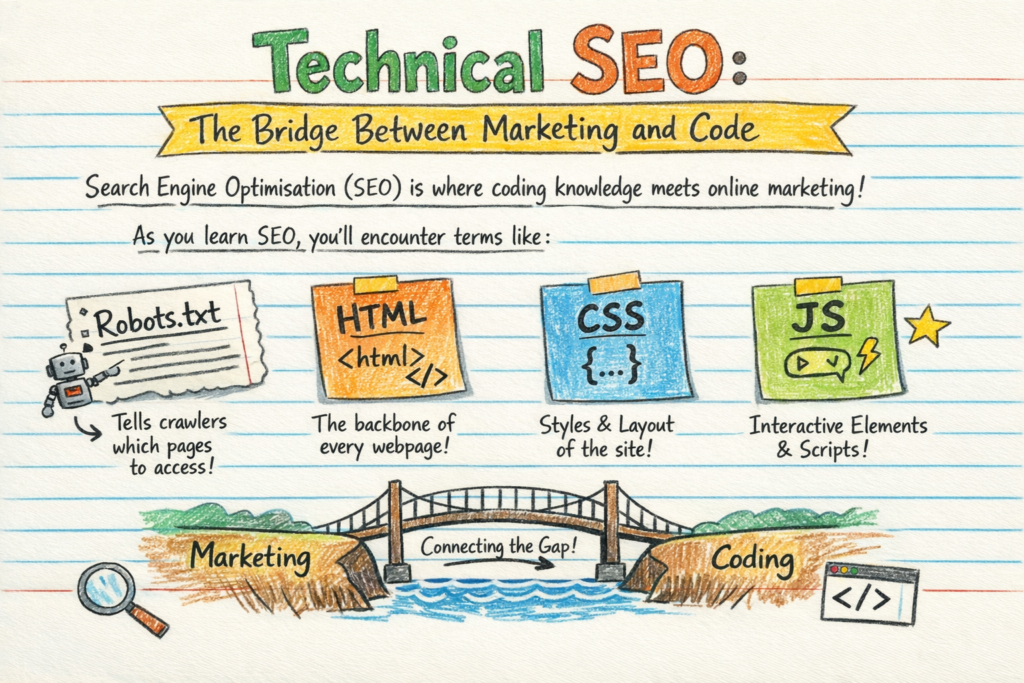
As learners progress in SEO, they will encounter terms like the following:
- Robots.txt: A file that tells search engine crawlers which pages to access.
- HTML (HyperText Markup Language): The backbone of every webpage.
- CSS (Cascading Style Sheets): The language used for styling and layout.
- JS (JavaScript): Used for creating interactive elements.
While you don’t need to be an expert developer, understanding these terms helps you understand how a website communicates with Google and other search engines.
4. Bridging the Communication Gap with Developers
One of the most significant advantages of knowing even basic code is the ability to communicate effectively with web developers.
In a professional setting, a digital marketer often needs to request changes to a client’s website for optimisation purposes. I
If you do not understand the developer’s language, a communication barrier can arise. You might ask for something that is technically impossible or takes an immense amount of time, while the developer might use jargon that leaves you confused.
Knowing how a website works allows you to:
- Speak the developer’s language, ensuring your instructions are clear.
- Understand why certain changes might take longer than others.
- Build a better professional relationship with the technical team.
5. Saving Time and Increasing Efficiency
In the fast-paced world of digital marketing, time is money. If you rely on a developer for every tiny change, such as updating a meta tag, changing a button colour, or fixing a broken link, your projects can get bogged down in delays.
If you possess a basic knowledge of website editing, you can handle these essential changes yourself. This DIY approach:
- Eliminates the wait time for a developer to become available.
- Allows for rapid A/B testing of different landing page elements.
- Gives you more control over the immediate execution of your SEO strategy.
6. The WordPress Exception: Marketing Without Code
If the thought of learning HTML or CSS still feels overwhelming, there are powerful alternatives. Platforms like WordPress have revolutionised the industry.
WordPress is a content management system (CMS) that allows you to:
- Create and edit websites through a visual interface.
- Perform comprehensive SEO tasks using plugins and built-in tools.
- Manage a professional digital presence without any knowledge of coding.
For many digital marketers, mastering a platform like WordPress is a more practical and efficient use of time than learning a programming language from scratch.
7. Roles Where Coding is Entirely Unnecessary
It is important to remember that digital marketing is not just SEO. Many high-paying, high-impact roles have almost zero reliance on coding.
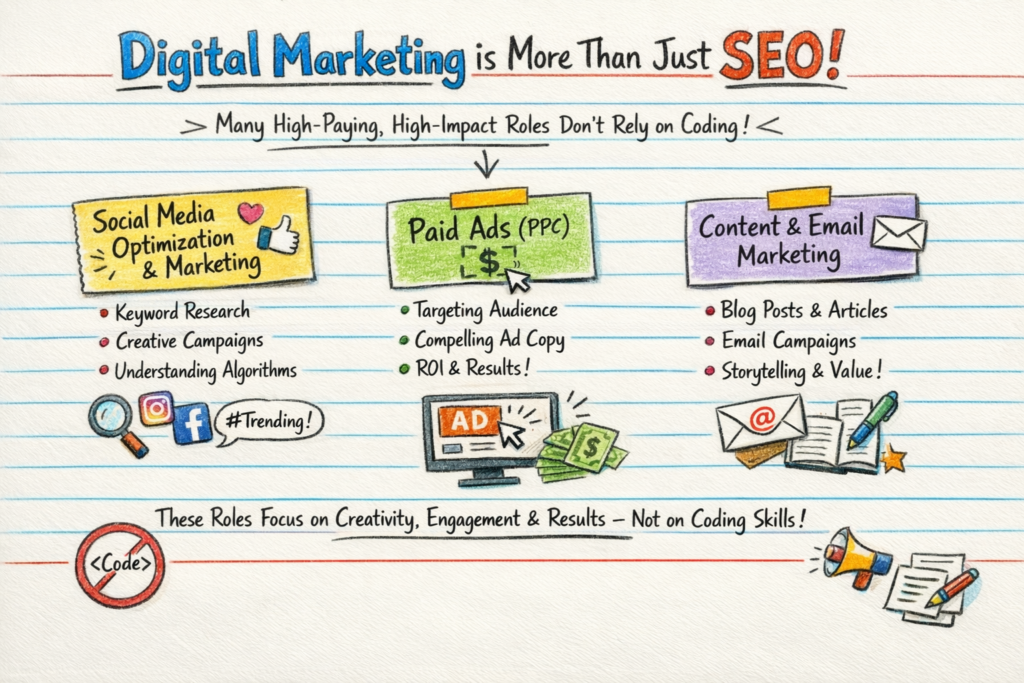
Social Media Optimization (SMO) and Marketing
Optimising platforms like Instagram or Facebook does not require knowledge of their construction. Success depends on:
- Keyword research to reach the right audience.
- Creative campaign design that captures attention.
- Understanding platform algorithms and user engagement.
Paid Advertisements (PPC)
Running paid ads focuses on investment and results. Learners need to know how to target the right demographics and write compelling ad copy, but they do not need to understand the “backend” code of the advertising platform.
Content and Email Marketing
In fields like content marketing, blogging, email marketing, and affiliate marketing, coding offers almost no necessity or advantage. These roles are driven by storytelling, persuasion, and value delivery rather than technical infrastructure.
8. The Role of Data Analytics
Modern digital marketing is increasingly leaning toward data analytics. While not strictly “coding” in the web development sense, learning basic SQL (for database queries) or Python (for data automation) is becoming a popular “plus” for senior marketing roles.
These skills allow marketers to handle massive datasets that standard tools like Excel might struggle with. However, like web development, these are specialised skills rather than entry-level requirements.
Most marketers will find that tools like Google Analytics provide all the data they need without requiring a single line of code.
9. Automation and “No-Code” Tools (External Information)
We are currently in the era of the ‘no-code’ movement. Beyond WordPress, there are hundreds of tools (like Zapier, Bubble, or Webflow) that allow marketers to build complex automations and web apps using visual “drag-and-drop” builders.
For a modern marketer, being “tech-savvy” (knowing which tools to use and how to connect them) is often much more valuable than being a “coder” (knowing how to write the software from scratch).
10. How to Start Your Journey
If just starting, do not let the fear of technology stop anyone. The best way to learn is by doing.
- Work on real projects: You will naturally pick up technical terms as you encounter them.
- Focus on core marketing skills: Master keyword research, campaign strategy, and content creation first.
- Learn the basics of HTML/ CSS: You don’t need to be a pro, but knowing what a <h1> tag or a <a> link looks like will help you immensely in SEO.
- Use CMS platforms: Get comfortable with WordPress to bypass the need for deep coding knowledge.
Start your journey with the best digital marketing course in Hyderabad powered by AI from WhiteScholars.
Conclusion
Is coding necessary for digital marketing? No. Is it helpful? Yes, primarily in SEO and developer collaboration.
If you are passionate about social media, content, or paid ads, you can have a long and successful career without ever touching a line of code. The most important thing is to work hard, learn the essential marketing skills, and stay curious. Don’t let a lack of programming knowledge stop you from becoming the digital marketer you want to be.
Frequently Asked Questions
1. Is coding a compulsory requirement to become a digital marketer?
No, it is not compulsory or necessary to learn programming languages to enter the field, and a lack of technical background will not be a hurdle for your success. While it is not a requirement, having these skills can provide you with an “upper hand” when working on real-world projects.
2. Which specific areas of digital marketing benefit the most from coding knowledge?
Coding is most relevant in technical SEO, where understanding the structure of a website, including HTML, CSS, and JS, helps you optimise how search engines crawl pages. It is also useful for making quick, essential edits to a site without needing to wait for a developer’s assistance.
3. Can I perform SEO and manage a website if I don’t want to learn to code?
Yes, platforms like WordPress are a major exception, allowing you to create, edit, and perform full SEO tasks through a user-friendly system without any coding knowledge. This makes it possible to maintain a professional digital presence strictly through “no-code” platforms.
4. Do social media marketing and paid advertising roles require any programming?
No, roles in Social Media Optimisation (SMO) and paid ads focus on keyword research and campaign strategy rather than the technical backend of the platforms. In these areas, as well as in content and email marketing, coding offers almost no necessity or professional advantage.
5. How does knowing basic code improve a marketer’s efficiency?
It allows you to communicate more effectively with web developers by speaking their language and understanding technical limitations. Furthermore, it saves significant time because you can handle minor website optimisations and changes yourself instead of waiting for a technical team to become available.
