
Top 9 Python Libraries for Data Science, AI and ML
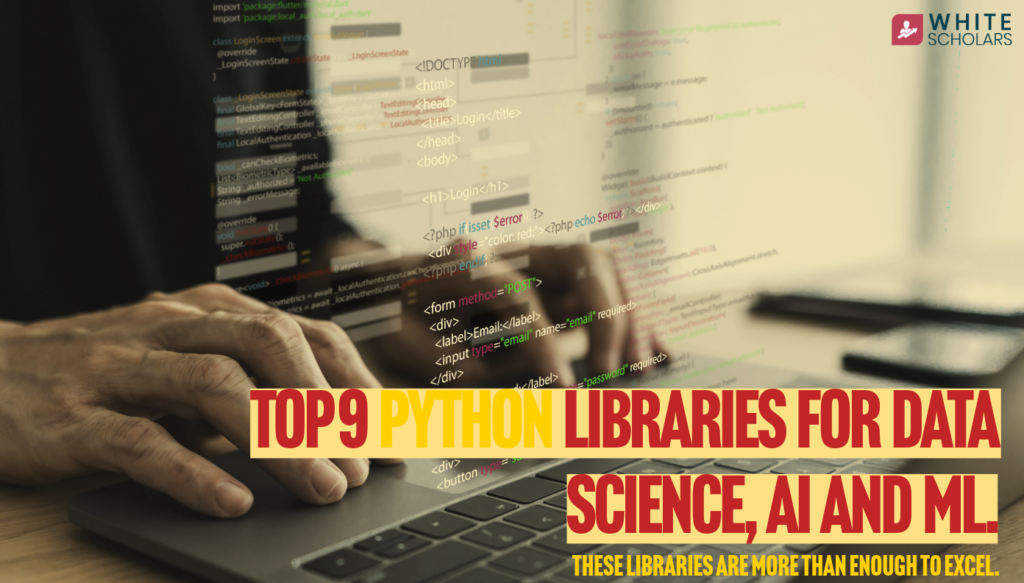
Table of Contents
Let’s break them down in a practical order. Starting with the foundations, then into AI and concluding with machine learning.
Introduction
Python dominates AI and machine learning for one simple reason: its ecosystem is amazing. Most projects are built on a small set of libraries that handle everything from data loading to deep learning at scale. Knowing these libraries makes the entire development process fast and easy.
Core Data Science Libraries
These are non-negotiable. Every beginner who touches data, they use these. Your fundamentals in AI/ML are dependent on familiarity with these.
1. NumPy – Numerical Python
This is where everything actually begins. If Python is the language, NumPy is the math brain behind it. Due to which they have implicit type checking when an operation is performed on them. Numpy lists are homogeneous! and allowing faster operations.
Used for:
- Vectorized math
- Linear algebra
- Random sampling
Almost every serious ML or DL library quietly depends on NumPy doing fast array math in the background.
Install using : pip install numpy
2. Pandas – Panel Data
Pandas is what turns messy data into something you can reason about. It feels like Excel on steroids, but with actual logic and reproducibility instead of silent human errors. Pandas especially shines when it is used for processing huge datasets.
Used for:
- Data cleaning
- Feature engineering
- Aggregations and joins
It allows for efficient manipulation, cleaning, and analysis of structured, tabular, or time-series data.
Install using: pip install pandas
3. SciPy – Scientific Python
SciPy is for when NumPy alone isn’t enough. It gives you the heavy scientific tools that show up in real problems, from optimization to signal processing and statistical modeling.
Used for:
- Optimization
- Statistics
- Signal processing
Ideal for those looking to get scientific and mathematical functions in one place.
Install using: pip install
Machine Learning Libraries
This is where models start happening.
4. Scikit-learn – Scientific Kit for Learning
Scikit-learn is the library that teaches you what machine learning actually is. Clean APIs, tons of algorithms, and just enough abstraction to learn without hiding how things work.
Used for:
- Classification
- Regression
- Clustering
- Model evaluation
For ML learners who want seamless integration with the Python data science stack, Scikit-learn is the go-to choice.
Install using: pip install scikit-learn
5. XGBoost – Extreme Gradient Boosting
XGBoost is the reason neural networks don’t automatically win on tabular data. It’s brutally effective, optimized, and still one of the strongest baselines in real-world ML.
Used for:
- Tabular data processing
- Structured prediction
- Feature importance recognition
For model trainers who want exceptional speed and built-in regularization to prevent overfitting.
Install using: pip install xgboost
6. CatBoost – Categorical Boosting
CatBoost is what you reach for when categorical data becomes a pain. It handles categories intelligently out of the box, so you spend less time encoding and more time modeling.
Used for:
- Categorical-heavy datasets
- Minimal feature engineering
- Strong baseline models
Install using: pip install cat boost
Artificial Intelligence Libraries
This is where neural networks live. The fundamentals of data science would build on these.
7. TensorFlow – Tensor Flow
Google’s end-to-end deep learning platform. TensorFlow is built for when your model needs to leave your laptop and survive in the real world. It’s opinionated, structured, and designed for deploying models at serious scale.
Used for:
- Neural networks
- Distributed training
- Model deployment
For those looking for a robust ecosystem on artificial intelligence and machine learning.
Install using: pip install tensorflow
8. PyTorch – Python Torch
Meta’s research-first framework. PyTorch feels more like writing normal Python that just happens to train neural networks. That’s why researchers love it: fewer abstractions, more control, and way less fighting the framework.
Used for:
- Research prototyping
- Custom architectures
- Experimentation
Perfect for those looking to ease their way into AI.
Install using: pip install torch
9. OpenCV – Open Source Computer Vision
OpenCV is how machines start seeing the world. It handles all the gritty details of images and videos so you can focus on higher-level vision problems instead of pixel math.
Used for:
- Face detection
- Object tracking
- Image processing pipelines
The one-stop for image processing enthusiasts who are looking to integrate it with machine learning.
Install using: pip install cv2
Learn These Libraries with WhiteScholars
Ready to master Python’s AI/ML ecosystem through structured courses and hands-on projects? WhiteScholars offers beginner-friendly training tailored for aspiring data scientists, it is the best Data Science institute in Hyderabad, their course covers NumPy to PyTorch with real-world datasets, portfolio-building assignments, and career guidance to kickstart your journey in AI and full stack development.
FAQ’s
What is NumPy used for, and why is it foundational for AI/ML?
NumPy handles vectorized math, linear algebra, and random sampling with homogeneous arrays that enable fast operations via implicit type checking. Almost every ML/DL library relies on it for efficient array math in the background.
How does Pandas simplify data handling?
Pandas excels at data cleaning, feature engineering, aggregations, and joins, turning messy datasets into analyzable structures like Excel but with reproducibility. It shines for processing huge tabular or time-series data efficiently.
When should you use SciPy over NumPy?
SciPy builds on NumPy for advanced scientific tasks like optimization, statistics, and signal processing. It’s ideal when you need heavy mathematical functions consolidated in one place.
What makes Scikit-learn great for ML beginners?
Scikit-learn provides clean APIs for classification, regression, clustering, and model evaluation, teaching core ML concepts without excessive abstraction. It integrates seamlessly with the Python data science stack.
Which libraries are best for neural networks and deployment?
TensorFlow suits production-scale neural networks, distributed training, and deployment, while PyTorch favors research prototyping and custom architectures with Python-like flexibility. Both power deep learning, with OpenCV adding image processing for computer vision tasks like face detection.
