

Essential Skills That Recruiters Seek in Aspiring Digital Marketers
Recruiters seek digital marketers with SEO, content, analytics, creativity, communication skills, and a strong willingness to learn and adapt quickly.
The 2026 Digital Marketer’s Blueprint: Results Over Resumes
The landscape of digital marketing has undergone a massive transformation over the past decade, with companies across all industries investing heavily in their online presence to boost visibility, generate leads, and drive sales.
Simply learning digital marketing tools is no longer sufficient to secure a position in this competitive field. While thousands of candidates apply for roles annually, recruiters remain highly selective, shortlisting only a small percentage who can demonstrate an ability to solve business problems and generate measurable results.
The High Stakes of Modern Recruitment
Recruiters in 2026 are increasingly cautious because digital marketing has a direct impact on a company’s growth trajectory.
A skilled professional can significantly increase traffic, improve brand awareness, and generate thousands of leads, whereas a poor strategy can result in the waste of substantial budgets.
Consequently, the hiring process focuses on finding individuals who can contribute specifically to revenue growth, customer acquisition, and long-term brand value.
By understanding these specific recruiter expectations, candidates can better position themselves within the industry.
Mastery of Marketing Fundamentals
A primary area of evaluation for recruiters is a candidate’s grasp of marketing fundamentals rather than just their proficiency with specific software.
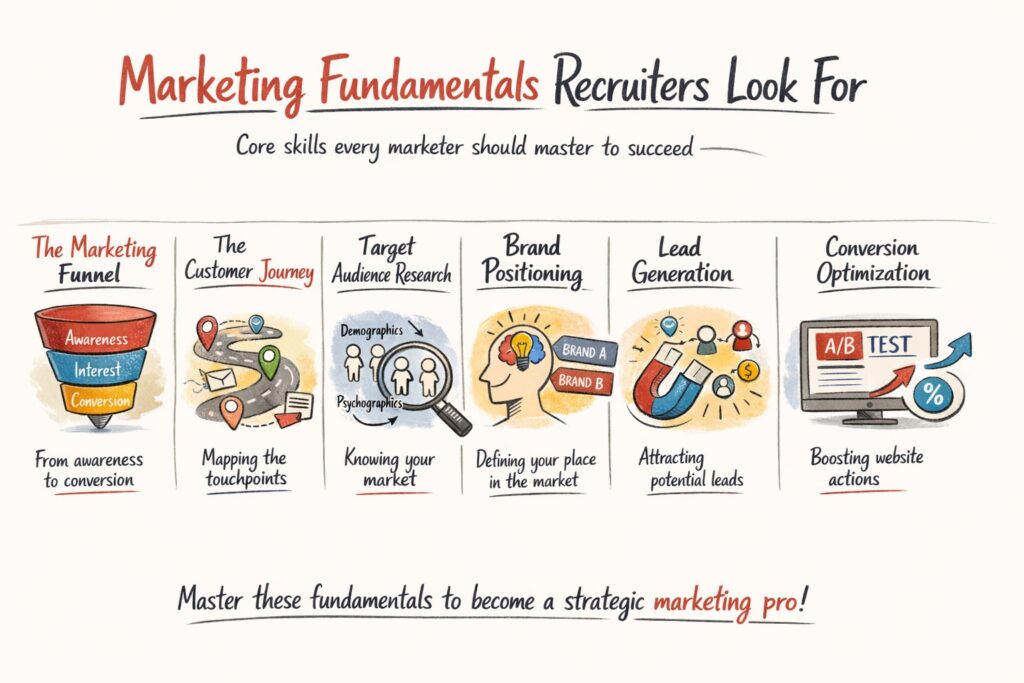
While many beginners focus solely on tools like ad platforms or SEO software, experienced recruiters prefer those who understand core principles. These essential fundamentals include:
- The Marketing Funnel: Understanding how to lead a potential customer from awareness to conversion.
- The Customer Journey: Mapping out the various touchpoints a consumer has with a brand.
- Target Audience Research: The ability to identify and understand the specific demographics and psychographics of a potential market.
- Brand Positioning: Determining how a brand should be perceived in the mind of the consumer relative to competitors.
- Lead Generation Strategies: Developing methods to attract and convert strangers into prospects.
- Conversion Optimisation: The process of increasing the percentage of users who perform a desired action on a website.
When a marketer masters these concepts, they gain the ability to build strategies that align perfectly with business objectives, making them a long-term asset to any organisation.
The Necessity of Practical Channel Experience
Recruiters rarely consider candidates who possess only theoretical knowledge; they demand hands-on experience across multiple marketing channels.
Search Engine Optimisation (SEO) SEO is identified as one of the most valuable channels due to its ability to drive long-term organic traffic. Recruiters look for expertise in:
- Keyword Research: Identifying the terms users type into search engines.
- On-page SEO: Optimising individual web pages to rank higher.
- Technical SEO Basics: Ensuring a website meets the technical requirements of modern search engines.
- Link Building Strategies: Acquiring hyperlinks from other websites to your own to improve authority.
- Algorithm Updates: Staying informed about changes to Google’s ranking systems.
Performance Marketing and Paid Advertising
For businesses seeking rapid results, performance marketing is essential. Recruiters seek candidates experienced in platforms such as Google Ads, Meta Ads, and LinkedIn Ads.
Key skills in this area include campaign optimisation, audience targeting, and budget management. Most importantly, marketers must understand financial metrics like Return on Ad Spend (ROAS) and Cost Per Acquisition (CPA) to prove their value.
Social Media and Content Marketing
Social media is vital for brand awareness and engagement. Recruiters value those who can create content strategies, analyse engagement metrics, understand platform algorithms, and manage influencer collaborations to build online communities.
Furthermore, content is the foundation of digital strategy. Proficiency is expected in blog strategy, SEO content writing, storytelling, email marketing campaigns, and video marketing. Marketers who can educate and attract audiences through storytelling bring immense long-term value.
The Power of Data and Analytics
Digital marketing in 2026 is described as being heavily data-driven. Recruiters prioritise candidates who can interpret campaign performance and make decisions based on empirical evidence rather than intuition.
Key tools and concepts that candidates should master include:
- Google Analytics and Google Search Console: For tracking website performance and search visibility.
- Conversion and UTM Tracking: To understand exactly where leads and sales are originating.
- KPI Analysis and Marketing Dashboards: For monitoring key performance indicators and presenting data clearly.
Candidates who can interpret this data and explain insights clearly to stakeholders often stand out during the hiring process. Companies rely on these data-driven individuals to optimise marketing budgets and improve overall campaign performance.
Demonstrating Measurable Results
One of the most critical factors a recruiter evaluates is proof of results. Instead of merely listing skills on a resume, successful candidates provide concrete examples of their impact. Impressive results often shared with recruiters include:
- Increasing organic traffic by a specific, verifiable percentage.
- Generating a high volume of qualified leads through targeted campaigns.
- Substantially improving conversion rates or reducing the cost per lead.
- Scaling paid advertising campaigns profitably.
Backing up achievements with hard numbers builds immediate credibility and trust with hiring managers. In the modern market, results are considered more important than the resume itself.
The Rise of the T-Shaped Marketer
Recruiters are increasingly looking for T-shaped expertise. This concept refers to a professional who has deep, specialised knowledge in one specific area (the vertical bar of the T) while maintaining a broad understanding of other marketing channels (the horizontal bar). Examples include:
- An SEO specialist who also understands content marketing and analytics.
- A performance marketer with knowledge of landing page optimisation.
- A social media marketer who understands audience psychology and brand storytelling.
This multidisciplinary approach is preferred because modern digital strategies often require various channels to work in harmony.
Human-Centric Skills: Communication and Strategy
Digital marketers do not operate in isolation; they must collaborate with designers, developers, content writers, sales teams, and management.
Therefore, the ability to communicate ideas clearly and work effectively within diverse teams is a highly sought-after quality. Marketers who can translate complex strategies and performance data into simple, actionable terms for non-marketers tend to perform better in professional settings.
Additionally, strategic thinking is a major differentiator. Rather than just executing tasks, strategic marketers ask critical questions regarding the target audience, the problem the product solves, and which channels will deliver the best results.
Candidates who demonstrate this high-level thinking are often fast-tracked for growth roles within marketing teams.
Adaptability in an Evolving AI Landscape
The digital marketing field is in a state of constant evolution, influenced by changing search algorithms, new social media features, and the emergence of AI technologies.
Recruiters value professionals who demonstrate adaptability and a commitment to continuous learning.
Specifically, knowledge of AI and marketing automation is becoming a significant competitive advantage. Companies are looking for marketers who can integrate AI tools for:
- Content Creation and Ad Optimisation: Using AI to generate and refine assets.
- Data Analysis: Leveraging AI to find patterns in large datasets.
- Marketing Automation: Streamlining repetitive tasks.
- Customer Personalisation: Tailoring experiences to individual user needs.
Start your digital marketing journey today with the best digital marketing course powered by AI in Hyderabad from WhiteScholars.
Why Your Digital Marketing Interviews Aren’t Converting
In the modern job market, simply having a certification or a basic understanding of marketing software is no longer a ticket to employment.
While the demand for digital marketers has exploded over the last decade as companies prioritise online visibility and lead generation, the hiring process has become significantly more rigorous.
Recruiters are now tasked with filtering through thousands of applications to find the small percentage of candidates who can actually move the needle for a business.
Below is a detailed breakdown of why freshers often fail these interviews and what recruiters are specifically looking for instead.
1. Over-Reliance on Tools and Ignoring Fundamentals
A common reason freshers fail is the “tool trap”. Many candidates spend months learning how to navigate the interfaces of Google Ads or specific SEO software but neglect the core principles of marketing.
Recruiters have observed that freshers often cannot explain the strategy behind the tool. To succeed, a candidate must demonstrate a deep understanding of the following:
- The Marketing Funnel: How to Guide a Stranger from Awareness to a Final Purchase.
- The Customer Journey: Identifying every touchpoint a consumer has with a brand before they decide to buy.
- Target Audience Research: Knowing exactly who the customer is, what they need, and where they spend their time.
- Brand Positioning: Determining how to make a product stand out in a crowded market.
- Lead Generation and Conversion Optimisation: Not just getting traffic, but turning that traffic into revenue.
Without these fundamentals, a marketer cannot build a strategy that aligns with a company’s business objectives, making them a “risk” rather than an asset.
2. The “Theory Only” Problem: Lack of Practical Experience
Freshers often fail because they possess only theoretical knowledge. In 2026, recruiters rarely hire someone based on what they know; they hire based on what they have done.
A successful candidate needs hands-on experience across multiple channels. If a fresher cannot discuss the practicalities of the following, they are likely to be rejected:
- SEO (Search Engine Optimisation): This includes keyword research, on-page optimisation, and understanding the technical basics that allow a site to be indexed.
Candidates must also understand link-building strategies and stay current with Google’s frequent algorithm updates.
- Performance Marketing: Recruiters look for those who have actually managed budgets on Google Ads, Meta Ads, or LinkedIn Ads.
A candidate who doesn’t understand Return on Ad Spend (ROAS) or Cost Per Acquisition (CPA) demonstrates a lack of financial accountability that businesses cannot afford.
- Social Media & Content: It is not enough to just “post” on social media. Recruiters want to see content strategies, engagement metric analysis, and an understanding of platform-specific algorithms.
3. Inability to Analyze Data and Performance Tracking
Digital marketing is an inherently data-driven field. Many freshers fail because they cannot interpret the results of their actions.
Recruiters prioritise candidates who can look at a dashboard and derive actionable insights.
Key areas where freshers often fall short include:
- Analytics Proficiency: Lack of experience with Google Analytics and Google Search Console.
- Technical Tracking: An inability to set up UTM tracking or conversion tracking, which are essential for proving which marketing efforts are actually working.
- KPI Analysis: Failing to identify the key performance indicators (KPIs) that matter to a business’s bottom line.
Candidates who can clearly explain marketing data to stakeholders and use it to optimize future budgets are the ones who stand out.
4. Failure to Provide “Proof of Results”
In a competitive market, a resume filled with skills is less impressive than a portfolio filled with numbers. Freshers often fail because they talk about their responsibilities rather than their achievements.
Recruiters are specifically looking for measurable impact, such as:
- The exact percentage by which you increased organic traffic.
- The number of qualified leads generated through a specific campaign.
- How you successfully reduced the cost per lead (CPL).
- Evidence of scaling a paid campaign while maintaining profitability.
Providing real achievements backed by hard numbers builds immediate credibility and trust with a hiring manager.
5. Lack of “T-Shaped” Versatility
Many freshers make the mistake of being too narrow in their focus. In 2026, the industry demands T-shaped marketers, individuals with deep expertise in one area (the vertical bar) but a broad understanding of other marketing functions (the horizontal bar).
For example, a recruiter might reject an SEO specialist who knows nothing about how their work impacts content marketing or analytics. Conversely, they value:
- Performance marketers who understand landing page optimisation.
- Social media managers who understand brand storytelling and the psychology of the audience.
Modern digital strategies require multiple channels to work in harmony, and candidates who don’t understand these intersections are often passed over.
6. Poor Communication and Collaboration Skills
Digital marketing is not a solo endeavour; it requires constant interaction with designers, developers, sales teams, and upper management. Freshers often fail interviews because they lack the “soft skills” to translate complex marketing jargon into simple terms that a CEO or a developer can understand.
The ability to communicate ideas clearly and work effectively within a diverse team is a major factor in a recruiter’s decision. If a candidate cannot explain their strategy simply, they are seen as a potential bottleneck in a fast-moving company.
7. Absence of Strategic Thinking and Problem-Solving
Recruiters are moving away from hiring “task-doers” and are looking for “problem-solvers”. Freshers often fail because they show they can execute a campaign but cannot explain why it should be executed in the first place.
Strategic thinkers ask the “big questions”:
- Who is our actual target audience, and is this the right channel to reach them?
- What specific problem does this product solve for the customer?
- How can we optimise this campaign for better performance rather than just letting it run?
Candidates who demonstrate this level of thinking are viewed as future leaders and growth-drivers within the marketing team.
8. Resistance to AI and Automation
As of 2026, artificial intelligence has transformed marketing strategies. Freshers who are not actively using or understanding AI tools are falling behind.
Recruiters look for candidates who can integrate AI for:
- Efficient content creation and ad optimisation.
- Advanced data analysis and marketing automation.
- Scaling customer personalisation.
An understanding of how AI complements traditional marketing strategies is now a significant competitive advantage.
9. Lack of Adaptability and Continuous Learning
The digital landscape changes almost weekly, with new social media features, evolving search algorithms, and shifting consumer behaviours. A common reason for failure is appearing “stagnant” in one’s knowledge.
Recruiters value professionals who:
- Stay updated with industry trends.
- Experiment with new tools and strategies on their own.
- Demonstrate a “growth mindset” by continuously updating their skills.
Summary of Recruiter Expectations for 2026
To avoid the common pitfalls that lead to interview failure, freshers must master a blend of technical and strategic skills. The most successful candidates are those who focus on:
- Organic Growth (SEO) and Paid Performance (PPC).
- Storytelling through content and social media.
- Data interpretation to prove ROI.
- Strategic thinking and clear communication.
In the modern era of digital marketing, results matter more than resumes. Focus on building a portfolio of measurable achievements and practical insights into emerging trends like generative engine optimisation (GEO) to stay ahead of the competition.
Frequently Asked Questions
1. What are the most important marketing fundamentals for building a digital strategy?
Recruiters look for an understanding of the marketing funnel, customer journey, and target audience research. Mastering these concepts allows you to build strategies that align directly with business objectives and conversion optimisation goals.
2. How do you measure the success of a performance marketing campaign?
Success is typically measured through financial metrics like return on ad spend (ROAS) and cost per acquisition (CPA). Demonstrating knowledge of these metrics proves your ability to manage budgets effectively and generate quick, measurable results for the company.
3. What is your approach to improving a website’s organic visibility?
A strong approach involves a combination of keyword research, on-page optimisation, and technical SEO basics. It is also essential to stay updated on Google algorithm changes and implement link-building strategies to drive long-term organic traffic.
4. How do you use data and analytics to influence your marketing decisions?
Interviewers want to see proficiency in tools like Google Analytics and the use of UTM tracking to monitor campaign performance. Being able to interpret this data and explain insights clearly allows you to optimise marketing budgets and improve overall campaign ROI.
5. Can you provide examples of measurable results you have achieved in past campaigns?
Recruiters prioritise candidates who can show specific achievements, such as increasing organic traffic by a certain percentage or reducing the cost per lead. Presenting these results backed by hard numbers builds immediate credibility and proves the direct impact of your work.
