

From CSE To Full Stack Mastery: 6-Month Roadmap
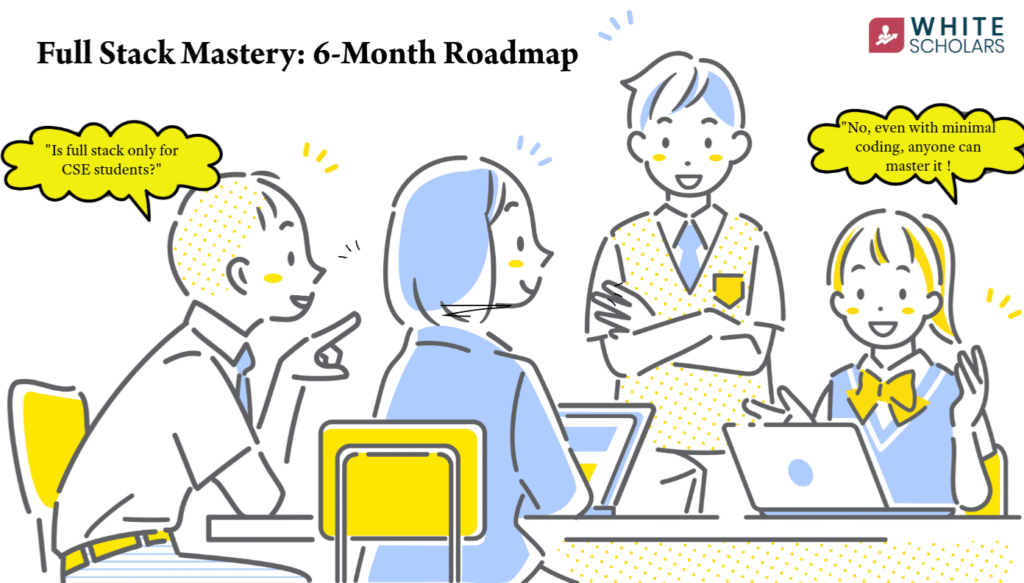
Table of Contents
Not Just CSE students but also the students who have minimal coding knowledge can also start their Full Stack Developer journey in 6 months with focused effort.
Does a CSE Student Become a Full Stack Developer ?
CSE students already possess a strong foundation in programming fundamentals like C, C++, Java, Python, data structures, algorithms, DBMS, OS, and OOP from their B.Tech syllabus.
CSE students have a head start in full stack development thanks to their syllabus covering programming, you have already conquered coding mountains in your B.Tech syllabus
This foundation makes full stack development not just achievable, but your easiest career pivot in 6 months, turning classroom theory into high-paying MERN jobs (₹6-12 LPA starting).
This article leverages that base to guide you toward full stack development in just 6 months with targeted practice.
Leverage Your CSE Syllabus
Your engineering curriculum covers 70-80% of full stack prerequisites. Subjects like Programming (C/C++/Java/Python), Data Structures (arrays, linked lists, trees), Algorithms (sorting, searching), OOP (classes, inheritance), DBMS (SQL queries, normalization), OS (processes, memory), and Computer Networks (TCP/IP basics) directly apply to backend logic, databases, and APIs.
Skip basics and focus on web-specific skills. For example, use your DSA knowledge for efficient React state management or Node.js routing. This accelerates your path compared to non-CSE beginners.
Opportunity for IT, ECE, and Other Branches
Students from IT, ECE, EEE, Mechanical, or Civil branches—you’re not left behind! While CSE peers have heavy coding exposure (C++, DSA, DBMS), your syllabus often include lighter programming like basic C/Python in IT or MATLAB in ECE, giving you a starting point.
Your chance is real: Transition to full stack in 6-7 months with focused effort—add 20-30% extra time upfront on fundamentals.
What is full stack development?
Full stack development encompasses the complete process of application software development, including both
- Front-end development
- Back-end development
The front end consists of the user interface (or UI), and the back end handles the business logic and application workflows that run behind the scenes.
Full stack developers build everything in a web app, from the shiny buttons users click to the hidden databases storing their data.
Roadmap: Step-by-Step
Month 1: Frontend Foundations HTML/CSS/JS Refresh
- Master HTML: paragraphs, headings, lists, attributes
- CSS: text-align, background-color, Flexbox pseudo-classes
- JS basics: iterating arrays, date methods, math/console
| Topic | Practice |
| HTML Tags/Attributes | Portfolio page |
| CSS Selectors/Pseudo | Responsive navbar |
| JS Arrays/Objects | Todo calculator |
- Build 3 static sites: personal portfolio, landing page, calculator app.
- Learn Git/GitHub for version control (essential from CSE projects).
Daily: 2 hours coding , learn Git
Outcome: Deploy a responsive portfolio on GitHub Pages.
Month 2: Advanced Frontend with JS, DOM & React.Js
- Start with Advance JavaScript topics.
- Cover DOM (access/create elements, append/remove, events), scope (functional/block), events (click, hover, bubbling). Tie to your algorithms: Use array methods (sort, filter) for dynamic lists.
Projects:
- Wikipedia search app (fetch, events).
- Interactive form with validation.
Dive into React.js (components, hooks, props, state with useState/useEffect). Your data structures knowledge helps with array/map/filter operations in lists.
Add Tailwind CSS for styling, integrate free APIs (e.g., OpenWeather).
- Practice: React docs.
- Milestone: Build/deploy a dynamic frontend.
Months 3-4: Backend with Node.js & Express
- Node basics (async callbacks, event loop, emitters),
- Express (HTTP servers, middleware, MySQL/MongoDB connect).
Apply OS processes to Networks to secure HTTP,to handling requests and DBMS for data flow.
Use Node.js and Express for servers, routing, middleware. REST APIs: for error handling, validation.
- Build: Todo API with auth (bcrypt/JWT).
- Testing: Assertion module, debugger.
- Project: E-commerce backend (Postman).
Month 5: Databases & Full Integration
MongoDB (NoSQL, schemas with Mongoose)—leverage DBMS normalization for data modeling. Integrate frontend-backend: React calls Express APIs.
| Integration Step | Time |
| Connect React to Node APIs | 1 week |
| Add MongoDB CRUD | 2 weeks |
| JWT Auth full flow | 1 week |
- Handle files/uploads, basic testing (Jest).
- Deploy backend to Render/Heroku.
Month 6: Projects & Polish
Deploy full stack: Vercel/Netlify (frontend), Render (backend), MongoDB Atlas (DB). Add CI/CD basics with GitHub Actions.
Build 3 portfolio projects:
- Task manager with real-time (Socket.io).
- E-commerce site (fake payments).
- Social clone (chat/auth).
Prep interviews: System design (from OS/Networks), Update LinkedIn/GitHub, apply to jobs.
| Project | Features | Deploy |
| Task App | CRUD, auth, real-time | Vercel + Render |
| E-com | Cart, payments (Stripe) | Full MERN |
| Chat App | Socket.io, users | Live demo |
Daily Routine & Tips
- 4 hours a day: 60% coding, 20% debugging, 20% docs/videos.
- Track: Notion board for progress.
- Community: Reddit r/learnprogramming, Discord MERN groups.
- India-specific: Upskill via WhiteScholars(aligns with your interests).
- Enroll WhiteScholars Hyderabad for hands-on, Your CSE base + WhiteScholars syllabus = job-ready in 6 months.
Consistency beats intensity—your CSE base makes 6 months realistic. Start today with a simple HTML page!
Wrap-Up: Your Path Starts Now
CSE, IT, ECE students, and rookies—your roadmap mixes syllabus skills with MERN steps to build full apps in 6 months.
Put in 4 hours a day: mostly coding, some fixing bugs, and learning. Make 3 projects for your portfolio. Extra work for non-CSE? It pays off fast.
WhiteScholars Full Stack Course Details
Elevate your journey with WhiteScholars’ full stack academy Hyderabad, offering the premier full stack developer course in Hyderabad focused on MERN stack mastery. This hands-on full stack developer course program, trains aspiring MERN stack developers in MERN full stack development, covering React, Node.js, Express, and MongoDB through real-world projects and placement support.
Not only for CSE students but any interested beginners, it aligns perfectly with your 6-month roadmap for job-ready skills as a MERN stack developer.
FAQ’s
1. Can non-CSE students like ECE or Mechanical really become full stack developers in 6 months?
Yes, with focused effort, students from IT, ECE, EEE, Mechanical, or Civil can transition in 6-7 months. Your syllabus likely includes basic C/Python or MATLAB, giving a starting point. Add 20-30% extra time upfront for fundamentals like DSA and JS, then follow the MERN roadmap—your consistency will close the gap quickly.
2. What daily routine should I follow to complete this in 6 months?
Aim for 4 hours daily: 60% coding (projects), 20% debugging, 20% docs/videos. Use a Notion board to track progress. In Month 1, dedicate 2 hours to HTML/CSS/JS + Git. Join communities like Reddit’s r/learnprogramming or MERN Discord groups for support.
3. Do I need prior experience with React or Node.js to start?
No leverage your CSE syllabus (programming, DSA, DBMS, OS). Skip basics and jump to web skills: Month 1 refreshes HTML/CSS/JS, Month 2 covers advanced JS/DOM/React. Non-CSE folks brush up on arrays/objects first. Practice via projects like a todo app or Wikipedia searcher.
4. What are the best portfolio projects to land MERN jobs (₹6-12 LPA)?
Build these 3 full-stack projects in Month 6:
- Task manager (CRUD, auth, real-time with Socket.io; deploy on Vercel + Render).
- E-commerce site (cart, fake/Stripe payments; full MERN stack).
- Social chat clone (users, Socket.io; live demo).
Deploy everything (Netlify/Vercel for frontend, Render for backend, MongoDB Atlas for DB) and showcase on GitHub/LinkedIn.
5. Which resources or courses align best with this roadmap in India?
- Practice: GitHub Pages, Postman, MongoDB Atlas.
- India-specific: Enroll in WhiteScholars Hyderabad for hands-on MERN training—it builds on your job-readiness in 6 months. Track trends on Towards Data Science or Medium.
