

Guide to Beginner SEO Tools and Strategies in 2026

Let’s discover different beginner-friendly tools that can be used for search engine optimisation in 2026 and different strategies to be followed.
Introduction
Success in search engine optimisation (SEO) is difficult to achieve without the appropriate technical resources.
A basic SEO tool stack is typically divided into three primary categories: research, content creation, and tracking and analytics.
Utilising these tools effectively allows for a simplified approach that produces measurable results without the need for an overwhelming number of platforms.
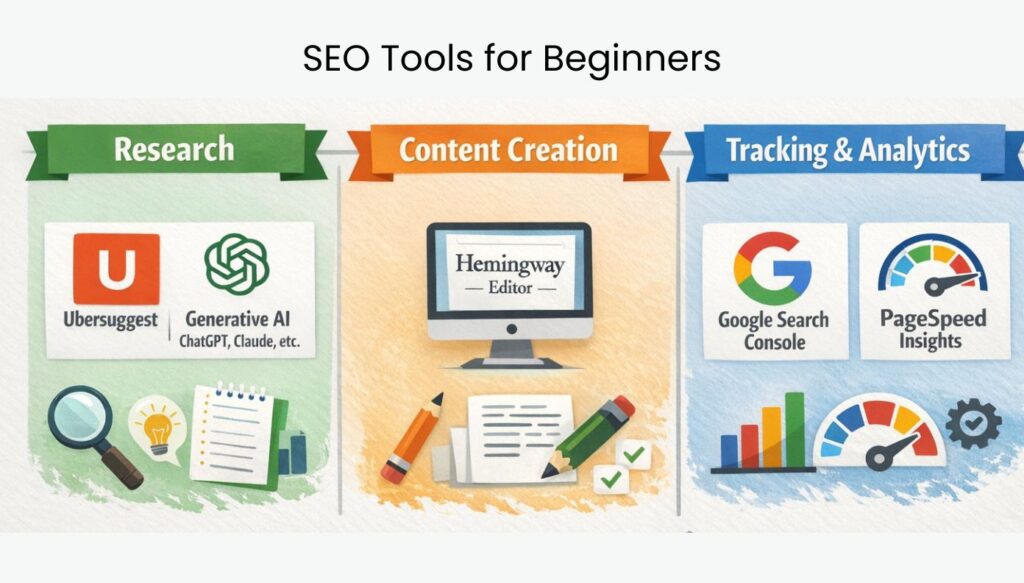
Section 1: Detailed Breakdown of SEO Research Tools
Research is the foundation of any SEO strategy, focusing on identifying the right keywords and understanding the competitive landscape.
1. Ubersuggest
This tool is highlighted as the top recommendation for beginners due to its affordability and user-friendly interface. It offers a free seven-day trial and limited free daily searches for those testing the platform.
- Keyword Research: The tool identifies search volume and the level of competition for specific terms. It also generates new keyword ideas to expand a search strategy.
- Competitor Spying: By entering a competitor’s URL, the tool provides a full overview of their performance, including their organic keywords, Domain Authority (also known as ‘page authority’) and the number of backlinks they possess.
- Traffic Insights: It reveals a competitor’s monthly organic traffic and their top-performing SEO pages.
2. Google Search (The Search Engine as a Tool)
The search engine itself is a powerful, free research resource.
- Autocomplete Suggestions: Typing a keyword into the search bar prompts Google to suggest related terms based on actual user behaviour.
- People Also Ask (PAA): This section displays common questions related to a search term, providing insight into the specific information users are seeking.
- Related Searches: Found at the bottom of the results page, these terms represent additional phrases people have used that are relevant to the primary keyword.
3. Advanced Research Platforms: Semrush, Ahrefs, and MozPro
- Semrush and Ahrefs: These are described as robust, advanced tools that offer deep technical insights. While powerful, they are often more expensive and may be complex for those just beginning their SEO journey.
- MozPro: This platform serves as a middle ground, offering professional research and tracking features at a more affordable price point than the most advanced options.
4. Generative AI (ChatGPT, Claude, Perplexity, Gemini)
Generative AI engines are excellent for brainstorming and planning.
- Keyword Lists: AI can generate lists of keywords tailored to specific business types and target audiences.
- Search Intent: These tools help distinguish between informational intent (users looking for knowledge) and commercial intent (users looking to buy).
- Validation: It is noted that any keywords generated by AI should always be validated through a tool like Ubersuggest to check for actual search volume and competition levels.
Section 2: Content Creation and Optimization Tools
Once keywords are identified, content must be crafted to rank effectively in both traditional search engines and AI-driven search platforms.
5. ChatGPT for Planning
Beyond keyword lists, AI is used for structural planning.
- Topic and Title Generation: AI helps brainstorm blog topics and keyword-rich titles.
- Article Outlines: It can create detailed outlines to guide the writing process.
- A Note on Quality: To maintain high quality, it is advised that AI should not be used to write entire articles; instead, it should be a tool for planning and structure.
6. Hemingway Editor
Search engines prioritise clear and simple language because it enhances the user experience.
- Readability Check: This tool flags complicated or difficult sentences.
- Simplification: It suggests ways to simplify text, making it a critical final step before publishing content meant to rank in SEO and AI search engines.
Section 3: Tracking, Analytics, and Technical Health
Monitoring progress is essential to determine if SEO efforts are working or if adjustments are required.
7. Google Search Console
This is considered an essential, free tool for every website owner.
- Query Tracking: It identifies which specific search queries are driving traffic to the site.
- Ranking Position: The tool monitors the average position of the website in search results.
- Click-Through Rate (CTR): It shows how often people click on the website after seeing it in the results.
- Top Pages: It highlights which individual pages are the most successful at attracting visitors.
8. Google Analytics
This free tool focuses on visitor behaviour once they arrive at the site.
- Organic Traffic Monitoring: It tracks how many visitors arrive via search engines.
- Engagement Metrics: It measures the engagement rate, the time spent on the site, and the performance of specific landing pages.
9. Ubersuggest (Analytics Features)
In addition to research, Ubersuggest provides ongoing monitoring tools.
- Keyword Tracking: This allows for month-to-month monitoring of keyword rankings.
- Site Audits: The tool performs full audits to identify technical issues that might hinder ranking performance.
10. Google PageSpeed
Site speed is a critical SEO factor.
- Performance Testing: This free tool tests how fast a site loads on both mobile and desktop devices.
- User Experience: Slow sites are often deprioritised by Google because they provide a poor user experience.
To understand more about such research, content-creating and analytics tools, learn digital marketing from the best in Hyderabad from WhiteScholars powered by AI.
Section 4: Strategies for SEO Success
To deepen the understanding of SEO, several strategies should be integrated into a beginner’s strategy.
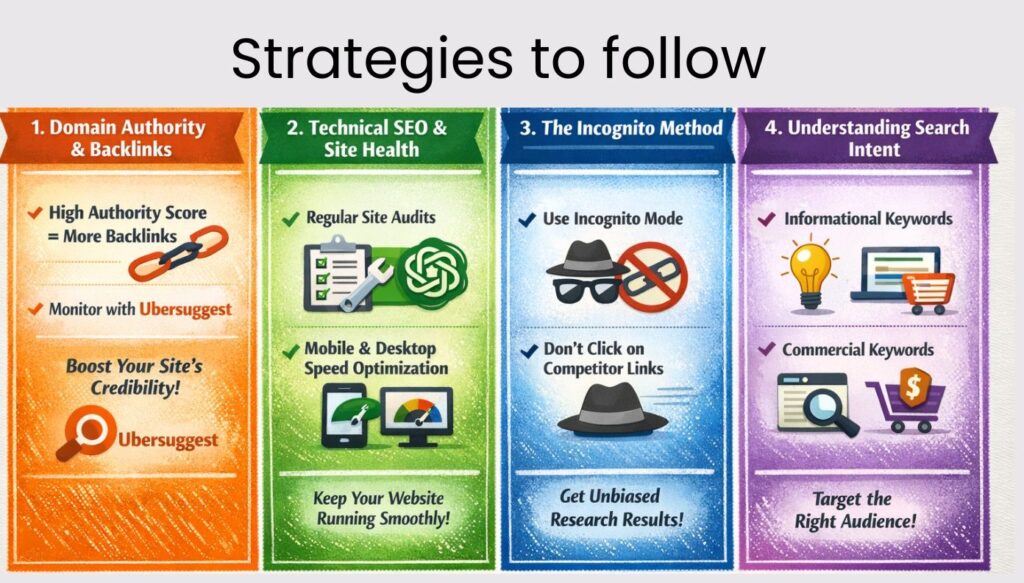
I. The Importance of Domain Authority and Backlinks
Search engines use backlinks (links from other websites to your site) as a primary indicator of credibility.
- Authority Score: A higher number of quality backlinks typically results in a higher authority score.
- Ranking Priority: Websites with high authority scores and many backlinks are given more priority in search rankings. Monitoring these metrics through tools like Ubersuggest is vital for understanding why competitors might be outranking a site.
II. Technical SEO and Site Health
SEO is not just about keywords; it also involves the technical health of the website.
- Technical Audits: Regular audits can flag underlying issues that prevent search engines from correctly indexing or ranking a page.
- Mobile vs. Desktop Performance: A site must pass speed tests for both platforms, as Google tracks performance across all device types.
III. Proper Research Habits: The Incognito Method
When conducting manual research on Google, using an incognito window is a professional standard.
- Avoiding Bias: Standard search results are often influenced by personal browsing history. An incognito window ensures the results seen are unbiased and representative of what a typical user would see.
- Competitor Interaction: It is advised not to click on competitor links directly from the search results. Doing so tells Google that the competitor is a good match for that keyword, potentially boosting their ranking. Instead, the URL should be typed directly into the browser.
IV. Understanding Search Intent
A successful content strategy matches keywords with the intent of the searcher.
- Informational Keywords: These target users seeking answers, guides, or explanations.
- Commercial Keywords: These target users who are further along in the buying process and looking for solutions or products. Using AI to categorize these intents helps in creating content that satisfies the user’s specific goal.
Final Thoughts
By combining these research, content, and analytics tools, beginners can build a sustainable SEO practice.
Focusing on site speed, clear communication, and authority-building through backlinks ensures a website provides the high-quality experience that modern search engines reward.
Frequently Asked Questions
1. Which tool is most recommended for those just starting with SEO research?
Ubersuggest is the top recommendation for beginners because it is affordable and user-friendly, offering a free trial to test its features. It allows users to identify keyword search volume, analyse competitor backlinks, and track monthly ranking performance.
2. How can Google’s standard search page assist in keyword research?
Google’s autocomplete suggestions, the “People Also Ask” section, and related searches at the bottom of the page reveal what users are actively searching for. These free features provide immediate insight into search intent and popular queries without needing third-party software.
3. Is it a good idea to use AI to write full blog articles for SEO?
It is better to use AI for brainstorming and outlining rather than writing full posts, as Google deprioritises AI-only content. Search engines prioritise human-written content that demonstrates real-world experience and expertise over automated text.
4. Why should website owners monitor their site’s loading speed?
Page speed is a major ranking factor because search engines deprioritise slow-loading sites that provide a poor user experience. Tools like Google PageSpeed can confirm if a site passes speed tests on both mobile and desktop devices.
5. What are the primary differences between Google Search Console and Google Analytics?
Google Search Console tracks search queries, average positions, and click-through rates before a user reaches the site. Google Analytics focuses on the visitor’s behaviour after arrival, monitoring organic traffic volume and engagement rates.
