

Gen-AI Is Creating High-Paying Jobs for the Future
Introduction
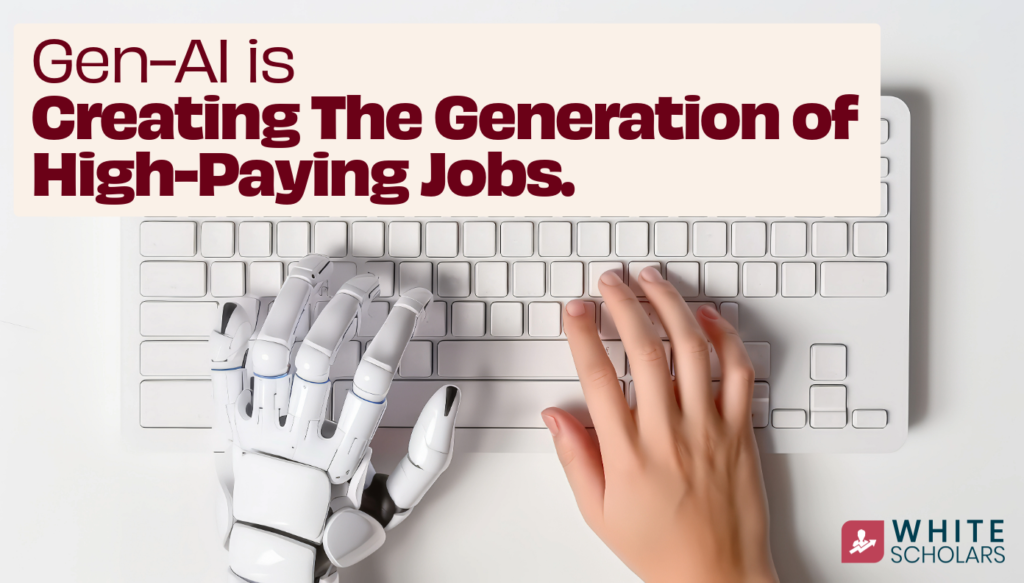
Gen-AI is creating high-paying jobs, not replacing human workers. Instead, it is opening up entirely new career paths in data science, AI engineering, and machine learning. As businesses rush to integrate large language models into their daily workflows, the demand for professionals who can build, fine-tune, and manage these systems has skyrocketed. This makes it the perfect time to develop in-demand AI skills and transition into one of the fastest-growing and highest-paying career fields.
In 2026, enterprise adoption has matured from simple chatbots to autonomous agent systems, creating a surge in demand for net-new professions. These include AI Implementation Strategists who manage inference economics, Prompt Engineers who design systemic instructions, and AI Governance & Compliance Leads who police ethical boundaries and data privacy. Emerging tech professionals who combine domain-specific knowledge with hands-on AI tool proficiency can command premium salary packages globally and across India’s booming tech hubs.
What is Generative AI?
Generative AI is a subset of artificial intelligence that uses advanced data science machine learning models to create brand-new content—such as text, images, code, or audio—by learning patterns from massive datasets.
How AI is Reshaping the Job Market
Honestly, this confused me at first. I used to think AI would just automate everything and leave us with fewer tech jobs. But in real projects, we are seeing the exact opposite. Every time a company deploys an AI tool, they suddenly need a team of data specialists to maintain it, evaluate its data accuracy, and prevent it from “hallucinating”.
This shift has become more valuable than ever. We’re moving away from traditional static software towards dynamic, data-driven intelligence.
Emerging Job Roles in 2026
- Prompt Engineers: Designing precise inputs to get the best outputs from AI models.
- AI Data Auditors: Ensuring training data is clean, unbiased, and compliant with privacy laws.
- LLM Fine-Tuning Specialists: Taking base models and training them on specific company data.
The 2026 New AI Job Landscape Matrix
The corporate shift from basic automation to agentic infrastructure has given rise to specialized roles that did not exist a few years ago. The table below details the newly created job taxonomy dominating the tech landscape in 2026:
| Brand-New AI Role (2026) | Primary Corporate Mandate | Essential Skills Required | Indian Market Salary Range |
| Prompt Engineer / Specialist | Optimizing structured input frameworks to guide LLMs toward accurate, brand-aligned corporate outputs. | Prompt design, token tracing, A/B testing, linguistic logic. | ₹6 LPA – ₹12 LPA (1-2 years exp) |
| AI Implementation Strategist | Bridging business logic and technology by identifying high-ROI use cases and managing GPU cloud compute budgets. | FinOps for AI, system integration, business metrics calculation. | ₹12 LPA – ₹22 LPA (3-5 years exp) |
| AI Governance & Compliance Lead | Auditing AI outputs for bias/drift and ensuring semantic data assets comply with regional privacy regulations (GDPR/DPDP). | Risk management, data privacy legislation, ethical AI frameworks. | ₹15 LPA – ₹30+ LPA (Senior levels) |
| AI Content Strategist & Director | Conceptualizing and directing generative text and visual diffusion models to run hyper-personalized campaigns at scale. | Visual design principles, prompt engineering, IP/licensing management. | ₹5 LPA – ₹10 LPA (Entry/Mid level) |
Step-by-Step: How a Generative AI Model is Deployed
Building these systems isn’t magic—it relies heavily on core data science workflows. Here is how companies actually bring a generative model to life:
1.Data Collection & Scraping: Step 1.
Gathering massive volumes of high-quality text, code, or images. This is where most beginners struggle because dirty data ruins the entire project.
2.Data Preprocessing: Step 2.
Cleaning the dataset, removing duplicates, and structuring it so the AI can read it efficiently.
3.Model Training or Fine-Tuning: Step 3.
Feeding the data into a neural network. Most companies don’t build models from scratch anymore; they fine-tune existing models using specific business data.
4.Evaluation & Human-in-the-Loop Testing: Step 4.
Testing the model for accuracy. Humans score the outputs to guide the model toward better answers over time.
Real-World Example: AI in Customer Support
Think about the last time you chatted with a customer support bot. A couple of years ago, they were clunky and useless. Today, companies use generative AI trained on their internal knowledge bases to answer complex questions instantly.
Behind that smooth chatbot is a team of data scientists who cleaned the data, integrated the APIs, and constantly monitored the system performance using tools like Python, PyTorch, and vector databases.
The Rise of “Professionalized” and “Seniorized” Work
Data from the 2026 PwC Global AI Jobs Barometer indicates that AI-exposed positions are experiencing significantly faster wage growth and higher demand than traditional roles. However, this shift changes the traditional career ladder.
Because boilerplate work—like basic debugging, routine copywriting, and initial data entry—is fully automated, junior roles are being “seniorized.” Entry-level professionals are now expected to master advanced human skills much earlier in their career trajectories.
The 2026 Reality: Success no longer depends on executing repetitive tasks. It depends on strategic decision-making, stakeholder management, system architecture, and critical empathy.
AI handles the execution, while the human professional serves as the editor, director, and governor of the output.
Launching Your Career: Skills, Salary, and Demand
If you look at job boards today, the data science field is booming. Enrolling in a reputable data science academy hyderabad gives you a massive competitive edge.
Key Skills You Gain
- Advanced Python programming and SQL database management.
- Deep Learning and Neural Network architecture.
- Natural Language Processing (NLP) and LLM deployment.
Career Outcomes
Salaries for skilled data professionals have hit all-time highs. Freshers entering the market can expect strong starting packages, while experienced engineers moving into AI roles are seeing exponential salary hikes due to the severe talent shortage.
If you’re serious about building a career in this, structured training can really help. Learning through hands-on projects at premier institutes like WhiteScholars and choosing a comprehensive data science course ensures you learn what employers actually look for.
The WhiteScholars “Future-Proof Career Launchpad” Ecosystem
At WhiteScholars Academy, we bypass outdated academic curricula to train you for the actual workforce requirements of 2026. Our educational framework is designed to transition freshers and corporate switchers into specialized AI roles.
Enterprise Simulations on “Activity Saturdays”
Every week, our campus transforms into an active corporate sandbox during Activity Saturdays. Students do not just listen to lectures; they operate as AI Consultants within simulated enterprise environments.
- The Challenge: You will take a traditional brick-and-mortar business model, audit its operational inefficiencies, and architect an end-to-end AI agent deployment plan.
- The Pitch: You will defend your AI integration strategy, inference budget, and risk-mitigation guardrails before a panel of veteran industry experts.
NASSCOM-Certified, Industry-Vetted Upskilling Tracks
We do not focus on dry coding syntax that automated tools can generate in seconds. Our NASSCOM-certified GenAI tracks train you in production-level tool orchestration, prompt testing, evaluation frameworks, and governance guardrails.
We ensure your GitHub and LinkedIn portfolios showcase practical, enterprise-grade AI implementations that immediately capture the attention of tier-1 recruiters across Hyderabad’s tech corridors.
Quick Summary
Generative AI isn’t killing tech jobs, it is completely reinventing them. The market has shifted from basic data analytics to advanced AI implementation, creating a massive demand for trained professionals who understand machine learning pipelines, data cleaning, and model optimization.
Next Steps
Don’t get overwhelmed by the sheer volume of AI tools out there. Focus on mastering the foundations: Python, SQL, and basic machine learning. Once you have those down, building into generative AI becomes a natural, straightforward next step.
You can also explore related topics in our content cluster, such as Data science & Data analysis or Deep Learning Foundations for Beginners to broaden your tech portfolio.
Frequently Asked Questions
Do I need a math background to learn data science for AI?
Not a PhD, but you do need a solid grasp of basic statistics, linear algebra, and probability to understand how these models process information.
What is the duration of a standard data science course in Hyderabad?
Most comprehensive, industry-aligned programs run between 4 to 8 months, depending on whether you study full-time or part-time.
Can a working professional from a non-tech background switch to AI?
Yes, absolutely. Most programs start from the absolute basics of Python before moving into advanced machine learning algorithms.
What tools are essential for Generative AI development in 2026?
You should focus heavily on Python, PyTorch, Hugging Face libraries, LangChain, and understanding how vector databases work.
Are companies in Hyderabad actively hiring data scientists?
Yes, Hyderabad is one of India’s largest tech hubs, with hundreds of multinational corporations and startups actively searching for AI and data talent.
Do I need a heavy computer science background to become an AI Consultant?
No. The dominant corporate roles in 2026 value domain expertise, logical reasoning, and systems thinking over raw coding ability. Business professionals, marketers, and domain experts are often better equipped to identify high-ROI use cases and manage AI compliance than traditional programmers.
Is Prompt Engineering still a sustainable career path in 2026?
Yes, but the role has evolved. Simple, single-line prompting is obsolete. Today’s Prompt Specialists focus on systemic instruction design, programmatic prompt chaining, token optimization, and managing prompt vulnerabilities (such as prompt injection). It has transitioned from a creative trick into an engineering discipline.
How can a non-programmer get a high-paying job in AI?
By focusing on the orchestration, strategy, and governance layers of AI. Industry sectors need professionals who understand how to integrate AI tools into existing business workflows, manage compliance frameworks like the DPDP Act, and direct generative content engines.
Will learning Generative AI save my tech career?
Yes. Upskilling in Generative AI transforms you from a vulnerable execution agent into an indispensable AI orchestrator. It shifts your professional value from doing the work to directing the systems that do the work.
