

How Generative AI Is Creating New Job Opportunities in 2026
Generative AI is transforming industries, creating new career paths, and increasing demand for professionals with AI skills across diverse fields.
How Generative AI Is Creating New Job Opportunities
Imagine AI writing content, creating images and videos, building software, analysing data, and helping businesses make smarter decisions. This is no longer the future it is happening today.
While many people worry that AI will replace jobs, Generative AI is also creating new careers and exciting opportunities. Companies now need professionals who can build AI solutions, write effective prompts, manage AI systems, create AI-powered content, and use AI to solve real business problems.
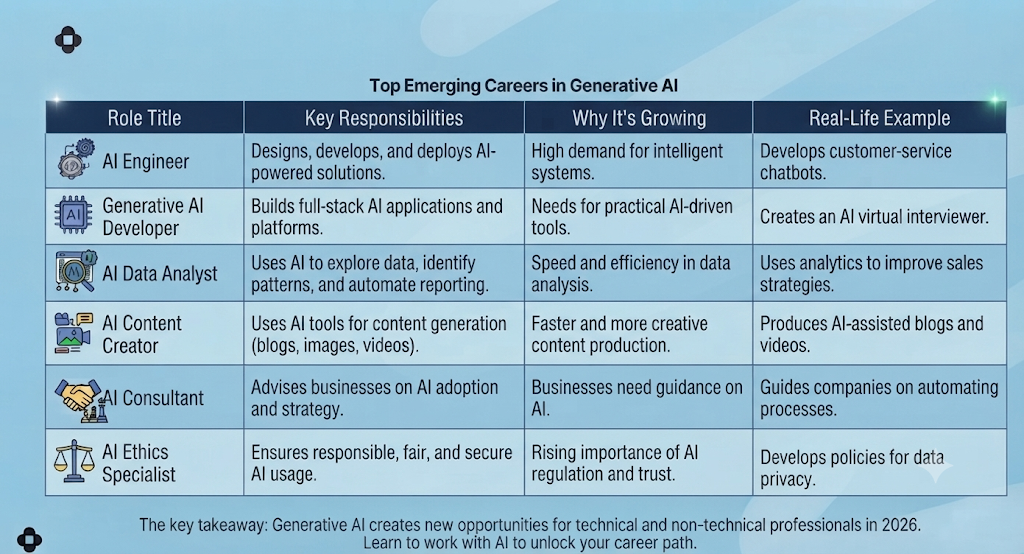
From AI Engineers and Prompt Engineers to AI Consultants, AI Data Analysts, and AI Content Creators, a new generation of careers is emerging.
Whether you are a student, fresher, or working professional, learning the right AI skills can help you stay ahead and prepare for the future of work.
Let’s explore the new job opportunities Generative AI is creating in 2026, the careers to watch, and the skills you need to build a successful AI-powered career.
Skills You Need to Build a Career in Generative AI
The good news? You don’t need to be an AI expert to get started. By combining AI knowledge with your existing skills, creativity, and industry experience, you can prepare yourself for exciting career opportunities.
Here are some important skills to learn:
1. Generative AI & LLM Fundamentals
Understand the basics of Generative AI and how Large Language Models (LLMs) work. Learn concepts like AI models, tokens, embeddings, and how AI is used in real-world applications.
2. Prompt Engineering
Learn how to write clear and effective prompts to get better results from AI tools. Good prompting helps you give better instructions, provide context, and solve complex tasks.
3. Python Programming
Python is widely used in AI and machine learning. Learning Python can help you build AI applications, work with APIs, process data, and integrate AI into software solutions.
4. Machine Learning & Data Skills
A basic understanding of machine learning, statistics, data analysis, and databases can help you understand how AI systems work and solve real-world problems.
5. AI Tools & APIs
Learn how to use modern AI platforms and APIs to build practical solutions such as chatbots, AI applications, and automated business workflows.
6. Communication & Problem-Solving
AI skills alone aren’t enough. Companies also value people who can understand business problems, communicate ideas clearly, work in teams, and find practical ways to use AI.
7. Keep Learning
Generative AI is changing every day, with new tools and technologies appearing constantly. Keep experimenting, learning, and updating your skills to stay ahead in the fast-changing AI job market.
Industries Creating AI-Powered Job Opportunities
Generative AI isn’t just changing the tech industry. From healthcare and finance to marketing, education, and retail, businesses across industries are using AI to work smarter, automate repetitive tasks, and deliver better customer experiences.
As AI adoption grows, new career opportunities are opening up for professionals who know how to use AI effectively.
Here are some of the major industries creating AI-powered job opportunities:
- Information Technology
The IT industry is leading the adoption of Generative AI. Companies are using AI to build software, automate testing, improve cybersecurity, and develop intelligent applications.
Job Opportunities:
- AI Engineers
- Machine Learning Engineers
- Generative AI Developers
- Prompt Engineers
- AI Solutions Architects
2. Healthcare
AI is helping healthcare organisations analyse information, support research, automate documentation, and improve patient experiences. Professionals who combine healthcare knowledge with AI and data skills are increasingly valuable.
Job Opportunities:
- Healthcare AI Specialists
- AI Data Analysts
- Healthcare Data Scientists
- AI Research Professionals
- AI Implementation Consultants
3. Banking and Finance
Banks and financial institutions are using AI for fraud detection, customer support, risk analysis, research, and process automation.
Job Opportunities:
- AI Financial Analysts
- AI Risk Specialists
- Data Scientists
- AI Automation Specialists
- FinTech AI Professionals
4. Marketing and Advertising
Generative AI is changing how businesses create content and connect with customers. AI is being used for campaign ideas, content creation, customer analysis, and personalised marketing.
Job Opportunities:
- AI Content Creators
- AI Marketing Specialists
- Prompt Engineers
- Marketing Data Analysts
- AI Creative Strategists
5. Education and E-Learning
AI is helping educators create personalised learning experiences, develop educational content, and provide AI-powered tutoring and support.
Job Opportunities:
- AI Education Specialists
- AI Curriculum Designers
- AI Content Developers
- E-Learning AI Consultants
- AI Learning Experience Designers
6. E-Commerce and Retail
Retail and e-commerce companies are using AI to personalise recommendations, improve customer service, create product descriptions, and understand customer behaviour.
Job Opportunities:
- AI Product Specialists
- AI Customer Experience Specialists
- Data Analysts
- AI Automation Professionals
- E-Commerce AI Consultants
7. Media and Entertainment
AI is opening new possibilities in content creation, video production, image generation, script development, audio, and digital storytelling.
Job Opportunities:
- AI Content Creators
- AI Video Specialists
- AI Creative Directors
- AI Production Specialists
- Generative AI Designers
Conclusion
Generative AI is changing not just how we work, but also the careers we can build. As businesses adopt AI, the demand for professionals who can understand and use these technologies is growing rapidly.
From AI Engineers and Prompt Engineers to AI Data Analysts, AI Consultants, and AI Content Creators, exciting new career paths are emerging. At the same time, traditional roles are evolving as professionals use AI to work smarter and solve problems faster.
The key takeaway? Generative AI is not just about technology it’s about using technology to create real value. Whether you’re a student, fresher, or working professional, developing AI skills can help you stay relevant and explore new opportunities.
By combining your existing expertise with Generative AI skills and practical experience, you can prepare yourself for the exciting career opportunities shaping the future of work in 2026 and beyond.
Final Advice
Generative AI is evolving fast, and the best time to start learning is now. You don’t need to become an expert overnight. Start with the basics, explore AI tools, and build your skills through practical projects.
If you’re a student or fresher, focus on skills like Python, data analytics, machine learning, prompt engineering, and AI tools. If you’re already working, look for ways to use AI in your current field to improve productivity and create new opportunities.
The key is to combine AI skills with what you already know. Whether you’re interested in technology, marketing, finance, healthcare, education, or business, AI can help you build a more future-ready career.
Learning through structured training, hands-on projects, and guidance from experienced professionals can make your journey easier and more effective. The right learning environment can help you turn AI concepts into practical skills that you can confidently use in real-world situations.
Learn. Experiment. Build. Keep adapting. With the right skills and practical experience, you can stay ahead of the curve and prepare for the exciting career opportunities Generative AI is creating in 2026 and beyond.
FAQ’s
1. Is Generative AI creating new job opportunities in 2026?
Yes. Generative AI is creating new roles while also transforming existing jobs. Careers such as AI Engineer, Prompt Engineer, Generative AI Developer, AI Consultant, AI Data Analyst, and AI Content Creator are gaining popularity as businesses adopt AI technologies.
2. What are the best careers in Generative AI?
Some of the most promising career options include AI Engineer, Machine Learning Engineer, Prompt Engineer, Generative AI Developer, AI Data Analyst, AI Consultant, and AI Ethics Specialist. The right career depends on your interests, technical background, and skills.
3. Do I need programming skills to start a career in Generative AI?
Not always. Some roles, such as AI Engineer and Generative AI Developer, require strong programming skills. However, roles in AI content creation, prompt engineering, marketing, and AI consulting may require less coding. You can start by learning the basics and gradually develop technical skills.
4. What skills should I learn for a career in Generative AI?
You can start with Generative AI fundamentals, prompt engineering, Python, machine learning, data analytics, AI tools, and APIs. Communication, creativity, critical thinking, and problem-solving skills are also valuable.
5. Can non-technical professionals build careers in Generative AI?
Absolutely. Generative AI is creating opportunities across marketing, finance, healthcare, education, media, and business. Professionals can combine their existing industry knowledge with AI skills to explore new career opportunities.
6. Is Prompt Engineering a good career option in 2026?
Prompt engineering is a valuable skill for working effectively with Generative AI systems. However, it is often most powerful when combined with another skill, such as programming, data analytics, content creation, marketing, or business knowledge.
7. How can I start learning Generative AI?
Start by learning the fundamentals of Generative AI and exploring popular AI tools. Then, choose a career path based on your interests and build practical skills through structured learning, hands-on projects, and real-world applications.
8. Will Generative AI replace jobs?
Generative AI is expected to automate some tasks and change how certain jobs are performed, but it is also creating new roles and opportunities. Professionals who learn to work effectively with AI can adapt to these changes and remain competitive in the evolving job market.
