

Top 20 Data Science Tools to Master in 2026 Complete Guide
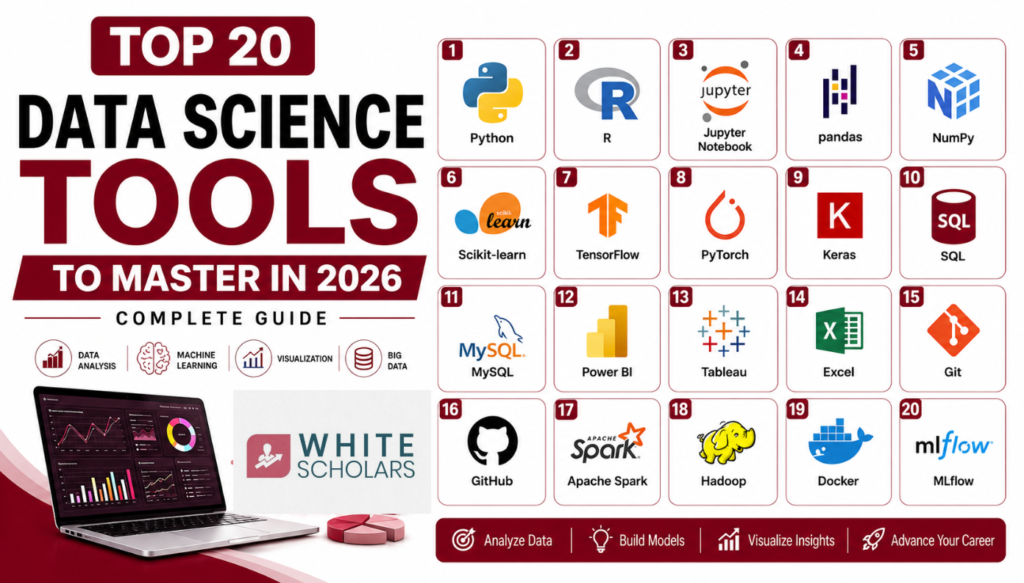
Discover the top 20 Data Science tools every aspiring data scientist should master in 2026 to analyze data, build AI models, and accelerate career growth.
What Are Data Science Tools?
Data Science is significantly changing how companies make decisions and the right Data Science tools are making this happen.
Data Science tools are used to collect, analyze, and understand data. They are also used to build machine learning models and create simple visual reports from data.
These tools help people who work with data solve problems fast and easily.
For people who are just starting out, picking the tools can be a lot to handle.
Learning a few tools that everyone in the industry uses can make things a lot easier.
People use tools like Python, SQL, Power BI, TensorFlow and Jupyter Notebook to look at data, make AI models and get ideas that’re useful for business.
This guide talks about the 20 Data Science tools that everyone who wants to be a data scientist should learn how to use in 2026.
Each Data Science tool is explained so that learners know what it can do, how it can be used and why it is important.
The skills needed for a career in Data Science are gained by learners through this.
Why Are Data Science Tools Important?
Data Science tools are effectively important for every project that uses data. They help people who work with data do their jobs better. These tools make it easier for them to collect data, clean it up, look at it, make pictures with it and understand what it means. This helps companies make decisions.
If you do not have the Data Science tools it can take a long time to manage a lot of data and make models that can learn from data and get useful information from it. The tools that most people in the industry use can do tasks automatically, make mistakes and make the whole process of working with data faster.
Data Science tools are used by many companies in areas like healthcare, finance, shopping, and advertising. These tools are used to understand data, predict future results, and solve business problems. By learning these tools, better job skills can be developed, and more career opportunities in Data Science can be achieved.
If you learn about the popular Data Science tools you can get good at using them, work on real projects and be competitive in a world where data is really important. Learning Data Science tools is an idea for people who want to work with data. They can use Data Science tools to do their jobs and be successful.
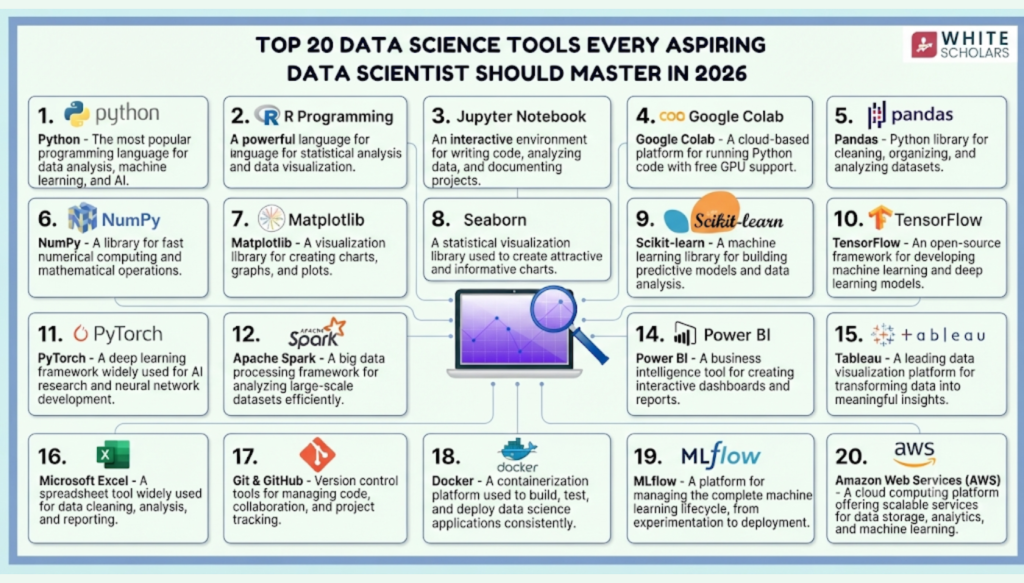
Top 20 Data Science Tools Every Beginner Should Learn in 2026
Many tools are used in Data Science for different tasks. Data is collected and analyzed with some tools. Machines are trained with machine learning tools. Charts and graphs are created to understand data better. Models are also deployed with different tools. Some tools are used for programming and statistics. Other tools are used to visualize data, work on cloud platforms, and manage large amounts of data.
There are 20 Data Science tools that people who work with data and organizations all over the world use a lot. If we know what these Data Science tools can do, how to use them and why they are important it will help people who want to work in Data Science learn the skills they need and have a start to a successful career in Data Science.
Now let’s take a look at each of these important Data Science tools.
1. Python
Python is the leading programming language for Data Science, widely used for data analysis, machine learning, AI, and automation. Its simple syntax and powerful libraries make it an essential tool for every data scientist.
Key Features:
- Easy syntax
- Rich libraries
- Cross-platform support
Applications:
- Machine Learning
- Data Analysis
- AI Development
2. R Programming
R is a programming language designed for statistical computing and data visualization. It is widely used for data analysis, predictive modeling, and research.
Key Features:
- Statistical analysis
- Advanced visualization
- Extensive packages
Applications:
- Predictive Analytics
- Research
- Financial Analysis
3. Jupyter Notebook
Jupyter Notebook is an interactive development environment used for writing, testing, and documenting code. It is ideal for data exploration and machine learning workflows.
Key Features:
- Interactive coding
- Built-in visualization
- Easy documentation
Applications:
- Data Exploration
- Model Development
- Research
4. Google Colab
Google Colab is a cloud-based platform for running Python notebooks with free GPU and TPU support. It enables data scientists to develop and train models without local setup.
Key Features:
- Cloud-based
- Free GPU/TPU
- No installation
Applications:
- Deep Learning
- AI Projects
- Data Analysis
5. Pandas
Pandas is a Python library used to clean, organize, and analyze structured data. It simplifies data preprocessing and supports multiple file formats.
Key Features:
- Data manipulation
- Fast processing
- DataFrame support
Applications:
- Data Cleaning
- EDA
- Reporting
6. NumPy
NumPy is a Python library used for fast numerical computing and array operations. It is used to perform mathematical calculations quickly and handle large datasets efficiently.
Key Features:
- High-speed arrays
- Mathematical functions
- Matrix operations
Applications:
- Data Processing
- Scientific Computing
- Machine Learning
7. Matplotlib
Matplotlib is a visualization library used to create charts and graphs from data. Data is presented in a visual format, so patterns and trends can be understood easily. Different types of plots can also be created for better data analysis.
Key Features:
- Multiple chart types
- Customizable plots
- Easy integration
Applications:
- Data Visualization
- Trend Analysis
- Reporting
8. Seaborn
Seaborn is a Python library used for creating statistical and interactive data visualizations. Attractive charts and graphs are created to make data easier to understand and analyze. Better insights can be gained from complex datasets with clear visualizations.
Key Features:
- Statistical charts
- Built-in themes
- Correlation plots
Applications:
- Exploratory Data Analysis
- Business Analytics
- Statistical Reporting
9. Scikit-learn
Scikit-learn is a machine learning library used to build and evaluate predictive models. Different machine learning models are trained, tested, and improved with simple and easy-to-use tools.
Key Features:
- ML algorithms
- Model evaluation
- Data preprocessing
Applications:
- Classification
- Regression
- Clustering
10. TensorFlow
TensorFlow is an open-source framework used to develop machine learning and deep learning models.
Key Features:
- Deep learning support
- Scalable framework
- GPU acceleration
Applications:
- Image Recognition
- NLP
- AI Solutions
11. PyTorch
PyTorch is an open-source deep learning framework widely used for AI research and neural network development.
Key Features:
- Dynamic computation
- GPU support
- Easy model building
Applications:
- Deep Learning
- Computer Vision
- NLP
12. Apache Spark
Apache Spark is a big data processing framework designed for fast and large-scale data analytics. Large amounts of data are processed quickly, and complex data tasks are handled efficiently.
Key Features:
- Fast processing
- Distributed computing
- Big data support
Applications:
- Big Data Analytics
- Data Engineering
- Real-Time Processing
13. SQL
SQL is a database language used to store, retrieve, and manage structured data efficiently. Data is organized, updated, and searched easily in relational databases using SQL.
Key Features:
- Data querying
- Database management
- High performance
Applications:
- Data Retrieval
- Reporting
- Database Analysis
14. Power BI
Power BI is a business intelligence tool used to create interactive dashboards and reports. Business data is displayed clearly, and better decisions are made with easy-to-understand visual reports.
Key Features:
- Interactive dashboards
- Data visualization
- Real-time reporting
Applications:
- Business Intelligence
- Dashboard Development
- Data Analysis
15. Tableau
Tableau is a leading data visualization tool used to transform raw data into interactive dashboards. Data is presented with clear charts, helping trends and business insights to be understood easily. Reports are created quickly, and better decisions are supported with visual data analysis.
Key Features:
- Drag-and-drop interface
- Interactive dashboards
- Multiple data sources
Applications:
- Data Visualization
- Business Analytics
- Performance Reporting
16. Microsoft Excel
Microsoft Excel is a spreadsheet application widely used for data analysis, reporting, and data management.
Key Features:
- Formulas & functions
- Pivot Tables
- Charts
Applications:
- Data Analysis
- Reporting
- Data Cleaning
17. Git & GitHub
Git and GitHub are used to manage code versions and support collaboration on data science projects. Code changes are tracked, shared, and updated easily by team members during project development.
Key Features:
- Version control
- Team collaboration
- Code management
Applications:
- Project Management
- Code Sharing
- Team Development
18. Docker
Docker is a containerization platform used to build, test, and deploy applications consistently across environments.
Key Features:
- Containerization
- Easy deployment
- Platform independence
Applications:
- Model Deployment
- Application Packaging
- Cloud Deployment
19. MLflow
MLflow is an open-source platform used to manage the complete machine learning lifecycle. Machine learning models are tracked, tested, and deployed easily throughout the entire project.
Key Features:
- Experiment tracking
- Model management
- Deployment support
Applications:
- Model Tracking
- ML Deployment
- Workflow Management
20. Amazon Web Services (AWS)
AWS is a cloud computing platform that provides scalable services for data storage, analytics, and machine learning.
Key Features:
- Cloud infrastructure
- Scalable services
- AI & ML integration
Applications:
- Cloud Analytics
- Data Storage
- Machine Learning Deployment
Real-World Applications of Data Science Tools
Data Science tools are transforming industries by helping organizations analyze data, automate processes, and make data-driven decisions. From startups to global enterprises, these tools are used to solve complex business challenges and improve operational efficiency.
Some of the most common applications include:
- Healthcare: Disease prediction, medical image analysis, and patient care.
- Finance: Fraud detection, risk assessment, and investment analysis.
- E-commerce: Product recommendations, customer segmentation, and demand forecasting.
- Marketing: Customer behavior analysis, campaign optimization, and sentiment analysis.
- Manufacturing: Predictive maintenance, quality control, and supply chain optimization.
- Transportation: Route optimization, traffic prediction, and fleet management.
Mastering these tools enables aspiring data scientists to work on real-world projects and contribute to data-driven decision-making across diverse industries.
Conclusion
Building a successful career in Data Science starts with learning the right tools. Python, SQL, TensorFlow, and Power BI are widely used for data analysis, machine learning, AI, and data visualization. Gaining hands-on experience with these tools through real-world projects helps build practical skills and prepares you for industry challenges. For those looking to develop these skills in a structured way, a Data Scientist Course Hyderabad offered by Whitescholars Academy can provide practical exposure alongside self-learning. As Data Science continues to evolve, staying updated with new technologies and continuously improving your skills is essential for long-term career growth.
Frequently Asked Questions (FAQs)
1. Which is the best programming language for Data Science?
Python is the most widely used programming language for Data Science due to its simplicity, extensive libraries, and strong support for machine learning, AI, and data analysis.
2. Is SQL important for Data Science?
Yes. SQL is essential for retrieving, managing, and analyzing data stored in relational databases, making it one of the core skills required for data science roles.
3. Which Data Science tool is best for beginners?
Python, Jupyter Notebook, Pandas, and Microsoft Excel are excellent starting points because they are beginner-friendly and widely used in real-world projects.
4. Are Data Science tools used in industries other than IT?
Yes. Data Science tools are widely used in healthcare, finance, retail, manufacturing, education, marketing, and many other industries to analyze data and support decision-making.
5. How long does it take to learn Data Science tools?
The learning duration depends on the individual’s background and practice. With consistent learning and hands-on projects, beginners can develop a strong foundation within a few months.
