

Top 10 Data Scientist Skills Companies Want in 2027
August 16, 2026
What Does a Data Scientist Really Do?
A data scientist uses data to solve problems, discover patterns, make predictions, and support better business decisions. The work usually involves collecting and cleaning data, analyzing it, building models, and presenting useful insights.
For example, a company may use data science to predict customer behavior, detect fraud, recommend products, or improve business performance.
As AI and automation continue to grow, the role of data scientists is also changing. In 2027, companies will look for professionals who can combine technical skills, AI knowledge, problem-solving, and business understanding to turn data into meaningful results.
Why Data Science Skills Are Changing in 2027
Data science is changing quickly as AI, automation, and big data become part of everyday business. Companies are no longer looking only for professionals who can analyze data or build machine learning models.
They also want data scientists who can work with Generative AI, understand cloud technologies, solve real business problems, and communicate insights clearly.
This shift means aspiring data scientists need to build a combination of strong fundamentals and modern skills to stay relevant and job-ready in 2027.
Top 10 Data Scientist Skills Companies Will Look for in 2027
The data science field is becoming more advanced, but the most valuable skills are not always the most complicated ones. Companies need data scientists who can understand data, use modern technology, solve real problems, and turn complex information into clear decisions.
The following are the top 10 skills that aspiring data scientists should develop to stay competitive in 2027.
1. Python Programming
Python is a core data science skill used for data preprocessing, exploratory data analysis (EDA), machine learning, and automation.
Data scientists commonly work with libraries such as NumPy, Pandas, Matplotlib, Seaborn, and Scikit-learn to manipulate data, visualize patterns, and build predictive models.
In 2027, strong Python knowledge will remain important for developing data pipelines, ML workflows, and AI applications.
2. SQL and Database Management
SQL is essential for querying, filtering, joining, and analyzing structured data stored in databases.
Data scientists use SQL to work with large datasets, create aggregations, and prepare data for analysis and machine learning. Knowledge of JOINs, subqueries, CTEs, window functions, and indexing can make data retrieval more efficient.
Strong SQL skills help data scientists work effectively with real-world business data and modern data platforms.
3. Statistics and Probability
Statistics and probability provide the foundation for understanding data, identifying patterns, and evaluating predictions.
Data scientists use concepts such as hypothesis testing, probability distributions, correlation, regression, confidence intervals, and statistical significance when analyzing datasets and building models.
Strong statistical knowledge helps ensure that data-driven conclusions are reliable, measurable, and meaningful.
4. Machine Learning
Machine learning enables data scientists to build systems that learn patterns from data and make predictions or decisions.
Key areas include supervised learning, unsupervised learning, classification, regression, clustering, and model evaluation. Common algorithms include linear regression, decision trees, random forests, and gradient boosting.
In 2027, companies will value data scientists who can select the right models, evaluate performance, reduce overfitting, and apply machine learning to real-world problems.
5. Data Visualization
Data visualization helps data scientists identify patterns, trends, and relationships that may not be obvious in raw data.
Tools such as Matplotlib, Seaborn, Plotly, and Power BI are commonly used to create charts, dashboards, and interactive reports.
Strong visualization skills help data scientists turn complex analysis into clear, actionable insights that business teams can understand and use.
6. Generative AI and Large Language Models
Generative AI and Large Language Models (LLMs) are becoming important parts of modern data science workflows.
Data scientists may work with LLMs, prompt engineering, embeddings, vector databases, RAG, and AI APIs to build intelligent data applications.
Understanding how these technologies work can help data scientists develop AI-powered analytics, automated workflows, and intelligent applications.
7. Data Cleaning and Feature Engineering
Real-world datasets often contain missing values, duplicates, outliers, and inconsistent formats. Data cleaning prepares this information for reliable analysis and modeling.
Feature engineering involves creating or transforming variables to improve machine learning performance.
Knowledge of imputation, encoding, scaling, outlier treatment, and feature selection is essential for building effective models.
8. Cloud Computing and Big Data
Modern data science often involves datasets that are too large for traditional local systems. Cloud platforms provide the storage, computing power, and scalability needed to process such data.
Data scientists can benefit from knowledge of platforms such as AWS, Microsoft Azure, and Google Cloud, along with technologies such as Spark and distributed data processing.
Cloud skills can help data scientists work efficiently with large-scale machine learning and data pipelines.
9. Business and Problem-Solving Skills
Technical skills alone do not make a successful data scientist. Companies also need professionals who can understand business problems and convert them into data-driven solutions.
This includes defining the right problem, selecting relevant data, identifying useful metrics, and interpreting results.
Strong problem-solving skills help ensure that data science projects create real business value rather than just accurate models.
10. Communication and Data Storytelling
Data scientists often need to explain technical findings to managers, clients, and non-technical teams.
Data storytelling combines visualization, context, and clear communication to explain what the data means and why the findings matter.
Strong communication skills help data scientists turn complex technical results into clear recommendations and actionable business decisions.
Which Skills Should Beginners Learn First?
Beginners do not need to learn everything at once. A step-by-step approach can make the learning process easier:
- Start with Python – Learn programming basics and essential data science libraries.
- Learn SQL – Practice querying, filtering, joining, and analyzing databases.
- Build Statistics Knowledge – Understand probability, distributions, correlation, and hypothesis testing.
- Learn Data Visualization – Practice presenting data using charts and dashboards.
- Move to Machine Learning – Learn algorithms, model training, evaluation, and optimization.
- Explore Generative AI – Understand LLMs, prompt engineering, embeddings, and RAG.
- Learn Cloud and Big Data – Gain basic knowledge of cloud platforms and distributed data processing.
- Develop Business Skills – Learn how to connect data insights with real business problems.
- Improve Communication – Practice explaining technical findings in a simple and clear way.
How to Become Job-Ready as a Data Scientist in 2027
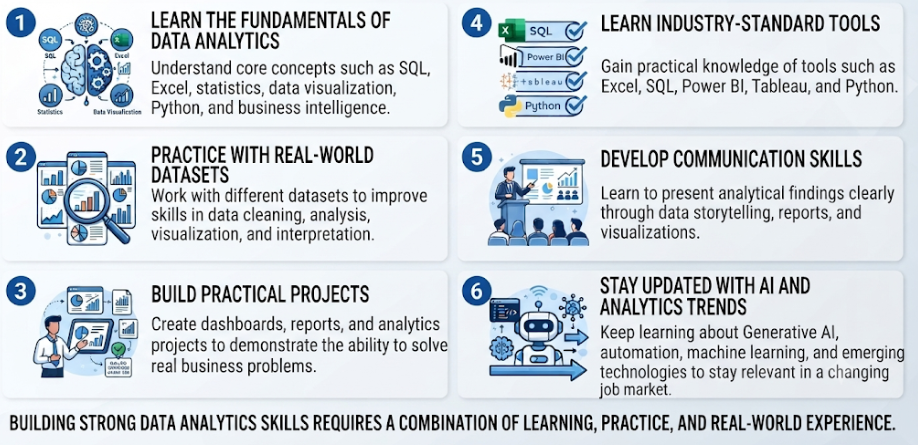
Becoming job-ready requires more than completing courses. Aspiring data scientists can focus on practical skills and real-world experience.
- Build strong fundamentals in Python, SQL, statistics, and machine learning.
- Work on real-world projects that involve data cleaning, analysis, modeling, and visualization.
- Create an impressive portfolio with projects that demonstrate practical problem-solving.
- Learn modern AI tools such as LLMs, embeddings, and RAG.
- Understand cloud platforms and basic data engineering concepts.
- Practice explaining projects clearly to both technical and non-technical audiences.
- Prepare for interviews by practicing SQL, statistics, machine learning, and real-world case studies.
Conclusion
Data science is evolving rapidly, and the skills companies value in 2027 will go beyond traditional data analysis and machine learning. Python, SQL, statistics, machine learning, Generative AI, cloud technologies, and communication will all play an important role.
Aspiring data scientists who build strong fundamentals, work on real-world projects, and stay updated with emerging technologies can become better prepared for the changing job market.
For learners looking for structured guidance, a Data Scientist course in Hyderabad can provide practical training, industry-focused skills, and hands-on project experience. Whitescholars in Hyderabad can be a useful option for learners who want to develop their data science skills and prepare for career opportunities in this growing field.
The goal is not to master every tool at once. It is to build the right skills, apply them to real problems, and keep learning as data science continues to evolve.
Frequently Asked Questions (FAQs)
1. What are the most important skills for a data scientist in 2027?
Python, SQL, statistics, machine learning, Generative AI, data visualization, and problem-solving are among the key skills expected to remain valuable.
2. Is Python enough to become a data scientist?
No. Python is an important foundation, but data scientists also need knowledge of SQL, statistics, machine learning, data visualization, and business problem-solving.
3. Will Generative AI be important for data scientists in 2027?
Yes. Knowledge of LLMs, prompt engineering, embeddings, RAG, and AI APIs can help data scientists build modern AI-powered solutions.
4. Do data scientists need to learn cloud computing?
Cloud knowledge is increasingly useful because many organizations process and store large datasets using cloud platforms such as AWS, Azure, and Google Cloud.
5. Can beginners learn data science without a computer science background?
Yes. A structured learning path covering Python, SQL, statistics, machine learning, and practical projects can help beginners build the required foundation.
