

How Generative AI Is Changing Data Science in 2026
August 10, 2026
Generative AI is transforming data science in 2026 and 2027 by automating analysis, accelerating insights, and helping data scientists build smarter solutions faster.
Introduction
Generative AI is rapidly changing how data scientists work in 2026 and 2027. Tasks that once required hours of manual effort, such as writing code, cleaning data, generating insights, creating visualizations, and documenting models, can now be completed faster with AI-powered tools.
Instead of replacing data scientists, Generative AI is becoming an intelligent assistant that helps professionals focus on problem-solving, model development, experimentation, and business decision-making.
From automated Python and SQL code generation to natural language data analysis and AI-assisted machine learning, Generative AI is becoming an important part of the modern data science workflow. This transformation is also increasing the demand for professionals who combine strong data science fundamentals with Generative AI skills.
Benefits of Generative AI for Data Scientists in 2026
Generative AI is providing data science professionals with practical benefits across development, analysis, and decision-making.
1. Reduced Development Time
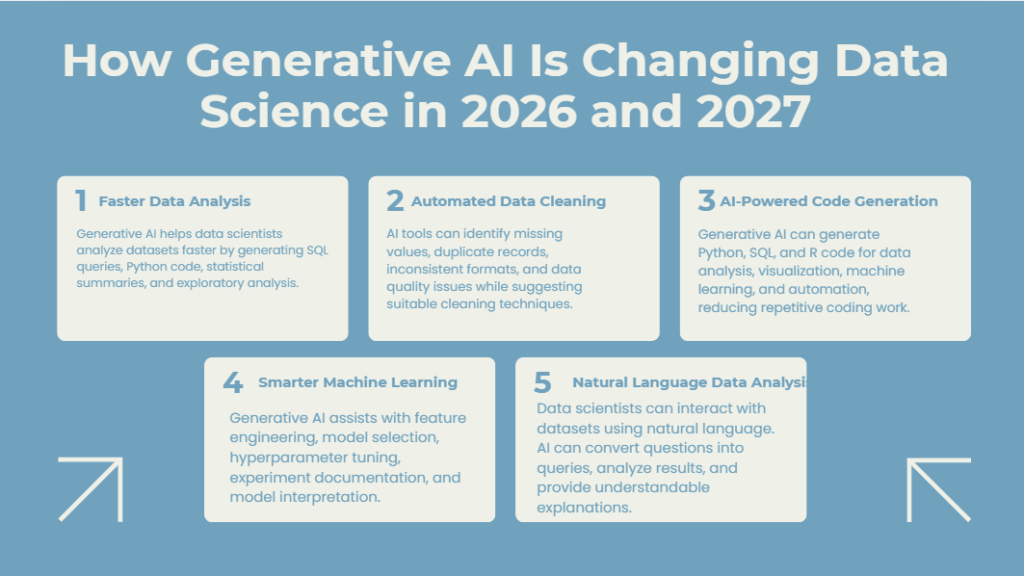
AI can generate code, queries, documentation, and analysis templates, allowing data scientists to complete routine tasks faster.
2. Higher Productivity
Automating repetitive activities gives data scientists more time to focus on complex problems, experimentation, and business insights.
3. Faster Experimentation
Generative AI can quickly suggest models, features, algorithms, and analytical approaches, helping teams test multiple ideas efficiently.
4. Improved Accessibility
Natural language interfaces make data analysis easier for professionals who may not have advanced programming or SQL skills.
5. Better Collaboration
AI-generated explanations, documentation, and summaries can help technical and non-technical teams understand data science results more clearly.
Skills Data Scientists Need in the Generative AI Era
As Generative AI becomes part of modern data science workflows, professionals need a combination of traditional data skills and AI-focused capabilities.
1. Python and SQL
Strong Python and SQL skills remain essential for data manipulation, analysis, machine learning, and database operations.
2. Machine Learning Fundamentals
A solid understanding of supervised learning, unsupervised learning, model evaluation, and feature engineering helps professionals use AI tools effectively.
3. Generative AI and LLMs
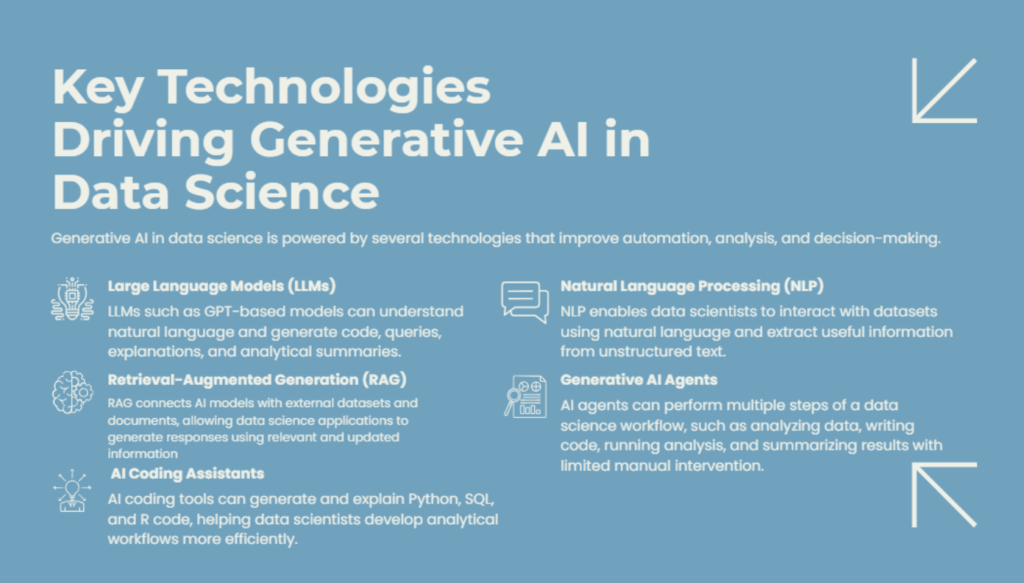
Knowledge of LLMs, embeddings, RAG, AI agents, and model limitations is becoming increasingly valuable for modern data science roles.
4. Prompt Engineering
Data scientists need to create clear and structured prompts to obtain accurate code, analysis, explanations, and insights from Generative AI tools.
5. Data and AI Ethics
Understanding privacy, bias, hallucinations, security, and responsible AI practices is essential when using Generative AI with real-world data.
Challenges of Using Generative AI in Data Science
Despite its growing impact, Generative AI also introduces several challenges in data science. AI-generated code and insights can sometimes contain errors, incorrect assumptions, or hallucinations, making human validation essential. Data privacy is another concern, especially when AI tools are used with sensitive customer or business information.
Generative AI can also produce biased results when the underlying models or data contain bias. Overdependence on AI may reduce the importance given to core skills such as statistics, programming, and critical thinking. In addition, understanding how an AI model arrives at a particular output can be difficult, creating explain ability concerns in areas where decisions need to be transparent.
For this reason, data scientists need to treat Generative AI as an assistive technology rather than a replacement for human expertise. Careful validation, responsible data handling, and strong technical knowledge remain essential for reliable data science.
Real-World Applications of Generative AI in Data Science
Generative AI is already being applied across different stages of data-driven work. In healthcare, it can assist with clinical data analysis and generate summaries from large volumes of medical information. In finance, AI can support fraud analysis, risk assessment, and automated reporting.
In retail and e-commerce, Generative AI can analyze customer behavior, summarize purchasing patterns, and support personalized recommendations. In marketing, it can combine customer and campaign data to generate insights and identify potential trends.
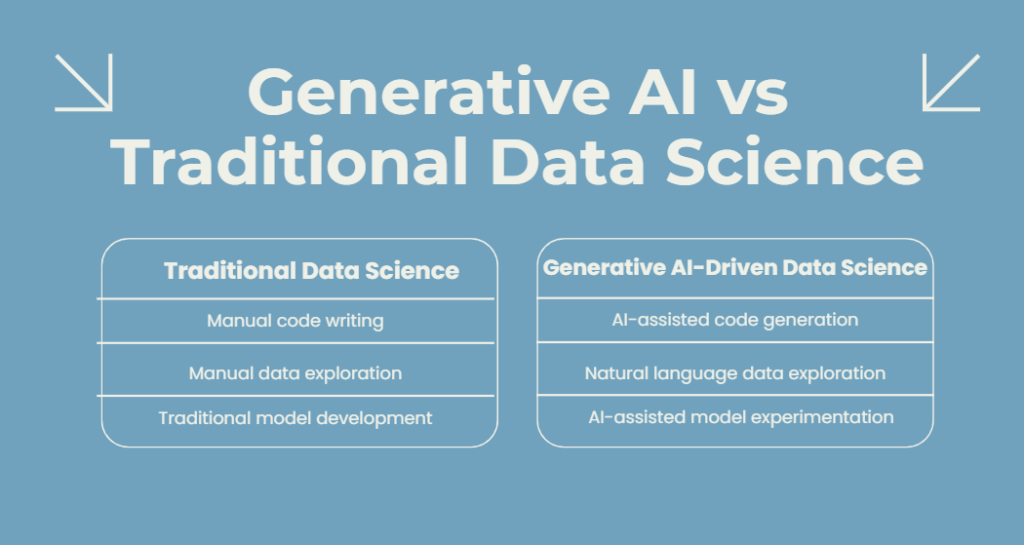
Another important application is business intelligence, where Generative AI allows users to ask questions about company data in natural language and receive analytical summaries. These applications show how Generative AI is moving data science beyond traditional coding and statistical analysis toward more interactive and automated workflows.
How Generative AI Is Changing the Role of a Data Scientist
The role of a data scientist is gradually shifting from performing every technical task manually to designing, guiding, and validating AI-assisted workflows. Generative AI can handle repetitive activities such as writing initial code, generating SQL queries, documenting experiments, and summarizing datasets.
This allows data scientists to spend more time on higher-value responsibilities, including defining the right business problem, selecting appropriate analytical methods, evaluating model performance, and communicating insights to stakeholders.
As a result, future data scientists will need more than programming and machine learning knowledge. Critical thinking, domain expertise, AI literacy, data ethics, and the ability to validate AI-generated results will become increasingly important skills in the profession.
How to Prepare for a Data Science Career in 2026
The growing use of Generative AI does not reduce the importance of core data science skills. Professionals still need a strong foundation in Python, SQL, statistics, machine learning, data visualization, and data handling, while also developing an understanding of LLMs, Generative AI, prompt engineering, and AI-assisted workflows.
For learners looking for structured training, a Data Scientist course in Hyderabad can provide a practical way to build these skills through guided learning and real-world projects. WhiteScholars offers a job-ready Data Science program covering areas such as Python, machine learning, SQL, statistics, data visualization, and AI-related concepts.
The most effective approach is to learn how to work with AI rather than depend entirely on it. Professionals who combine strong fundamentals with practical Generative AI skills can be better prepared for the changing requirements of data science roles in 2026.
Conclusion
Generative AI is changing data science by automating repetitive tasks, accelerating analysis, supporting machine learning workflows, and making data interaction more accessible. In 2026, data scientists are increasingly working alongside AI tools rather than performing every stage of a project manually.
However, successful AI-powered data science still depends on human expertise. Professionals need to understand the data, validate AI-generated results, identify potential bias, and make informed decisions based on business requirements.
The future of data science will therefore belong to professionals who can combine strong technical fundamentals with Generative AI capabilities. Building these skills through practical projects, continuous learning, and structured training can help aspiring professionals stay prepared for the evolving data science landscape.
Frequently Asked Questions
1. How is Generative AI changing data science in 2026?
Generative AI is automating tasks such as code generation, data analysis, documentation, visualization, and machine learning experimentation, allowing data scientists to work more efficiently.
2. Will Generative AI replace data scientists?
Generative AI is unlikely to completely replace data scientists. Instead, it is changing their responsibilities by reducing repetitive work and increasing the importance of problem-solving, validation, domain knowledge, and AI skills.
3. What skills should data scientists learn in 2026?
Data scientists should strengthen Python, SQL, statistics, machine learning, and data visualization skills while learning Generative AI, LLMs, prompt engineering, RAG, and AI agents.
4. Is Generative AI useful for beginners in data science?
Yes. Generative AI can help beginners understand code, explore datasets, generate SQL queries, and learn analytical concepts. However, fundamental data science knowledge remains important.
5. What is the future of data science with Generative AI?
The future is expected to involve greater automation and AI-assisted workflows, with data scientists focusing more on complex problem-solving, model validation, business strategy, and responsible AI implementation.