

15 Real-World Data Science Projects for Your Portfolio in 2026 & 2027

Wondering how data scientists are staying ahead as AI reshapes the industry? Discover the skills, tools, and projects needed to become AI-ready in 2026.
What Is an AI-Ready Data Scientist?
An AI-ready data scientist is more than someone who works with data. They know how to combine data, AI, and business thinking to solve real-world problems. Instead of simply analyzing what happened, they can use technology to uncover patterns, make predictions, and build smarter solutions.
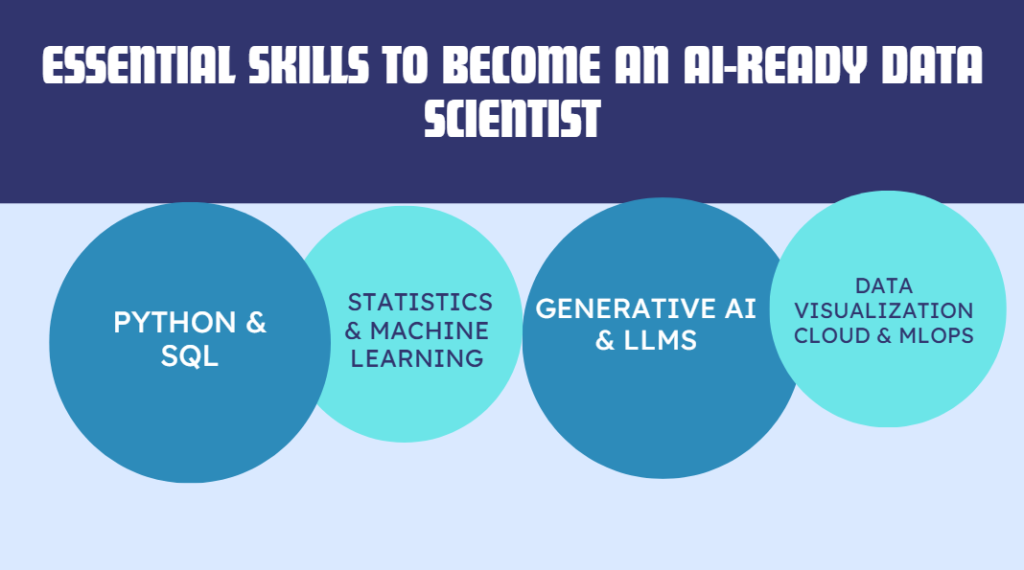
This requires a strong mix of Python and SQL, machine learning, Generative AI and LLMs, data visualization, cloud technologies, and MLOps. Together, these skills help Data Science Projects for Your Portfolio move from simply working with data to creating solutions that can make a real difference.
Why Data Scientists Need AI Skills in 2026
AI is no longer a skill that data scientists can treat as optional. It is becoming part of how data is analyzed, models are developed, and business problems are solved. Modern data scientists are increasingly using AI to work more efficiently, automate repetitive tasks, uncover deeper insights, and build smarter solutions.
Include skills such as:
- Python and SQL
- Statistics and probability
- Machine learning
- Generative AI and LLMs
- Prompt engineering
- RAG (Retrieval-Augmented Generation)
- AI APIs
- Data visualization
- Cloud platforms
- MLOps and model deployment
- Git/GitHub
- Communication and business understanding
This makes the article more comprehensive and gives Google more relevant topical coverage.
The shift can be seen clearly:
Traditional Data Science → Data Science + AI → AI-Ready Data Scientist
Learning AI does not mean replacing core data science skills. Instead, it adds another layer of capability, helping data scientists work smarter, solve more complex problems, and stay prepared for the changing demands of the industry.
Generative AI, LLMs, and RAG
Generative AI & LLMs: How data scientists use models such as LLMs to build intelligent applications, automate analysis, extract information, summarize data, and create natural-language interfaces.
RAG: Explain that Retrieval-Augmented Generation allows an AI application to retrieve relevant information from company documents, databases, or knowledge bases before generating an answer.
Also mention technologies such as:
- Embeddings
- Vector databases
- LangChain or similar frameworks
- AI APIs
- Evaluation of LLM outputs
Don’t make this section too technical.
Data Quality and AI Readiness
You can explain that AI systems are only as reliable as the data behind them. An AI-ready data scientist should understand:
- Data cleaning
- Missing values
- Data validation
- Data governance
- Data privacy
- Bias detection
- Data lineage
- Feature quality
This connects traditional data science with modern AI.
Data Scientist Career Roadmap for 2026
Your conclusion currently tells beginners to start with fundamentals, but a roadmap would make the article much more actionable.
Easy way to learn Data Scientist :
Step 1: Python + SQL
↓
Step 2: Statistics + Data Analysis
↓
Step 3: Machine Learning
↓
Step 4: Generative AI + LLMs
↓
Step 5: Cloud + Deployment
↓
Step 6: MLOps
↓
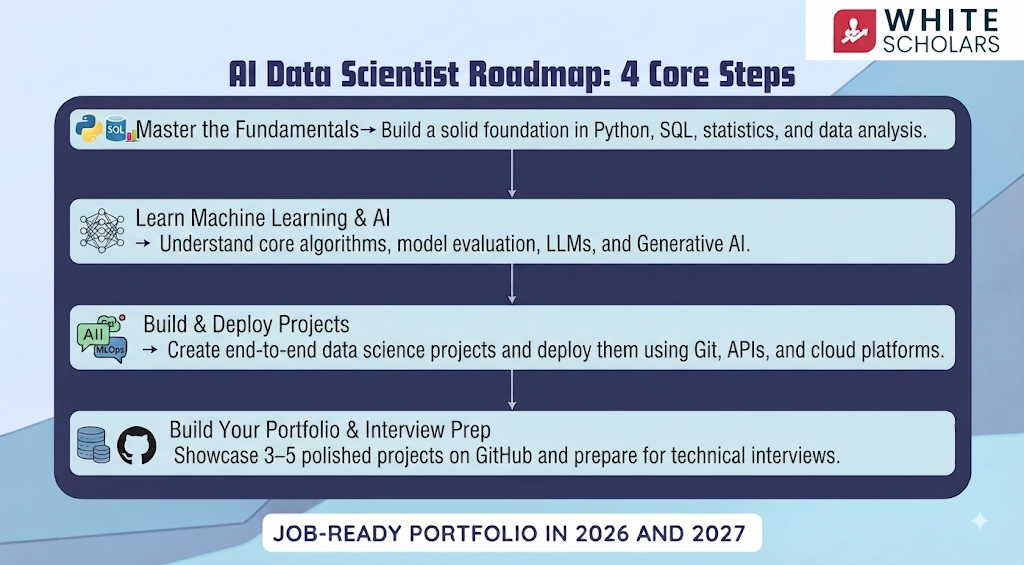
Step 7: Build 3–5 portfolio projects
↓
Step 8: Resume + GitHub + Interview preparation
Tools and Technologies to Learn
The goal is not to learn every tool available. It is about understanding which tools are useful and when to use them. The key technologies can be grouped into two areas:
- Data Science & Machine Learning: Python and SQL provide the foundation, while Pandas, NumPy, and Scikit-learn support data preparation and machine learning. TensorFlow and PyTorch are useful for deep learning.
- AI, Visualization & Deployment: Hugging Face and AI APIs support Generative AI and LLM applications, while Power BI and Tableau help present insights clearly. Git, GitHub, AWS, Azure, and Google Cloud support collaboration, deployment, and real-world applications.
AI and Machine Learning Projects to Build
Want to stand out as an AI-ready data scientist? Projects are where skills turn into proof. Instead of building only basic models, focus on projects that solve realistic problems.
- Customer Churn Prediction – Predict which customers are likely to leave.
- AI Resume Analyzer – Use NLP and LLMs to analyze resumes and identify relevant skills.
- Sales Forecasting Dashboard – Predict future sales and present insights using Power BI.
- Sentiment Analysis – Analyze customer reviews or social media feedback.
- Recommendation System – Build personalized product, movie, or content recommendations.
- AI-Powered Chatbot – Create a chatbot that can understand questions and respond using real-world data.
- Fraud Detection System – Identify unusual transactions using machine learning.
- Customer Segmentation – Group customers based on their behavior and purchasing patterns.
How to Build a Job-Ready Data Science Portfolio
A resume can state that you know data science, but a strong portfolio can demonstrate the skills and projects you have built, making your profile more memorable to recruiters.
Instead of adding dozens of basic projects, a job-ready portfolio should focus on 3–5 meaningful projects that demonstrate practical skills. Each project should clearly cover:
- Problem: What real-world challenge does it solve?
- Data: What dataset was used and how was it prepared?
- Tools: Which technologies were used?
- Approach: How was the problem analyzed or solved?
- Results: What did the analysis or model achieve?
- Impact: How could the solution help a business?
Projects can then be showcased on GitHub with clean code, a clear README, useful visualizations, and well-explained results. A portfolio becomes much stronger when it shows not only what was built, but also why it matters.
Common Mistakes Beginners Should Avoid
- Learning too many tools at once – Build strong fundamentals first.
- Only watching tutorials – Practice by building real projects.
- Ignoring SQL and statistics – Both remain essential data science skills.
- Copying projects – Understand the problem, process, and results.
- Chasing every AI trend – Focus on skills with long-term value.
- Building projects without purpose – Choose projects that solve real problems.
- Ignoring communication skills – Learn to explain technical insights clearly.
Conclusion
Becoming an AI-ready data scientist in 2026 is about combining strong data science fundamentals with practical AI skills. Python, SQL, machine learning, Generative AI, cloud technologies, and real-world projects can help aspiring professionals stay competitive in a rapidly changing industry.
The journey does not require learning everything at once. Start with the fundamentals, build meaningful projects, keep learning, and continuously improve. For learners looking for structured guidance, a data science institute in Hyderabad such as WhiteScholars Academy can be one choice to explore while building these skills. With the right knowledge, hands-on practice, and a strong portfolio, a beginner can take confident steps toward a successful data science career.
Frequently Asked Questions (FAQs)
1. What is an AI-ready data scientist?
An AI-ready data scientist combines traditional data science skills with modern AI technologies such as Generative AI, LLMs, NLP, and AI APIs.
2. What skills are needed to become an AI-ready data scientist?
Python, SQL, statistics, machine learning, data visualization, Generative AI, cloud technologies, and basic MLOps are valuable skills to develop.
3. Is Python enough to become a data scientist?
Python is an important foundation, but data scientists also need SQL, statistics, machine learning, data visualization, and problem-solving skills.
4. Which AI tools should data scientists learn in 2026?
Tools and platforms such as Hugging Face, AI APIs, PyTorch, TensorFlow, and cloud AI services can help data scientists work with modern AI applications.
5. How many projects should a data science portfolio have?
A focused portfolio with 3–5 high-quality, real-world projects is often more effective than having many simple or incomplete projects.
