

How Data Analysts Can Use AI Without Losing Analytical Skills
Introduction
Artificial intelligence (AI) is changing the way data analytics is done. From writing SQL queries to generating reports AI helps data scientists to work more efficiently. However an important question is how data analysts can use AI without losing their analytical skills.
AI makes you faster – More subtly makes you wrong. The difference is in the approach.
A few years ago a tricky SQL window function would require a lot of research looking at documentation trying different things and making errors. Now one can just describe the problem in words and get working code in seconds. While this is a step forward there is a hidden danger – a loss of learning chances.
The analysts who will succeed are those who use AI, not the way around.
Here are some important tips on how data analysts can use AI without losing their skills.
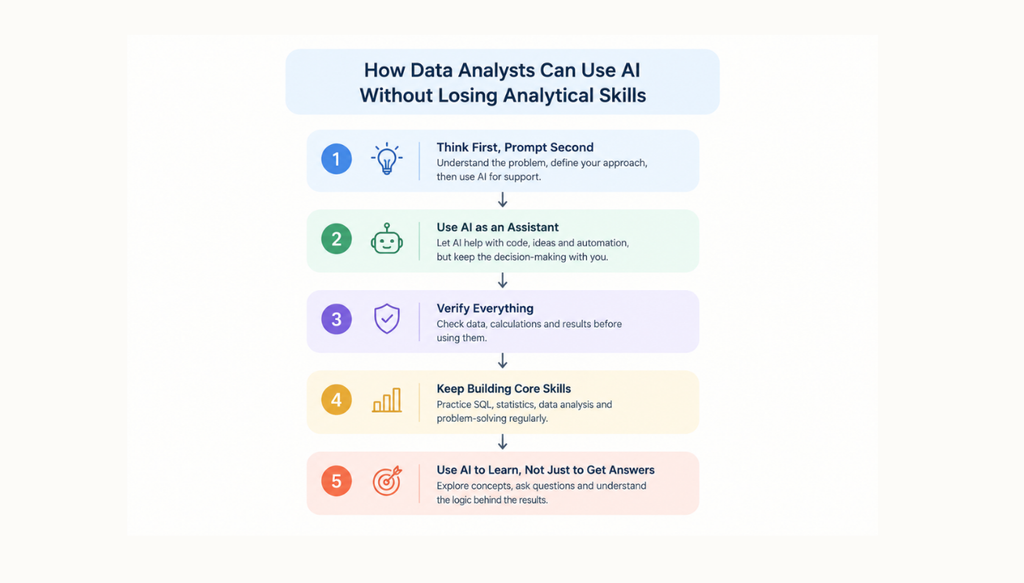
1. Think first prompt second
Before using the chatbot take a moment to write down your thoughts:
- What question are we trying to answer?
- What data do we have and what level of detail should the result be at?
- What would a reasonable answer look like? What size?
Then use AI to compare and check its results against your thoughts.
Using AI without thinking leads to results that’re not useful. When the AI suggests a solution you need to have your idea to evaluate the response properly.
2. Know the Difference Between AI As An Assistant. Ai As A Replacement
AI can be a tool for data analysts but it is important to remember that it only understands what it is taught. AI should be treated as an assistant for data analysts not as a replacement for data analysts skills. For example if the AI notices a drop in sales the analyst should check factors that might be causing the drop, such as seasonal changes, pricing decisions, customer behavior and the supply chain.
How to do this in life:
- Ask AI for help coming up with ideas, not final answers
- Always check AI’s suggestions carefully
- Make sure the results are correct with real information
- Make a final decision based on proof
The main point is that data analysts should always be in control of the analysis process to make sure the results are correct and the work is more efficient.
3. Check Everything That Matters
Treat AI code like any code from a new developer. In short, always check the results. You need to do this to make sure the code works and has no mistakes. Here are some ways to develop a habit:
- Check the number of rows. Does the result have the number of rows you expect? Did a join cause many rows?
- Compare totals with a known number, like a month’s report or a simple COUNT().
- Make sure it handles cases. Nulls, duplicates, time zones and empty groups often cause problems in generated code
- Look through the code. If you can’t explain a line of code you don’t understand it. Ask the AI to explain it and as importantly check the explanation.
Checking is a skill and like any skill it needs to be practiced. The important part of checking is being able to see when something is not right which is a skill best learned through experience.
4. Improve Your SQL and Data Analysis Skills
SQL is a part of any data analyst’s work. This is because SQL is used to get, filter, join and look at data. While AI can create SQL code quickly, data analysts should still know SQL well to make sure the code is correct and works well.
Relying on AI to make code without understanding it can lead to mistakes, slow queries and trouble with more complicated SQL tasks. To get better at SQL practice writing queries without using AI tools. Here are some areas to focus on:
- Filtering and sorting data
- Joins, subqueries and common table expressions
- Aggregation and window functions
- Handling duplicates and missing data
- Checks and making the code better
The same goes for other data analysis tools and programming languages such as Excel, Python, Power BI and more. For example, using AI to make a data model or a picture you can try using Excel formulas or Python scripts. Practice helps you learn tools and get better at using the language and its rules.
A good way to practice your thinking skills is to try a data challenge on your own and then ask AI for another way. This lets you see how AI deals with problems while also practicing your skills.
5. Do the Simple Tasks Keep the Judgment
Some jobs are good to give to AI while others are not. Here is a list of some bad tasks for AI:
Good tasks for AI:
- Repetitive code and simple data tasks
- Regular expressions, date math and other rare operations
- Final versions of reports and data descriptions
- Formatting charts, tables and text fields
- Brainstorming or thinking of new ways to look at data
Tasks for people:
- Deciding what to measure and what question to ask
- Picking the right method and knowing its limits
- Looking at the results and seeing what is wrong
- Deciding what to suggest and what not to suggest
- Explaining the results clearly and defending them
By giving the first set of tasks to AI a data analyst can save time and avoid the problem of copying AI.. If a data analyst gives the second set of tasks to AI they will miss out on learning important skills.
6. Keep Your Data Private and Safe
Data analysts often work with customer data, financial records, employee information and other sensitive business files. Before using any AI tools it is important to make sure that private information remains safe and not shared. One of the dangers of using AI tools is the risk of data leaks. To reduce this risk data analysts should do the following:
- Follow company rules and data protection laws
- Use approved AI platforms or tools
- Make sure that private data is not sent or uploaded without permission
- Follow the company policies and guidelines
- Remove personal details from data sets before using them with AI
Remember using AI responsibly is a key skill for a data analyst. This is because privacy, safety and ethics are always important when working with data.
7. Learn to Ask Better Questions and Use Better Prompts
One of the ways a data analyst can get better is by asking better questions. In this way, asking the right questions can improve the analysis. For example a vague request like “analyzing this data” is not as good as a request like “monthly sales by category and region.” Here is an example of a request:
Objective: Find what causes sales to drop
Context: Sales by category and region each month
Requirements: Look at trends. Compare by category and region. What stands out?
Output: Evidence and explanation. Explain the limits.
As you can see, a clear request can help AI give results. With a good request a data analyst still has to check the results to make sure they are correct. In short, even the best requests are not perfect.
Learning how to ask questions is also a key skill for a data analyst. This is because it helps them think deeply about the data and information they work with.
8. Follow a Balanced Routine to Keep Analytical Skills Sharp
Using data analysis with AI is not bad. In fact it can help build habits like checking and testing results. However the best way to make sure you don’t depend much on one tool is to practice the skills that help you understand, check and improve its results.
9. Work on Projects Without Relying Much on AI
Working on projects is a great way for data analysts to practice their skills. It is also a way to test their skills without depending too much on AI. There are types of projects like looking at sales data, customer data, marketing results or financial reports. Here are some steps to take when working on a project:
- Define the problem. Set goals
- Decide what the project includes
- Look at the data. Find any issues
- Clean the data
- Use SQL, Excel or another tool to do the analysis
- Make charts or a dashboard
- Explain the results. Suggest ideas
- Ask AI to check the analysis and suggest changes
For example when working on a sales project you might look at sales by category and region to find trends, seasonal changes and strange results. After checking the data you can also use AI to ask questions and find new areas to explore. This helps you get better at your skills and build a portfolio at the same time.
10. Focus, on the Skills That AI Cannot Replace
As mentioned above AI should be used as an assistant rather than a replacement for a data analyst’s expertise. In particular there are skills that a data analyst must develop, such as business knowledge, critical thinking, communication skills and so on. AI can be used to support and augment these skills. It cannot replace them. Below is a list of some skills that a data analyst must develop:
Business knowledge:
A strong business sense is one of the most important skills that a data analyst can have. This is because it enables an individual to identify drivers and ask the right questions. Having an understanding of the industry one works in can prove to be invaluable in many situations.
Critical thinking:
This skill is useful because it enables one to evaluate information and make judgments. A data analyst with critical thinking skills can assess the validity and relevance of data, detect any inconsistencies and draw logical conclusions.
Communication:
Strong verbal and written communication skills are important because they enable one to convey ideas and concepts clearly and concisely. This is particularly useful when dealing with -technical audiences.
Problem-solving:
A good problem-solving skill set is useful because it enables one to identify and resolve issues. This is important in data analytics because it can help one to tackle situations and come up with effective solutions.
Ethics:
Having an ethical and moral compass is important because it enables one to take responsibility for one’s actions. This is important in data analytics because the decisions that one makes can have an impact on the business.
Decision-making:
The ability to make judgments and decisions based on data is another crucial skill for a data analyst. This is because it enables one to recommend solutions while taking into account the limitations and uncertainties of the data.
Build Practical Data Analytics Skills with WhiteScholars Academy
At WhiteScholars Academy, students learn how to use AI tools effectively while developing strong analytical thinking and problem-solving skills. Our practical training helps learners understand data analysis, SQL, Python, and real-world projects. If you are looking for a Data Analytics Course in Hyderabad, WhiteScholars Academy helps you build the technical knowledge and practical experience needed to prepare for a career in data analytics.
Conclusion
AI is changing the practice of data analytics. In particular it is making coding, reporting, visualizations and other tasks more accessible and efficient. With that said, strong analytical skills are still required to frame questions, verify results, make sense of the findings and provide recommendations.
In short, data analysts can use AI without losing their skills by practicing regularly focusing on core competencies verifying results, building projects and developing a deeper understanding of the subject matter. The successful data analysts will be those who know how to use AI to supplement their skills while critically evaluating its results.
FAQs
1. Can AI replace the skills of a data analyst?
No AI cannot replace the skills of a data analyst. This is because AI requires expertise to train and validate. In other words no algorithm can teach itself. Therefore a human data analyst is still needed to perform tasks, such as asking the right questions and interpreting the results.
2. How can data analysts use AI without becoming dependent on it?
Data analysts can use AI without becoming dependent on it by developing analytical skills first practicing regularly and double-checking the results produced by AI.
3. Which skills should data analysts continue to practice?
Data analysts should continue to practice a range of skills such as writing SQL queries using Excel and Python statistical analysis, data cleaning and preprocessing data visualization and storytelling and business knowledge and communication skills.
4. Is learning AI important for a data analyst?
Yes, learning AI is important for a data analyst. This is because AI tools can help to increase productivity, reduce the time spent on tasks and provide insights into data. At the time it should not replace fundamental analytical skills, such as data cleaning, statistical analysis and visualization.
5. How can beginners learn data analytics with AI?
Beginners should start with the fundamentals of data analytics such, as learning how to use spreadsheets, SQL, statistics and data visualization. Once they have developed an understanding of the tools and concepts they can use AI to help them learn more advanced topics.
