

How to Make Your Website More Visible in AI Search Results
Introduction
Search engines are changing. With the rise of AI and other search platforms such as ChatGPT and Google AI Overviews people are depending on search results. Questioning AI search engines to get relevant answers.
Businesses looking to strengthen their online presence can also benefit from effective digital marketing strategies. For companies exploring Digital Marketing Training in Hyderabad, optimizing websites for traditional search engines and AI-powered search platforms can help improve online visibility, reach relevant audiences, and attract potential customers.
So how can you make your website searchable and visible in AI search? If you are wondering how to optimize your website for AI search engines the short answer is to create high-quality content to improve SEO and build trust. Companies that take steps to prepare for the dawn of AI SEO will reap rich rewards in terms of traffic, visibility and digital growth.
In this blog post you will discover how to make your website visible and searchable by AI.
What Is AI Search Visibility?
AI search visibility refers to the extent to which your website’s information is showcased, referenced or utilized by AI search platforms.
While SEO traditionally focuses on how your pages can rank in natural search results, AI search introduces a layer of complexity as your content may be leveraged by AI to answer a question.
For instance when a user asks an AI search engine “what are the best skills to learn for a data analyst job?” AI search engines may pull information from sources to formulate an answer.
If your website has information on data analyst job skills, the website may get. Included in the response.
However there is no guarantee that your website will always appear in the responses and the key is to ensure that your data is accessible and trustworthy enough to be integrated.
Why Is AI Search Visibility Important?
AI search engines are becoming a discovery channel for users.
A potential customer may ask an AI assistant to recommend service providers, compare solutions, explain details, list companies, research products, find answers, summarize topics and identify businesses offering services.
If the website has information it can be used by AI search engines as a source of information. AI search visibility is not a replacement for SEO; rather AI search visibility is a channel to invest in building a strong presence.
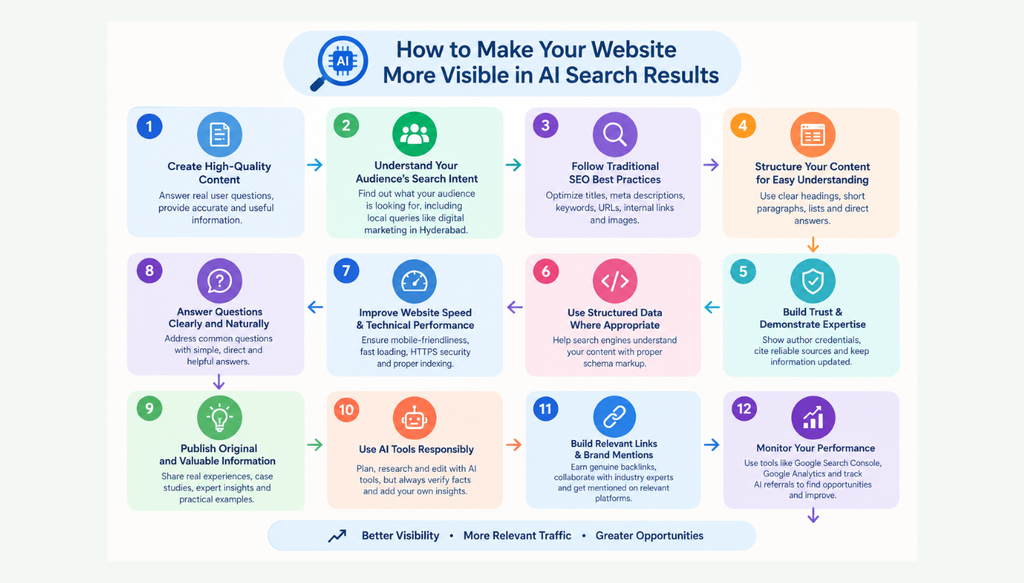
How to Make Your Website Visible and Searchable by AI
1. Create quality and helpful content
Content quality is paramount as AI search is aimed at providing helpful information. Simply writing articles for the sake of keywords is no longer sufficient as users turn to search platforms to find solutions to their questions.
For instance, if you want to write about marketing websites, you should publish comprehensive guides on improving website traffic, such as Content Marketing, SEO and local search optimization for small businesses.
- To optimize content website should address the reader’s query directly, include
- Up-to-date information
- Use simple language that the target audience understands
- Provide examples and practical recommendations
- Avoid generic and unnecessary information and cite research, statistics or case studies, if applicable.
Website content needs to deliver value beyond definitions and encourage website visitors to return for information.
2. Know what your audience is searching for
Before creating content, creating content is important to understand what type of information a website’s target audience is looking for.
Many users turn to search engines to find answers to questions so addressing them directly is a good idea. Many queries take the form of questions so tackling them with question-based articles is an idea.
Understanding local search intent is also important for businesses targeting a specific location. For example, people searching for digital marketing in Hyderabad may want to compare agencies, explore SEO services, or find experts who can improve their online presence. Creating useful content that answers these questions can help businesses connect with relevant local audiences.
For instance for users in website optimization the following questions may be worth considering:
- How can I improve my website’s visibility?
- Why is my website not visible on Google?
- What is the difference between SEO and AI search optimization?
- How can small businesses attract website visitors?
Using keyword research tools, customer feedback and related searches on Google, the website can identify questions and transform them into articles by directly answering them and providing additional information if needed.
3. Follow traditional SEO best practices
SEO remains a practice as search engines need to be able to crawl and index websites in order to surface websites in the search results or use it as a reference. To optimize website, for search spiders website needs to focus on the following:
- Create page titles
- Write descriptions
- Use keywords,
- Structure your content using subheadings
- Add internal links
- Optimize images.
- Keep URLs.
- Create an XML sitemap if applicable.
- Fix crawlability and indexation problems.
- Meta descriptions do not influence rankings.
- Meta descriptions should entice website visitors.
4. Structure website content so it can be scanned easily.
Website content should be simple to read and navigate for both users and search engines. Long paragraphs, hard formats and bad formatting stop people from getting information well.
Make sure the website is ready for scanning by using these formatting methods:
- Headings – use H1 for the page title
- H2 for subheadings
- H3 for subheadings.
- Paragraphs – avoid blocks of text.
- Tables – use tables to show information, such as steps, instructions or comparisons.
5. Build trust and credibility.
Users prefer websites. Make sure the website is credible enough to be a reference for search engines. Do this by:
- Listing author names
- Citing research publishing white papers
- Giving up-to-date information
- Providing contact details
- Posting About Us pages correcting errors and more.
6. Implement data.
Structured data helps search engines understand content better. Schema markup tells what type of information is on a page.
Types of data include:
- Article for articles and blog posts.
- Organization for organizations.
- Product for products.
- Local Business for businesses.
- Breadcrumb
- List to show page hierarchy.
7. Optimize website technical performance.
Websites should be easy to access on all devices. Technical issues hurt user experience and search performance. Consider these factors:
Responsiveness – make websites work on mobile and desktop.
Speed – reduce image sizes and scripts speed up performance.
Security – use HTTPS.
Crawlability – avoid blocking search crawlers.
Indexation – follow practices to make pages searchable.
Navigation – make menus simple so users find information. Ensure website content is in the format for search engines.
If a website wants to appear in AI search results review requirements of each platform as each platform may differ.
8. Answer questions clearly and naturally.
Users look for answers to questions on search platforms.
Address them directly. For example if a website is about marketing answer questions like:
- What’s search engine optimization?
- How can I learn SEO?
- What SEO tools are best?
- How can businesses improve website traffic?
When writing articles start with the common questions, answer them and add more info.
Add an FAQ section at the end of the article. Avoid questions as they hurt user experience. Every question should be relevant, answerable, informative and useful. Clear answers help users. Raise website ranking.
9.Publish Original and Valuable Information
Many websites publish similar articles about popular topics. To stand out, provide information that offers something more than a general overview.
Consider including:
- First-hand experiences and observations.
- Original surveys and research.
- Case studies from real projects.
- Expert interviews.
- Step-by-step tutorials.
- Comparisons based on clear criteria.
- Practical examples and lessons learned.
10. Leverage AI tools for content creation.
You can use AI tools to support parts of content creation for example compiling research outlining articles asking questions editing and improving readability.
However avoid publishing volumes of AI-generated content because it may be full of errors and lack quality. Use AI tools to generate ideas, organize information and optimize language. Make sure to review the final version to ensure that it is error‑free, informative and does not appear spammy.
AI-generated information is not automatically excluded from search results. The quality of the content matters, as does its ability to serve the end-users’ needs.
11. Track your progress
It is important to monitor performance to identify what works and what needs improvement. The following tools can help measure success:
- Google Search Console – a tool from Google that helps track performance in organic search results, including click‑through rates, impressions, crawl errors and more.
- Google Analytics – this tool helps understand audience and traffic sources.
- Bing Webmaster Tools – a Bing counterpart to Google Search Console.
- AI data – this helps understand if content is being discovered in AI search results if available.
You can also use AI search tools to ask questions and see if a website is being cited. In addition you can track traffic sources, conversions and indexation performance. Make sure to review content and update it when necessary.
AI search results may vary depending on platform and queries so treat this as a process rather than a one‑time task. In short make sure to optimize content, keep it up‑to‑date and adhere to the guidelines while regularly evaluating performance.
Common Mistakes to Avoid
When optimizing site for AI search there are common mistakes to avoid including:
- Keyword stuffing,
- Publishing low-quality content
- Neglecting SEO
- Providing unsubstantiated information
- Creating content for AI search only and expecting quick results.
Avoiding these mistakes can help get the value from optimization efforts.
Conclusion
Making your website more visible in AI search results requires a combination of helpful content, Effective SEO, technical accessibility, and credibility.
Start by understanding your audience, answering their questions clearly, organizing your articles properly, and maintaining accurate information. Use structured data where appropriate, improve website performance, and monitor your results regularly.
Most importantly, focus on creating content that provides real value instead of chasing shortcuts or relying on keyword repetition.
As AI-powered search continues to evolve, websites that prioritize useful, accessible, and trustworthy information will be better prepared to adapt to changing search experiences.
FAQs
1. What is AI search optimization?
Ans. AI search optimization encompasses all activities related to preparing a site for AI search, including content improvement, technical SEO, structured data implementation and credibility‑building.
2. How can I get my website to appear in AI search results?
Ans. Optimize content, improve SEO, use structured data and build credibility to improve visibility in AI search results although it is important to note that content will not always appear in the search results.
3. Is SEO still important for AI search?
Ans. Yes, as search engines need to be able to find and analyze content in order to use it.
4. Does content created by AI hurt website visibility?
Ans. No, long as it is high‑quality, accurate and serves a particular purpose.
5. How long does it take to improve AI search visibility?
Ans. It depends on factors, including quality of content, technical performance, competition and search platform. There is no formula or timeline.
