

How RAG Is Transforming Data Science and Generative AI
Introduction
AI is having a significant effect on businesses. Chatbots, virtual assistants and also data and content generation can all benefit from AI. However, typical AI may contain old or even wrong information and can sometimes be unable to answer questions that require ‘industry or company specific’ knowledge.
And so, Retrieval Augmented Generation (RAG) has been introduced.
RAG is a new innovation for Generative AI and can enhance the quality and relevance of AI output. RAG works by enabling AI to seek information to add to that held within Large Language Models (LLMs).
At present, RAG is being utilised to develop smart applications and also to enhance the usage of Generative AI. Moreover, it is also proving to be highly advantageous for students, in their studies of AI and Data Science.
We will discuss the nature of RAG, how it works and the advantages of using it. Furthermore, we will examine why RAG is such an important technology for AI.
What is RAG?
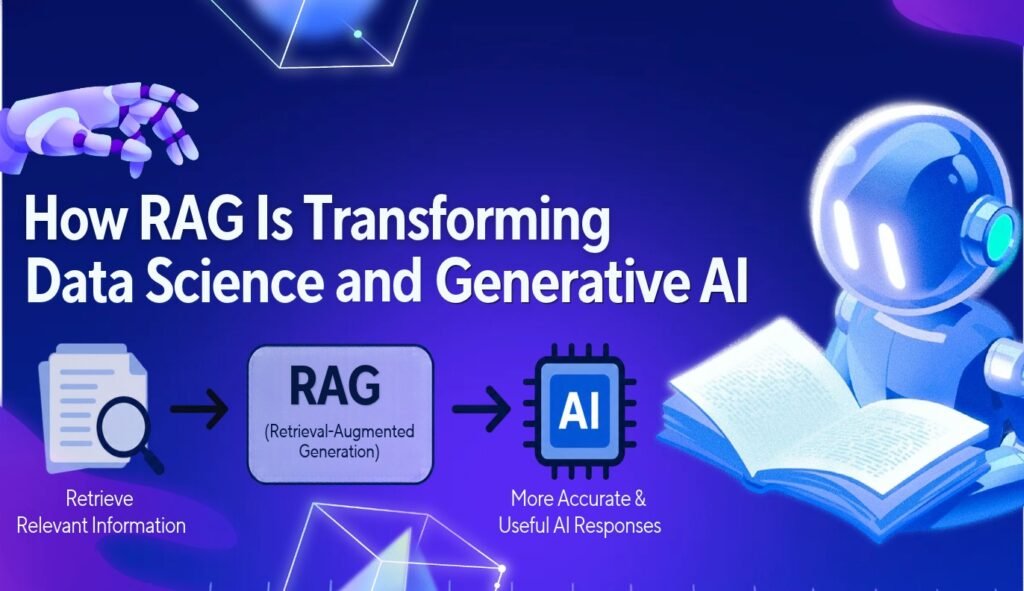
RAG enhances the quality of AI outputs by enabling AI to access information from external data sources.
Whilst Generative AI responds to questions using the information it has been trained on, this may be either out of date or too general to be fully suitable to address a particular question.
Using Retrieval Augmented Generation, AI can search external data sources (such as documents, databases and/or knowledge and company data) and so locate appropriate information to inform its response to queries.
Put simply, RAG can be compared to a student accessing notes to aid in answering a question.
For instance, if an employee was to query an AI chatbot regarding holiday entitlements; without RAG a generic response would likely be returned. But employing RAG enables the chatbot to search a company’s actual HR policy documentation in order to respond. Consequently, the provided information can be more current.
Consequently, a more appropriate and relevant response can be given.
How does it work?
There are 3 principal elements to RAG:
1. Retrieval
Appropriate information is retrieved.
A query is entered and relevant information is identified and gathered from data sources.
For example, should a query concern the key role duties of a data analyst, relevant information will be located in documents or knowledge bases.
2. Augmentation
Appropriate information is incorporated to further inform the original query.
With increased context, a model can utilise further detailed information and so better comprehend a query.
Drawing on both the training data and supplementary pertinent information, an output can then be returned.
3. Generation
A Large Language Model (LLM) generates a response.
Considering the query and added context, a basic response can be formed.
Within a Customer Services chat bot for example, a customer could receive step-by-step guidance relating to a product, from a relevant product manual.
Importance of RAG for Generative AI
Generative AI is now increasingly being used in many industries. It is crucial that AI can effectively and appropriately respond to data in a business.
RAG can support this.
Below are reasons for RAG being a valuable technology for Generative AI:
- More Accurate
Accessing external information can decrease the likelihood of incorrect information being delivered.
- Up to Date Information
Whilst standard language models may not be familiar with the most recent data, RAG enables AI to search current documents and databases and so responses can be founded on contemporary data.
- Minimising Hallucinations
AI can at times hallucinate. Nevertheless, by supplying relevant information to a model, hallucinations can be minimised. Nonetheless, hallucinations cannot always be avoided.
- Company Specific
RAG can access a company’s data sources including documents, reports and policies. This enables employees to obtain company specific information.
- Time Saving
Rather than having to manually search numerous documents, a user can submit a query and rapidly receive relevant information.
How RAG Is Transforming Data Science
Data Science involves collecting, analysing and examining data so that valuable information can be obtained. As Generative AI has become more prominent, data scientists have been able to innovatively utilise extensive data.
RAG has greatly enhanced data science.
Easy Data Analysis
Data Scientists frequently need to analyse substantial volumes of data, reports and documents. Nevertheless, identifying particular information can be labour intensive.
Using RAG, a user can input natural language queries to extract suitable information from associated data sources.
For instance, a business analyst can input a query such as “What were the main reasons for the drop in sales last quarter?” Using a suitably configured RAG application, they can then access suitable sales related reports which can in turn guide them in ascertaining the cause of the sales reduction.
Enhancing Business Intelligence
Business Intelligence is used to demonstrate a business’ performance, for example by using reports, and dashboard and visual displays.
Implementing RAG in Business Intelligence tools considerably increases their interactivity. Users can input queries to further analyse business data.
Rather than having to individually check various dashboards, a manager can consult an AI assistant to obtain information. For instance, details on revenue for a specific month, or on customer behaviour and sales performance.
The relevant information can then be rapidly located and clearly presented to answer a query.
Useful for Research
Researchers and data scientists may need to examine numerous journals, technical information and reports.
Using RAG, information can readily be extracted from these. Significantly relevant information can then be identified and key findings highlighted.
This is therefore both time effective and highly efficient.
Intelligent Chat Bots
Previously, chat bots had relatively limited capability.
Nevertheless, using RAG, developers can design smart chat bots which can search databases and documents to obtain relevant information.
Within an educational institute for example, a chatbot can be designed to respond to queries. Such queries may centre on course content, costs, admissions and timetables. Answers can thus be sourced from official documentation. As a result, the user experience can be enhanced.
Real World Application of RAG
RAG can be utilised in a variety of sectors.
Health Care
Healthcare organisations possess extensive data in relation to medicine, together with patient and research information.
Within healthcare, RAG can be implemented to enable authorised medical professionals to swiftly identify suitable data and research information. Indeed, stringent guidelines must be adhered to when using RAG in healthcare, to guarantee the security, confidentiality and medical accuracy of the data.
Education
RAG assistants can be used in educational establishments to assist students in gaining information regarding courses, work, resources and examinations.
Queries can be answered by drawing on information contained within an educational institution’s study resources.
Banking / Finance
Banks hold financial information, customer queries and company policy as well as transactional data.
Employees can utilise RAG to search a company’s data sources and so obtain relevant information relating to financial goods, procedures and services.
E-commerce
E-commerce websites can implement RAG to improve customer service.
Customers can query data including product features, return and delivery information together with comparisons between products.
Such a system can investigate product and company policy data, in order to supply pertinent information.
Human Resources
Staff frequently seek advice from a business’ human resources department. This can pertain to company policy, holidays, remuneration and procedures.
With RAG assistants, human resources can analyse internal human data. Hence, appropriate information can be obtained.
Key Technologies for RAG
Information on the following technologies is valuable for the development of RAG applications.
Python
Python is highly prevalent in data science and AI. Using this programming language, developers can analyse data and documents, integrate APIs and develop RAG applications.
Large Language Models (LLMs)
LLMs interpret and reply to queries. Well known examples of LLMs are GPT and open source language models.
Vector Databases
Vector databases collate data in numerical form, known as embeddings. Therefore, data can be searched by meaning, rather than merely by specific words.
Pinecone, Chroma and Weaviate are examples of vector databases.
Embedding
Text can be transformed into numeric vectors. This facilitates an appreciation of the connections between different information.
LangChain
LangChain is used to integrate language models, data retrieval and other application components with external data sources.
Therefore, applications can analyse and comprehend data and so generate valuable information.
Problems with RAG
RAG faces challenges like poor data quality, incorrect information retrieval, chunking issues, slow responses, and AI hallucinations. These problems can affect answer accuracy and overall performance.
Incorrect Information
Should the information in associated data sources be incorrect or out of date, erroneous data may be supplied.
Irrelevant Information
At times, inappropriate data can be obtained.
Security
Companies must ensure that confidential data can only be accessed by those that are permitted to do so.
Difficult to Implement
Developing an appropriate RAG application requires expertise in data analysis, embedding, vector databases and language models.
Slow Response Times
If a large number of documents are analysed in response to a query, then answer times can be protracted. However, with suitably optimised systems, response times can be expedited.
Being aware of these challenges can aid developers in producing more reliable AI applications.
The Future for RAG in Data Science and Generative AI
Looking ahead, RAG seems to hold a highly positive outlook. As AI driven solutions are further adopted by businesses, RAG is likely to become ever more significant.
Within the future, RAG will be highly important for AI applications, smart assistants, research tools and automated business functionality.
Possibly, even more advanced RAG technology may emerge. This could analyse not just textual information, but also data in a variety of other forms, for instance, visual and tabular data.
Furthermore, it will be highly significant to integrate RAG with AI agents. Such systems can search data and undertake actions. Moreover, they can engage with diverse tools to execute complex functions.
As a Data Scientist, comprehension of RAG can empower you to design applicable applications. You can devise applications which offer solutions to genuine business issues.
To pursue a profession in the AI industry, it is highly important to thoroughly grasp key areas, such as Python, Statistics, Machine Learning and Generative AI.
Additionally, enrolling in a strong data scientist training in Hyderabad can provide hands-on experience. Undertake live projects and ascertain how RAG and other technologies can be applied in realistic situations.
Conclusion
By integrating data retrieval and language models, Retrieval Augmented Generation is revolutionizing Generative AI. More pertinent, contextual and valuable information can be produced.
RAG has considerable potential to further how information can be accessed within many industries including healthcare, education, banking, e-commerce and business intelligence.
Knowledge of RAG is increasingly valuable for data scientists and AI developers. It can open up numerous possibilities for the production of smart chat bots, search mechanisms, AI assistants and innovative data applications.
As Generative AI continues to develop, technologies such as RAG will be highly important in ensuring that AI is both practically and effectively utilised by businesses.
To pursue a career in this area, it is advisable to begin to learn fundamental data science, Python, machine learning and Generative AI knowledge. This can then equip you well for the continually expanding prospects in the AI industry.
Frequently Asked Questions (FAQs)
1. What is RAG in Generative AI?
RAG stands for Retrieval-Augmented Generation. It is a technique that allows AI models to retrieve relevant information from external sources before generating an answer.
2. How does RAG improve AI accuracy?
RAG provides additional information to AI models from relevant documents and databases. This helps generate more context-based answers and reduces the chances of incorrect information.
3. Is RAG used in data science?
Yes. RAG is used in data science applications such as intelligent data analysis, document search, research assistance, business intelligence, and AI-powered chatbots.
4. Which programming language is used for RAG?
Python is one of the most commonly used programming languages for building RAG applications because of its AI, machine learning, and data processing libraries.
5. Do I need machine learning knowledge to learn RAG?
Basic knowledge of Python, machine learning, embeddings, and Generative AI is helpful when learning RAG. However, beginners can gradually learn these concepts through practical projects.
