

Automation’s Journey: From Traditional to Agentic AI Models
Explore automation’s evolution, comparing traditional systems, AI agents, and agentic AI models shaping the future of intelligent workflows.
Introduction
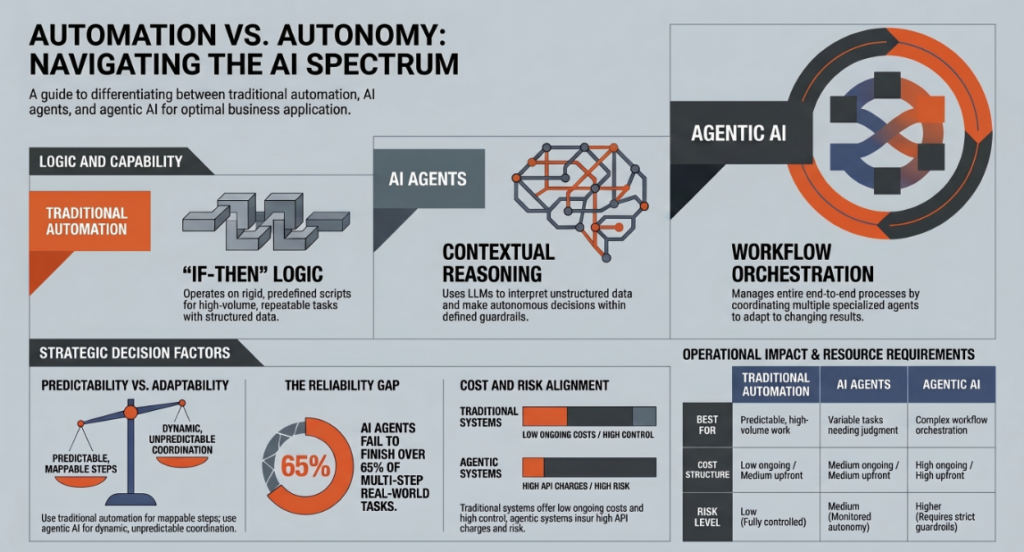
Choosing between traditional automation, AI agents, and agentic AI depends on the predictability of the task and the level of judgement required.
While traditional automation is perfect for rigid, rule-based repetitive work, AI agents and agentic AI are necessary for handling unstructured data and complex, multi-step workflows that require autonomous decision-making.
Honestly, this used to be a lot simpler. A few years ago, “automation” just meant writing a script and letting it run.
Now, with the rise of large language models (LLMs), the lines are blurring. This is where things get interesting and a bit complicated for enterprise teams trying to figure out where to put their budget in 2026.
The Quick Comparison
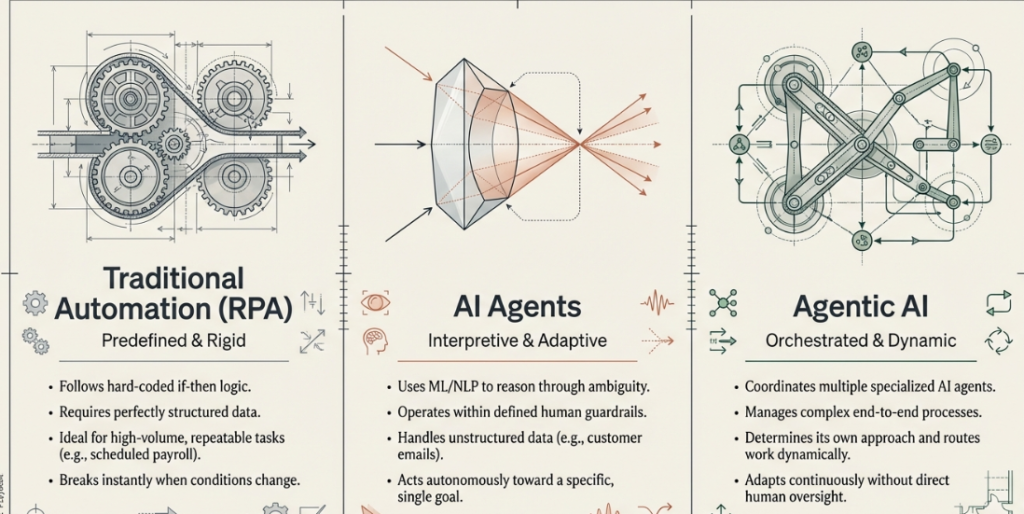
- Traditional Automation: Rigid “if-then” logic for predictable, high-volume tasks.
- AI Agents: Goal-orientated systems that use reasoning to handle individual variable tasks.
- Agentic AI: An orchestrator that manages multiple agents to complete end-to-end processes.
What is Traditional Automation?
Traditional automation refers to rule-based systems that execute routine tasks without human intervention by following a strict “if-then” logic.
These systems are essentially digital assembly lines designed for speed and consistency in environments where the data never changes its shape.
In digital marketing, automation streamlines campaigns by delivering targeted content at scale, ensuring consistency and efficiency across platforms.
What is Traditional Automation?
Traditional automation is a deterministic system that follows predefined scripts to perform repetitive, structured tasks without the ability to adapt to unexpected changes.
In real projects, this is the “workhorse”. Most beginners struggle with the idea that “AI” isn’t always the answer. If a business needs to send a welcome email every time a form is filled, a simple rule-based trigger is cheaper and more reliable than a complex AI model.
Understanding AI Agents: The Individual Specialists
AI agents represent a step up because they use machine learning and natural language processing to understand context. Unlike a script that breaks if a comma is in the wrong place, an AI agent can “read” an email, figure out what the customer wants, and decide on a response.
What are AI agents?
AI agents are autonomous systems that use LLMs to interpret inputs, reason through ambiguity, and take goal-directed actions within defined guardrails.
Common Use Cases for AI Agents:
- Parsing unstructured customer emails to identify sentiment.
- Evaluating support requests for potential escalation.
- Drafting personalised responses using internal product documentation.
Agentic AI: The Project Manager
If an AI agent is a specialist, agentic AI is the manager. It doesn’t just do one task; it looks at a goal (like “manage the Q3 marketing campaign”) and figures out which sub-tasks need to happen, which agents should do them, and how to fix things when they go wrong.
What is Agentic AI?
Agentic AI is an orchestration layer that coordinates multiple specialised AI agents to plan, adapt, and execute complex, multi-step workflows from start to finish.
This is a massive shift for 2026 workflows. Instead of humans building every bridge between software, the agentic system builds the path dynamically.
Decision Matrix: Which One Do You Need?
| Feature | Traditional Automation | AI Agents | Agentic AI |
| Logic | Fixed Rules | Contextual Reasoning | Dynamic Orchestration |
| Flexibility | None | Moderate | High |
| Data Type | Structured Only | Unstructured/Ambiguous | Multi-source/Complex |
| Cost | Low Ongoing | Medium Ongoing (API) | High Ongoing (Multiple APIs) |
A Step-by-Step Guide to Choosing Your System
Choosing the wrong path can lead to “automation debt” or massive API bills. Following this logic helps narrow it down:
- Evaluate Predictability: Can the task be mapped out in a flowchart with zero “maybe” moments? If yes, stick to traditional automation.
- Check Data Structure: Is the input a clean spreadsheet or a messy chat transcript? AI agents are needed for the latter.
- Define Autonomy: Does the system need to decide its own next steps? If the system must figure out its own approach based on what it discovers, use agentic AI.
- Assess Risk: Mistakes in traditional automation are predictable; mistakes in agentic AI can be “creative” and costly. High-risk tasks usually require AI agents with a “human-in-the-loop” for approval.
Learn to optimise your search engine in a real-world scenario from WhiteScholars’ digital marketing course in Hyderabad, powered by AI.
Real-World Case: The Customer Service Evolution
Imagine a customer has a billing dispute.
- Traditional automation would check the database and send a generic “We received your request” email based on a trigger.
- An AI agent would read the dispute, look at the account history, realise the customer was overcharged, and draft a refund confirmation for a human to approve.
- Agentic AI would see the dispute, check the billing system, pull order history, analyse the customer’s lifetime value, decide to offer a 20% discount on the next month to prevent churn, and then follow up two days later to ensure they are happy.
The 2026 Reality Check: Risks and Costs
It isn’t all magic and efficiency. Honestly, this part confused many early adopters: AI agents aren’t 100% reliable yet. Research shows that in simulated office environments, even the best agents only completed about 34.4% of tasks correctly.
In digital marketing, this unreliability means AI agents may mismanage campaigns or miss personalisation cues, requiring human oversight to ensure accuracy.
Common Pitfalls and Mistakes:
- Permission Bloat: 90% of AI agents have way more permissions than they actually need, which is a massive security risk.
- The “Broken Link” Problem: In a 5-step agentic workflow, if step two fails, the whole chain usually collapses.
- Cost Creep: Enterprise-grade multi-agent systems can cost over $400,000 to build, with monthly API and infrastructure costs ranging from $3,200 to $13,000.
Career Outcomes: Why Master These Skills Now?
The demand for professionals who can bridge the gap between business needs and agentic orchestration is skyrocketing. In the current market (2025–2026), AI engineers are seeing base salaries around $140,000, while AI data scientists average $129,000.
Skills Gained Through Training:
- Prompt engineering and guardrail implementation.
- Multi-agent orchestration and API management.
- Retrieval-Augmented Generation (RAG) for domain-specific tasks.
If anyone is serious about building a career in this, structured training can really help navigate the shift from simple coding to complex AI orchestration.
Final Thoughts
The shift from rigid scripts to reasoning agents is the defining trend of 2026. While the reliability of fully autonomous systems is still evolving, the ability to handle unstructured data and complex judgement calls provides a competitive edge that traditional tools simply cannot match.
Starting with well-defined AI agent pilots and gradually moving toward agentic orchestration is often the most sustainable path for modern organizations. Maintaining a clear view of API costs and security guardrails ensures these systems provide actual ROI rather than just technical novelty.
Frequently asked Questions
Q: Can AI agents replace traditional RPA?
A: Not entirely. RPA (traditional automation) is still better and cheaper for high-volume, structured tasks like payroll, where 100% accuracy is mandatory.
Q: Why is agentic AI more expensive?
A: Because it involves multiple “calls” to an AI model. Each time an agent thinks, communicates, or acts, it consumes tokens that cost money.
Q: Is agentic AI safe for regulated industries?
A: It requires heavy oversight. These systems often struggle with confidentiality and can accidentally surface sensitive data they shouldn’t have access to.
Q: Why do many agentic AI projects fail to show a clear ROI?
A: Many projects struggle due to high failure rates in multi-step tasks, often exceeding 65%, and the significant recurring costs associated with continuous API calls and technical maintenance.
Unclear business impact and the extreme complexity of scaling these systems also lead to high cancellation rates.
Q: How does the “dynamic approach” of agentic AI differ from an AI agent’s “predefined approach”?
A: While an AI agent interprets inputs to apply a specific, pre-set rule within a defined scope, agentic AI assesses a situation to determine its own path, coordinating with other agents and systems to reach a goal.
This allows agentic AI to handle complex scenarios where the necessary steps cannot be fully mapped out in advance.