

8 Best Career Paths After Data Science and AI in 2027
Explore the 8 best career paths after Data Science and AI in 2027, including AI Engineer, Data Scientist, ML Engineer, Data Engineer, and Generative AI roles.
Introduction
Data science professions are some of the best-paying and most stable jobs you can get. Companies in every field are spending a lot of money on smart technology and data-driven projects, which makes it hard to find skilled individuals. Jobs in AI are growing even faster as companies quickly adopt generative tools, predictive analytics, and automation solutions. Because of this, AI jobs pay higher, and even jobs in the middle of the pay scale can pay well into the six figures.
If you are planning to build a best career paths after Data Science and AI in 2027, there are several exciting career paths to explore in 2027. From developing intelligent systems to turning complex data into business insights, these careers offer strong opportunities for growth and specialization
This article lists the 8 best-paying jobs in the industry. Based on market data, you will get real job duties, skills you need, for the years 2025 to 2026. These jobs are great for people who want to switch occupations or progress up in their current one. They are important and give you a lot of chances to climb forward.
Before choosing a career path consider some of the self-discovery questions and reflect on your skills and interests.
Your Problem-Solving Style
- Do you naturally look for patterns in complexity?
- Are you energized by solving mathematical puzzles?
- Do you enjoy building things from scratch?
- Is predicting future outcomes something that fascinates you?
Your Technical Comfort
- Do you find joy in learning new programming languages?
- Are you comfortable with mathematical concepts?
- Do you enjoy working with complex systems?
- How do you feel about continuous learning and adaptation?
Your Work Impact Preferences
- Do you prefer working on long-term, complex projects?
- Are you more interested in practical applications or theoretical research?
- Do you enjoy explaining complex concepts to others?
- What kind of impact do you want to make in your organization?
Here Is “Your Guide to the Top 8 Data Science & AI Careers in 2027”
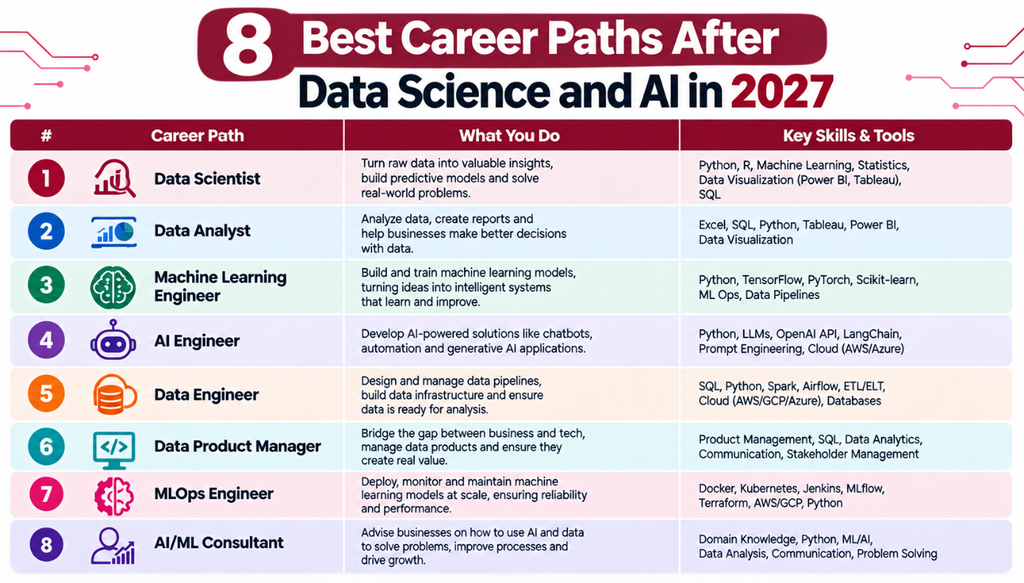
1. Machine learning engineer:
A Machine Learning Engineer develops and deploys systems that allow computers to learn from data and make predictions or decisions without being explicitly programmed for every task.
What do they do?
- Build and train machine learning models
- Work with large datasets
- Improve model accuracy and performance
- Deploy ML models into real-world applications
- Collaborate with data scientists and software engineers
Key skills : Python, machine learning algorithms, statistics, SQL, TensorFlow, PyTorch, and cloud platforms
2. AI engineer:
AI engineers make apps smarter by adding smart automation and recommendation algorithms to them. They make models that are more accurate, work better, and are cheaper to use on a large scale.
What do they do?
- Develop and deploy AI-powered applications
- Integrate machine learning models into software
- Work with APIs, cloud platforms, and AI frameworks
- Build systems using technologies such as LLMs, computer vision, and NLP
- Test, optimize, and maintain AI solutions
Key skills: Python, software engineering, machine learning, deep learning, APIs, cloud computing, databases, and AI frameworks such as PyTorch or TensorFlow.
3. Data scientists:
Combines statistical analysis and machine learning to build predictive models and solve complex business problems and look at a lot of data to detect trends, make forecasts, and tell leaders how to apply what they find. You should be able to talk to people well and know how to use data visualization tools.
What do they do?
- Collects and analyzes large datasets
- Identifies patterns and trends
- Builds predictive models
- Uses machine learning algorithms
- Communicates insights to business teams
Key skills: Python, SQL, Statistics, Machine Learning, Data Visualization, and Deep Learning.
4. AI Product Manager:
AI product managers use their technical abilities and business understanding to set goals, find out which features are most important, and make sure that AI solutions are useful for both people and businesses.
What do they do?
- Identifying AI product opportunities
- Understanding customer requirements
- Defining product strategies
- Working with technical teams
- Measuring product performance
Key skills: AI fundamentals, Product Management, Business Strategy, Communication, Analytics, and Problem-Solving.
5. Data Engineer
A data engineer works on large amounts of data collected by companies, especially on social networks and e-commerce websites. This raw data can be related to customers, products or company performance, and is often hard to manage or analyse. Indeed, finding your way in this goldmine of information is no easy feat! The data engineer’s mission is to develop tools to make use of this data, in a strategic way for the company. This requires technical expertise and specific skills..
What do they do?
- Data pipelines
- Databases
- Cloud platforms
- Data warehouses
- ETL/ELT processes
- Big Data systems
Key skills: Python, SQL, Apache Spark, Cloud Computing, Databases, ETL, and Data Warehousing.
6. NLP Engineer (Natural Language Processing):
Engineer for NLP (Natural Language Processing) NLP engineers build systems that can read, write, and understand human language. These systems are what make chatbots, sentiment analysis, translation tools, and content management systems work.
What do they do?
- Develops and trains language-based AI models
- Works with text and speech datasets
- Builds chatbots and virtual assistants
- Performs sentiment and text classification
- Develops language translation systems
- Works with Large Language Models (LLMs)
- Improves the accuracy and performance of NLP applications
Key skills: Python, Machine Learning, Deep Learning concepts Transformers and or TensorFlow, SQL and data processing.
7. MLOps Engineer:
MLOps engineers make the whole process of machine learning easier, from building and testing models to keeping an eye on them and retraining them in real-world situations.
What do they do?
- Deploy ML models
- Build ML pipelines
- Automate model training and deployment
- Monitor models in production
- Manage cloud infrastructure
- Handle scaling and version control
Key skills: Python, Docker, Kubernetes, Cloud, CI/CD, Git, ML pipelines, and DevOps.
8. Generative AI Specialist
A Generative AI Specialist focuses on using AI models that can create new content such as text, images, code, audio, and video. With the rapid growth of tools powered by Large Language Models (LLMs), Generative AI has become one of the emerging career paths in the technology industry.
What do they do?
- Develops and integrates generative AI applications
- Works with Large Language Models (LLMs)
- Creates AI-powered chatbots and assistants
- Designs prompt and AI workflows
- Builds Retrieval-Augmented Generation (RAG) applications
- Tests and evaluates AI-generated outputs
- Uses AI to automate business processes
- Works with text, image, audio, or code-generation models
Key skills: Python, Generative AI fundamentals, LLMs and Transformers, Prompt Engineering, RAG, APIs and AI tools, Vector databases, Machine Learning fundamentals.
Which Career Should You Choose?
There is no single best career paths after Data Science and AI. The right choice depends on what you enjoy doing. Choosing a career always depends on you most importantly, the career of your choice should be the work which encourages you the most and the work you enjoy doing.
For example ;
- Love coding? → AI Engineer or Machine Learning Engineer
- Enjoy statistics and research? → Data Scientist
- Like dashboards and business insights? → Data Analyst or BI Analyst
- Enjoy databases and systems? → Data Engineer
- Interested in new AI technologies? → Generative AI Specialist
- Love business and strategy? → AI Product Manager
How to Prepare for Your Career
Learning the theory is only the beginning. To become job-ready, focus on applying what you learn.
Start by building:
- Strong fundamentals – Python, SQL, statistics, and machine learning.
- Practical projects – Solve real-world problems using real datasets.
- A portfolio – Showcase your projects, GitHub work, dashboards, or applications.
- AI knowledge – Stay updated with generative AI, LLMs, and automation.
- Communication skills – Learn to explain technical insights in simple language.
- Domain knowledge – Understanding an industry can help you stand out.
Career Opportunities with Data Science Training at WhiteScholars Academy
WhiteScholars Academy is a training institute in Hyderabad that helps students develop practical skills in Data Science, Data Analytics, Artificial Intelligence, and other in-demand technologies. The academy focuses on hands-on learning, real-time projects, trainer guidance, and technical interview preparation to help students understand industry requirements. For students looking to build a career in data science, data science training in Hyderabad at WhiteScholars Academy provides an opportunity to strengthen technical knowledge, improve problem-solving skills, and gain practical experience for future career opportunities.
Conclusion.
Choosing the right career depends on your interests, strengths, and long-term goals. If you enjoy coding and building intelligent systems, technical roles such as AI or Machine Learning Engineer may be a good fit. If you prefer analytics and business decision-making, careers such as Data Analyst or Business Intelligence Analyst could be more suitable. Similarly, those interested in strategy and innovation can explore roles such as AI Product Manager or AI Consultant.
However, completing a Data Science and AI course is only the beginning. Building practical projects, developing strong technical and analytical skills, staying updated with emerging technologies, and gaining real-world experience can help you stand out in the job market.
FAQs
1. What are the best career options after Data Science and AI?
A. Top career paths include Machine Learning Engineer, AI Engineer, Data Scientist, Data Engineer, and Generative AI Specialist.
2. Which career is best for someone who loves coding?
A. AI Engineers and Machine Learning Engineers are great choices for people who enjoy coding and building intelligent systems.
3. What skills are needed for a Data Science and AI career?
A. Key skills include Python, SQL, statistics, machine learning, data visualization, cloud computing, and AI technologies.
4. Is Generative AI a good career option in 2027?
A. Yes. Generative AI is an emerging career path involving LLMs, prompt engineering, RAG, AI applications, and automation.
5. How do I choose the right career path?
A. Choose a career based on your interests, strengths, technical skills, and long-term goals rather than popularity alone.
