

Boosting SEO: A Simple Guide for New Businesses
In this blog let’s focus on how to boost search engine optimisation for new businesses and discuss several success strategies.
Introduction: From Unknown to Recognized
In the modern digital landscape, a company’s visibility is linked to its search engine performance. Small businesses frequently compete for attention in crowded markets, but as the sources show, a shift in focus to search engine optimisation (SEO) can be transformational.
For example, by prioritising its search strategy, the White Scholars Training Institute in Hyderabad has grown from a small-scale training provider to a well-known EdTech institute with over 600 batches, 3,200+ students trained, and partnerships with 240+ hiring companies.
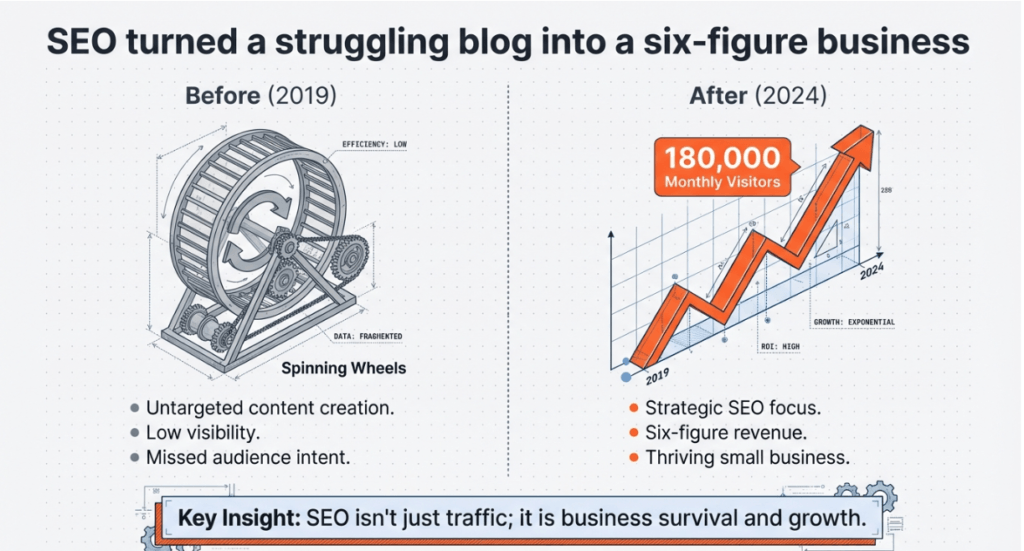
It has positioned itself as a bridge between academia and industry, offering job-ready programs in Data Science, Digital Marketing, full-stack development, and more
Defining the Scope of Modern Visibility
Search engine optimisation for smaller entities involves refining the architectural and content elements of a website to capture traffic from platforms like Google. This process is distinct from broader SEO in that it typically operates with fewer resources and focuses on targeted, niche-specific keywords rather than broad, highly competitive terms.
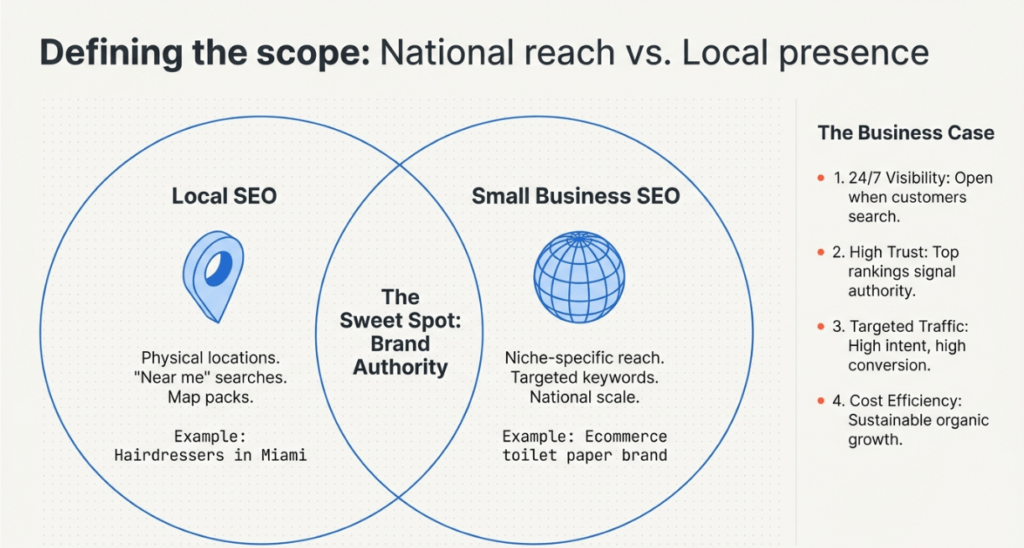
It is essential to distinguish between general small business optimisation and local SEO. While the former aims to reach a specific audience regardless of geography (such as an e-commerce site selling products nationwide), the latter is vital for businesses with physical locations.
Local SEO focuses on “near me” searches or specific city-based queries, such as a resident searching for a local hairdresser or plumber. Both strategies, however, share the common goal of boosting brand recognition and positioning the company as a trusted authority.
The Long-Term Value of Organic Presence
Investing in search visibility offers several compounding advantages for a growing brand:
- Enhanced Recognition: Ranking within the top search results ensures that more potential customers are exposed to the brand, which gradually builds familiarity.
- Precision Traffic: SEO targets individuals who are already actively seeking the specific solutions or products a business provides.
- Credibility: High-ranking positions signal to users that a business is a leader in its respective field.
- Continuous Availability: Unlike a physical location, an optimised website serves as a 24/7 representative, interacting with customers at all hours.
- Sustainability: While paid advertising requires constant capital, organic rankings, once established, are often more cost-effective to maintain over time.
1. Decoding Audience Search Patterns
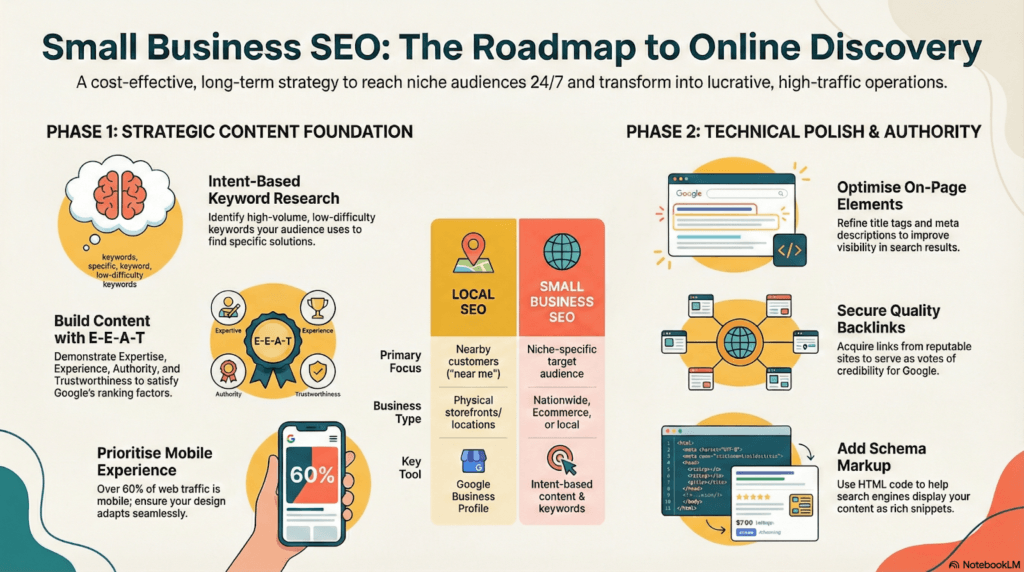
The foundation of any successful strategy is keyword research, the process of identifying the exact phrases potential customers use.
It is recommended to begin with Google’s autocomplete feature to see real-time search trends, such as typing a broad term like “smart home” followed by different letters of the alphabet to see what users are curious about.
To add professional depth, tools like the Semrush Keyword Magic Tool provide access to massive databases of search data. When evaluating potential phrases, businesses should focus on three critical metrics:
- Search Intent: Determining if the user wants information, a specific website, or is ready to make a purchase.
- Search Volume: The average number of monthly queries for that term.
- Keyword Difficulty: A percentage indicating how hard it would be to break into the top 10 results for that specific term.
Marketers should organise these findings into structured lists or templates to guide their content creation efforts.
2. Prioritizing Quality through E-E-A-T
Creating content is not just about using keywords; it is about fulfilling the user’s “search intent” by answering their underlying questions. Google prioritises content that adheres to the E-E-A-T framework:
- Experience: Showcasing practical, first-hand knowledge or case studies.
- Expertise: Demonstrating deep professional knowledge or featuring industry experts.
- Authoritativeness: Using reputable data and citing high-quality sources.
- Trustworthiness: Maintaining transparency about business practices and authorship.
To understand what an audience truly needs, businesses should conduct customer interviews, use tools like SurveyMonkey for broader feedback, monitor industry forums, and utilise Google Trends to identify rising topics.
3. Structural Refinement of Webpages
On-page SEO involves adjusting elements within the site that the owner can directly control to help search engines index the content accurately. Key elements include title tags, meta descriptions, header tags, visual assets, and internal interconnectivity.
4. Fortifying the Technical Infrastructure
Technical SEO ensures that a website meets the performance requirements of search engines. If a site cannot be “crawled” or navigated by search bots, it will not appear in results.
- Crawlability: Using Google Search Console helps identify indexing errors. Establishing a clear navigation menu and submitting an XML sitemap provides a roadmap for search engines.
- Integrity: Regularly auditing the site to fix broken links (404 errors) is crucial, as dead ends signal neglect to search engines.
- Performance Speed: Users have short attention spans; tools like PageSpeed Insights can identify issues that slow down a site.
- Mobile Adaptability: With the majority of traffic coming from mobile devices, a site must be responsive and easy to use on various screen sizes.
- Security: Transitioning to the HTTPS protocol via an SSL certificate is a vital trust signal for both users and search engines.
5. Building Authority through Link Equity
Backlinks, links from other sites to yours, function as “votes of credibility”. A robust link profile increases a site’s authority and can drive direct referral traffic. Strategies include:
- Guest Contribution: Writing high-value articles for other reputable sites in your niche.
- Broken Link Strategy: Identifying dead links on other websites and offering your own relevant content as a replacement.
- Competitive Analysis: Tools like the Backlink Gap tool allow you to see which sites link to your competitors but not to you, highlighting new outreach opportunities.
6. Communicating Content via Structured Data
Schema markup is a form of code that tells search engines exactly what your content represents, which can result in rich snippets.
These enhanced results, which might include star ratings, event dates, or story carousels, take up more space in search results and often lead to higher conversion rates.
For WordPress users, plugins like Yoast SEO or Rank Math can automate this process. Other platforms may require using generators to create JSON-LD code to be pasted into the site’s header.
7. Enhancing the Visitor Experience
User experience (UX) is a significant ranking factor. A user-friendly site features intuitive navigation, readable content broken up by headers, and fast load times.
To truly understand how visitors interact with a site, tools like Hotjar provide heatmaps that show where users click, scroll, and linger.
These insights allow businesses to place important information where people naturally look and identify design elements that may be causing frustration.
8. Mastering Regional Presence
For businesses with a physical shopfront, a Google Business Profile (GBP) is indispensable. This profile manages how a business appears on Google Maps and Search, including its address, hours, and photos.
To succeed, businesses must verify their profile (often via video) and ensure their NAP (name, address, phone number) is consistent across the web. Tools like Listing Management can synchronise this data across hundreds of directories automatically.
9. Cultivating Social Proof
Customer reviews are a powerful signal of engagement and reliability. Fresh, positive feedback can improve local rankings and provide insights into what customers value.
Businesses should actively encourage reviews by providing excellent service, using QR codes at physical locations, or sending automated follow-up emails with direct review links.
10. Monitoring and Iterative Growth
Finally, businesses must track their progress to see if their efforts are yielding results. Using a position tracking tool allows you to monitor where your site ranks for specific keywords over time.
By analysing the distribution of rankings and seeing how many terms are in the top 3, 10, or 20 positions, marketers can identify what is working and where they need to pivot their strategy.
Enroll in the WhiteScholars Digital Marketing Course with generative AI in Hyderabad today and explore these 10 steps practically.
Exploring the roadmap with an example
Let’s look at the roadmap for the White Scholars Institute in Hyderabad; here is a streamlined, executive-style strategy focused on the core pillars of digital growth:
1. High-Precision Keyword Strategy
- Methodology: Use Google’s autocomplete to find real-time student queries and the Semrush Keyword Magic Tool to identify phrases with high volume and manageable difficulty.
- Focus: Target niche-specific keywords related to competitive exams and Hyderabad-based coaching rather than broad educational terms.
2. Academic Authority (E-E-A-T)
- Content Goal: Produce high-quality content that answers the specific “search intent” of students.
- Framework: Adhere to Google’s E-E-A-T (Experience, Expertise, Authoritativeness, Trustworthiness) by showcasing faculty credentials, student testimonials, and data-backed success rates.
3. Core Page Optimization
- Structural Tweaks: Ensure title tags are under 60 characters and meta descriptions are under 160 characters to maximise click-through rates.
- Clarity: Use header tags (H1, H2) to organise course information and include alt text on campus images to improve accessibility and image search.
4. Technical Health and Performance
- Accessibility: Use Google Search Console to ensure search engines can “crawl” and index all course pages.
- User Experience: Prioritise mobile-friendliness and site speed via tools like PageSpeed Insights, as most students search via smartphones.
- Security: Implement HTTPS to build trust during student registrations.
5. Local Dominance in Hyderabad
- Google Business Profile (GBP): For an institute with a physical location, this is vital for appearing in “near me” searches.
- NAP Consistency: Ensure the institute’s name, address, and phone number are identical across all online directories like Facebook and Bing.
- Reviews: Actively encourage student feedback via QR codes on campus, as positive reviews are a major ranking signal.
6. Authority Building and Social Proof
- Backlinks: Gain “votes of credibility” by guest blogging on educational portals or using a Backlink Gap tool to see where local competitors are cited.
- Schema Markup: Use code (via plugins like Yoast or Rank Math) to generate rich snippets, allowing the institute to display star ratings or FAQ sections directly in search results.
7. Tracking and Future Readiness
- Monitoring: Use position tracking to observe how the institute’s rankings improve for specific Hyderabad-related keywords.
- AI Integration: Prepare for the next phase of search by ensuring the brand is “seen and trusted” by AI tools through Answer Engine Optimisation (AEO) and Generative Engine Optimisation (GEO).
Final thoughts
The SEO landscape is evolving beyond traditional search engines into the realm of AI search and answer engine optimisation (AEO). Strategies such as Generative Engine Optimisation (GEO) and LLM Seeding are becoming critical for brands that want to be cited by AI tools and large language models.
Monitoring “AI visibility” and ensuring a brand is “seen and trusted” by these new platforms is the next frontier in digital marketing.
In conclusion, while search optimisation may appear complex at first, even small, consistent improvements in these ten areas can significantly improve a small business’s ability to be discovered online.
Starting with a thorough audit and following a structured checklist can lay the groundwork for long-term organic growth.
Frequently asked questions
1. What is the difference between small business SEO and local SEO?
Small business SEO uses niche-specific keywords to reach ideal customers regardless of their location, making it ideal for entities like e-commerce brands. In contrast, local SEO focuses on appearing in “near me” searches for businesses with physical locations, like a local hairdresser or restaurant.
2. How do I find the right keywords for my website?
You can start by typing phrases into Google’s search bar to see autocomplete suggestions, which reveal what people are currently searching for. For more precision, use tools like the Keyword Magic Tool to evaluate a term’s search volume, user intent, and how difficult it will be to rank in the top 10 results.
3. What are backlinks, and why are they valuable?
Backlinks are links from external websites to your own, which search engines interpret as “votes of credibility” for your content. High-quality backlinks increase your website’s overall authority, improve your rankings, and can drive direct referral traffic to your site.
4. How does E-E-A-T help my content rank higher?
E-E-A-T stands for Experience, Expertise, Authoritativeness, and Trustworthiness, which are the benchmarks Google uses to define high-quality content. By showcasing first-hand experience, citing reputable sources, and being transparent about your business, you signal to Google that your content is reliable.
5. Why is technical SEO essential for my online presence?
Technical SEO ensures that search engines can easily “crawl” and index your site’s structure so your pages actually appear in search results. It also focuses on the user experience by improving site speed, ensuring mobile-friendliness, and maintaining security through HTTPS protocols.