

Data Analyst Interview for Freshers: Round-by-Round Guide
Introduction
A data analyst as a career can be an exciting and great opportunity for freshers. It is trending and growing in various non-IT fields; it also gives businesses key insights into where they are lacking and new growth potentials.
The good news data analyst interview for freshers is that they are not expecting much professional expertise, but they want to know whether to work with data, think logically, understand business problems, and communicate their findings clearly.
The major questions fresh graduates often come up with are how to enter this booming market, what the selection process at companies is, and what the most asked interview questions are.
The data analyst interview question that freshers get in their minds first and foremost is: how many rounds of interviews are there?
Knowing about the interview process clearly in the company clears the mind prior to attending the interview. Since one can expect when and how the results will be declared and known.
The number of rounds of interviews in companies is not generic or the same in all companies. It depends on the company’s size and also on its requirements. But, in general, one can expect around 3 to 5 rounds of the selection process one can go through.
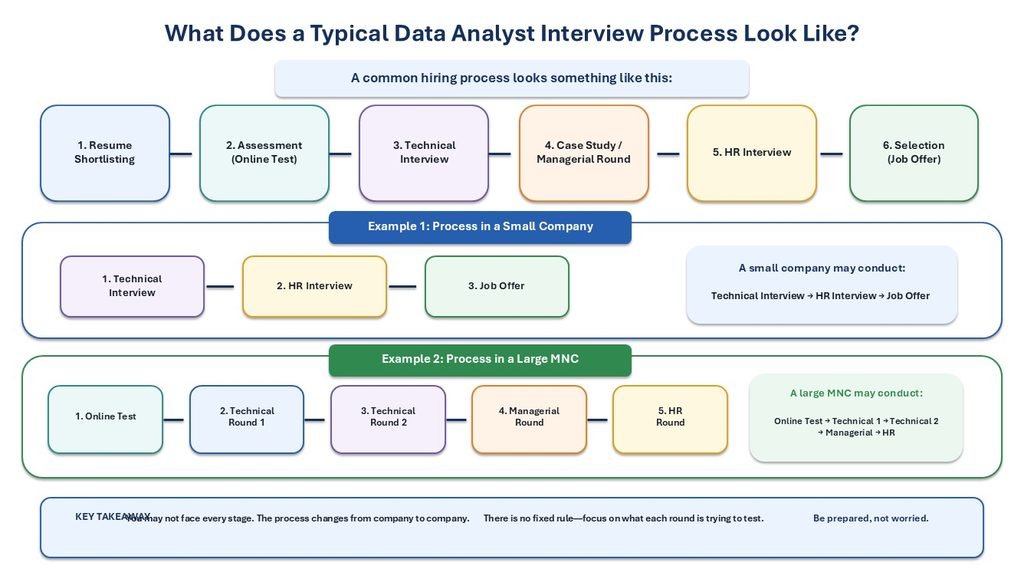
A common hiring process looks something like this:
Resume Shortlisting → Assessment → Technical Interview → Case Study Round → HR / Managerial Interview → Selection
You may not face every stage. The process changes from company to company.
For example, a small company may conduct:
Technical Interview → HR Interview → Job Offer
A large MNC may conduct:
Online Test → Technical Round 1 → Technical Round 2 → Managerial Round → HR Round
So, don’t worry if you hear that another company has a different process. There is no fixed rule.
What matters is knowing what each round is trying to test.
1st Round: Resume Shortlisting / Screening
It is the first and foremost round of any selection process. Once applied for the post, your resume will go through a screening process where the eligibility criteria are checked and matched with the company’s requirements.
This may be done online/offline.
Typical questions include:
· Tell me about yourself.
· Why do you want to become a data analyst?
· What data analytics tools do you know?
· Tell me about your academic or personal projects.
· Why are you interested in this company?
The recruiter tries to look at:
· Your degree and educational background
· Internships
· Data analytics projects
· SQL skills
· Excel skills
· Power BI or Tableau
· Python
· Statistics
· Certifications
· Relevant achievements
2nd Round: Aptitude or Online assessment
The organization may conduct an online test before inviting candidates for technical interviews.
Here, the recruiter tries to look at your
· Quantitative aptitude
· Logical reasoning
· Data interpretation
· Verbal ability
· Basic SQL
· Analytical reasoning
This is done to understand and assess the candidate’s ability to process information and solve problems in a structured manner.
What should freshers focus on?
Don’t spend all your preparation time learning advanced concepts.
Make sure your basics are strong.
For example, in SQL, you should be comfortable with:
SELECT, WHERE, GROUP BY, ORDER BY, JOIN, CASE and aggregate functions.
In Excel, understand:
Pivot Tables, XLOOKUP/VLOOKUP, IF, SUMIFS, COUNTIFS and basic charts.
The same principle applies to statistics and Power BI.
Strong fundamentals are more valuable than a long list of half-understood topics.
3rd Round: Technical Round
This is the round where fresh graduates need not be nervous, and there is no need to panic.
The interviewer usually wants to find out whether you can actually work with data.
A technical group, project manager, or any technical head may conduct this particular round of interviews.
This round will have questions all about your understanding and working efficacy, technically in
Excel, SQL, Power BI, statistics, and Python.
The manager tries to look at what it assesses.
Writing queries, using joins, aggregations, and subqueries to extract and manipulate data in SQL
Using pivot tables, VLOOKUP/XLOOKUP, and basic formulas for data tasks in Excel.
Basic competency in data cleaning and analysis in Python or R
Building dashboards or charts in tools like Power BI or Tableau.
Explaining foundational math concepts, probability, or hypothesis testing in Statistics.
4th Round: Case Study
This round will be critical and very interesting also.
The main aspect of this one may get questions either from the project or the case study they have already done, or a new case study will be provided by the company to the candidate to do a specific task and showcase their analysis and results accordingly.
Here, the interviewer looks for
Data Execution: How well you clean, assess, and extract patterns from the data you got.
Structured thinking: How can you solve the difficult and unresolved questions with logic and analysis in a structured and designed manner?
Recommendations: Can you give clear insights from the analysis done by you, and any suggestions or recommendations to improve the outcome?
5th Round: HR / Managerial Round / Final Round:
Data Analyst Interview for Freshers after completing the technical round, you could be going through the last and final round, which may be with the HR / Managerial head of the company
The most common questions from the top management may look like this
· Why Data Analytics?
· Why should we hire you?
· What are your strengths?
· What is your biggest weakness?
· Tell me about a difficult project.
· Tell me about a mistake you made.
· How do you handle deadlines?
· How would you explain a technical finding to a non-technical manager?
· What would you do if your manager disagreed with your analysis?
· Where do you see yourself in five years?
· What would you do if two reports showed different numbers?
· How would you explain your findings to a manager who doesn’t understand technical terms?
· What would you do if you received three urgent requests at the same time?
· Tell me about a problem you faced during your project.
What they try to look in a candidate
This is a very important point for freshers. Suppose the interviewer asks a question and you genuinely don’t know the answer. Don’t panic.
Don’t try to invent an answer. Instead, explain what you know and show how you would approach the problem.
For example:
“I haven’t worked with that concept directly yet, but based on what I understand, I would approach the problem by…”
This shows honesty and analytical thinking.
Remember:
An interview is not designed to prove that you know everything.
It is designed to understand whether you can become effective in the role.
| Evaluation Area | What Interviewers Look For |
| Technical Skills | SQL, Excel, Power BI, Python and statistics |
| Analytical Thinking | Ability to break problems into smaller questions |
| Business Understanding | Ability to connect data to business outcomes |
| Data Quality | Ability to detect missing, incorrect or inconsistent information |
| Communication | Ability to explain findings clearly |
| Problem Solving | Ability to reason through unfamiliar situations |
| Projects | Evidence of practical application |
| Behaviour | Ownership, teamwork and willingness to learn |
A perfect way to crack an interview is to practice and clearly understand the process of the interview.
FAQ’s
1. Is any coaching required for getting a data analytics role?
The structured manner of learning will always help not only for getting a job but also in career building. WhiteScholars provide best data analytics training in Hyderabad.
2. How many rounds of interview will there be ?
Depends on company and their requirement, in general 3 to 5 rounds of interview will be conducted
3. What happens after applying for the job ?
First step after applying for a job, your resume will go through screening either by ATS and or by HR.
4. Is the aptitude test very important?
Yes, it tests and shows your ability of thinking and adaptability.
5. How to get a road map for freshers for a data analyst job?
A 12-Month Road Map for freshers looking for a data analyst or data scientist role is given in our previous blog.
