

Land a Data Analyst Job in 2027: Skills & Interview Tips
August 18, 2026
Learn how to become job-ready for a Data Analyst job role in 2027 with the right skills, projects, resume, portfolio, and interview preparation.
Introduction
Data Analyst roles continue to attract students, freshers, and professionals looking to build careers in the data field. However, learning a few tools is not enough to become job-ready.
A job-ready Data Analyst should be able to work with data, solve business problems, communicate insights, and use analytical tools effectively.
In 2027, candidates can strengthen their preparation by developing skills in Excel, SQL, Python, Power BI, data visualization, and statistics, while also building practical projects that demonstrate what they can do.
A strong resume, portfolio, and interview preparation can further help candidates present these skills confidently to potential employers.
This guide explains the key skills, projects, resume strategies, portfolio requirements, and interview preparation steps that can help aspiring data analysts become job-ready for 2027.
What Does It Mean to Be Job-Ready?
Being job-ready means having the practical skills and confidence needed to perform the responsibilities of a Data Analyst role.
A job-ready data analyst should be able to:
- Understand a business problem and identify what data is needed.
- Clean and organize raw data.
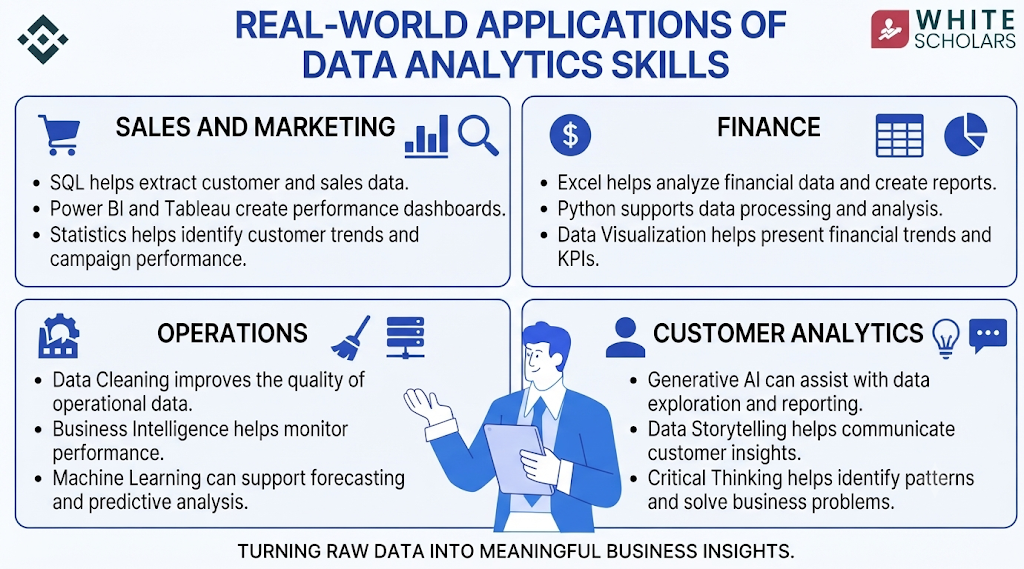
- Use Excel and SQL to analyze data.
- Use Python for data cleaning and exploration when required.
- Create clear dashboards using tools such as Power BI or Tableau.
- Identify trends, patterns, and useful insights.
- Explain findings in simple business language.
- Present recommendations based on data.
Job readiness is therefore not about knowing every data tool available. It is about combining technical skills, analytical thinking, business understanding, and communication skills to solve real problems with data.
A candidate who can demonstrate these abilities through practical projects is better prepared to take on the responsibilities of an entry-level Data Analyst role.
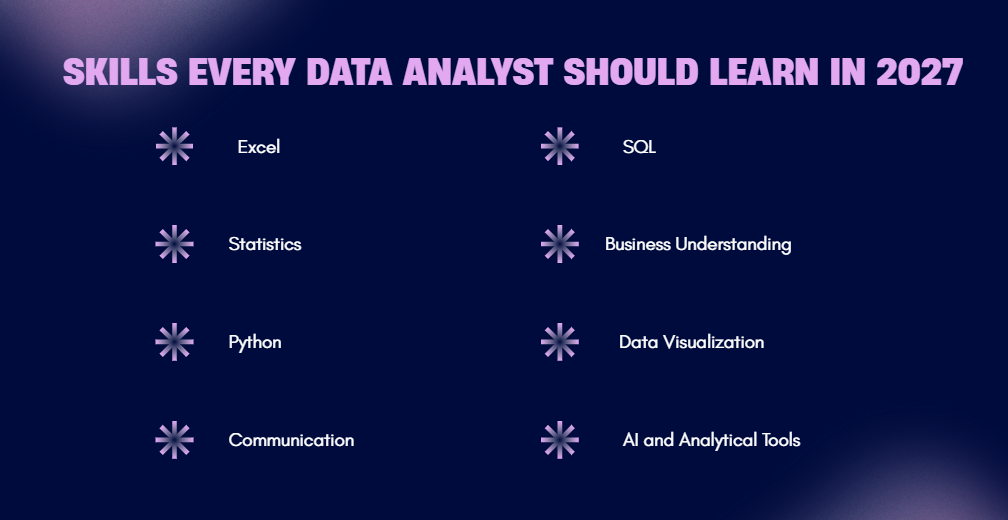
The goal is not to master every tool. It is to build a strong combination of technical skills, analytical thinking, business knowledge, and communication that can be demonstrated through practical work.
Tools to Master for a Data Analyst Role
| Tool | What It Helps With |
| Excel | Data cleaning, calculations, PivotTables, and basic analysis |
| SQL | Querying databases and analyzing large datasets |
| Python | Data cleaning, exploration, and analysis |
| Power BI | Interactive dashboards and business reporting |
| Tableau | Data visualization and storytelling |
| Git & GitHub | Managing and showcasing project work |
Projects That Build Job-Ready Skills
Projects are one of the best ways for aspiring Data Analysts to turn theoretical knowledge into practical experience. A good project should demonstrate how data is collected, cleaned, analyzed, visualized, and converted into useful business insights.
Instead of creating many small projects, candidates can focus on 3–4 strong end-to-end projects.
1. E-Commerce Sales Analysis
This project can analyze sales, revenue, profit, products, customers, and regional performance.
Skills: Excel, SQL, Power BI
2. Customer Churn Analysis
This project can identify customer groups with high churn rates and explore factors that may influence customer retention.
Skills: Python, SQL, Power BI
3. Marketing Campaign Analysis
This project can compare marketing campaigns based on engagement, conversions, spending, and revenue.
Skills: Excel, SQL, Power BI
4. HR Analytics
This project can analyze employee turnover, salaries, departments, job roles, and workforce trends.
Skills: Excel, SQL, Power BI
What Makes a Project Job-Ready?
A strong project should include:
Business Problem → Dataset → Data Cleaning → Analysis → Visualization → Key Insights → Recommendations
The project should also explain why the analysis was performed and what the findings mean for the business.
For example, instead of simply showing a Power BI dashboard, a candidate can explain that the analysis identified a decline in sales in a particular region and recommended strategies to improve regional performance.
Projects like these give candidates something concrete to discuss during interviews and provide evidence of their analytical and problem-solving abilities.
How to Prepare for Data Analyst Interviews
Interview preparation is an important part of becoming job-ready. A candidate should prepare for both technical questions and real-world problem-solving situations.
1. Prepare for SQL Questions
Candidates should practice:
- SELECT statements
- WHERE and GROUP BY
- JOINs
- Subqueries
- CTEs
- Window functions
- Aggregate functions
Practice should focus on solving business-based questions rather than memorizing queries.
2. Revise Excel
Important areas include formulas, PivotTables, VLOOKUP/XLOOKUP, conditional functions, data cleaning, and charts.
3. Practice Data Visualization
Candidates should be prepared to explain why a particular chart or dashboard was chosen and what insights it communicates.
4. Understand Basic Statistics
Questions may cover averages, percentages, distributions, correlation, and other fundamental statistical concepts.
5. Prepare for Case Studies
Some interviews may provide a business problem and ask the candidate to explain how the data would be analyzed.
A good approach is:
Understand the Problem → Identify the Data → Clean the Data → Analyze → Find Insights → Recommend an Action
6. Know Every Portfolio Project
Candidates should be able to clearly explain every project on their resume or portfolio, including the problem, dataset, tools, analysis, challenges, insights, and recommendations.
7. Practice Communication
Technical knowledge alone is not enough. Candidates should practice explaining complex findings in simple, business-friendly language.
Regular practice with SQL problems, analytics case studies, project discussions, and behavioral questions can help candidates approach interviews with greater confidence.
Common Mistakes to Avoid
Becoming job-ready is not only about learning more tools. Avoiding common mistakes can make the preparation process more effective.
- Learning too many tools at once: It is better to master a few important tools than have basic knowledge of many.
- Ignoring SQL: SQL is a core skill for many Data Analyst roles and should receive consistent practice.
- Building only tutorial projects: Projects should demonstrate original analysis and practical problem-solving.
- Focusing only on dashboards: A good analyst should be able to explain the insights behind the visuals.
- Ignoring business knowledge: Analysis should connect data findings to real business questions.
- Having a weak resume: The resume should clearly highlight relevant skills, projects, and achievements.
- Not practicing interviews: Technical knowledge needs to be supported by regular interview practice.
- Using AI without verification: AI can support analytics work, but its outputs should always be reviewed for accuracy.
- Ignoring communication skills: Analysts need to explain findings clearly to both technical and non-technical audiences.
The best preparation combines technical skills, practical projects, business understanding, communication, and consistent interview practice.
Final Advice
Becoming job-ready for a Data Analyst role in 2027 does not require learning every tool or technology available. The focus should be on building a strong foundation and gaining practical experience.
Candidates can start with Excel and SQL, then build skills in Power BI, Python, statistics, and data visualization. Practical projects can help turn these skills into real experience, while a strong resume and portfolio can make that experience easier for recruiters to see.
Regular practice is equally important. Solving SQL problems, working with real datasets, building dashboards, and preparing for interview questions can gradually improve confidence and job readiness.
For candidates who want structured guidance and hands-on learning, Whitescholars can help build practical data analytics skills through focused training and projects. Exploring a data analytics course in Hyderabad at WhiteScholars can be a useful step for those preparing for a career in Data Analytics.
The key is simple: learn the right skills, practice them through real projects, present them professionally, and prepare consistently for interviews.
FAQs
1. What skills are needed to become a Data Analyst in 2027?
Important skills include Excel, SQL, Python, Power BI, data visualization, statistics, business understanding, and communication.
2. Is SQL still important for Data Analyst jobs in 2027?
Yes. SQL remains an important skill for working with databases, retrieving information, and answering business questions using data.
3. How many projects should a beginner build?
A beginner can focus on 3–4 strong projects that demonstrate different skills and business use cases rather than creating many small projects.
4. Is Python necessary for a Data Analyst?
Python is not required for every Data Analyst role, but it can be valuable for data cleaning, exploration, automation, and working with larger or more complex datasets.
5. How can a fresher prepare for a Data Analyst interview?
A fresher can practice SQL, Excel, statistics, visualization, case studies, behavioral questions, and portfolio-based questions. Every project on the resume should also be thoroughly understood.
