

Data Analyst vs Data Scientist in 2026: Roles, Tools, Skills, and Complete Roadmap
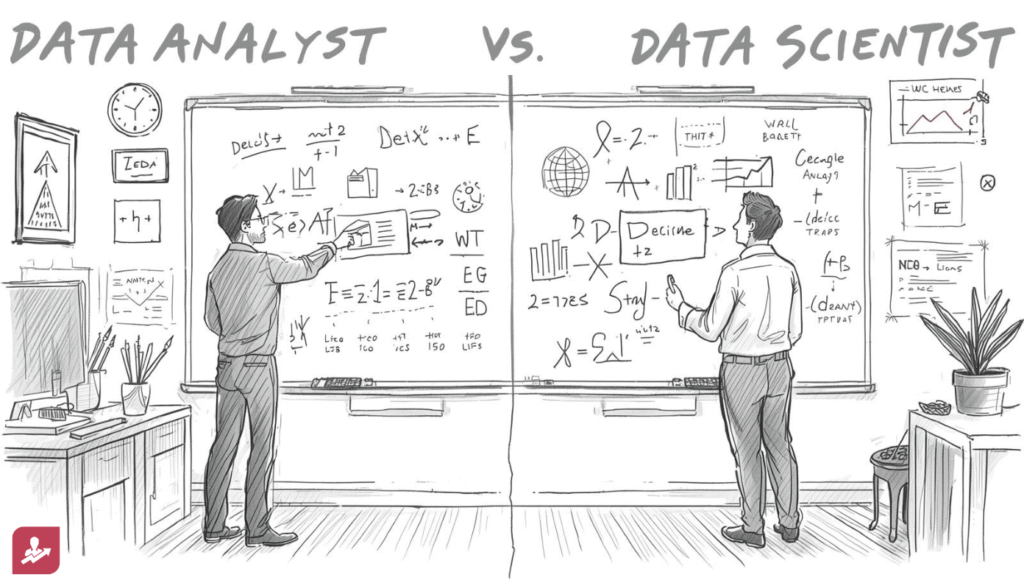
Table of Contents
If you want to pursue your career in data, it is a smart move to know the difference between a Data Analyst and a Data Scientist as this would help you to choose the right path.
Data Analyst vs Data Scientist Difference and Tools
Data analytics and Data science both are considered as two of the most in-demand careers in today’s world. Both are important in putting purposeful power behind the decision but they differ in scope, skill sets and job responsibilities.
Data Analyst
A data analyst primarily interprets data and draws derived actions from it. It typically works with structured datasets and uses data analysis, visualization, and presentation tools. Its primary goal is to answer specific business questions and improve decision-making. Technical skills that are required to become a data analyst are:
- Python programming
- MS Excel
- Power BI or Tableau
- SQL
- Basic statistics
In addition to these technical skills, a data analyst must have strong analytical and problem-solving skills, statistical knowledge and communication skills.
Data Scientist
A data scientist deals with complex data problems. It handles large, unstructured datasets and build predictive models using advanced algorithms and statistical methods. Its primary goal is to develop solutions and drive innovation. To become a data scientist, you must have following technical skills:
- Advance Python programming
- Power BI or Tableau
- SQL
- Statistics
- Machine-learning frameworks
- Deep-learning
- Generative AI
A data scientist is responsible for designing machine learning models, developing predictive algorithms, experimenting with different data solutions, and working with big data technologies.
Scope & Salary
Both careers offer highly paid jobs and good salaries but Data scientists are offered bit higher than Data analysts because of their complexity of work. However, demand for both careers is growing rapidly. Let’s see the average salaries of both
- Data Analyst Average Salary: $60,000 — $85,000 per year.
- Data Scientist Average Salary: $90,000 — $130,000 per year.
Data Scientist vs. Data Analytics Responsibilities
Data Scientist
- EDA (Exploratory data analysis)
- Cleaning dirty data
- Identify trends in data using unsupervised machine learning
- Make predictions based on trends in the data using supervised machine learning
- Write code to assist in data exploration and analysis
- Provide code to technology/engineering to implement into products
Data Analyst
- EDA (Exploratory data analysis)
- Cleaning dirty data
- Manage data warehousing and ETL (Extract Transform Load)
- Develop KPI’s to assess performance
- Develop visual representations of the data, through the use of BI platforms (i.e. Tableau, Power BI,etc.)
Data Analyst Roadmap
Phase 1: Core foundations (1–2 months)
- Learn Python fundamentals: variables, data types, control flow, functions, lists, dictionaries, error handling, and basic OOP.
- Build Excel skills: formulas, functions, PivotTables, sorting, filtering, conditional formatting, and basic descriptive statistics for quick analysis.
Phase 2: Data handling and SQL (1–2 months)
- Practice data handling with Pandas: importing data, cleaning, handling missing values, joins/merges, groupby, and basic feature engineering.
- Learn SQL in depth: SELECT, WHERE, GROUP BY, HAVING, JOINs, subqueries, window functions, and database concepts to query structured datasets.
Phase 3: Analytics, statistics, and EDA (1–2 months)
- Study basic statistics: measures of central tendency, dispersion, probability basics, hypothesis testing, and correlation needed for business insights.
- Perform EDA and data cleaning: identify outliers, trends, and patterns in structured datasets using Python and SQL to answer specific business questions.
Phase 4: BI tools and visualization (1–2 months)
- Learn Power BI or Tableau: connect to data sources, build dashboards, KPI views, and publish reports.
- Focus on storytelling: design clear charts, define KPIs, and present insights to non-technical stakeholders, which is central to the Data Analyst role.
Phase 5: Projects, specialization, and job prep (1–2 months)
- Build 3–5 projects: sales dashboard, customer segmentation analysis, marketing performance report, and operations performance KPIs using Excel, SQL, and BI.
- Prepare for jobs: refine resume and portfolio, practice SQL and case-based interview questions, and be ready for placements and oppurtunities.
Data Scientist Roadmap
Phase 1: Programming and analytical base (2 months)
- Master advanced Python: data structures, OOP, modules, packages, error handling, and working with scientific libraries such as NumPy, SciPy, and Pandas.
- Strengthen math and stats: probability distributions, inference, regression basics, and linear algebra foundations that feed into machine learning models.
Phase 2: Data wrangling and visualization (1–2 months)
- Work with complex and larger datasets: APIs, web scraping, advanced Pandas operations, and dealing with semi-structured data as included in Data Handling with Pandas, APIs, Web Services, and Web Scraping modules.
- Visualize and analyze data: advanced EDA and visualization using Matplotlib, Seaborn, and BI tools (Power BI or Tableau) to understand patterns before modeling.
Phase 3: Core machine learning (2–3 months)
- Learn supervised and unsupervised ML: regression, classification, clustering, dimensionality reduction, and model evaluation, aligned with standard data science syllabi.
- Implement ML in Python: use frameworks like scikit-learn to build, tune, and validate models, matching the “designing machine learning models” responsibility described in your article.
Phase 4: Advanced topics: deep learning and GenAI (2–3 months)
- Study deep learning: neural networks, CNNs, RNNs and frameworks like TensorFlow or similar libraries.
- Learn Generative AI: diffusion models, GANs, and large language models at a practical level.
Phase 5: Big data, deployment, and engineering touchpoints (2–3 months)
- Explore big data tools: concepts of working with large-scale data and integrating with cloud.
- Practice deployment and MLOps basics: write production-ready code, work with APIs, and collaborate with engineering to integrate models into products, which aligns with responsibilities such as providing code to tech teams.
Phase 6: Projects, research mindset, and job prep (2–3 months)
- Build an end-to-end portfolio: EDA, feature engineering, model building, evaluation, and deployment for problems like churn prediction, recommendation systems, and NLP tasks.
- Prepare for advanced roles: focus on ML algorithms, case studies, coding interviews, and continuously update skills in AI and automation, as 2026 expectations for data scientists emphasize deeper AI integration.
Better Option?
When it comes to data analytics and data science, both careers are in high demand,f and it totally depends on your interests and goals. If you’re good in coding and solving complex problems then Data scientist is the perfect career for you whereas if you enjoy working on structured data and creating reports than you must go for Data analyst.
Data Analytics Course in Hyderabad at WhiteScholars
From graduates to working professional who want to enter the data career track, the data analytics course in Hyderabad offered through WhiteScholars is designed to be beginner-friendly yet industry-aligned.
The curriculum typically includes spreadsheets, SQL, Python basics, statistics, and visualization tools like Power BI or Tableau, mapped directly to common tasks performed by entry-level data analysts.
This type of program helps you:
- Build a portfolio of dashboards and reports based on real or simulated business data, which is critical for job interviews and LinkedIn visibility.
- Prepare for roles such as junior data analyst, business intelligence associate, reporting analyst, and marketing analyst, all of which are growing rapidly as Indian companies modernize their decision-making.
Data Science Course in Hyderabad at WhiteScholars
For graduates or working professional those who willing to go deeper into algorithms and machine learning, a data science course in Hyderabad through WhiteScholars can be the next step after foundational analytics skills.
This typically adds supervised and unsupervised learning, model evaluation, feature engineering, and possibly deep learning basics, framed around real-world problems.
With this path you can:
- Work toward roles like junior data scientist, ML engineer trainee, or applied AI analyst, which require both coding skills and understanding of business use-cases.
- Position yourself for long-term growth, as data science remains one of the highest-paying and fastest-growing segments in the engineering job market in India through 2026 and beyond.
Frequently Asked Questions (FAQs)
Q1. What is the main difference between a Data Analyst and a Data Scientist?
A Data Analyst focuses on interpreting structured data and providing business insights using tools like SQL, Excel, and Power BI, whereas a Data Scientist deals with unstructured or large-scale data, builds predictive models, and creates AI-driven solutions using machine learning and deep learning.
Q2. Which career is better in 2026 — Data Analyst or Data Scientist?
Both careers are high in demand. The better option depends on your interests — choose Data Analyst if you enjoy business reporting and visualization, and Data Scientist if you like coding, algorithms, and solving complex problems.
Q3. Are Data Analysts and Data Scientists equally paid?
Not exactly. On average, Data Analysts earn around $60,000–$85,000 per year, while Data Scientists typically earn between $90,000–$130,000 per year, reflecting the higher technical depth in data science roles.
Q4. What are the essential tools for Data Analysts in 2026?
Common tools include MS Excel, Python, SQL, and BI platforms like Power BI or Tableau for visual storytelling.
Q5. What tools do Data Scientists use regularly?
They work with Python, SQL, Machine Learning frameworks (e.g., Scikit-learn, TensorFlow), Big Data technologies, and Generative AI tools for innovation-driven tasks.
Q6. How can the Data Analytics course at WhiteScholars help beginners?
It offers a beginner-friendly curriculum covering Spreadsheets, SQL, Python, Statistics, and BI tools, helping learners build job-ready portfolios aligned with real-world data problems.
Q7. What career roles can I get after completing a Data Analytics course?
Roles include Junior Data Analyst, Business Intelligence Associate, Reporting Analyst, and Marketing Analyst.
Q8. Who should pursue the Data Science course at WhiteScholars?
Graduates or professionals with basic analytics knowledge who want to master algorithms, machine learning, and advanced data models.
Q9. What job roles can a Data Science course prepare me for?
Common roles are Junior Data Scientist, Machine Learning Engineer (Trainee), and Applied AI Analyst.