

Data Analyst vs Data Scientist: Roles, Skills & Career Differences
Data Analyst vs Data Scientist explained. Compare roles, skills, workflows, and career paths to choose the right data career.
Data Analyst: Unveiling Insights
Data analysts are the detectives of the data world. Their primary mission is to unravel the mysteries hidden within structured data sets. Armed with statistical techniques and visualization tools, they meticulously dissect data trends and patterns, generating insightful reports crucial for present-day decision-making.
Their domain revolves around providing descriptive and diagnostic insights, supporting operational efficiency, and ensuring informed choices.
Data Scientists: Architects of the Future
On the other hand, data scientists are the architects of the data landscape. Their canvas extends far beyond mere analysis; they sculpt predictive models and machine learning algorithms to tatricate business challenges. Immersed in both structured and unstructured data, data scientists employ advanced statistical techniques, programming prowess, and domain expertise to forecast future outcomes.
Their creations automate decision-making processes, drive innovation, and pave the way for strategic advancements.
Data Science vs Data Analytics: Scope and Focus
The primary distinction between data science and data analytics lies in their scope and focus.
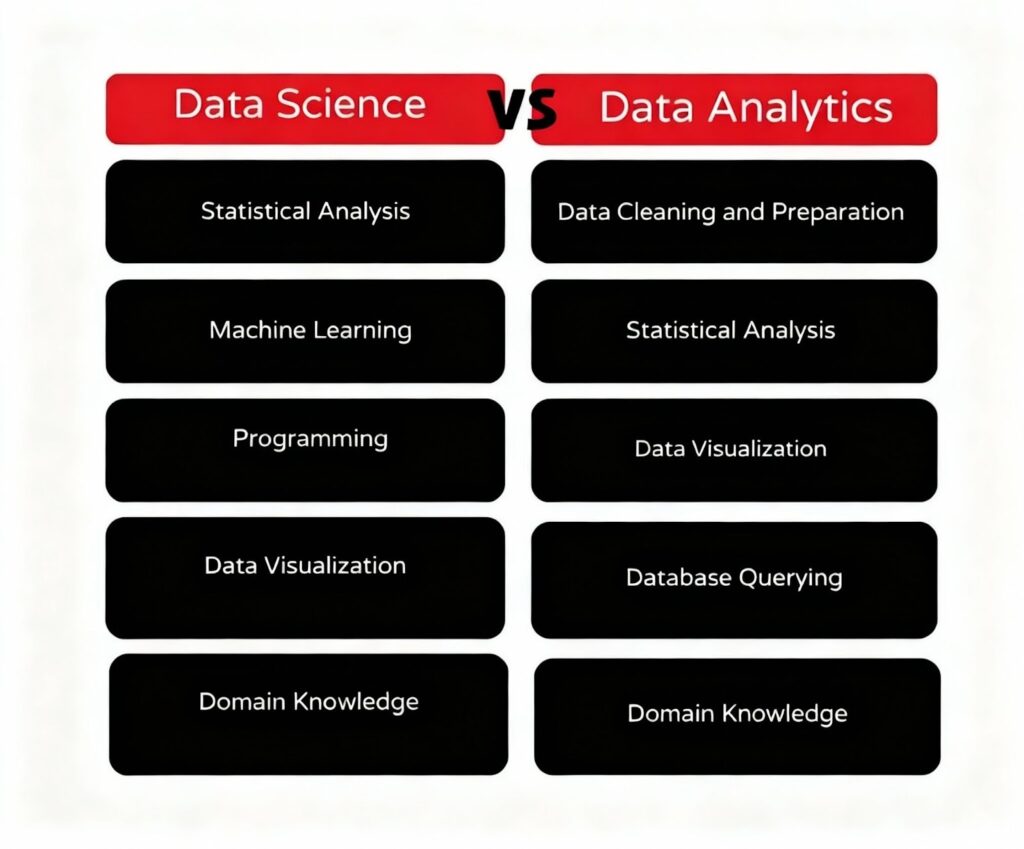
Scope of Data Scientist
This Data Scientist field primarily focuses on discovering solutions to problems we aren’t even aware of yet. it is a multifaceted field that incorporates various disciplines to extract actionable insights from large volumes of raw and structured data.
Scope of Data Analyist
Data Analytics involves the examination and statistical analysis of existing datasets. Analysts work on creating methods to capture, process, and organise data to uncover actionable insights for current issues. Unlike data science, data analytics is more focused on producing results that can lead to immediate improvements.
Core Role Differences
Data analysts work with structured data to answer “what happened” and “why,” using tools to create reports and dashboards that guide daily decisions. They extract data from databases, clean minor issues, and visualize trends for teams in marketing or finance.
Data scientists, however, tackle unstructured data and complex problems, developing machine learning algorithms to forecast outcomes like customer churn or demand. Their work involves experimentation, model tuning, and deploying solutions that automate insights.
A data analytics training in Hyderabad emphasizes practical reporting skills, while a data scientist course Hyderabad dives into predictive modeling for strategic roles.
Skills and Tools Breakdown
| Aspect | Data Analyst Skills/Tools | Data Scientist Skills/Tools |
| Primary Focus | Descriptive/diagnostic analytics | Predictive/prescriptive analytics |
| Programming | Basic SQL, Excel | Advanced Python |
| Visualization | Tableau, Power BI | Matplotlib, advanced ML viz |
| Math/Stats | Basic statistics | Advanced stats, linear algebra |
| Data Types | Structured data | Structured + Unstructured |
Data analysts master BI tools for quick insights, but data scientists need coding prowess for scalable models. Local programs like data analytics training in Hyderabad teach SQL and dashboards first, building toward data science course in Hyderabad content covers all the domains of data analytics and then advance python, ML frameworks.
Data Science vs Data Analytics: Responsibilities in Business Field
Data Science Responsibilities
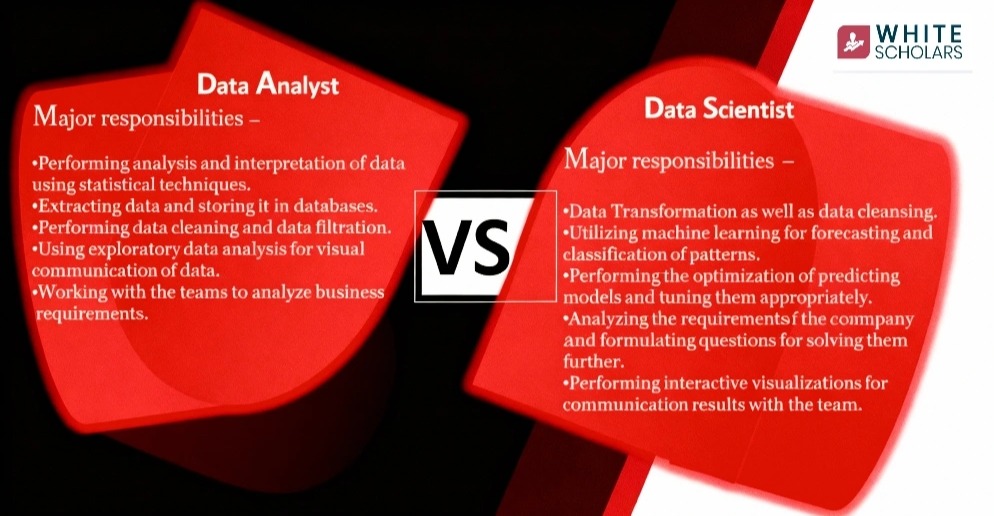
Data scientists play a pivotal role in organisations, owing to their ability to solve highly complex problems. They help define objectives and interpret results based on business domain expertise, manage the organisation’s data infrastructure, utilise relevant programming languages, statistical techniques, and software tools, and have the curiosity to explore and spot trends and patterns in data. They are also effective communicators and collaborators.
The primary responsibilities of a data scientist include designing and maintaining data systems and databases, using statistical tools to interpret data sets, preparing reports that effectively communicate trends, patterns, and predictions based on relevant findings.
Data Analyist Responsibilities
The role of a data analyst involves designing and maintaining data systems and databases, using statistical tools to interpret data sets, preparing reports that effectively communicate trends, patterns, and predictions based on relevant findings.
They work closely with the IT team to develop data governance policies and improve data integration and management processes. They use a data analytics or BI tool to build apps, perform analyses, create dashboards and visualisations, and dive deep into the data to find relationships and insights.
Data Analyst vs Data Scientist: Workflow Contrasts Unveiled
Data analysts follow a streamlined process focused on structured data to deliver quick business insights, while data scientists engage in an iterative, experimental workflow handling complex, often unstructured data for predictive models. This difference shapes their daily tasks, tools, and impact in organizations.
Data Analyst Workflow
Data analysts start by defining business questions with stakeholders, then extract structured data via SQL from databases or CRMs. They clean minor inconsistencies, perform descriptive and diagnostic analysis using stats and tools like Excel or Tableau, and end with visualizations, dashboards, and reports for immediate decisions.
- Extraction: Query ready tables for sales or customer metrics.
- Cleaning: Fix formats and outliers quickly.
- Analysis: Spot trends via aggregates and correlations.
- Reporting: Build interactive BI dashboards for teams.
This linear approach supports operational needs like campaign ROI or inventory checks.
Data Scientist Workflow
Data scientists begin with problem scoping, often involving unstructured sources like APIs, logs, or big data lakes, collaborating with engineers for extraction. They invest heavily in exploratory data analysis (EDA), feature engineering, model building with Python/R and ML libraries, rigorous testing/tuning, and finally deploy models into production pipelines.
- Extraction: Pull vast, messy data from multiple sources.
- Cleaning/EDA: Deep dive into anomalies and patterns.
- Modeling: Train/test algorithms like regression or neural nets.
- Deployment: Productionize via MLOps for ongoing predictions.
This cyclical process targets foresight, such as churn prediction or personalization engines.
Side-by-Side Workflow Comparison
| Stage | Data Analyst Approach | Data Scientist Approach |
| Data Sourcing | Structured DBs (SQL queries) | Structured + unstructured (APIs, big data tools) |
| Preperation Time | 20-30% of effort (basic cleaning) | 50-80% (feature engineering, EDA) |
| Analysis Focus | Descriptive/diagnostic (what/why) | Predictive/prescriptive (what if/next) |
| Tools | SQL, Excel, Tableau/Power BI | Python/R, Scikit-learn, TensorFlow, Spark |
| Output | Dashboards/reports for stakeholders | Deployed models/APIs for automation |
| Iteration | Ad-hoc or weekly refreshes | Continuous training/validation loops |
Analysts prioritize speed for business users; scientists emphasize accuracy for scalable solutions.
WhiteScholars data analyst course in Hyderabad teaches this efficient workflow through SQL, BI projects on retail datasets, ideal for quick job entry. Data analytics training in Hyderabad builds reporting skills for operational roles at local firms.
For deeper processes, WhiteScholars also offers data science course in Hyderabad covers ML pipelines, deployment, suiting predictive needs in fintech or e-commerce. A data scientist course Hyderabad includes capstones on fraud models, preparing for advanced positions.
Salary and Career Progression
Data analysts in India earn ₹6-12 LPA starting, rising to ₹20 LPA with experience; Data scientists start at ₹10-20 LPA, reaching ₹30+ LPA. Demand favors scientists for innovation roles.
Progression: Analysts advance to senior analyst or BI manager; scientists move to lead data scientist or ML engineer. A data analyst course in Hyderabad launches quick entry; data science course in Hyderabad accelerates to high-pay tracks.
Conclusion
Data analysts and Data scientists are two sides of the same data‑driven coin, working together to turn information into business value but doing so at different depths and with different toolkits Both clean data, use stats, and communicate insights, so analysts often upskill to scientists.
Choosing between these paths is less about which role is “better” and more about which process matches your strengths and interests: a clearer, reporting‑oriented workflow for analysts versus an experimental, model‑driven workflow for scientists. With solid foundations in SQL, Python, statistics, and visualization, it is entirely possible to start in analytics and grow into data science over time, building a flexible and future‑proof career in the data ecosystem.
Frequently Asked Questions
Which is better, a data scientist or a data analyst?
The best choice between a data scientist and a data analyst depends on one’s interests and career goals. Data scientists typically work on more complex problems and require advanced programming and machine learning skills. On the other hand, data analysts focus on interpreting and analyzing data to provide insights.
Both roles are in high demand and offer lucrative career opportunities. Individuals should assess their skills, interests, and career aspirations before deciding which role fits them better.
Who earns more, data scientist or data analytics?
Data Scientists typically command higher average salaries compared to Data Analysts. However, salary discrepancies are influenced by variables like location, industry, and experience level. Despite this, both positions provide competitive pay and avenues for career advancement, deciding between the two roles contingent upon individual aspirations and objectives.
Overall, both data scientists and data analysts have promising earning potential. The key is to learn and adapt continuously as the role of data evolves across industries.