

Most Asked Data Science Interview Questions at Cognizant in 2026
Introduction
In today’s technology-driven world, data science plays a major role in helping companies make smarter decisions using data. This has created a growing demand for skilled data science professionals across industries.
For fresh graduates, preparing for Data Science interviews requires a strong foundation in Python, SQL, statistics, machine learning, and analytical thinking. Companies like Cognizant evaluate candidates on their technical knowledge, problem-solving skills, and ability to apply concepts to real-world scenarios.
In this blog, we will explore the commonly asked Data Science interview questions at Cognizant and learn how fresh graduates can prepare effectively to start their data science careers.
Why Data Science Skills Are Important for Cognizant Interviews
Data Science helps companies like Cognizant solve business problems using data, analytics, and technology. Recruiters look for candidates with strong skills in:
- Python and data handling
- SQL and database analysis
- Statistics fundamentals
- Machine learning concepts
- Problem-solving skills
- Real-world project knowledge
For fresh graduates, building these skills and practicing interview questions can improve confidence and increase chances of success in Data Science interviews.
Top Data Science Interview Questions Asked at Cognizant
Cognizant Data Science interviews focus on testing technical knowledge, problem-solving skills, and practical understanding. Here are some commonly asked questions with short answers.
1. What is Data Science?
Answer:
Data Science combines statistics, programming, and machine learning to analyze data and generate useful insights for decision-making.
2. Explain the Data Science lifecycle.
Answer:
The Data Science lifecycle includes data collection, data cleaning, analysis, model building, evaluation, and deployment.
3. What is the difference between AI, ML, and Data Science?
Answer:
AI enables machines to think like humans, ML helps machines learn from data, and Data Science uses data, statistics, and ML to solve problems.
4. How do you handle missing data?
Answer:
Missing data can be handled by removing missing values or filling them using methods like mean, median, or mode.
5. What is supervised learning?
Answer:
Supervised learning trains models using labeled data to predict outcomes. Examples include classification and regression.
6. What is overfitting?
Answer:
Overfitting occurs when a model learns training data too well and performs poorly on new data.
7. What is precision and recall?
Answer:
Precision measures correct positive predictions, while recall measures how many actual positives are identified correctly.
8. How do you explain a Data Science project?
Answer:
Explain the problem, dataset, approach, model used, evaluation, and final results clearly.
9. What is the difference between supervised and unsupervised learning?
Answer:
Supervised learning uses labeled data to train models and predict outcomes, while unsupervised learning finds hidden patterns in unlabeled data.
10. How do you evaluate a Machine Learning model?
Answer:
A Machine Learning model is evaluated using metrics like accuracy, precision, recall, F1-score, and RMSE based on the type of problem.
How to Prepare for a Data Science Interview
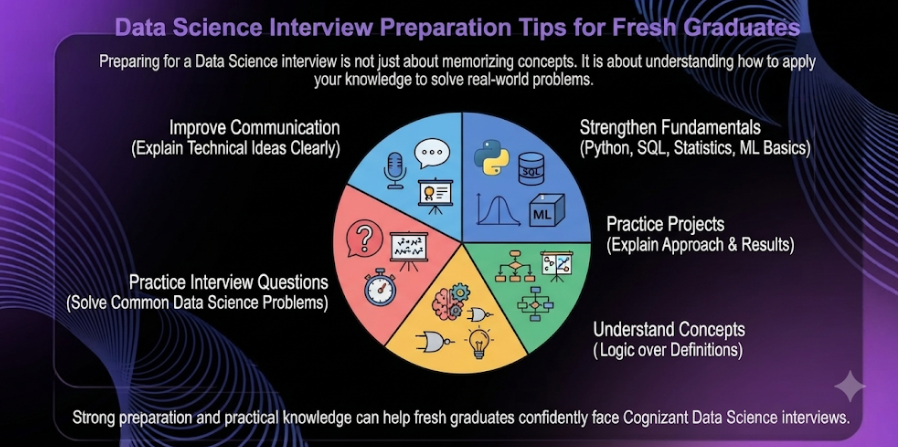
Preparing for a Data Science interview becomes easier with a structured approach. Follow these steps:
- Learn the Basics: Build strong knowledge of Python, SQL, statistics, and machine learning.
- Work on Projects: Gain practical experience by working on real-world datasets.
- Practice Problem-Solving: Solve data analysis and machine learning problems regularly.
- Revise Important Concepts: Focus on frequently asked interview topics and algorithms.
- Mock Interviews: Practice explaining your answers with confidence.
Consistent learning and hands-on practice can help fresh graduates become interview-ready for Data Science roles.
Common Data Science Interview Mistakes to Avoid
Fresh graduates often make these mistakes during Data Science interviews:
- Memorizing concepts without understanding their practical use
- Not explaining projects clearly
- Ignoring Python and SQL fundamentals
- Choosing machine learning models without proper reasoning
- Focusing only on theory and avoiding hands-on practice
- Not communicating answers clearly
Avoiding these mistakes can help candidates improve confidence and perform better in Cognizant Data Science interviews.
Data Science Course in Hyderabad at WhiteScholars
For fresh graduates who want to build a career in Data Science, learning with practical industry exposure can create better career opportunities.
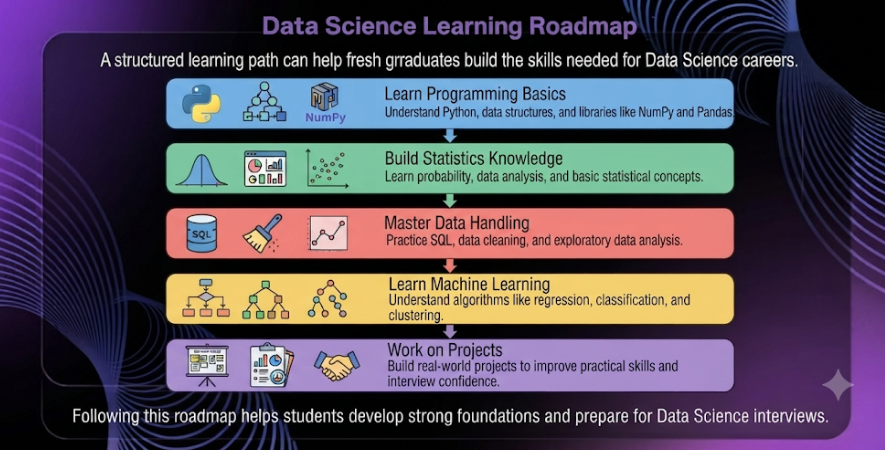
The Data Science course at WhiteScholars focuses on helping students develop skills in Python, SQL, Machine Learning, Statistics, and real-world projects.
Through hands-on learning and interview preparation, students can build the confidence needed to start their Data Science careers.
How WhiteScholars Helps Fresh Graduates
WhiteScholars focuses on helping students bridge the gap between academic knowledge and industry requirements.
Students get:
- Practical project-based learning
- Industry-focused curriculum
- Hands-on Data Science practice
- Interview preparation support
- Guidance from experienced mentors
The goal is to help fresh graduates develop job-ready skills and confidently begin their Data Science careers.
A Message from WhiteScholars
Hey, we are Team WhiteScholars.
Thank you for taking the time to read this blog. Our mission is to help learners build practical skills and understand technologies that create better career opportunities.
We believe learning becomes more valuable when combined with real-world practice and continuous improvement.
Keep learning, keep building, and keep growing with WhiteScholars.
FAQs
1. What skills are required for a Data Science interview at Cognizant?
A. Candidates should focus on Python, SQL, statistics, machine learning, and problem-solving skills.
2. Is Data Science a good career choice for fresh graduates?
A. Yes, Data Science offers growing career opportunities across industries due to the increasing use of data.
3. What machine learning topics should I prepare for Cognizant interviews?
A. Prepare topics like regression, classification, clustering, model evaluation, and overfitting.
4. How can fresh graduates prepare for Data Science interviews?
A. Practice concepts, work on projects, improve coding skills, and revise commonly asked interview questions.
5. Is project experience important for Data Science interviews?
A. Yes, explaining real-world projects helps interviewers understand your practical knowledge and problem-solving ability.
