

Digital Marketing: A Comprehensive Guide to Strategy and Skills
In today’s world, digital marketing is everywhere, but how does one start and run a successful digital marketing business? Let’s take a look at how digital marketing differs from other passive income streams, as well as what to avoid, with a particular emphasis on skills.
1. Defining Digital Marketing and the Passive Income Model
Digital marketing is defined as the practice, strategy, or act of promoting a specific brand or product through digital channels, most commonly social media platforms like Instagram, Facebook, and Pinterest, or search engines like Google. In the modern world, this field has evolved into a powerful tool for achieving financial freedom through passive income models.
Unlike traditional 9-to-5 jobs that require individuals to trade their time for money (imposing a natural limit on earning potential), digital marketing allows for a “build it once, sell it forever” business model. This approach involves creating a digital asset, such as a template or guide, and uploading it to a marketplace where it can be purchased repeatedly without further maintenance or shipping requirements.
2. Digital Marketing vs. Digital Products: Understanding the Synergy
It is crucial to distinguish between digital products and digital marketing. The items for sale are digital products, which include online courses, ebooks, printable wall art, and Canva templates. Digital marketing, on the other hand, is the enabling strategy used to help customers find those products. Without marketing skills, even the highest-quality digital product will struggle to reach its target audience.
3. The Digital Marketing Trap: Identifying Predatory Pyramid Schemes
The “digital marketing trap” is currently prevalent on social media. This frequently involves “get rich quick” schemes in which individuals are sold expensive courses (often costing $500 or more) that simply teach the buyer how to resell the same course to others. This creates an artificial, oversaturated market rather than serving a natural demand.
A legitimate business addresses real-world issues for specific market segments, such as providing educational resources for teachers or organisational planners for mothers. If a strategy requires constant “door-to-door” digital salesmanship, such as anonymously DMing people or posting incessantly to convince them to buy, it is not a truly passive or sustainable model.
4. Types of Digital Marketing Agencies and Their Specialisations
Digital marketing businesses take various forms depending on their area of expertise:
- Full-service Agencies: Offer a comprehensive suite of services, including SEO, social media management, PPC, and email marketing.
- SEO agencies specialise solely in increasing website visibility and organic rankings on search engine results pages (SERPs).
- Social Media Agencies: Focus on managing brand presence and running targeted ads across platforms like TikTok, Instagram, and LinkedIn.
- Content Marketing Agencies: Create high-quality material to attract and engage audiences across multiple channels.
- PPC Advertising Agencies: Manage paid media campaigns on platforms such as Google Ads and Bing Ads to increase ROI.
- Email Marketing Agencies: Handle lead engagement through list building, automation, and targeted campaigns.
5. Essential Services Provided by Digital Marketing Businesses
A professional agency provides several core services to ensure a client’s success in the digital realm:
- Strategy Development: Creating customised roadmaps by analysing market trends and competitor behaviour.
- Search Engine Optimisation (SEO): Employing technical and creative techniques to improve organic rankings.
- Content Marketing: Distributing valuable assets like blog posts, infographics, and explainer videos to inform audiences.
- Social Media Management: Curating content and managing profiles to drive brand awareness.
- Analytics and Reporting: Monitoring performance metrics to allow for data-driven, informed decision-making.
6. A Blueprint for Starting a Digital Marketing Venture
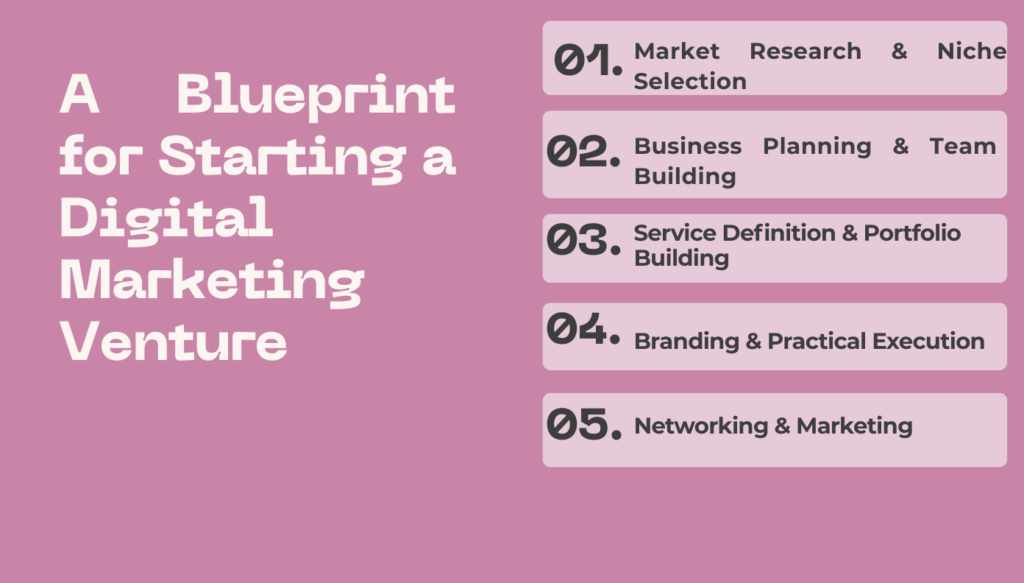
Starting a digital marketing business requires a structured approach to transition from a vision to a thriving operation:
Step 1: Market Research & Niche Selection
Understand the landscape by identifying competitors and finding a niche with natural demand. Specialising in a specific industry, such as healthcare or education, allows you to develop deep expertise in that sector’s unique challenges and regulations.
Step 2: Business Planning & Team Building
Develop a plan including your mission, vision, and core values. Assemble a “dream team” of experts, including SEO specialists, all media managers, social media managers, and data analysts.
Step 3: Service Definition & Portfolio Building
Clearly define your offerings to set client expectations. If you lack experience, create your own projects or blogs to serve as a “live demonstration” of your ability to drive results.
Step 4: Branding & Practical Execution
Define your brand’s essence and voice. In practice, this could entail using design tools like Canva to create high-value products, such as inclusive, dyslexia-friendly worksheets for the educational market.
Step 5: Networking & Marketing
Attend industry conferences and webinars to establish your presence. Partner with complementary firms, such as video production or PPC agencies, to expand your reach through cross-niche collaboration.
7. Strategies for Standing Out in a Competitive Market
To succeed when competing with numerous other agencies, a business must offer more than just basic services:
- Unique Value Proposition (UVP): Identify distinct strengths, such as innovative methodologies or a deep niche specialization.
- Exceptional Client Service: Focus on responsive communication and a client-centric approach to build long-term trust.
- No Gatekeeping: Sharing behind-the-scenes insights and being transparent about strategies can build authority and rapport with potential clients.
8. The Digital Marketing Tech Stack: Essential Tools for Success
An efficient agency requires specialised software to manage campaigns and analyse data:
- Website Audit & SEO Tools: Ahrefs, Moz Pro, and Google Analytics are essential for identifying technical issues and tracking rankings.
- Project Management: Software like Asana, Trello, and Basecamp helps teams collaborate and track task progress.
- Workflow Automation: Tools like HubSpot, Zapier, and StoryChief reduce repetitive manual work, such as scheduling posts or generating reports.
- Social Media Management: Platforms like Hootsuite and Sprout Social allow for managing multiple channels from a single dashboard.
9. Focus: Essential Skills for Digital Marketing
To excel in this industry, whether as an independent creator or an agency owner, you must master several high-demand skills:
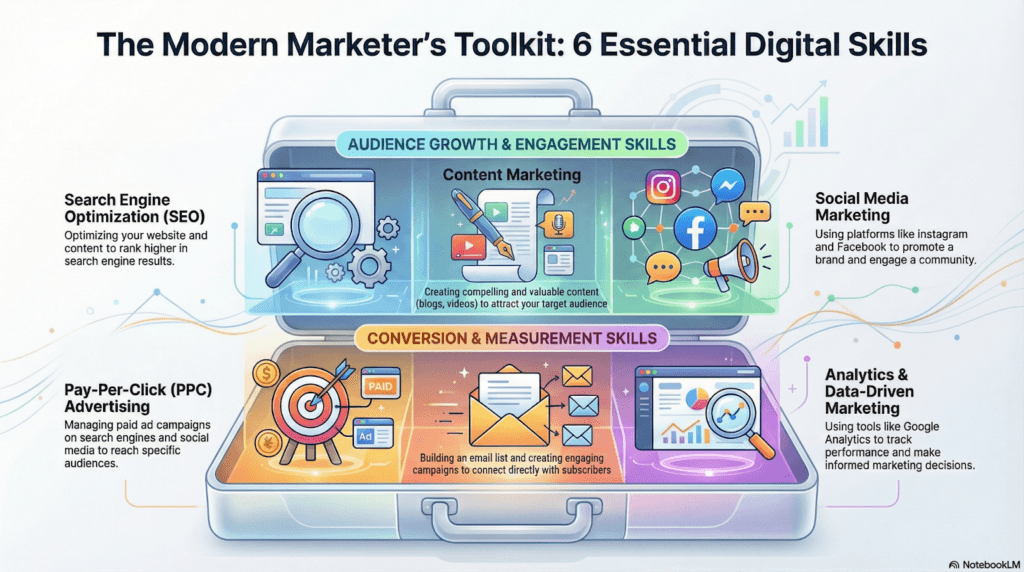
Digital marketing requires a diverse blend of technical, creative, and analytical skills. These can be divided into two categories: core technical channels (the specific methods used to reach audiences) and operational strategic skills (required to manage campaigns or run a successful agency).
Core Technical Skills
These are the fundamental “hard” skills taught in professional courses and used every day to implement digital strategies:
- Search Engine Optimisation (SEO) is the process of optimising websites and content so that they rank higher in search results, increasing organic visibility. It necessitates expertise in keyword research, on-page optimisation, link building, and knowledge of search engine algorithms.
- Pay-Per-Click (PPC) Advertising: Marketers must know how to create and manage paid ad campaigns on search engines and social media platforms. Key components include selecting the right keywords, creating compelling ad copy, and tracking performance to maximise ROI.
- Social media marketing entails using platforms such as Instagram, Facebook, and Pinterest to promote brands and engage with specific audiences. To increase conversions, you must be able to develop effective social media strategies, manage accounts, and analyse data.
- Content Marketing: Often described as “king” in the digital world, this skill involves creating valuable, compelling content that attracts and informs an audience. It encompasses storytelling, content strategy, and proficiency in various formats like blog posts, e-books, and explainer videos.
- Email Marketing: This is still a cost-effective way to engage leads. Professionals must know how to build email lists, segment them, design automated campaigns, and measure success through deliverability tracking and analytics.
- Analytics and Data-Driven Marketing: A core requirement is the ability to collect and interpret data to make informed marketing decisions. This includes using Google Analytics to monitor user behaviour, website traffic, and conversion rates.
Operational and Strategic Skills
Beyond technical execution, digital marketing requires broader business and interpersonal capabilities:
- Strategy Development: The ability to create tailored plans that are in line with online marketing objectives is central to success. To develop a successful strategy, analyse market trends, competitor behaviour, and target audience needs.
- Client Relations and Communication: Particularly in an agency setting, maintaining exceptional client service and open lines of communication is vital for building long-term trust and fostering word-of-mouth referrals.
- Inclusive Design: To stand out and remain ethical, marketers should develop skills in inclusive design, such as using dyslexia-friendly fonts to ensure digital products are accessible to a wider audience.
- Market Research: Before launching a campaign or business, one must possess the skill to conduct thorough research to differentiate from competitors and identify unique selling points.
Business and Tool Proficiency
To operate efficiently, especially in the “passive income” or agency models, specific software skills are required.
- Creative Design Tools: Proficiency in platforms like Canva is essential for creating digital products (such as worksheets or templates) from scratch.
- Management and Automation Software: Success is enhanced by knowing how to use project management tools (like Asana, Trello, or Basecamp) and workflow automation platforms (like HubSpot, Zapier, or StoryChief) to reduce repetitive tasks and improve productivity.
- Ethical Discernment: A crucial skill for modern marketers is the ability to distinguish between natural demand (solving real problems for niches like education or real estate) and artificial demand (predatory “resell” schemes or pyramid scams).
Digital Marketing Course in Hyderabad
As a digital marketer, you will have numerous career options in fields such as social media marketing, search engine optimisation, content marketing, email marketing, and others.
Digital marketing is a fast-growing field with a high demand for skilled professionals. Therefore, taking a digital marketing course can significantly improve your career prospects.
The White Scholars Digital Marketing Course in Hyderabad has everything you need to start a business and develop real-world projects. They provide a hybrid mode of learning that includes one-on-one mentorship, recorded classes, and much more.
The White Scholars Training Institute also provides placement assistance and is known for its adversarial approach to learning. Start your learning today click here.
Final Thought
Digital marketing has evolved from a traditional promotional tool to a framework for passive income, making wealth creation more accessible to everyone. The most successful modern marketers avoid “get rich quick” reselling schemes and instead focus on providing tangible value to specific niches. By mastering technical skills like SEO and data analysis while maintaining a client-centric and inclusive approach to design, entrepreneurs can build sustainable businesses.
Whether you are running a full-service agency or an anonymous digital product shop, the key to longevity in this field is the lasting impact you make and solving real-world problems with your digital strategies. Success is not just about revenue; it is about the relationships nurtured and the transformative results delivered in a rapidly changing technological landscape.
FREQUENTLY ASKED QUESTIONS
1. What is the most important skill to start a career in digital marketing?
The most important skill is the ability to analyse data and consumer behaviour. Without insights, campaigns become guesswork. Tools like Google Analytics and social media dashboards help marketers measure performance and refine strategies. Strong communication skills ensure that ideas are clearly communicated to clients or teams.
2. How does SEO differ from paid advertising?
SEO (Search Engine Optimisation) focuses on improving organic visibility through content, keywords, and backlinks. It’s a long-term strategy that builds credibility and trust. Paid advertising, on the other hand, delivers immediate visibility by bidding for ad placements. Both complement each other; SEO builds sustainable traffic, while ads provide quick results.
3. Why is content marketing considered the backbone of digital strategy?
Content marketing builds trust by educating and engaging audiences rather than directly selling. Blogs, videos, and infographics help brands establish authority in their niche. Quality content also fuels SEO, social media, and email campaigns. Without strong content, other digital tactics often fail to connect meaningfully with customers.
4. How can beginners transition into digital marketing without prior coding knowledge?
Digital marketing doesn’t require coding expertise to get started. Beginners can focus on skills like social media management, copywriting, and analytics. Many tools (like Canva, HubSpot, or Mailchimp) simplify tasks with drag-and-drop features. Institutions such as White Scholars, Hyderabad provide structured mentorship and hands-on projects, helping students confidently bridge the gap from beginner to industry-ready professional.
5. What role does AI play in modern digital marketing?
AI enhances personalization by analyzing customer data and predicting behavior. Chatbots improve customer service, while AI-driven tools optimize ad targeting and content recommendations. Generative AI even helps create marketing copy, visuals, and campaign ideas faster. Businesses adopting AI gain efficiency and deeper customer engagement compared to traditional methods.