

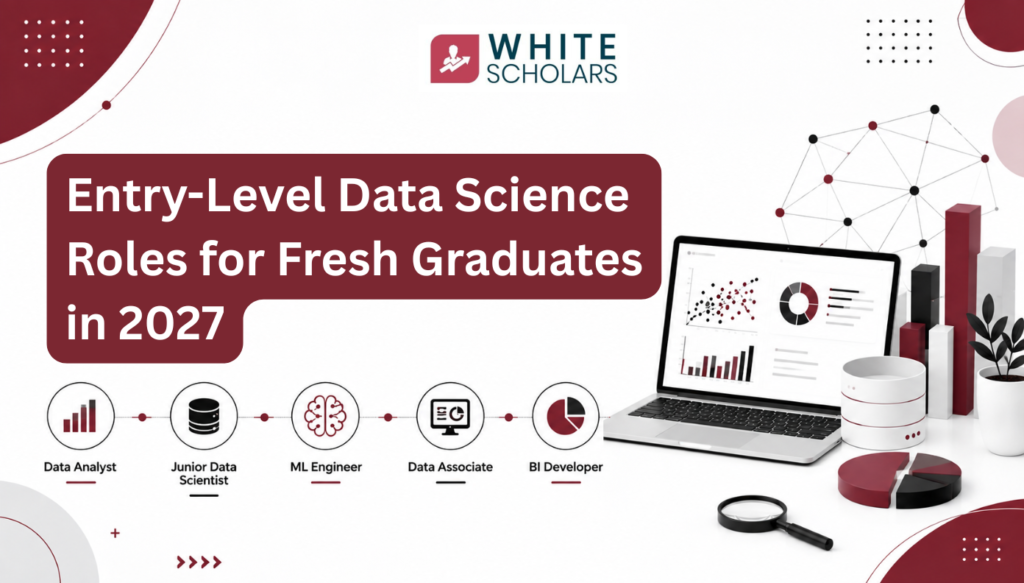
Entry-Level Data Science Roles for Fresh Graduates in 2027
(And how to actually break into them)
If you’re graduating in 2026–27 or graduated after 2020 and thinking about data science, you’re not late—you’re just entering a different game. The “generic data scientist” role is fading. What’s rising instead is a family of specialised roles built around AI, GenAI, and production systems.
This post breaks down the top 5 entry-level data science roles for fresh graduates that are realistic, in-demand, and beginner-friendly for fresh grads —plus what you actually need to learn, build, and show to get hired.
A good institute plays a key role because it gives you a data science course in Hyderabad with all additional inputs to fetch you jobs and make you skilled enough to join your dream job.
1. Data Analyst / Analytics Engineer (The Smart Entry Point)
What you’ll do:
Turn raw data into dashboards, reports, and insights that business teams use daily. You’ll work a lot with SQL, Excel/Sheets, and tools like Power BI or Tableau. In more advanced setups, you’ll also clean and model data using data and modern data stacks.
Why it’s great for freshers in 2027:
- It’s the most common “first role” in data.
- Companies still need humans who can ask the right questions and explain numbers clearly.
- GenAI helps with code, but not with business context or storytelling—that’s your edge.
Skills to focus on:
- SQL (joins, window functions, CTEs)
- One BI tool (Power BI / Tableau / Looker)
- Basic Python or R for analysis (pandas, visualisation)
- Data storytelling: turning charts into recommendations
Portfolio ideas:
- A dashboard that answers a real business question (e.g., “Which products are most profitable by region?”)
- A case study where you start from a messy dataset, clean it, and present 3–5 actionable insights.
2. Junior Data Scientist (Applied / Product-Focused)
What you’ll do:
Build predictive models and run experiments to support product, marketing, or operations. You’ll use statistics, machine learning, and increasingly, GenAI tools to prototype faster.
How the role has changed by 2027:
Companies no longer want “I built a model with 95% accuracy.” They want:
- “I built a model, deployed it, and it’s used in the X process.”
- “I ran an A/B test and changed the metric by Y%.”
Specialisation matters: think Product Data Scientist, Marketing Data Scientist, or Supply Chain Data Scientist instead of a generic title.
Skills to focus on:
- Python (pandas, scikit-learn, basic deep learning if relevant)
- Statistics & experimentation (A/B testing, hypothesis testing)
- Basic ML deployment (FastAPI, Streamlit, or cloud notebooks)
- Domain knowledge in one area (e.g., fintech, e‑commerce, health)
Portfolio ideas:
- A small end-to-end project: data → model → simple web app (Streamlit/Flask) hosted online.
- A write-up of an A/B test design for a realistic product scenario.
3. Machine Learning Engineer (Junior / Associate)
What you’ll do:
Take models from notebooks to production. You’ll work closely with data scientists and backend engineers to make sure models run reliably, scale, and are monitored.
Why this is hot in 2027:
Entry-Level Data Science Roles AI Engineer / ML Engineer is one of the fastest-growing roles globally as companies move from “cool demos” to real AI products.
Skills to focus on:
- Strong Python + software engineering basics (functions, classes, testing, Git)
- ML frameworks (scikit-learn, PyTorch or TensorFlow basics)
- Model serving (FastAPI, Flask, or cloud services like SageMaker / Vertex AI)
- Basics of MLOps: logging, monitoring, CI/CD for ML
Portfolio ideas:
- Deploy a model as an API and document how you’d monitor it.
- Refactor a messy Jupyter notebook into a clean Python package with tests.
4. GenAI / LLM Engineer (Entry-Level Tracks)
What you’ll do:
Build applications using large language models: chatbots, RAG systems, internal copilots, document Q&A, etc. You’ll work with prompts, embeddings, vector databases, and evaluation pipelines.
Is this realistic for freshers?
Yes—if you aim for junior or associate GenAI roles, or start in data/ML and grow into this. Many teams now have “GenAI Engineer” or “AI Engineer” tracks specifically for people who can prototype with LLMs and integrate them into apps.
Skills to focus on:
- Python + one web framework (FastAPI / Flask / basic frontend integration)
- LLM basics: prompts, few-shot examples, temperature, tokens
- RAG patterns: retrieval, vector DBs (e.g., FAISS, Pinecone, Chroma)
- Evaluation: how to test if your LLM app is actually good (not just “it feels fine”)
Portfolio ideas:
- A RAG-based Q&A bot over a public dataset or docs (e.g., “Ask anything about this company’s annual report”).
- A small internal-tool-style app: “Upload a resume, get structured fields + a summary.”
5. MLOps / AI Platform Engineer (Junior Track)
What you’ll do:
Build and maintain the infrastructure that lets ML and AI run in production: pipelines, model registries, monitoring, feature stores, and deployment workflows.
Why this matters in 2027:
As AI systems get bigger, companies care more about reliability, cost, and governance. MLOps and platform roles are among the most in-demand and well-paid, with clear growth paths.
Skills to focus on:
- Cloud basics (AWS/GCP/Azure): storage, compute, IAM
- Containers & orchestration (Docker, Kubernetes basics)
- ML tools: MLflow, Weights & Biases, or similar
- Pipelines: Airflow, Prefect, or cloud-native workflows
Portfolio ideas:
- A project where you containerize a model, deploy it, and set up basic logging/monitoring.
- A simple “ML pipeline” that ingests data, trains a model, and registers it in MLflow.
How to Choose Your First Role (Without Overthinking)
You don’t need to pick your “forever role” today. Think in terms of the first stepping stone:
- If you love business, storytelling, and quick impact → Data Analyst / Analytics Engineer.
- If you like stats, experiments, and product thinking → Junior Data Scientist (Applied).
- If you enjoy coding, systems, and making things run → ML Engineer or MLOps.
- If you’re excited by chatbots, copilots, and LLMs → GenAI / LLM Engineer track.
A practical rule for 2026–27: choose one path, go deep for 3–6 months, and build 2–3 strong projects that look like real work, not tutorial projects shown to you in social media.
What Actually Gets You Hired in 2027
Based on recent career advice from practitioners and hiring trends:
- Internships > Perfect Job Hunt
One real internship (even low stipend) beats months of applying with a generic resume. Companies want proof you can work with real data and teams.
- Niche Over “General Data Scientist”
“Data Scientist” is too broad. Pair your role with a domain:
- “Data Analyst – Fintech”
- “ML Engineer – Recommendation Systems”
- “GenAI Engineer – Documentation & Knowledge Bases”
This makes you memorable and reduces competition.
- Projects That Look Like Products
Instead of 10 Kaggle notebooks, build:
- A deployed app (even simple)
- A clear problem statement
- A short write-up: problem → approach → impact
Hiring managers skim; make it easy to see value in 30 seconds.
- Show You Can Work With AI, Not Just Use It
Mention how you used GenAI to speed up work (code, docs, analysis) and where you didn’t trust it (critical logic, evaluation). That balance is exactly what teams want.
A Simple 90-Day Plan (If You’re Starting Now)
Weeks 1–4:
- Pick one role from the five above.
- Learn core tools (e.g., SQL + Power BI for Analyst; Python + scikit-learn for DS/ML).
- Start one end-to-end project.
Weeks 5–8:
- Finish Project 1: clean code, README, and a short blog/LinkedIn post.
- Start Project 2 with a slightly harder problem or better deployment.
- Apply to internships and junior roles; tailor your resume to your chosen role + domain.
Weeks 9–12:
- Polish both projects; add one small improvement (deployment, tests, or better visuals).
- Do mock interviews; practice explaining your projects in 2 minutes.
- Keep applying, but spend at least 50% of your time building, not just scrolling job boards.
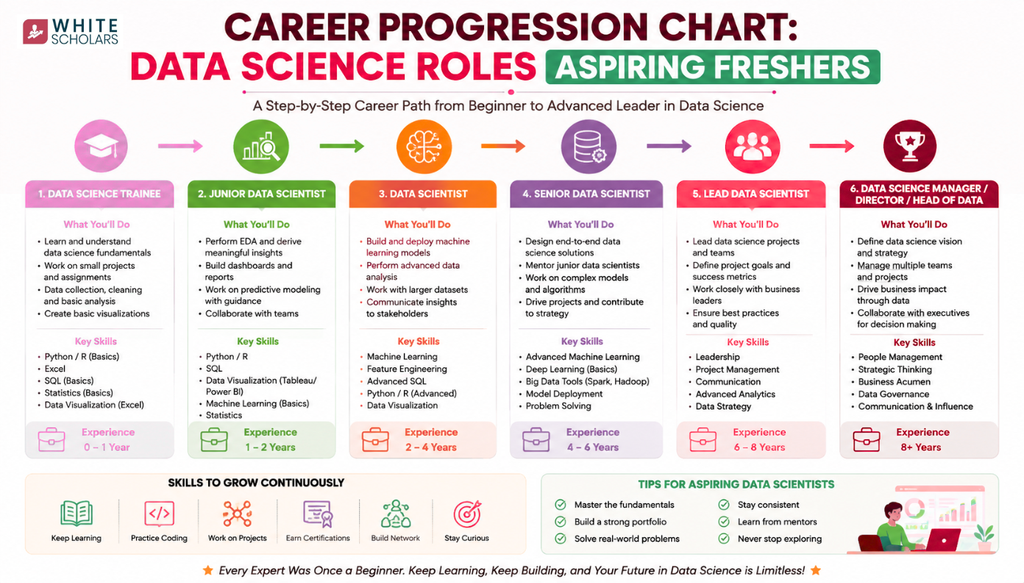
Career Progression Chart: data science roles aspiring freshers
Final Thought
Data science roles for freshers in 2027 isn’t about having the fanciest model. It’s about solving real problems with data and AI and being the person who can take an idea from “this could work” to “this is working in production.”
Pick one of these five roles, go deep, and treat your first job as a launchpad, not a final destination. The market is competitive, but it’s also full of teams that desperately need people who can ship real data and AI solutions.
If you tell me your background (degree, skills, interests), I can suggest which of these five roles fits you best and outline a custom 60–90-day plan.
FAQ’s
1. Does Graduates from any background eligible for Data Science roles
A. Yes, graduates from any stream are eligible for the the roles based on the skills they develop
2. When you completed your degree / graduation important for fresher roles
A. Graduates in 2027 are generally considered as fresh graduates, but companies are taking candidates who completed their degree after 2020.
3. What is the best way to showcase the skills for data science?
A. As mentioned, creating a good portfolio is the best way to showcase your skills also Linkedin posts.
4. What is best way for job search for data science roles
A. To crack the job market, you need to have a multi-lateral approach. No single or stand alone strategy works.
5. How much time it takes to learn the skills required to become eligible for data science roles
A. A minimum of 9 – 12 months dedicated and strategical mannered way of learning is required to acquire the skills to become eligible for data science roles.
