

Exploring the new era of search: Google’s AI Mode
Explore the new era of search with Google AI Mode. Learn how it works and how it differs from traditional AI overviews in search results.
Entry Points and Global Reach: How to Use AI Mode
Accessing Google’s AI Mode has become simplified as it moves from an experimental phase to a core search feature. There is no longer a separate opt-in process or a need to use Google Labs.
Users can access the feature through two primary pathways:
- The Direct Entry: In supported regions, AI Mode can be accessed directly from the Google homepage, appearing as a primary search option.
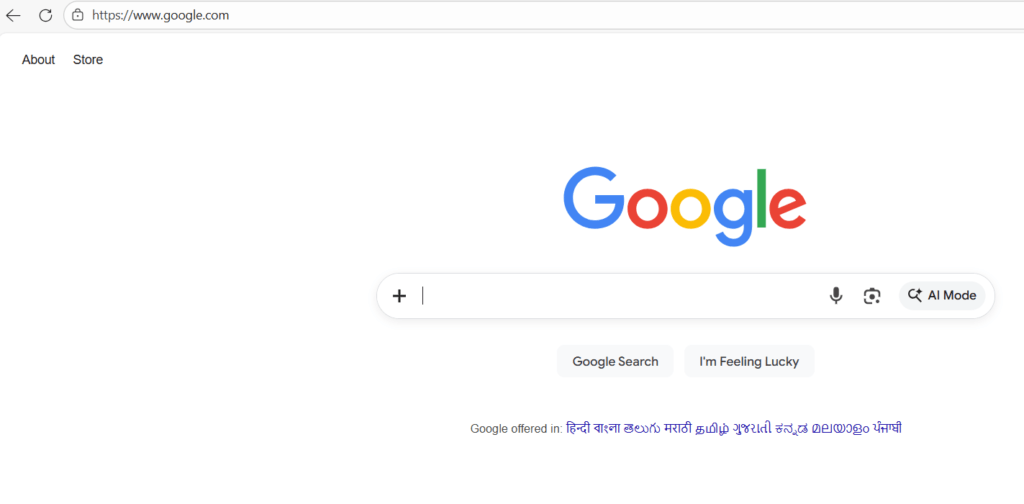
- The Dive Deeper Expansion: When a user interacts with a standard AI overview, they may see a “show more” option. Expanding this allows the user to click “Dive Deeper in AI Mode” to transition into the full conversational experience.
Once active, the system maintains contextual continuity, allowing users to ask follow-up questions without repeating their initial constraints. Users can also review their AI mode history to pick up previous conversations.
A Timeline of Progress: The Journey to AI-First Search
The development of AI Mode is the result of nearly a decade of focused AI research at Google.
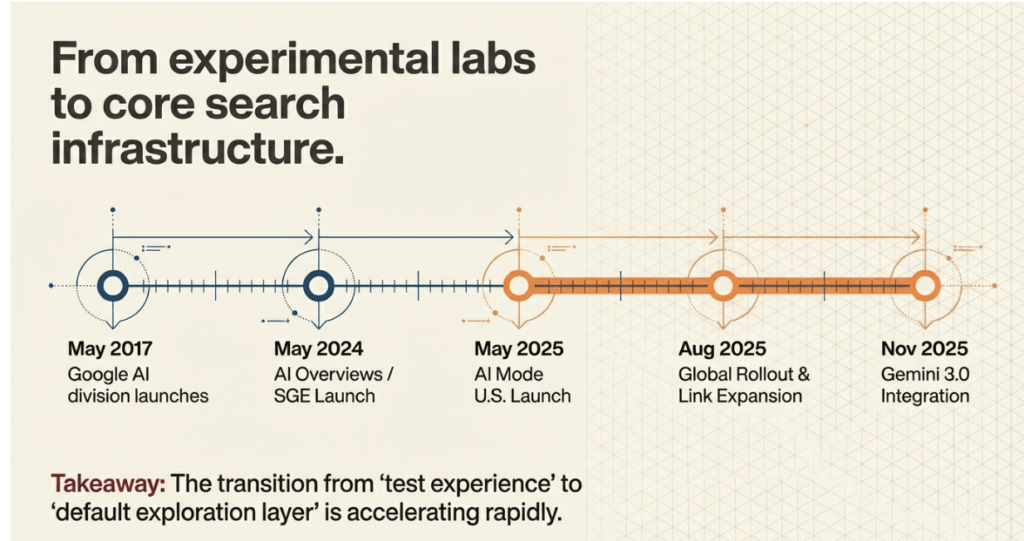
Timeline of Google Search Options with User Stats
| Year / Date | Event | Number of Users (approx.) |
| 1998 | Google Search officially launched. | 8.5B daily searches (2025 data). |
| 2002 | Google News was introduced. | Hundreds of millions of readers. |
| 2004–2005 | Gmail (2004) and Maps (2005) are linked to the search ecosystem. | Gmail: 1.5B users; Maps: >1B users. |
| 2015 | RankBrain AI integrated into Search. | All Google Search users. |
| 2019 | The BERT model improves natural language understanding. | All Google Search users. |
| May 2017 | Google’s AI division launched. | internal division |
| March 2023 | The Bard chatbot has been released for early access. | ~1M testers. |
| Feb 2024 | Bard rebranded as Gemini, integrated with Workspace. | Tens of millions (Workspace users). |
| Dec 2024 | Gemini is announced as multimodal (text, voice, and images). | Part of the Gemini ecosystem. |
| May 2024 | AI Overviews released publicly. | 2B monthly users. |
| May 2025 | AI Mode launches in U.S. | ~50M users (U.S. launch). |
| Aug 2025 | AI Mode global rollout. | 100M users (U.S. + India). |
| Nov 2025 | Gemini 3.0 + “Nano Banana” integrated. | Part of AI Mode’s 100M+ base. |
| 2025 | Gemini app adoption. | 650M monthly users, projected to be 1B by the end of May 2026. |
Google Search still dominates with 8.5 billion daily queries, but its AI Overviews (2 billion users) and AI Mode (100 million users) demonstrate how quickly AI-driven search is reshaping user behaviour. Gemini itself is on track to surpass 1B users, making it one of the fastest-growing AI platforms globally.
Summarisation vs. Logical Reasoning:
Choosing Between Overviews and AI Mode
While they appear similar, AI Overviews and AI Mode serve different purposes based on the complexity of the user’s intent.
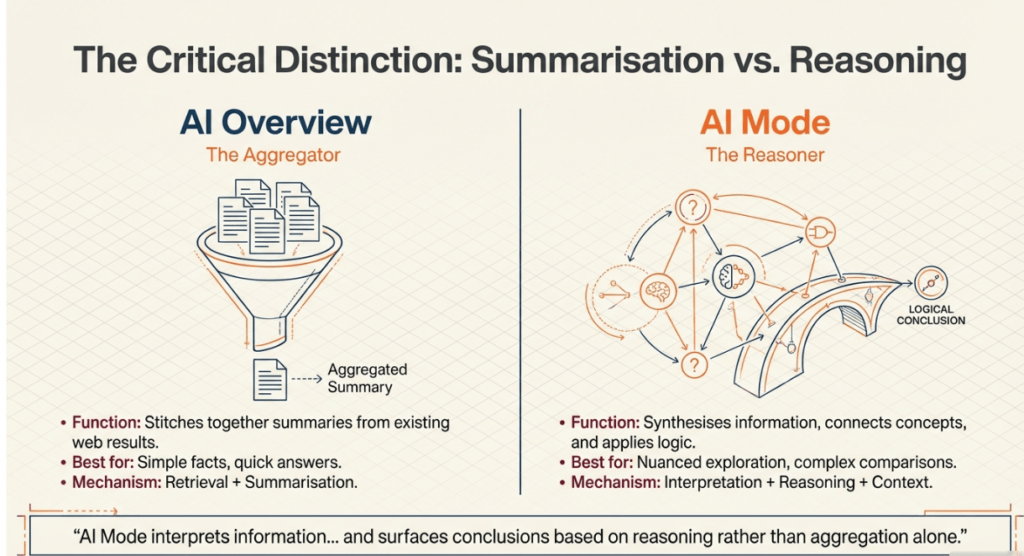
- AI Overviews are ideal for simple, fact-based queries. For example, searching for “popular spring break destinations” triggers an overview that stitches together general information into a quick summary.
- AI Mode is designed for complex questions. If a user adds specific constraints, such as “with a 6-month-old baby” , AI Mode uses structured reasoning to assess the suitability of destinations rather than simply summarising them.
The primary advantage of AI Mode is its ability to carry context forward in a conversational style, understanding follow-up prompts without needing the original context repeated.
The Relationship Between Gemini, Overviews, and the Conversational Interface
To understand the ecosystem, consider Gemini as the search engine and AI Overviews/AI Mode as the various ways the engine presents information.
- Gemini: The core multimodal large language model (LLM) that powers the intelligence behind all Google AI search features.
- AI Overviews: A summary layer designed to provide quick snapshots within traditional search results.
- AI Mode: An expanded, reasoning-heavy version of the AI Overview that allows for deep exploration and interaction.
Google continues to refine how these interfaces cite sources, moving toward contextual explanations that tell the user exactly why a particular link is relevant to their specific query.
The Scientific Processes Powering AI Responses
AI Mode distinguishes itself from standard chatbots through three specific technological processes:
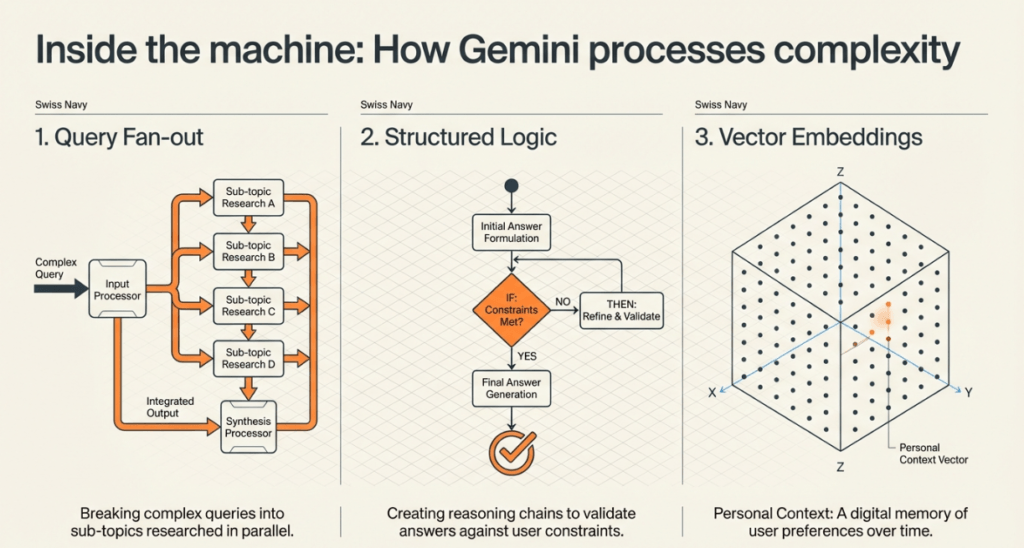
- Query Fan-out Technique: The AI breaks a complex query into multiple subtopics and researches them simultaneously. It then synthesises these parallel research points into one cohesive answer.
- Structured Logic Chains: The system creates a logical path to validate its answers. For instance, if a user asks for a hiking water bottle, the AI reasons that it requires durability and a specific capacity before checking potential products against those criteria.
- Personal Context & Vector Embeddings: The AI creates a “digital ID” or vector embedding of a user’s preferences over time. This serves as a background memory, allowing the AI to tailor its responses based on the user’s past interactions and recorded history.
Strategic Optimisation: How to Increase Visibility in AI Results
Optimising for AI Mode or often referred to as Generative Engine Optimisation (GEO), requires a mix of traditional and modern signals.
- Prioritise SEO Fundamentals: Google has confirmed that traditional SEO remains the primary factor for eligibility in AI Mode. High-quality content, technical health, and natural backlinks are essential. Sites ranking #1 in standard search are 25% more likely to be featured in AI results.
- Ensure Technical Indexing: Any indexed page is eligible to appear. Use Google Search Console to verify your pages are not blocked and return 200 success codes.
- Leverage Schema Markup: Adding structured data (schema) helps AI understand your content structure. Research shows LLMs extract data 30% more accurately from pages with proper schema.
- Participate in Communities: LLMs frequently cite discussion forums like Reddit for queries requiring “lived experience” or peer advice.
- Focus on Digital PR: Brand mentions on reputable third-party media sites help LLMs establish your “topical authority” during their training phases.
- Track AI Exposure: Use new tools like Writesonic or Profound to monitor how often your brand is cited as a source within AI-generated answers.
Forecasting Change: The Long-Term Impact on Digital Landscapes
As AI Mode becomes a default layer of search, the following five implications are emerging:
- Valuable Clicks Remain: While simple queries may see a drop in traffic, users still click through for complex decisions and comparisons where they need to see original source material.
- Long-Play Branding: Since LLMs rely on authority signals, brands must adopt a five-year outlook on brand building to ensure they are cited as trusted entities.
- Omnichannel “Search Everywhere”: Discovery is shifting across platforms. Brands must be visible in AI tools, social media (TikTok/Instagram), and niche communities to capture the full search journey.
- Rise of Specificity: AI-generated answers appear more frequently for long-tail, highly specific queries, whereas short navigational searches still favour traditional results.
- Increasing User Trust: user satisfaction with AI search is trending upwards as the technology improves in reliability and transparency.
Measuring Success: Growth Timelines and Real-World Outcomes
The time it takes for a business to grow using AI-integrated strategies depends on the consistency and quality of their digital footprint. Based on industry case studies, results can be significant over several months:
- Adobe: By launching an integrated SEO and content program, they saw a 648% increase in non-brand first-page rankings and gained over 25,200 downloads from organic search within six months.
- Western Union: A focused content and digital PR strategy resulted in a 487% increase in organic search share of voice.
- CNN Brasil: Strategic content and technical speed improvements led to a 91% increase in pageviews, surpassing 1 billion in a single year.
- Avianca Airlines: A comprehensive digital audit identified inefficiencies that unlocked $60 million in revenue and $2.5 million in savings by eliminating advertising waste.
Ultimately, while AI Mode changes how information is displayed, Google’s goal remains to solve the user’s needs. Companies that focus on high-quality, expert content will be best positioned for long-term visibility in the AI era.
How can brands monitor their visibility in Google AI Mode?
To monitor visibility in Google AI Mode, brands must shift their focus from traditional rankings to tracking how frequently and in what context their content appears within AI-synthesised responses.
Specialised AI Visibility Platforms
The most direct way to monitor this is through emerging AI visibility platforms, such as Writesonic and Profound. These specialised tools are designed to help businesses track the following metrics across large language models (LLMs):
- Citations: How often the AI credits your site as a source.
- Brand Mentions: The frequency with which your brand is named in AI-generated answers.
- Source Inclusion: Determining if your content is being used to build the AI’s reasoning chain.
Analysing Content and Entity Signals
These tracking tools provide early signals regarding which specific content formats, topics, and entities are being surfaced by the AI. By monitoring this data, marketing teams can see which parts of their content strategy, such as original research or specific tools, are successfully encouraging the AI to reference their brand.
Strategic Validation and Gap Analysis
Monitoring AI visibility allows brands to validate their efforts in SEO, digital PR, and structured data. It helps teams:
- Spot gaps: Identify where competitors are being cited instead of your brand.
- Test and adapt: Measure the impact of changes to content or schema markup to see if they increase AI exposure.
- Measure topical associations: Track how often the brand is cited in relation to specific subjects, which is a key measure of authority for LLMs.
Integrated Performance Tracking
AI visibility tracking should work alongside traditional performance metrics, not replace them. Brands can use custom dashboards and data analytics to get a complete view of their visibility across platforms like Google, social media, and AI tools.
You can use tools like Ubersuggest to analyse competitors’ strategies and determine what changes are required to improve your ranking in AI search results. Tracking these new data points helps show how a brand’s digital PR and SEO work is gaining real-world visibility in AI conversations.
Final Thoughts
Google’s AI Mode represents a fundamental shift in search, evolving from a link-based system into a conversational, interactive application layer. While it streamlines information retrieval through advanced reasoning and multimodal capabilities, the core principles of SEO, high-quality content and authority remain the primary drivers for visibility.
As Google integrates agentic workflows and deeper personalisation, brands must adapt by offering defensible value and proprietary insights. Ultimately, the goal remains solving user needs, but in a dynamic environment that prioritises comprehensive, synthesised answers over simple lists.
Discover the best digital marketing course near you: White Scholars Digital Marketing Course in Hyderabad.
Frequently Asked Questions
1. What exactly is Google’s AI Mode?
AI Mode is a conversational search feature powered by Gemini that provides detailed, reasoned answers to complex queries. Unlike traditional summaries, it synthesises information from across the web and the Knowledge Graph to create a context-aware response. Users can engage in ongoing dialogues, with the system carrying context forward for follow-up questions.
2. How can I access and use AI Mode?
In supported regions, users can enter AI Mode directly from the Google homepage or by selecting “Dive Deeper in AI Mode” from an expanded AI Overview. It functions as a ChatGPT-style interface where questions are entered conversationally. There is no longer a separate opt-in process, as it is being integrated into the standard search interface.
3. How do I optimise my website for visibility in AI mode?
Success is largely driven by strong SEO fundamentals, such as high-quality content, natural backlinks, and technical health. Additionally, using schema markup improves data extraction accuracy by 30%, and earning brand mentions in forums like Reddit or third-party media strengthens authority. Brands should also track their performance using new AI visibility platforms to monitor citations.
4. What technology makes AI Mode different from standard chatbots?
AI Mode uses a query fan-out technique to research subtopics in parallel and a reasoning chain to validate logically sound outcomes. It also incorporates vector embeddings to create a “digital ID” of user preferences, allowing for a highly personalised “background memory” during interactions. These processes enable it to handle nuanced, multi-layered questions more effectively than basic aggregators.
5. What does AI Mode mean for my website traffic?
Early data suggests that while clicks may decrease for simple informational queries, users still click through for complex decisions and high-consideration topics. Visibility in AI results actually rewards pages that rank well in traditional search, as the top result is 25% more likely to be featured. Brands must focus on long-term brand building to ensure they are cited as trusted authorities by the model.