

Inside Generative AI: Tokenization and Embeddings Explained
This brief guide explains how generative AI understands text using tokenization, embeddings, and vectors to create meaningful, human-like responses.
Introduction
Generative AI has grown very fast in the last few years. It is no longer used only for writing text. Today, it powers AI assistants, coding tools, search engines, chatbots, and business automation. Popular AI models like GPT-5, Gemini, and Claude can understand questions better, work with different types of data, and give more accurate answers.
Every answer generated by AI works because of three important technologies: tokenization, embeddings, and vector databases. These help AI understand human language, find the right information, and create useful responses.
In this blog, you will learn what tokenization, embeddings, and vector databases are, how they work, and why they are important in modern Generative AI.
Why Understanding Generative AI Matters in 2026
Generative AI is no longer limited to chatbots. It is now used across industries to automate repetitive tasks, improve productivity, and support decision-making.
Some common applications include:
- AI-powered customer support
- Content writing and marketing
- Software development and code generation
- Medical research and healthcare
- Financial analysis
- Education and personalized learning
- Business automation
- Data analysis and reporting
Understanding the technology behind these systems helps professionals build, customize, and use AI tools more effectively.
The machines are no longer just answering questions.
They are writing your emails.
Designing your logos.
Reviewing your code.
And quietly reshaping your career path.
This did not start with hype.
It started with a shock.
One day, AI was a background tool.
The next day, it wrote better text than most humans, in seconds.
If you felt that shift in your gut, you are not imagining it.
Generative AI is different.
And once you understand why, you will never look at software the same way again.
Old AI vs Generative AI
Old AI helped humans decide.
Generative AI helps humans create.
That is why people are paying attention.
What Generative AI Really Is
Most traditional AI systems analyze data.
They classify.
They predict.
They recommend.
Generative AI creates.
It produces:
-
- Text that sounds human
-
- Images that never existed
-
- Code that compiles and runs
-
- Audio that speaks with emotion
-
- Video that feels directed, not rendered
In simple terms:
Generative AI learns patterns so deeply that it can produce new content that fits those patterns.
It does not copy.
It generates.
That single difference changes everything.
At the core of most modern Generative AI systems is a Large Language Model (LLM).
How Modern LLMs Work
Today’s Large Language Models perform several steps before generating an answer.
- Receive the user’s prompt
- Break the text into tokens
- Convert tokens into embeddings
- Retrieve relevant information (if connected to external knowledge)
- Predict the next token repeatedly
- Generate a natural language response
Modern models can also understand images, documents, audio, and videos, making them multimodal AI systems.
What is an LLM?
LLM = Large Language Model
Examples:
-
- GPT (OpenAI)
-
- Gemini (Google)
Key Idea
An LLM does not understand language like humans. Instead, it:
-
- Converts text into numbers
- Learns statistical patterns
- Predicts the next most likely token
Tokenization
What is Tokenization?
Text → Tokens
Tokenization is the process of breaking text into smaller units called tokens.
Why Tokenization?
-
- Neural networks cannot process raw text
-
- They work only with numbers
Each token maps to a unique numeric ID.
User Request → Model Flow
-
- User sends a query
- Text is tokenized
- Tokens are converted into numerical representations
- Model processes the numbers using neural networks
- Model generates output tokens
- Tokens are converted back into readable text
What is Retrieval-Augmented Generation (RAG)?
Retrieval-Augmented Generation (RAG) is a technology that helps AI give better and more accurate answers.
Instead of using only the information it learned during training, RAG first searches for relevant information from other sources, such as:
- Company documents
- PDF files
- Knowledge bases
- Websites
- Databases
After finding the right information, RAG sends it to the AI model. The AI then uses this information to generate a more accurate, relevant, and up-to-date response.
This is why many modern AI applications use RAG to provide reliable answers.
The Role of Prompt Engineering
Prompt engineering is the process of writing clear and simple instructions for AI. A good prompt helps AI understand what you want and generate better answers.
A good prompt usually includes:
- Context – Background information about the task.
- Objective – What you want the AI to do.
- Constraints – Any rules or limits the AI should follow.
- Output Format – How you want the answer to be presented.
- Examples (Optional) – Sample inputs or outputs to guide the AI.
Writing clear prompts helps AI give more accurate, useful, and reliable responses while reducing mistakes.
Why Are Embeddings Important?
Embeddings help AI understand the meaning of words and sentences, not just the exact words that are used.
For example:
Sentence 1:
“I want to buy a laptop.”
Sentence 2:
“I’m looking for a notebook computer.”
These sentences use different words, but they have the same meaning. Embeddings place them close together, so AI understands they are talking about the same thing.
Because of this, AI can find information based on meaning instead of only matching keywords. This is called semantic search, and it helps AI provide more accurate and relevant results.
Vector Databases
A Vector Database stores embeddings and allows search by meaning.
How Vector Search Works
-
- Convert user query → embedding
- Search vector DB for nearest vectors
- Retrieve most relevant documents
Real-World Workflow of a Generative AI Application
A typical Generative AI application follows this workflow:
User Question
↓
Tokenization
↓
Embeddings
↓
Vector Database Search (Optional)
↓
LLM Processing
↓
Response Generation
↓
Human-readable Output
This workflow enables AI to provide relevant, context-aware responses.
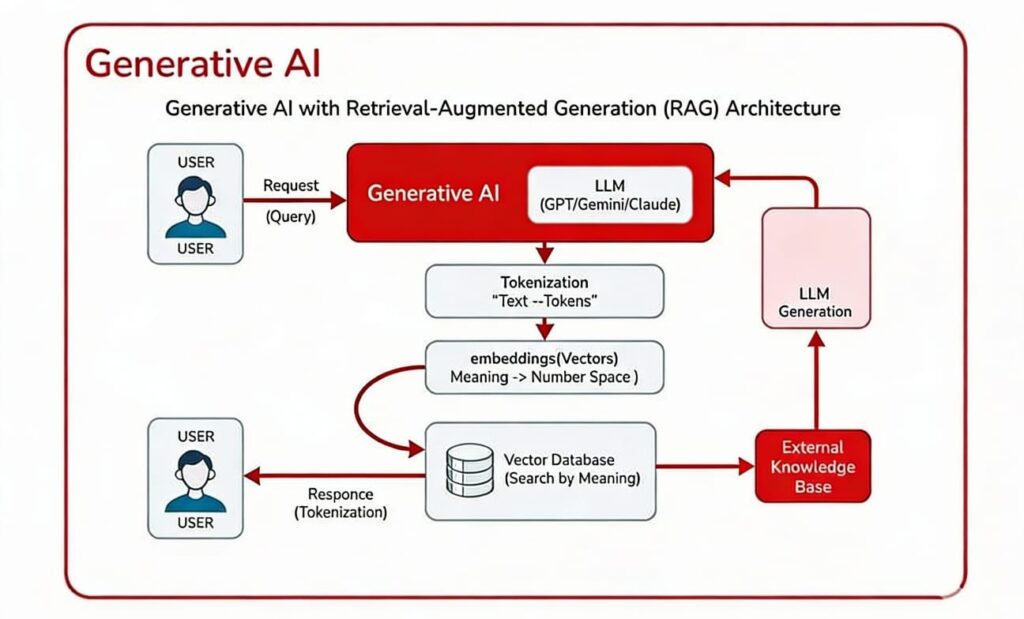
Generative AI Architecture and Workflow
-
- The “Generative AI” aspect is fed into “LLM”s such as “GPT/Gemini/Claude”.
-
- The overall workflow begins with a user “Request (Query)”.
This input goes into a Large Language Model (LLM) → The model then Tokenizes → turns the data into an “Embedding (Vectors)” → That information is stored in a Vector Database that uses “Search by Meaning” to find relevant information → And then is sent back to the User with a “Response (Tokenization)”.
-
- An “External Knowledge Base” can connect to the Vector Database to help with the processing.
Challenges of Generative AI
Generative AI is very powerful, but it also has some limitations. It may not always give correct or reliable answers.
Some common challenges are:
-
Incorrect information (Hallucinations): AI can sometimes generate wrong or made-up answers.
-
Bias: If the training data contains bias, the AI may also produce biased results.
-
Privacy concerns: Sensitive information must be handled carefully when using AI.
-
High computing cost: Running advanced AI models requires powerful computers and can be expensive.
-
Prompt sensitivity: The quality of the answer depends on how clearly you write the prompt.
-
Need for quality data: AI works better when it has accurate and high-quality data.
For important tasks like healthcare, finance, or legal work, AI should always be used with human review to ensure the results are accurate and reliable.
Career Opportunities in Generative AI
Generative AI is creating many new job opportunities. Companies are looking for people who have skills in AI, machine learning, and data science.
Some popular job roles are:
-
Generative AI Engineer
-
Prompt Engineer
-
Machine Learning Engineer
-
AI Research Assistant
-
NLP (Natural Language Processing) Engineer
-
AI Application Developer
-
Data Scientist
-
AI Product Manager
To prepare for these careers, it is helpful to learn Python, Machine Learning, Deep Learning, and Large Language Models (LLMs). Building hands-on projects and practicing with AI tools can also improve your skills and job opportunities.
Learn Generative AI with WhiteScholars Academy
If you want to learn Generative AI and build a career in AI, it is important to start with the basics of data science. Learning Python, machine learning, deep learning, and Large Language Models (LLMs) will help you understand how modern AI works.
The Data Science Course in Hyderabad at WhiteScholars Academy covers these topics through hands-on projects and real-world case studies. This practical learning approach helps you build the skills needed for today’s AI and data science jobs.
With this path you can:
-
- Work toward roles like junior data scientist, ML engineer trainee, or applied AI analyst, which require both coding skills and understanding of business use-cases.
-
- Position yourself for long-term growth, as data science remains one of the highest-paying and fastest-growing segments in the engineering job market in India through 2026 and beyond.
Glossary of Key Terms
-
- Tokenization: The process of breaking down text into smaller units (tokens), such as words or sub-words, that can be processed by an LLM.
-
- Tokens: The individual units of text resulting from the tokenization process (e.g., “the,” “cat,” “sat”).
-
- Vector Embedding: A numerical representation of a word, phrase, or other data type in a multi-dimensional space, capturing its semantic meaning and relationships to other concepts.
-
- Vector Database: A database specifically designed for storing and searching vector embeddings, enabling efficient similarity searches based on semantic meaning.
-
- Embedding Service: The component responsible for transforming raw data into vector embeddings.
Frequently Asked Questions
What is the difference between tokenization and embeddings?
Tokenization splits text into small parts called tokens so the AI can read and process it. Embeddings convert those tokens into numbers that help the AI understand their meaning and relationship with other words.
Do all LLMs use vector databases?
No. Not all Large Language Models (LLMs) use vector databases.
A basic LLM can generate answers using the knowledge it learned during training. A vector database is mainly used in Retrieval-Augmented Generation (RAG) systems to find relevant information from sources like documents, websites, or databases before generating a response. This helps the AI provide more accurate and up-to-date answers.
Can Generative AI understand images?
Yes. Modern multimodal AI models can process text, images, audio, videos, and documents together to provide more comprehensive responses.
What programming language is commonly used in Generative AI?
Python is the most widely used language for developing Generative AI applications because of its extensive ecosystem of AI and machine learning libraries.
What is LLM (Large Language Model) ?
A type of AI model trained on vast amounts of text data, capable of understanding and generating human-like text.
What is GPT (Generative Pre-trained Transformer) ?
A specific architecture of LLM developed by OpenAI known for its ability to generate coherent and contextually relevant text.
