

How AI Is Changing Data Analysts in 2026
Artificial Intelligence is transforming data analytics by automating tasks, improving insights, and helping data analysts make smarter decisions in 2026.
Introduction
How AI Is Changing Data Analysts in 2026 is becoming one of the most important topics in the data industry. Artificial Intelligence is reshaping the world of data analytics by transforming how data analysts collect, analyze, and interpret information. From automating repetitive tasks and improving accuracy to uncovering hidden patterns and generating faster insights, AI is becoming a powerful partner for modern data professionals, enabling them to make smarter, data-driven decisions.
The role of data analysts is evolving beyond traditional reporting. Today, analysts are using AI-powered tools to explore trends, solve complex business challenges, predict future outcomes, and support smarter decision-making.
As AI continues to advance, knowing how to work alongside these technologies is becoming an essential skill for every future-ready data analyst. If you’re curious about how AI is changing data analytics, whether it will replace analysts, and what skills are needed to succeed in 2026, this guide covers everything you need to know.
Why AI Is Changing Data Analytics
Artificial Intelligence is revolutionizing the field of data analytics by making the entire process faster, smarter, and more efficient. In the past, data analysts spent countless hours collecting data, cleaning datasets, preparing reports, and manually identifying patterns.
Today, AI-powered tools are changing the way analysts work. These technologies can automate repetitive tasks, analyse massive amounts of data, uncover hidden trends, generate accurate predictions, and deliver valuable insights within seconds.
From healthcare and finance to retail and technology, businesses across industries are adopting AI-driven analytics to make faster and more informed decisions. In 2026, data analysts who know how to effectively use AI tools will have a major advantage by combining human creativity, critical thinking, and AI capabilities.
AI is not replacing data analysts, it is empowering them to become more strategic, productive, and focused on solving complex business problems that require human expertise.
How AI Helps Data Analysts
AI is becoming a powerful assistant for data analysts by simplifying complex tasks, improving productivity, and helping professionals generate insights faster.
- Automating Data Cleaning: AI can identify errors, missing values, and inconsistencies in datasets, making data preparation faster and more accurate.
- Faster Data Analysis: AI-powered tools can analyse large datasets quickly and highlight important patterns, trends, and relationships.
- Creating Reports and Dashboards: AI helps analysts generate reports, visualizations, and summaries with less manual effort.
- Predictive Analytics: AI enables analysts to forecast future trends, identify possibilities, and make data-driven predictions.
- SQL and Coding Assistance: AI tools can help write SQL queries, debug code, and improve overall workflow efficiency.
- Improved Decision-Making: AI-generated insights help analysts focus on strategy, problem-solving, and delivering valuable business recommendations.
Benefits of AI for Data Analysts
AI is transforming the way data analysts work by improving speed, accuracy, and decision-making capabilities. With AI-powered tools, analysts can move beyond manual tasks and focus on finding deeper insights that create real business value.
Some key benefits of AI for data analysts include:
- Saves Valuable Time: AI automates repetitive tasks such as data cleaning, reporting, and basic analysis, allowing analysts to focus on more important strategic work.
- Improves Data Accuracy: AI can quickly identify errors, detect unusual patterns, and uncover trends that may be difficult to find through manual analysis.
- Delivers Faster Insights: AI tools can process large volumes of data within seconds, helping analysts discover meaningful insights and make quicker recommendations.
- Supports Better Decision-Making: AI-powered predictions and forecasts help businesses understand future trends and make smarter, data-driven decisions.
- Boosts Productivity: By reducing routine workloads, AI allows analysts to spend more time on problem-solving, innovation, and business strategy.
- Enhances Analytical Capabilities: AI works as a smart assistant, helping analysts explore complex datasets and uncover opportunities more effectively.
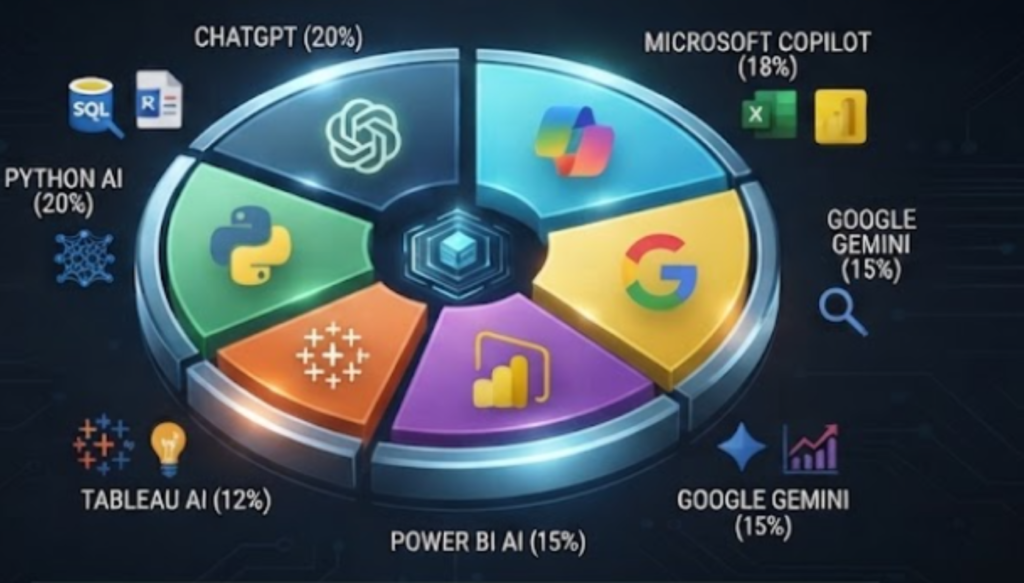
AI Tools Used by Data Analysts in 2026
Skills Every Data Analyst Needs in 2026
As Artificial Intelligence becomes an essential part of data analytics, data analysts need to continuously upgrade their skills to stay competitive. The future belongs to professionals who can combine traditional analytical expertise with AI-powered tools and technologies.
Some important skills for data analysts in 2026 include:
- SQL: Helps analysts manage databases, retrieve information, and efficiently analyse large datasets.
- Python: Enables data analysis, automation, machine learning applications, and advanced analytics.
- Data Visualization: Skills in tools like Power BI and Tableau help analysts present complex data through clear and meaningful visualizations.
- AI and Machine Learning Basics: Understanding AI concepts helps analysts use modern tools effectively and interpret AI-generated insights.
- Prompt Engineering: Creating clear and effective instructions helps analysts get better results from AI assistants.
- Statistical Knowledge: Helps analysts identify patterns, understand trends, and make accurate data-driven conclusions.
- Business Understanding: Knowing business goals allows analysts to convert data insights into valuable recommendations.
- Communication Skills: The ability to explain findings clearly helps analysts collaborate with teams and support decision-making.
The future of data analytics belongs to professionals who can combine analytical thinking with AI capabilities. Developing these skills will help data analysts adapt, grow, and succeed in the evolving AI-driven industry.
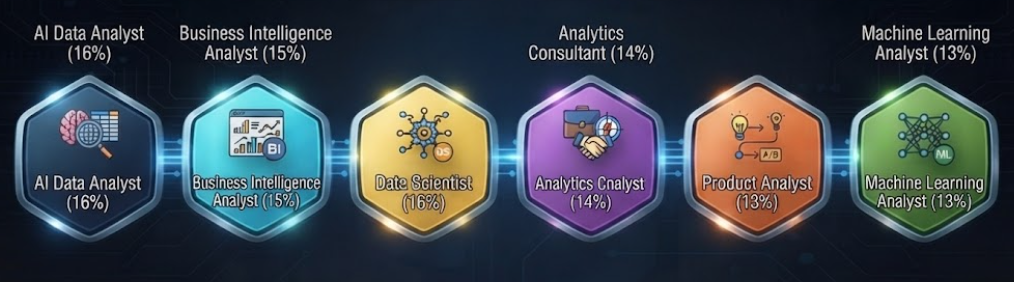
Career Opportunities for AI-Ready Data Analysts
Challenges of Using AI in Data Analytics
- Data Quality Issues: AI insights depend on accurate and complete data. Poor-quality data can lead to incorrect results.
- Lack of Human Understanding: AI can find patterns but may not understand business context or real-world situations.
- Data Privacy Concerns: Protecting sensitive information is important when using AI-powered analytics tools.
- Bias in AI Models: AI systems may produce biased results if the training data contains bias.
- Need for Human Validation: Analysts must review and verify AI-generated insights before making important decisions.
Your Next Step
Artificial Intelligence is changing the role of data analysts in 2026 by making analytics faster, smarter, and more powerful. Instead of replacing analysts, AI is helping them automate repetitive tasks, discover deeper insights, and focus on strategic decision-making.
Whether you are a student starting your data analytics journey or a professional looking to upgrade your skills, learning AI-powered analytics tools can help you stay ahead in the future job market.
Start by building strong foundations in SQL, Python, data visualization, and statistics. Explore AI tools, practice with real-world datasets, and develop projects that showcase your analytical skills.
The future of data analytics belongs to professionals who can combine human intelligence with Artificial Intelligence to solve complex problems and create meaningful business value.
Frequently Asked Questions
1. How is AI changing data analysts in 2026?
AI is helping data analysts automate repetitive tasks, analyse large datasets faster, discover patterns, and generate better insights for business decisions.
2. Will AI replace data analysts?
No. AI will not completely replace data analysts. Instead, it will support analysts by improving productivity and allowing them to focus on complex problem-solving and strategic tasks.
3. What AI tools should data analysts learn in 2026?
Data analysts should learn AI-powered tools such as ChatGPT, Microsoft Copilot, Google Gemini, Power BI AI features, Tableau AI, and Python-based AI libraries.
4. What skills do data analysts need in the AI era?
Important skills include SQL, Python, data visualization, statistics, AI fundamentals, prompt engineering, critical thinking, and business communication.
5. Is AI creating new career opportunities for data analysts?
Yes. AI is creating new roles and increasing demand for professionals who can combine data analytics skills with AI technologies to solve business problems.
