

How Data Analytics Powers Business Success: From Insights to Action
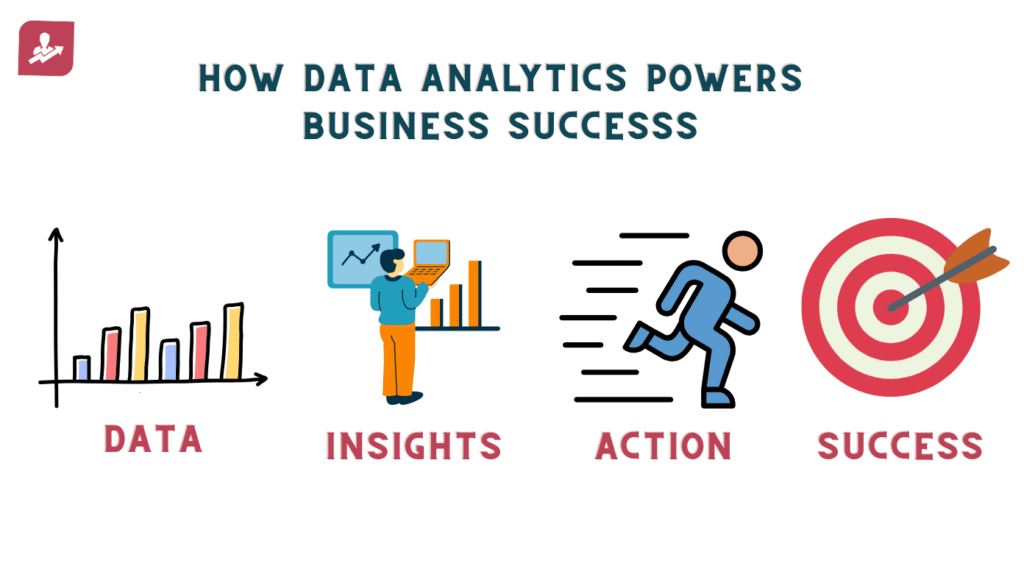
Table of Contents
If you’re curious about data analytics and want to learn it yourself, this article is for you; it includes role of business analyst in business, how analysts help business, types of analysts, various roles of analysts, and advantages seen in business
What is data analytics in business?
Data analytics is the process of collecting, cleaning, analyzing, and interpreting data to answer business questions or solve problems that can inform and guide strategic decisions, improve operational efficiency, and drive overall business growth.
It involves using various techniques, tools, and methodologies to transform raw data into actionable information. In a typical company, this data comes from sources like CRM systems, billing tools, social media, websites, and internal operations.
For students considering a data analytics course in Hyderabad, this is exactly what you learn: how to work with tools and techniques that convert business data into meaningful decisions. A structured data analyst course at WhiteScholars in Hyderabad will usually cover statistics, Excel, SQL, Python, Power BI, or Tableau (dashboards), and basic machine learning so you can support decision-making in real businesses.
Core steps: how analytics actually works
Generally, data analytics follows a repeatable cycle that looks like this.
- Data collection: Businesses capture data from POS systems, websites, apps, marketing platforms, ERPs, and customer support tools.
- Data cleaning and preparation: Analysts remove errors, handle missing values, and standardize formats so the data is trustworthy.
- Analysis and modeling: Teams use statistics, visualization, and sometimes machine learning to identify trends, correlations, and patterns.
- Interpretation and storytelling: Insights are turned into dashboards, reports, and recommendations that business leaders can act on.
- Action and optimization: The company updates prices, campaigns, inventory, or processes and then measures the impact in the next cycle.
It helps businesses understand customer preferences, optimize operations, mitigate risks, identify growth opportunities, and stay competitive in a rapidly changing business landscape.
The WhiteScholars course in Hyderabad will train you to work confidently in each of these steps using tools like SQL, Python, Power BI, or Tableau.
What made data analytics important for business?
Data analytics is important for business because it replaces guesswork with evidence, helping companies make faster, more accurate decisions that improve revenue, reduce costs, and strengthen competitiveness.
It turns day‑to‑day data into insights about customers, operations, markets, and risks, which is essential in today’s digital and highly competitive environment.
Better, faster decision-making
Data analytics gives leaders a factual view of what is happening in the business instead of relying only on intuition or experience. Historical and real‑time data reveal trends and patterns, so managers can choose strategies with more confidence and less uncertainty.
Deeper customer understanding
Businesses use analytics to study customer behavior, preferences, and feedback collected from websites, apps, and social media. This helps them segment audiences, personalize offers, and design products that better match customer needs.
When companies understand customers at this level, they can improve satisfaction, increase loyalty, and raise lifetime value through targeted communication and service.
Higher efficiency and lower costs
Analytics highlights bottlenecks, delays, and waste across operations such as supply chain, production, and service delivery. By seeing exactly where time or money is being lost, businesses can streamline processes, automate routine tasks, and optimize resource allocation.
This leads to lower operating costs, better use of staff and inventory, and more reliable performance overall. Over time, even small efficiency improvements across many processes can significantly improve profit margins.
Stronger risk management and fraud control
Data analytics helps organizations identify risks early by detecting unusual patterns in transactions, operations, or user behavior. This supports better forecasting, credit assessment, and compliance monitoring, reducing the chance of costly surprises.
In finance and e‑commerce especially, analytics is central to fraud detection systems that flag suspicious activity in real time. Catching issues quickly protects both customers and the company’s reputation.
Innovation and competitive advantage
By continually analyzing market trends, competitor moves, and customer feedback, businesses can spot gaps and new opportunities for products or services. This data‑driven view of the market makes it easier to innovate in ways that are aligned with real demand.
Organizations that use analytics well adapt faster, design better offerings, and make smarter investments, which creates a lasting competitive edge. In many industries, building strong analytics capability is now a basic requirement to stay relevant rather than a nice‑to‑have.
Role of a data analyst in business
Inside companies, data analysts act as the bridge between raw data and decision‑makers. Their daily responsibilities typically include:
- Collecting and querying data from databases and APIs using SQL and related tools.
- Cleaning, transforming, and joining datasets so they can be explored reliably.
- Building reports and dashboards that track KPIs and highlight risks or opportunities.
- Presenting findings in business language to marketing, operations, finance, or leadership teams.
Because this role is so central, many students join a data analyst course in Hyderabad specifically to build a job‑ready profile with hands‑on skills in Excel, SQL, Python, and BI tools.
Types of analytics used in Business
Businesses don’t use just one kind of analytics; they combine multiple layers to move from “what happened” to “what should we do next.”
- Descriptive analytics: Summarizes past data, such as monthly revenue or website traffic, to understand what has happened.
- Diagnostic analytics: Digs deeper to find reasons, like why sales dropped in one region or why one campaign outperformed others.
- Predictive analytics: Uses historical patterns to forecast future outcomes, such as demand, churn, or default risk.
- Prescriptive analytics: Suggests the best actions, for example, which customer segment to target or what price to set for maximum profit.
Modern data analytics courses in Hyderabad curricula are increasingly including modules on predictive and prescriptive analytics so learners can support advanced projects in real companies.
Where businesses use data analytics
Data analytics is now embedded across almost every function of a modern business.
- Marketing and sales: Teams analyze campaigns, conversion funnels, and customer segments to improve ROI and personalize offers.
- Operations and supply chain: Managers use analytics to optimize inventory, reduce delays, and avoid stockouts or overstock.
- Finance: Financial analysts forecast revenue, monitor margins, detect fraud, and manage risk using historical and real‑time data.
- Customer experience: Support data, NPS scores, and reviews are mined to reduce churn and improve service quality.
- Strategy and leadership: Leadership teams rely on dashboards for market trends, competitor moves, and product performance before making strategic bets.
If you enroll in a data analyst course in Hyderabad, you usually practice these use cases with real or simulated datasets from e‑commerce, banking, healthcare, and retail.
How small and local businesses do use analytics
Data analytics is not limited to large enterprises; small and medium businesses also benefit significantly.
- Local retailers: Use sales and footfall data to decide store layout, stock mix, discounts, and staffing schedules.
- Restaurants and cloud kitchens: Track orders by platform, time, and location to optimize menu, pricing, and delivery partners.
- Service businesses: Use CRM and social media analytics to identify their most profitable customer segments and high‑performing channels.
A practical data analytics course in Hyderabad often includes capstone projects on SMEs and startups, which mirrors how many local businesses are actually applying analytics in the city.
Benefits businesses gain from data analytics
When implemented properly, data analytics transforms how a business competes and grows.
- Better decisions: Leaders rely on evidence, not just intuition, leading to more accurate investments and strategies.
- Higher operational efficiency: Analytics exposes bottlenecks, idle resources, and unnecessary costs so processes can be streamlined.
- Deeper customer understanding: Companies track behavior and preferences, enabling hyper‑targeted marketing and better product design.
- Revenue growth and cost reduction: Studies show organizations using big data effectively report revenue gains and notable cost savings on average.
- Competitive advantage: Businesses that build strong analytics capabilities adapt faster to market changes and outperform slower rivals.
For learners, this is why demand for data analyst course Hyderabad options is rising: companies need professionals who can reliably deliver these benefits.
Skills covered in a data analytics course in Hyderabad
To work effectively with business analytics workflows, courses in Hyderabad focus on a mix of technical and business skills.
- Technical foundations: Descriptive statistics, probability basics, data cleaning, and data visualization.
- Tools: Excel or Google Sheets, SQL databases, Python or R, and BI tools like Tableau or Power BI.
- Business understanding: How to frame business problems, choose the right metrics, and measure ROI of initiatives.
- Communication: Turning complex analysis into clear charts, stories, and recommendations for non‑technical stakeholders.
If you are exploring a data analytics course in Hyderabad, look for strong project work that reflects real business cases so you can confidently show how data analytics works in business environments
Business use cases vs. course focus
Here is a quick view of how business needs and course content usually align in this field:
| Business need | Analytics activity in companies | What WhiteScholars data analyst courses teach (Hyderabad) |
| Understand past performance | Reporting, dashboards, KPI tracking | Descriptive stats, Excel/BI dashboards |
| Find reasons for problems | Root‑cause analysis, cohort and funnel analysis | Data cleaning, SQL joins, diagnostic charts |
| Predict future trends | Forecasting demand, revenue | Basic ML, time‑series and regression |
| Decide on the best actions | Pricing, campaigns, resource allocation | Scenario analysis, Feedback segementation |
| Improve customer experience | Segmentation, personalization, feedback analysis | Customer analytics projects and case studies |
For anyone planning to build a career in this space, choosing a well‑structured data analyst course Hyderabad programs provide can be a strong way to learn how real businesses collect, analyze, and act on their data every day.
Conclusion
Data analytics equips businesses from global giants to startups with the tools to turn everyday data into strategic wins across marketing, operations, finance, and customer service. By mastering its core steps, types, and applications, companies achieve better decisions, efficiency gains, and competitive edges that drive sustainable growth.
For aspiring professionals, a data analytics course in Hyderabad delivers hands-on skills in SQL, Python, Tableau, and real-world projects, positioning you to fill high-demand roles that deliver these results. Start your journey today to help businesses thrive in a data-driven world.
Frequently Asked Questions
Why is data analytics important?
Data analytics is crucial for businesses today, as it enables them to transform raw data into actionable insights that drive informed decision-making, optimize operations, gain a competitive edge, and enhance customer experience.
Is data analyst a stable job?
While Data Analyst roles are typically perceived as stable due to the escalating reliance on data-driven decision-making across industries, their stability can be subject to fluctuations influenced by industry trends, economic factors, and technological advances. Sectors like finance, healthcare, and e-commerce, deeply entrenched in data utilization, often present enduring opportunities for Data Analysts
What type of data analytics has the most value?
Prescriptive analytics, the most advanced form of data analysis, holds the greatest value. This is because it not only predicts future outcomes, but also recommends the optimal course of action to achieve desired results.
Will AI replace data analysts’ jobs?
It’s likely that AI won’t replace data analysts, but instead will help them be more efficient by handling routine tasks. This allows analysts to focus on more important things like understanding results, sharing insights, and making decisions. The future is a team effort between AI and human experts.
Is data analyst a high-paying job?
Data analyst salaries can vary based on experience, location, industry, and the specific company. While they may not be as high as those for more specialized roles like data scientists or machine learning engineers, they are often above average compared to many other professions. Additionally, as the importance of data-driven decision-making grows, skilled data analysts’ value will likely remain strong.