

How to Build Digital Marketing Resume That Lands Interviews
In this blog, let’s explore the five essential strategies that help you understand how to build a digital marketing resume that lands interviews.
Introduction
In the competitive world of digital marketing, your resume is often the only thing standing between you and your dream role.
However, many qualified candidates find their inboxes filled with rejections simply because their resumes aren’t communicating their value effectively. Turning those rejections into a flood of interview invites requires a shift in mindset:
Your resume is not just a list of things you’ve done; it is a sales page for you.
Below is a detailed breakdown of five core strategies to transform your resume into a high-performing lead-generation tool for your career.
1. Tailor Your Resume for Every Single Role
One of the most common mistakes marketing candidates make is using a resume that is not tailored to the specific job.
To stand out, you must adjust your resume for every specific role you apply for. While this process is time-consuming, the effort is completely worth it for the results it yields.
How to Implement This Strategy:
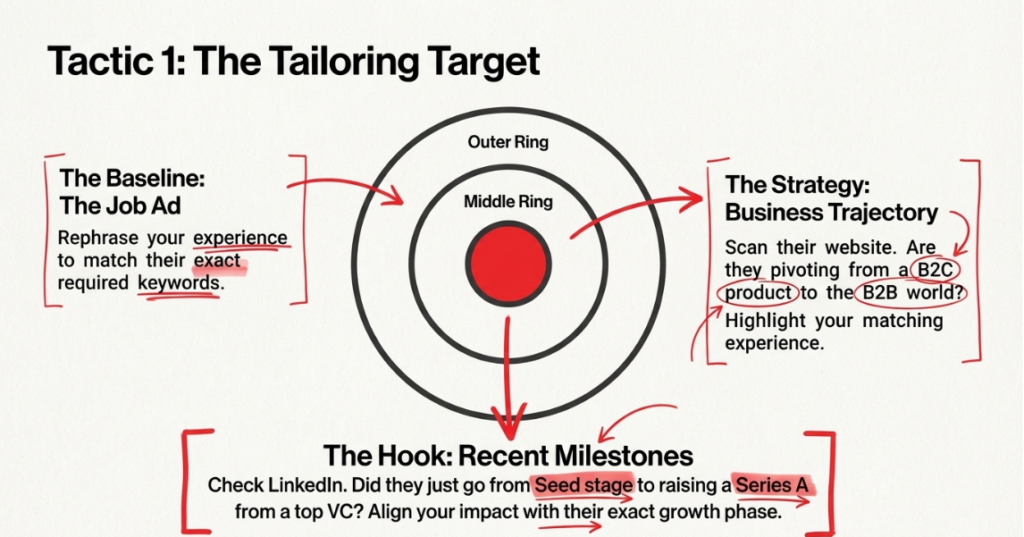
- Keyword Matching: Carefully read the job advertisement. Identify the specific requirements and skills the employer is looking for.
You should rephrase your previous experience to match the exact words used in the job ad. This helps both human recruiters and automated systems recognise you as a fit.
- Business Trajectory Analysis: Go beyond the job description by scanning the company’s website. Look for where the business is headed.
For example, if you notice a company is shifting from being a B2C (Business-to-Consumer) product to a B2B (Business-to-Business) model, highlight any experience you have in both sectors to show you can support that transition.
- Milestone Research: Check the company’s LinkedIn profile to identify recent major events, such as a Series A funding round.
If they have just raised capital, you can highlight how you helped your previous company scale from a “seed stage” to a major funding milestone. This demonstrates that you understand the specific growth stage the company is currently in.
2. Master the “Length vs. Attention” Balance
There is often a debate about whether a resume should be one or two pages. There is no significant difference in interview invites between a one-page and a maximum two-page resume.
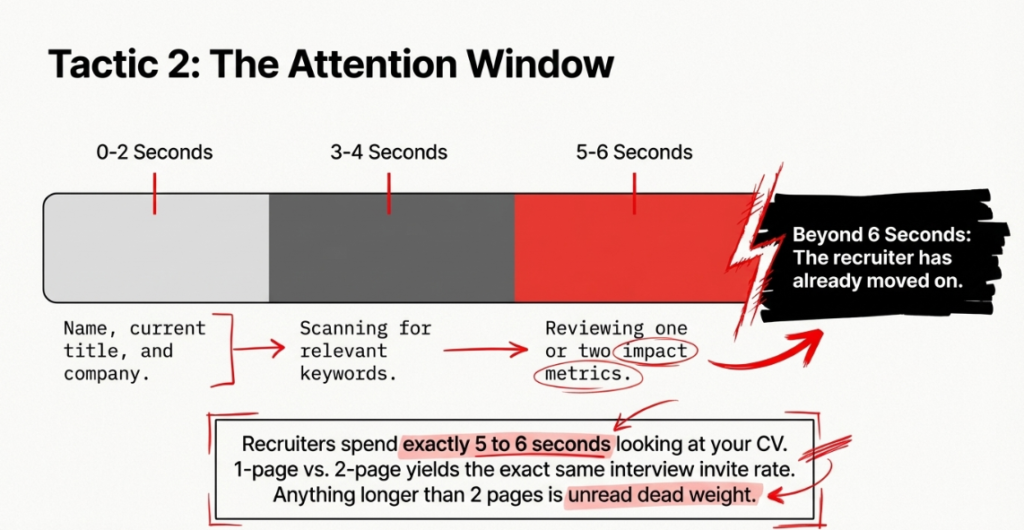
However, the most critical factor is the limited time a recruiter spends on your document.
The Strategy:
- The 5-6 Second Rule: Recruiters spend an average of five to six seconds initially looking at your resume. If your document exceeds two pages, they likely won’t have the time to dive deeply into your qualifications.
- Keep it Concise: While you have the flexibility to go to two pages, ensure every line earns its place.
If a piece of information doesn’t immediately prove your value for that specific marketing role, it should be removed to keep the focus on your most impactful achievements.
3. Use “Business Language” to Show Impact
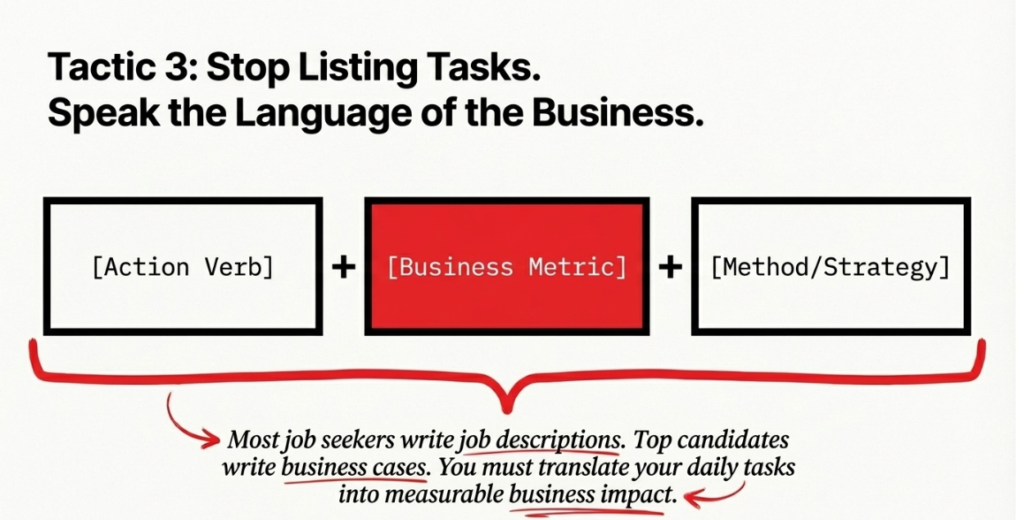
The most transformative change you can make to your marketing resume is to move away from listing tasks and to show business impact.
To get selected, you must speak the “business language” that hiring managers and stakeholders care about.
How to Rephrase Your Achievements:
- Pipeline vs. Strategy: Instead of saying you “developed a multi-channel digital strategy” (which is vague), state that you “delivered +65% pipeline growth in Q1 by executing a multi-channel GTM (Go-To-Market) strategy.”
- ROI and ROAS: Avoid boring descriptions like ‘set up paid advertising campaigns’. Instead, use the following: “Launched high ROI paid social and search campaigns and achieved a 3.5x return on ad spend (ROAS).”
- Lifecycle and Retention: Rather than saying you developed retention programs, be specific: “increased LCV (Lifetime Customer Value) by more than 30% in just one month via lifecycle email sequences and re-engagement workflows.”
By using metrics like pipeline growth, ROAS, and LCV, you prove that you aren’t just doing tasks but are actively driving revenue and growth for the business.
4. Cut the “Fluff” from Tools and Courses
A common pitfall is cluttering your resume with irrelevant certifications or every tool you’ve ever opened.
Recruiters are “drowning” in resumes in a competitive market where a single role might receive more than 500 applications, so they need yours to be completely to the point.
The Strategy:
- Remove Irrelevant Courses: Many candidates list management courses from their first year of university or general marketing courses that don’t add value.
Even if you take multiple courses a year, they may be irrelevant to the recruiter and can often be omitted entirely to save space.
- Strategic Tool Selection: Only include tools that the job ad requirements specifically mention. This keeps your skills section clean and directly aligned with what the employer needs right now.
5. Manage Your Location Strategically
Your physical location can sometimes lead to immediate, automated rejections based on company policy, even if you are willing to move.
The Strategy:
- Be Clear About Relocation: If you are open to moving or working remotely, add a line explicitly stating this right next to your location section.
- The “Target City” Approach: If your dream job is in a specific city (e.g., Berlin) but you currently live elsewhere, list the target city as your location to initiate the conversation with HR.
After the initial interview, clarify your openness to relocation or your legal right to work there. This prevents your application from being filtered out before you even get a chance to speak to a human.
The Strategic Shift: Treating the resume as a Professional Sales Page
When a resume adopts a sales mindset, it shifts from merely listing past experiences to strategically generating interest. Each section, from work history to skills, should be assessed for its potential to engage hiring managers.
The resume serves as a key tool in the recruitment process, aiming to capture a recruiter’s fleeting attention and secure an interview request.
This approach ensures that the resume content is relevant and impactful, directly addressing the hiring company’s specific challenges. Instead of a simple list of duties, it leverages persuasive metrics, like pipeline growth or return on ad spend (ROAS), to demonstrate how the candidate can resolve the employer’s issues.
This transforms a passive duty list into an active tool for career advancement, helping candidates stand out in competitive environments with numerous applications. Ultimately, viewing the resume as a sales tool enables candidates to effectively showcase their expertise to otherwise unreachable companies.
Final Thoughts: The Transformation from Applicant to Professional Asset
The transition from receiving a “flood of rejections” to securing over 30 interview invites, even from companies once considered out of reach, is achieved by shifting the fundamental purpose of the resume.
The document must evolve from a passive historical record into a dynamic sales page specifically engineered to generate leads for a career.
By speaking the “business language” of stakeholders and focusing on high-impact outcomes such as pipeline growth, Return on Ad Spend (ROAS), and Lifetime Customer Value (LCV), a candidate proves immediate value to a prospective employer.
Ultimately, success in a competitive market containing over 500 applications per role requires precision in tailoring, strategic brevity, and a relentless focus on demonstrating measurable results.
Common Digital Marketing Interview Questions
1. How is the success of a marketing campaign measured and reported to stakeholders?
An effective answer prioritises business impact over vanity metrics by citing specific improvements in pipeline growth or revenue-based KPIs. This demonstrates an understanding of how marketing activities directly contribute to the company’s financial health and trajectory.
2. What is the process for managing a digital strategy when a business changes its target model (e.g., B2C to B2B)?
The response should highlight experience in both sectors and explain how to bridge the gap between different customer behaviours. Emphasising the ability to support a company’s business trajectory shows that the candidate is a strategic partner rather than just a task-executor.
3. Can an example be provided of a time a campaign achieved a high Return on Ad Spend (ROAS)?
The candidate should describe launching high-ROI paid social or search campaigns and provide the exact numerical outcome, such as a 3.5x return. Specificity is key to proving technical competence and the ability to manage advertising budgets effectively.
4. How is a marketing funnel optimised to increase customer retention?
The answer should focus on technical workflows, such as implementing lifecycle email sequences and re-engagement strategies. Highlighting a measurable increase in Lifetime Customer Value (LCV) provides concrete evidence of the ability to drive long-term growth.
5. How are specific marketing tools selected and utilised to meet company requirements?
A strong response focuses only on the tools mentioned in the job advertisement to show a perfect technical match for the role. The explanation should detail how these tools were used to deliver impactful results rather than just listing software proficiency.