

How to Choose the Right Dataset for Your Analytics Projects
Explore top platforms to download free datasets for analytics projects. Find trusted sources for business, finance, health, and big data practice.
Introduction
Did you know that almost 80% of the time spent on data analytics projects is on data collection and cleaning? Many freshers tend to concentrate on things like Python or Power BI, but the key to the success of any project is selecting the right dataset. A poor dataset will result in poor analysis.
For freshers who are looking to make a career in data analytics, Understanding how to select the right datasets is extremely important. In this blog, it will be discussed how to select the right datasets, what needs to be considered, what tools are used, and how the right dataset improves the quality of projects. This guide will help you lay strong project foundations if you are looking to join or searching for a professional data analyst course.
Understand the Objective Before Selecting Data
However, before downloading any dataset, it is necessary to define the project objective. The problem statement should always match the dataset. Otherwise, even if the dataset is large, it will be useless.
For example, if the objective is to analyze the sales performance, then the dataset should contain columns such as revenue, date, region, product category, and customer information. Similarly, if the objective is to analyze customer churn, then the dataset should provide information regarding user behavior, subscription duration, and customer complaints.
In real-world organizations, business problems are always identified first. Later, data is collected. Similarly, in student projects, the same approach should be adopted.
How to Define the Right Objective
- Identify the problem
- Determine the insights
- Specify the columns and features
- Verify if the dataset helps to achieve the objective
This will help in ensuring that the analysis is meaningful and focused.
Check Data Quality and Structure
After defining the objective, the quality of the data needs to be examined. A data set may appear very promising but may have missing data, repeated data, or incorrect data.
In actual data analytics tasks, data cleaning is regarded as a significant process. Microsoft Excel, SQL, Python (Pandas, NumPy), and R Programming are employed for data cleaning and processing.
If the data set is small, the results may not be accurate. If it is large but disorganized, more time will be consumed in cleaning.
For example, a data set with 10,000 entries and appropriate columns is more valuable than a data set with 1 million unorganized entries.
Tools Used for Data Cleaning and Validation
- Excel for filtering, sorting, and deleting duplicates
- SQL for querying organized databases
- Python (Pandas) for managing missing values
- R Programming for statistical validation
- Power BI and Tableau for rapid data preview
Students who join organized data analytics training courses learn to assess the quality of the data set before actual analysis.
Hyderabad has emerged as a powerful technology destination, and selecting the appropriate data analytics coaching institute in Hyderabad can offer hands-on experience with actual data analytics tasks.
Consider Relevance, Size, and Source of Data
Not all available online datasets are trustworthy. The source should always be verified. More trustworthy sources include Kaggle, government websites, and business reports.
The dataset should also match with the skill level of the learner. Beginners should look for simpler datasets such as sales data, customer surveys, or website traffic data.
As experience grows, learners can go for more advanced datasets such as financial predictions, predictive maintenance, or customer segmentation.
Comparing Good vs Poor Dataset Selection
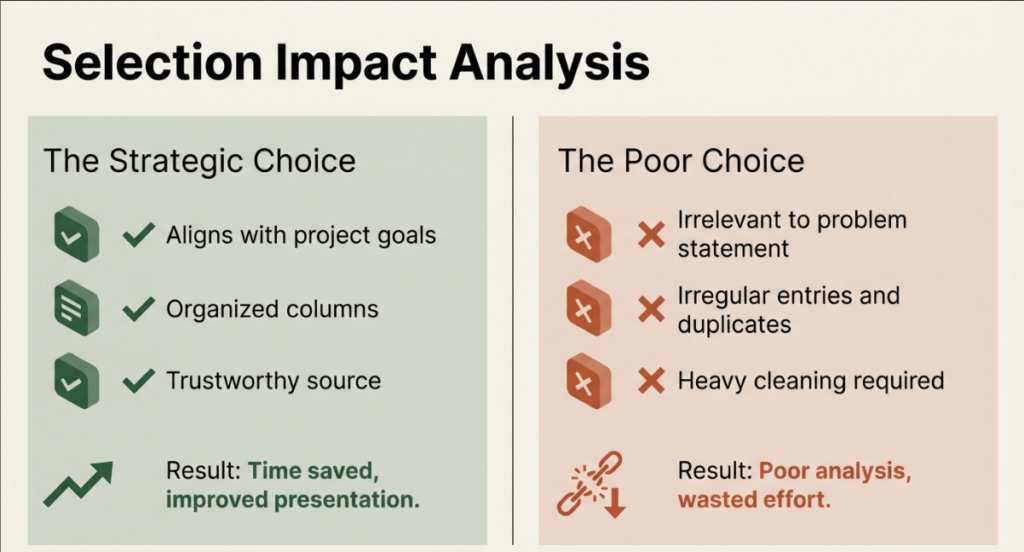
A good dataset:
- Aligns with project goals
- Has organized columns
- Has few missing values
- Is from a trustworthy source
A poor dataset:
- Does not have clear information
- Has irregular entries
- Does not relate to the problem statement
- Needs too much cleaning
The right choice will save time and improve project presentation.
Align Dataset with Tools and Skills
The dataset to be chosen should correspond to the tools being practised. If SQL is being learned in a data analyst course, a relational database dataset with multiple tables should be chosen. If Python is being practised, datasets that require data transformation and visualization should be chosen.
Some common tools used in data analytics are
- Microsoft Excel
- SQL
- Python (Pandas, NumPy, Matplotlib)
- R Programming
- Power BI
- Tableau
- Google Analytics
- Apache Hadoop
- Spark
Each of these tools has a different application. For example, Hadoop and Spark are used for large-scale data processing, while Power BI and Tableau are used for dashboard creation.
Selecting datasets according to tool capability improves project quality and learning efficiency.
Popular Dataset Platforms
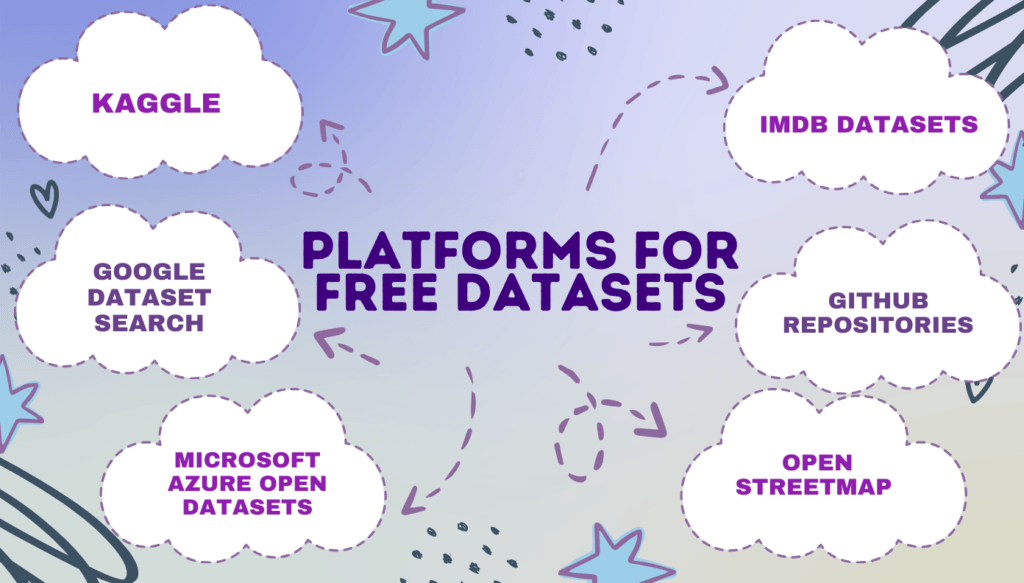
Here are some trusted platforms and websites where you can get datasets for your analytics projects for free:
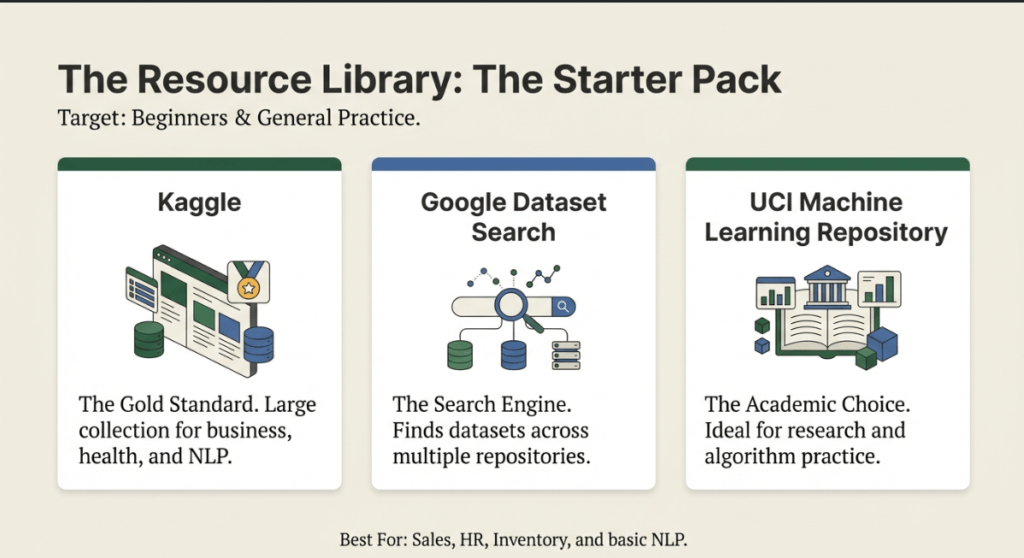
- Kaggle: Large collection of datasets for beginners and advanced users (business, healthcare, finance, NLP, etc.)
- Google Dataset Search: Search engine to find datasets from multiple sources
- UCI Machine Learning Repository: Academic datasets for research and practice
- Data.gov (USA Open Data Portal): Government datasets on economy, health, climate, education
- data.gov.in (India Open Data Portal): Indian government public datasets
- World Bank Open Data: Global economic and development data
- WHO (World Health Organization) Data Portal: Health and disease statistics
Business & Analytics Practice
- Google Analytics Demo Account: Real website traffic data for practice
- AWS Open Data Registry : Large public datasets hosted on cloud
- Microsoft Azure Open Datasets : Structured datasets for analytics and AI
- Quandl (Nasdaq Data Link): Financial and economic data
- FiveThirtyEight : Data used in journalism and analysis
Big Data & Advanced Projects
- OpenStreetMap: Geographic and location data
- IMDB Datasets : Movie and entertainment data
- GitHub Repositories: Many open-source dataset collections
Simple Beginner-Friendly Options
- Excel sample datasets (sales, HR, inventory)
- E-commerce sales datasets
- Customer churn datasets
- Student performance datasets
Mistakes to Avoid While Choosing Datasets
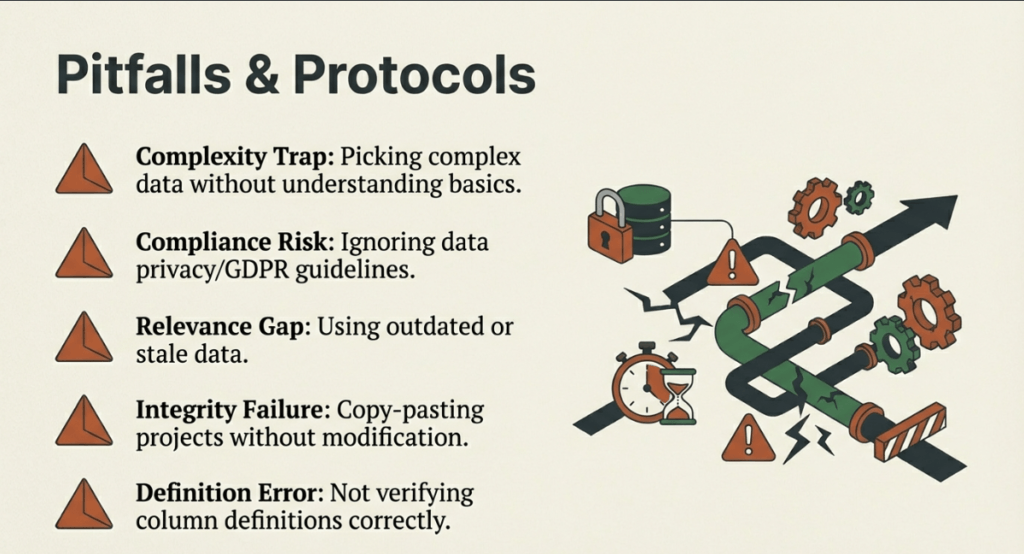
- Picking extremely complex data without understanding the basics
- Not following data privacy guidelines
- Picking outdated data
- Using copied projects without any changes
- Not verifying column definitions correctly
By avoiding these errors, learning becomes smoother and more professional.
Practical Tips for Freshers
For freshers entering the industry, it is always a good idea to start with something small. You can choose to work with simple data sets such as
- Retail sales data
- Student performance data
- E-commerce transaction data
- Website traffic data
- Customer feedback survey data
Once you have gained confidence, you can take up complex advanced projects.
Students who enroll in data analytics courses should have guided data sets and exposure to live projects. This ensures that students understand both theoretical and practical aspects of data analytics.
Conclusion
The key to the success of any analytics project begins with the right dataset. If the dataset is relevant to the objective, of good quality, and compatible with the tools used, insights can be generated.
For freshers, the skill of learning to assess and choose datasets is very important. Regular practice and proper training in data analytics will help in creating effective projects.
Keep the data simple. Keep it clear. Keep improving. The right dataset will give the right insights.
FAQ’s
1. Why is dataset selection important in data analytics?
Dataset selection has a direct impact on the quality of the results obtained. If the dataset does not connect to the project objective, the result could be incorrect or pointless. Selecting the appropriate dataset leads to effective analysis and improved decision-making. This also helps in increasing accuracy and project authenticity.
2. Where can beginners obtain free datasets?
Beginners can check out Kaggle, government open data portals, and free company reports. These portals have organized and credible datasets. There are also websites available for datasets in different industries such as healthcare, finance, and consumer products. These are perfect for practicing and portfolio projects.
3. How much data is enough for a project?
There is no specific amount of data required for each project. A few thousand clean and structured records are best for beginners. The focus should be on the quality of the data, not the quantity. Organized data provides better results than unorganized and large amounts of data.
4. What are the tools used to check the quality of the dataset?
Tools such as Excel, SQL, Python (Pandas), and R Programming are used to assess the quality of the dataset. These tools are used to identify missing values, duplicates, and errors in the dataset. These tools are also used to clean and preprocess the dataset for analysis. This is required for getting correct results.
5. Is real-time data required for student projects?
Real-time data is not required for beginners. Past datasets are sufficient for learning concepts and practicing analysis. But using updated or real-time data can make one industry-ready. This helps students understand how companies deal with real-time data.