

How to Learn SQL the Lazy Way

Learn SQL the easy way with simple steps and real examples. Perfect guide for beginners, analysts, and career switchers starting data analytics training in Hyderabad.
Introduction
Learning SQL may seem like a difficult task, especially for beginners. Most people think that dealing with a database is a complex task that requires a lot of technical knowledge. However, the truth is that SQL can be learned in a simple manner by following a specific method.
Research has shown that over 80% of the data that companies use is stored in a database, and SQL is the most commonly used programming language for handling data. This is why SQL is considered one of the most significant skills that a person can have in the data world.
For data analytics, SQL is considered a stepping stone for students, data analysts, Excel users, interns, marketers, freelancers, managers, and people who are changing their careers. This blog will show readers how they can learn SQL in a “lazy but smart” way by focusing only on the most useful concepts.
After reading this article, the readers will be able to understand how they can learn SQL in a simple way, the tools that are used in data analytics, and how a structured program such as a data analytics course can be helpful for students.
Understand What SQL Is and How We Use It
- SQL stands for “Structured Query Language,” and it is used to work with data stored in a database
- Companies use SQL to search for data such as sales information, customer data, or website data.
- This allows users to ask questions such as “How many customers bought a product last month?” and get the answer to such questions quickly.
- SQL is commonly used by data analysts, marketers, developers, and businesses to make sense of data and make decisions.
- Learning SQL is useful for beginners to understand how data is stored and how useful information can be derived from data.
Download Some Free SQL Tools
- For practice purposes, a database tool is required in which SQL can be practiced by writing SQL codes.
- For beginners, various free online tools are available that help them start practicing without any cost.
- MySQL, PostgreSQL, SQLite, and MySQL Workbench are some tools used for practicing SQL.
- These tools are used to write SQL codes and practice them.
- Installing a simple SQL tool on a laptop is useful for practicing SQL regularly.
Focus on the 20% of SQL That Solves 80% of Problems
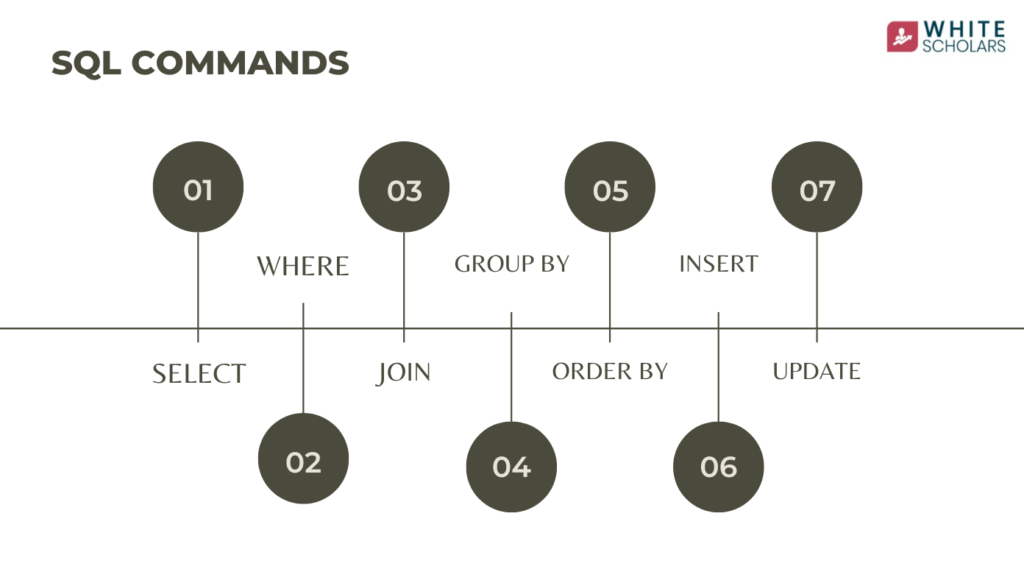
While SQL has many commands and techniques available, the fact is that most working professionals only use a handful of these on a daily basis. Learning these fundamental commands first will help you grasp SQL much faster and easier.
For many business professions, such as marketing, finance, or product analysis, SQL is used to simply access data from a database. There is no need to learn everything right from the start.
The fundamental SQL commands that are used on a daily basis are
SELECT: used to access data from a table
WHERE: used to sort data based on certain conditions
ORDER BY: used to sort data in either ascending or descending order
GROUP BY: used to analyze data
JOIN: used to access data from multiple tables
For example, an analyst working in a marketing team might be interested in writing a simple query that finds out how many users signed up the previous month. Instead of writing complex code, the analyst might be able to get the desired output using simple SQL commands.
Many new entrants to data analytics courses are eager to learn these basic commands. Many new entrants to data analytics courses in cities like Hyderabad learn these basic commands before moving to advanced data analytics techniques.
Simple Strategy to Start Learning SQL
Instead of memorizing a large list of commands, a new user can follow a logical sequence of skills that can be learned:
First, a new user can:
- Learn how data is stored in a database using tables and rows
- Practice basic SELECT queries
- Add filtering with WHERE clauses
- Join tables with JOIN operations
- Finally, analyze data with GROUP BY and aggregate functions
These few skills will get you through most real-world tasks.
Learn SQL by Solving Real Data Problems
The most effective method of learning SQL is through problem-solving rather than reading books or guides on the subject. It is a fact that if real data is used in the process of learning SQL, the process itself becomes quicker and more interesting.
For example:
- A marketer may want to analyze the results of a campaign
- A business analyst may want to analyze trends in customer purchase history
- A product manager may want to analyze user activity
- These are simple queries that help in extracting useful insights.
It has been found that most people who enroll in data analyst training are advised to use real-life problems involving sales statistics, customer statistics, or website statistics.
Tools Used in Data Analytics
When learning SQL, several tools are commonly used in the data analytics workflow.
Some important tools include:
SQL Database (MySQL, PostgreSQL, Microsoft SQL Server)
This is used to store data.
- Excel
This is used along with SQL to analyze data and clean it up.
- Python
This is used to automate data processing and analysis.
- Tableau or Power BI
These are used to present data using SQL.
- Database Query Editors
These are used to write SQL queries. Some query editors are DBeaver or MySQL Workbench.
While learning SQL in a data analytics coaching institute, students are generally trained to use these tools together to analyze data.
Build SQL Skills with Small Daily Practice
It is not necessary to study SQL for a long time. It is better to study it for a short time every day.
It is better to study SQL for 15 to 20 minutes a day instead of studying for a long time once a week. This helps the learner to improve their skills faster.
For example, the following are the exercises a person may do on a daily basis to improve their SQL skills:
- Write a query to find the total number of customers
- Write a query to filter the data by date/location
- Join two tables to find the sales and products
- Find the average revenue from the transactions
- Thus, the person gradually learns how to think critically.
In data analytics training courses, beginners usually are encouraged to solve short exercises on a day-to-day basis. In technology hubs such as Hyderabad, SQL exercises are taught in the course curriculum.
Get Your Hands Dirty, Starting With the Big 6 of SQL Querying
- Freshers should start off by learning the most frequently used SQL commands, which are enough to solve most common data-related issues.
- These are SELECT, WHERE, ORDER BY, GROUP BY, JOIN, and LIMIT.
- SELECT is for retrieving data, while WHERE is for filtering data according to specific criteria.
- ORDER BY is for arranging data, while LIMIT is for setting the number of records to be displayed.
- After mastering these SQL commands, one is already able to perform data analysis operations.
Learn Aggregate Functions and Use Them With GROUP BY
- Aggregate functions are useful for analyzing large data sets by breaking them down into simpler numerical values.
- Common examples used are COUNT, SUM, AVG, MAX, and MIN.
- COUNT can be used to retrieve customer data, while SUM can be employed to calculate total sales.
- Using Aggregate Functions along with GROUP BY
- By using Aggregate Functions along with GROUP BY, it is possible to perform data analysis according to different criteria, such as product name, location, month, etc.
- This method is widely used by businesses for reporting and also to perform data analytics to understand trends.
Learn Some Relational Database Theory
- The most common way that data is structured is through something called a relational database.
- In this type of database, the data is arranged in tables that relate to one another through relationships
- The tables have rows (records) and columns (fields) that describe the data.
- Data types like numbers, words, and dates are also important concepts that describe the type of data that will be placed in the tables.
- This basic knowledge will allow the learner to design a database that holds the data in an understandable and structured way.
Practice Querying Data From Multiple Tables
- In a real-world database, data is stored separately in different tables instead of a single large table.
- For example, customer data is stored separately from order data.
- SQL allows users to link two tables together using JOIN operations.
- By joining two tables together, users can analyze different data types.
- This skill is very important for analysts, as it enables them to ask more complex business questions.
Learn How to Create Your Own Schemas and Tables
- A schema is similar to a blueprint that shows how data is organized internally within a database.
- Creating tables allows users to manage columns, data types, and relationships between various data sets.
- SQL commands such as CREATE TABLE, INSERT, and ALTER are used for this purpose.
- Practicing with self-created tables will help users understand how databases work internally.
- Creating small databases for practice purposes will boost users’ confidence in working with actual data.
Set Reasonable Expectations
- Learning SQL does not happen overnight, especially for beginners who are new to databases.
- It is normal to get confused in the first week or two in understanding queries and relations.
- The more one practices, the sooner one will master SQL.
- Instead of trying to learn everything at one go, it would be more helpful to focus on simple queries and examples
- With patience and practice, SQL can be mastered easily.
Common Mistakes Beginners Should Avoid
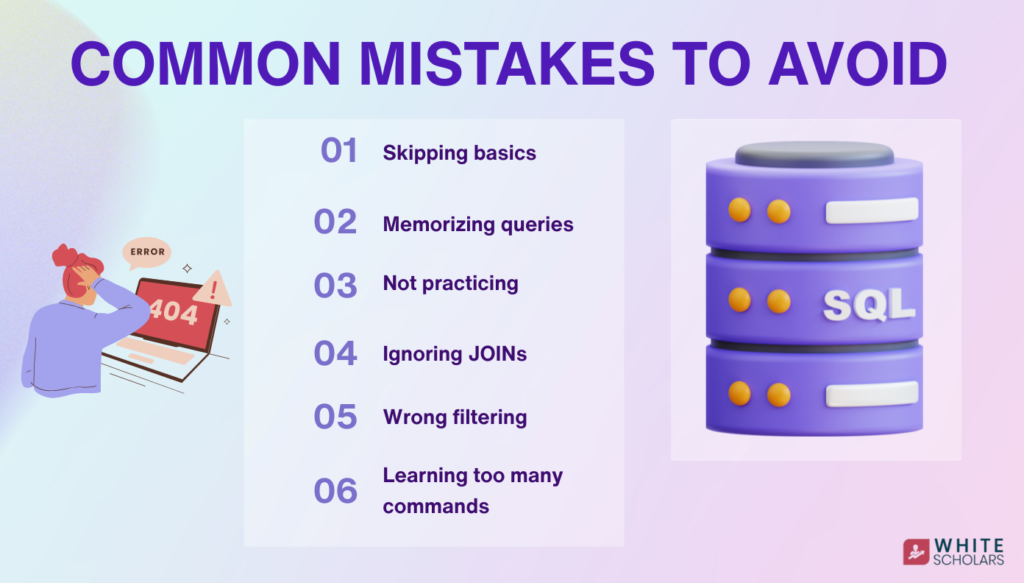
Some common mistakes are made by students while learning SQL.
These mistakes must be avoided.
- Memorizing SQL commands without proper knowledge
- Moving on to advanced topics too early
- Practicing theory without practicing with data
- Neglecting data visualization and storytelling
SQL is a powerful language when combined with other data analytics skills such as analysis, interpretation, and communication.
Conclusion
SQL is one of the easiest and most valuable skills that anyone interested in a data-related career can learn. It enables professionals to explore data, gain insights, and make business decisions.
By focusing on the most useful SQL queries, practicing with actual data, and creating small daily habits, anyone can learn SQL quickly. The “Lazy But Smart” approach makes learning SQL a simple and practical process.
Most people start their SQL learning journey through a data analyst course in tech hub cities like Hyderabad, Bangalore, Mumbai, etc., which is a structured learning environment that helps users learn about actual scenarios.
With consistent practice and curiosity, SQL can be a powerful starting point for a successful data analytics career if anyone is interested in it.
FAQ’s
1. How difficult is SQL for a beginner?
SQL is considered to be one of the simplest programming languages to learn. The commands are written in English-like words that are easy to understand. For a beginner, SQL is quite easy to learn within a matter of weeks with regular practice.
2. How long does it take to learn SQL?
The basics of SQL can be learned within a matter of 4 to 6 weeks. However, to master advanced SQL and database-related knowledge, it may take a couple of months or more to grasp these concepts.
3. Why is SQL important for data analytics?
SQL is used to analyze data from databases. SQL is used by organizations to prepare reports and analyze customer behavior. Since SQL is used to analyze data from databases, it is considered to be an important aspect of data analytics.
4. Do analysts still use Excel if they know SQL?
Yes, analysts still use Excel. SQL is used to retrieve data from a database and then analyze it. Excel is used to perform quick calculations and analyze data to some extent.
5. Where can beginners learn SQL for data analytics?
Beginners can learn SQL from various online resources. Many beginners opt to join a data analytics coaching institute to learn SQL and other data-related skills.
6. Can SQL help career switchers enter the data field?
Yes, SQL is used by many career switchers to enter the data field. SQL is used by beginners to enter the data field.