

How To Transform Business With Ranking-First Strategies: 2026
In the evolving AI world, businesses face constant change. Success depends on social strategies. Let’s examine ranking-first transformations for 2026.
What insights does this blog provide?
In the current digital landscape, digital marketing has shifted from a linear, website-centric model to a complex, multi-platform ecosystem where ranking-first strategies are essential for visibility.
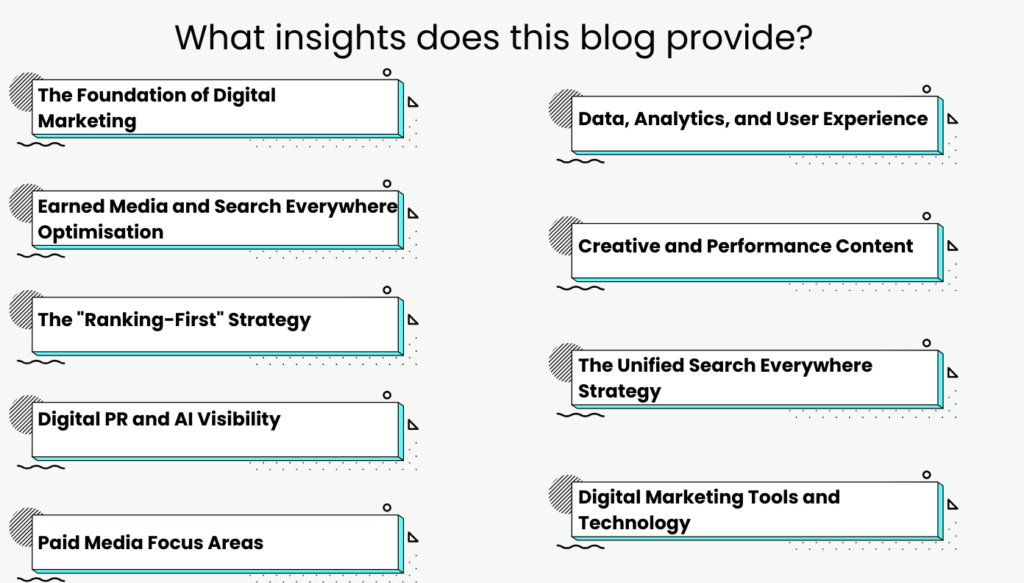
This blog mentions various categories of modern ranking-first strategies and how to establish them using various social platforms. Let us begin by discussing the fundamentals of digital marketing and how to successfully implement these strategies in real life.
1. The Foundation of Digital Marketing: Media Categories
We can categorise digital marketing into several key pillars that work synchronously to drive results:
- Earned Media: This involves gaining visibility through non-paid means, such as organic search rankings and mentions. It is described as “complicated” because search engine algorithms, like Google’s, change hundreds of times a year. Earned media are not given or bought; they’re earned through captivating content and alignment with platform best practices.
- Paid Media: This category includes strategies that require a financial investment to reach audiences on various platforms such as Google, Meta, and Amazon. It requires a full-funnel focus because modern customers consult an average of 10 sources and switch between devices before converting.
- Data & Analytics: This pillar uses technology to define customer audiences and their journeys, making marketing touchpoints more personalised and addressable. It provides the necessary insights for Chief Marketing Officers (CMOs) to optimise their digital spend.
- Creative: The mission here is to transform imagination into content that sparks meaningful conversation and actionable results. It represents a shift toward a blend of digital and traditional marketing to improve branding and performance outcomes.
- Technology: Proprietary technology, such as Ubersuggest, allows brands to reverse-engineer competitor strategies and process billions of data points to deliver faster results.
2. Earned Media and Search Everywhere Optimisation
Business Impact and Case Study Results:
The following data reflects the measurable results achieved by brands through the implementation of advanced SEO, Paid Media, and Digital PR strategies
| Brand / Project | Key Performance Outcome |
| Western Union | 487% increase in organic search share of voice |
| Adobe | 648% increase in non-brand first-page Google rankings |
| CNN Brasil | 91% increase in total views (over 1 billion in 2022) |
| Avianca Airlines | $60 Million in revenue unlocked via channel audit |
| Avianca Airlines | $2.5 Million saved by eliminating advertising waste |
| Levi’s | 38% improvement over previous Meta campaigns |
| Adobe (Traffic) | 49% of visitors driven by organic search |
In a ranking-first world, earned media extends far beyond traditional SEO. It includes:
- Search Engine Optimisation (SEO): Focused on skyrocketing online visibility and dominating search rankings through powerful strategies.
- AI Search Optimisation: Ensuring brand content appears in conversational and generative AI tools.
- App Store Optimisation (ASO): Techniques designed to unlock an app’s potential through maximum discoverability and user engagement within app stores.
- Content Marketing: The creation of compelling content to captivate and convert target audiences.
- Digital PR: Elevating brand reputation through strategic solutions that gain exposure.
- Influencer Marketing: Harnessing the reach and impact of influencers to amplify a brand.
- Organic Social Media: Cultivating meaningful connections and igniting a brand’s presence through non-paid social strategies.
- Email Marketing: Utilising personalised and engaging campaigns to drive results.
- Search Everywhere Optimisation: The practice of optimising content for search across all platforms, including Instagram, TikTok, YouTube, and ChatGPT, rather than just Google.
3. The “Ranking-First” Ranking Strategy
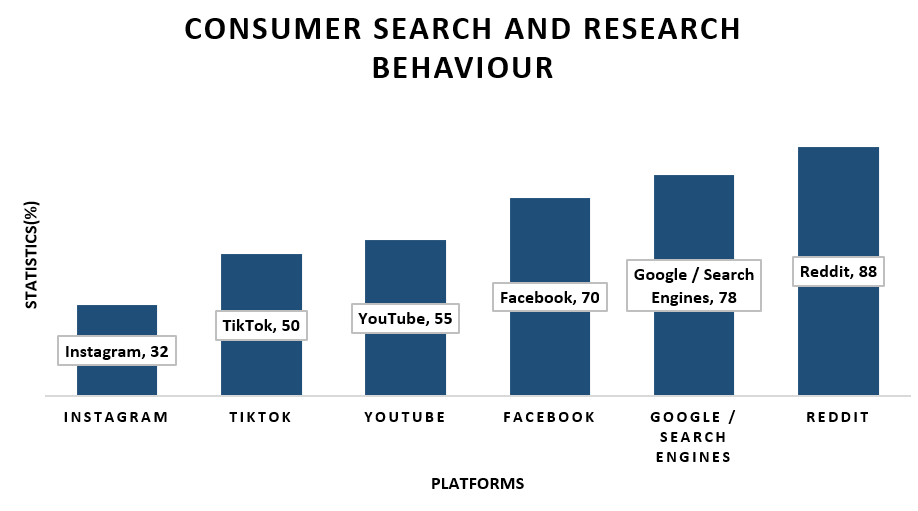
Visibility no longer starts on a brand’s website. Instead, it begins in places where people exchange unfiltered opinions, such as Reddit, TikTok, and niche forums. Let us look at the customer search across various social media platforms in a column chart.
The New Discovery Journey
Modern consumers follow a non-linear path. For example, when researching a product like an espresso machine, a user might:
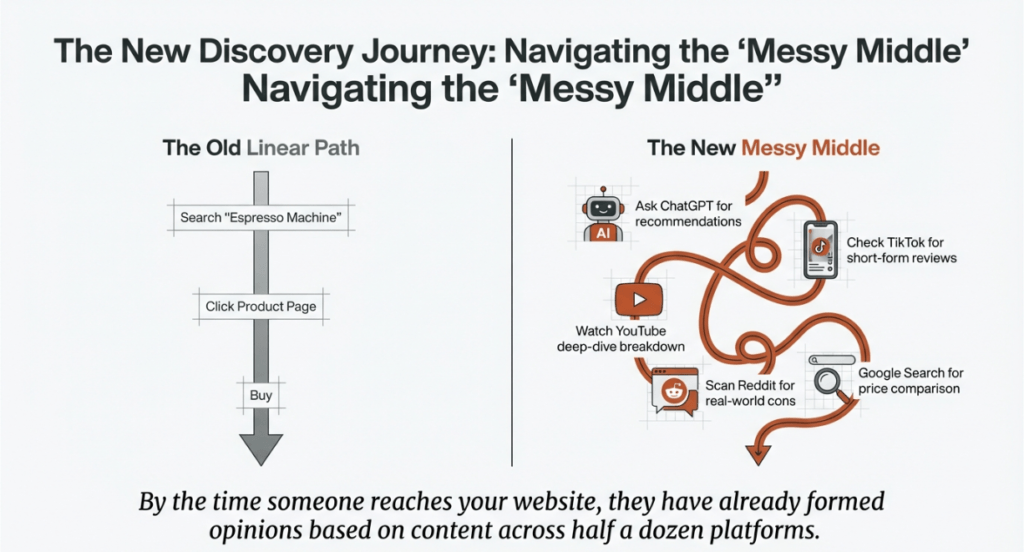
- Ask ChatGPT for recommendations.
- Check TikTok for short-form reviews.
- Watch long-form breakdowns on YouTube.
- Scan Reddit for real-world pros and cons.
- Visit Google only for final price comparisons.
This messy middle is where brands win or lose visibility. Google has adapted to this by including short-form videos, social carousels, and Reddit threads directly on its first page.
Forums and Community Engagement
Reddit and niche forums are critical because they contain firsthand experiences that AI and search engines trust. Reddit content is highly visible, appearing in Reddit search, subreddits, Reddit Answers (AI tool), and Google’s “Discussions and Forums” section.
To succeed on any digital platform, the “join-browse-launch” strategy is recommended:
- Join: Listen to the community, join them, and build interactions slowly to understand norms.
- Browse: Answer questions honestly and provide context without being promotional.
- Launch: Launch a brand, create content pillars, and scale moderation.
Authentic participation is key; brands that engage genuinely see significantly higher positive sentiment compared to general mentions.
Social Search as a Visibility Engine
Social media is now a core part of the search journey, with more than 80% of users relying on social search during their purchase process.
- Platform Signals: Social platforms and Google understand content through audio transcription, text recognition, and caption scanning.
- Keywords: Effective social search requires researching keywords within platforms (e.g., TikTok’s Creator Search Insights) and placing them in captions, spoken audio, and on-screen text.
- Engagement: Content needs a strong hook and clear audio. It does not need high-end production but must be timely and relatable.
- UGC and EGC: User-Generated Content (UGC) and Employee-Generated Content (EGC) are vital for discoverability because they combine authenticity with expertise.
4. Digital PR and AI Visibility
Digital PR has evolved from a “press release machine” into a strategy that fuels the narrative across platforms that feed AI models.
- Fuelling AI Overviews: AI tools (like LLMs) prefer fresh, authoritative, third-party information. Digital PR provides this through data studies, surveys, and expert insights.
- Recency and Authority: News coverage tied to a press release can lead to AI Overview citations within days.
- Partnerships: Some publishers have partnerships with AI companies, so securing placements there increases the likelihood of being cited by AI models.
- Measurable Impact: Brands using digital PR to supply authoritative signals have seen referrals from AI tools grow by over 1,000% within a year.
5. Paid Media Focus Areas
To combat non-linear customer journeys, paid media must be strategic and efficient:
- Media Strategy & Planning: Creating a comprehensive roadmap to optimise brand resonance.
- Paid Search: Targeted campaigns to drive traffic and boost ROI.
- Paid Social: Elevating presence and sparking conversations on social platforms.
- Programmatic & Display: Using precision targeting and visuals for efficient conversions.
- Marketplaces: Optimising presence on e-commerce platforms like Amazon to expand customer bases.
- Streaming: Engaging audiences through video and audio streaming strategies.
6. Data, Analytics, and User Experience
Optimising the digital journey requires deep technical insights:
- Data Analytics & Insights: Using forecasting and full-funnel exploration to understand performance. The best analytics training academy in Hyderabad offers the White Scholars Data Analytics Course in Hyderabad.
- Dashboard Development: Creating visuals for marketing metrics.
- Conversion Rate Optimisation (CRO): Improving testing programs to decrease acquisition costs.
- User Experience (UX): Using data and design best practices to improve website engagement.
- Front-End Development: Transforming design ideas into data-driven web solutions.
- Ad Operations: Integrating marketing platforms and site tags to stay ahead of the media landscape.
7. Creative and Performance Content
The creative aspect focuses on driving actionable results:
- Performance Creative: Effective campaigns designed for high visibility and thought leadership.
- Branding: Developing unique identities, messaging platforms, and brand architectures.
- Content Production: Creating visually stunning content using professional directors and stylists.
- Website Design: Crafting sites optimised for speed, responsiveness, and conversion.
- Graphic & Motion Design: Developing original assets, including 2D and 3D animations.
- Audio Production: Producing state-of-the-art music, podcasts, and radio spots.
8. The Unified Search Everywhere Strategy
A unified workflow is required to maximise visibility across all surfaces:
- Conduct a Study: Create first-party research (e.g., a security test).
- Multi-Asset Creation: Turn findings into YouTube videos, TikToks, Reels, and media pitches.
- Community Engagement: Join relevant Reddit conversations to contribute data.
- Media Outreach: Pitch journalists and update existing articles with new data.
- Repurpose: Distribute content through newsletters, blogs, paid ads, and social channels.
9. Digital Marketing Tools and Technology
Several tools are mentioned to facilitate these strategies:
- Ubersuggest: A private search technology for keyword research and competitor analysis.
- Answer The Public: A tool for discovering what people are searching for.
- AI-Powered Tools: This includes an AI Writer, AI SEO Meta Tags, AI Social, and AI Paid Ads tools.
- Diagnostic Tools: Such as the Google Ads Grader, SEO Analyser, and A/B Testing Calculator.
By integrating these topics, from digital PR fuelling AI to genuine community engagement on forums, brands can create a “visibility architecture” that meets customers wherever they search, compare, and validate decisions. To learn more about these tools, enrol in the White Scholars digital marketing with advanced AI course in Hyderabad.
Final Thoughts
The digital landscape has fundamentally changed from a website-centric model to a search-everywhere ecosystem. In this new era, visibility is earned by maintaining an authentic presence on platforms where audiences are active, such as Reddit, TikTok, and YouTube.
The modern consumer journey is nonlinear, with an average of ten sources before a conversion takes place. To navigate this muddled middle, brands must adopt a ranking-first strategy that prioritises first-hand experience and community engagement over traditional SEO. Furthermore, digital public relations has emerged as a critical driver of AI visibility, sending authoritative signals to language models and AI search engines.
Finally, successful digital marketing necessitates a unified visibility strategy. By combining data-driven analytics with creative, high-impact content and strategic community participation, brands can ensure they are not only visible but also trusted. Staying relevant means appearing wherever people learn, evaluate, and talk, as search engines increasingly index social conversations that reflect real user behaviour.
Frequently asked questions
How quickly can a brand appear in AI Overviews and search tools?
When a brand distributes fresh, authoritative information and earns credible media coverage, inclusion can occur in a matter of days. AI models prioritise recency and trust, so news coverage related to a strategic press release or data study can result in almost immediate citations within these tools.
Should every brand be active on Reddit and other community forums?
Every brand should “listen” on Reddit to learn about customer needs and sentiment. Active participation makes sense only once you understand the community norms; however, authentic engagement can shift brand sentiment from 41% positive in unmanaged threads to nearly 100% in managed ones.
Does social media content actually influence traditional search visibility?
Yes, because Google increasingly indexes social posts, TikToks, and YouTube Shorts directly on the first page of results. High engagement on social platforms often correlates with stronger visibility across multiple search surfaces, as search engines now rely on the unfiltered opinions found in these social conversations.
What criteria do AI models use to decide which brands to cite?
Language models favour sources that appear reliable, current, widely referenced, and easy to interpret through structured data. Digital PR helps facilitate this by producing expert insights, data studies, and media mentions in authoritative publications, which AI tools treat as credible and trustworthy information.
What is “Search Everywhere Optimisation”, and why is it important?
This strategy involves optimising content for search across all platforms, including TikTok, Instagram, and ChatGPT, rather than focusing solely on Google. It is vital because modern consumers consult an average of 10 sources across 11 or more platforms before making a purchase, moving through a “messy middle” of discovery.