

Insights to Optimize Your PPC Advertising: Tips for freshers
PPC advertising focuses on paying for audience engagement rather than just advertising the product. Let’s draw the insights to optimise your PPC advertising.
The Basic Structure of PPC
Pay-Per-Click (PPC) represents a sophisticated advertising model where advertisers do not pay for the mere display of an advertisement but rather for the actual engagement it generates.
The advertiser pays a publisher, which is typically a search engine titan like Google or a social media platform like Facebook, every time a user interacts with their advertisement by clicking on it.
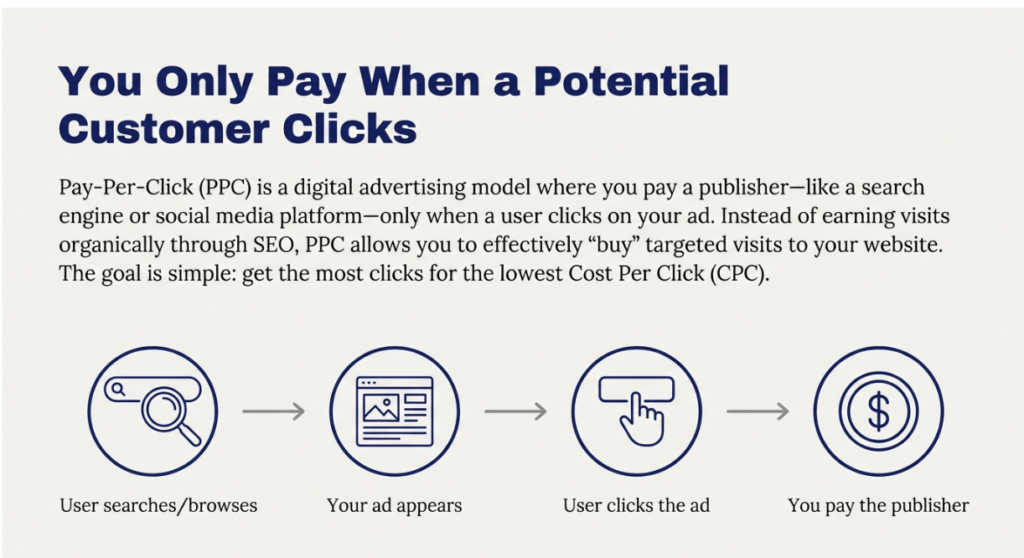
The essence of PPC is the ability to “buy” visits to a website or landing page. Unlike organic methods that require months of building authority, this tool allows for the immediate gain of traffic.
The primary goal of any specialist managing these campaigns is to achieve the highest possible volume of clicks while maintaining the lowest possible CPC, thereby increasing the efficiency of the budget.
The Necessity of Paid Engagement
Why is PPC considered a non-negotiable component of a modern digital marketing strategy?
For a small business or a new venture, the options for visibility can be overwhelming. PPC is required because it provides a method to quickly impact leads and sales in a way that other branches cannot match.
Furthermore, PPC is required because it allows for a level of precision that traditional advertising lacks. A campaign can be tailored to deliver a message to a specific audience at the exact time they are looking for a solution.
This “right place, right time” requirement is what makes PPC a primary revenue stream for many successful enterprises. Without pay-per-click, a strategy may struggle to gain traction in highly competitive sectors where organic search results are dominated by established industry leaders.
To effectively improve your pay-per-click advertising, go beyond just setting it up and focus on using data to refine your targeting, quality measures, and creative tests.
Simple Keyword and Audience Focus
The foundation of a high-performing campaign is precise targeting. This can be optimized as follows:
- Using Keyword Tools: Use platforms such as Google Keyword Planner to find terms that are both highly relevant to your target audience and have a large search volume.
- Balancing Intent and Awareness: Optimize for intent on search engines by using text-based ads that answer specific queries. For products with low search volume, use social media ads to build awareness through demographic and interest-based targeting.
- Granular Filtering: Refine your reach by targeting specific locations, languages, and devices used by your ideal customers.
- Better Suited Ads: Generally, the more accurately an ad is suited to the audience, the higher the click-through rate (CTR) and the lower the cost-per-click (CPC).
Improving the Quality Score and Ad Rank
In a bid-based model, the winner of an ad spot is determined by rank, not just the highest bid. You can improve your ranking by focusing on your Quality Score (rated 1-10), which is influenced by:
- Keyword Quality: Selecting the most relevant search terms for your business.
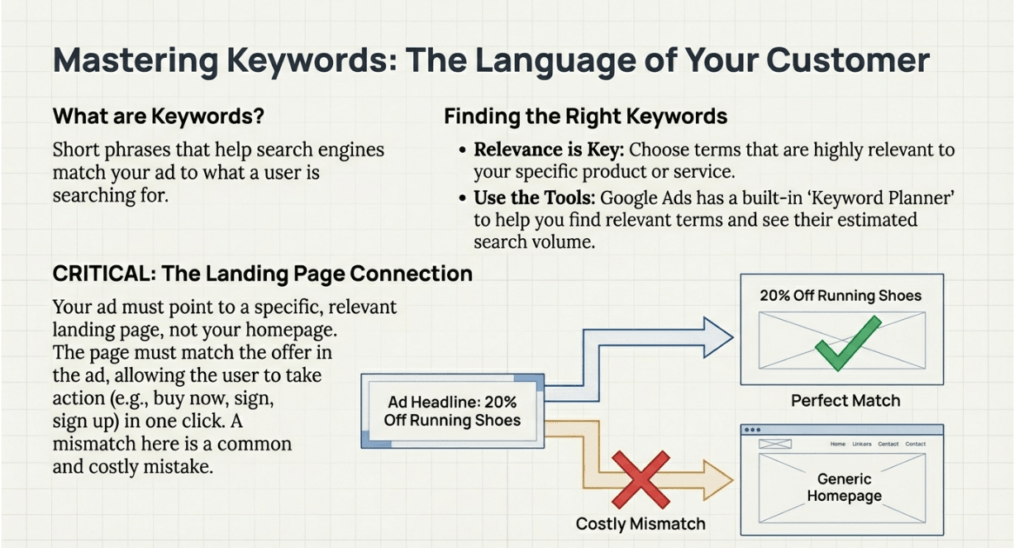
- Ad Relevance: Ensuring your ad text directly relates to the targeted keywords.
- Landing Page Experience: Creating a high-quality, useful destination for the user. Improving this score has an enormous influence on lowering your costs and increasing the effectiveness of your ads.
Destination and Conversion Optimisation
The post-click experience is critical for ensuring your ad spend results in revenue:
- Synchronised Landing Pages: Never point an ad to a generic homepage. Instead, create a specific landing page that matches the exact offer in the ad so users can purchase or sign up in just one click.
- Creative Testing: Constantly fine-tune your efforts by testing different ad copy, graphics, or special offers and comparing the results to see what resonates best with your audience.
Financial and Analytical Management
Optimization necessitates rigorous financial planning and data tracking.
- Reverse Engineering Costs: Begin with a reasonable acquisition cost and calculate your ideal CPC from there.
- Tracking Essential Metrics: Keep track of impressions, clicks, and conversions, as well as their average cost, to ensure that the campaign is effective.
- Assessing Long-term Value: Compare your KPIs against the average lifetime value of a customer to determine if your PPC spend is sustainable and profitable.
Driving Business Growth with Paid Ads
PPC acts as a fast driver for business growth. It helps a business grow by providing a direct pipeline to high-intent customers. Because it is primarily based on keyword targeting, businesses can bid on terms that are relevant to their specific offerings.
When a user searches for these terms, the business’s ad appears prominently on the Search Engine Results Page (SERP), driving immediate traffic. A business grows through PPC by leveraging the scalability of the model.
If a campaign is performing well and generating a high return on investment (ROI), the business can simply increase its budget to capture more of the market in real time.
Additionally, PPC assists growth by providing invaluable data. The measurability of PPC allows businesses to see exactly what is working, allowing them to fine-tune their messaging and product offerings based on actual user behavior.
Different types of PPC models
Pricing Models in Digital Marketing:
- Flat-Rate Model: In this structure, the advertiser and publisher agree on a fixed fee for every click. This is common on sites with specific rate cards for different sections of their website.
- Bid-Based Model: This is the most commonly used model in platforms such as Google Ads. Advertisers compete in an automated auction, setting a maximum bid they are willing to pay for an ad spot. The winner is determined by a “rank” that considers both the bid amount and the quality of the content.
Platform Varieties in
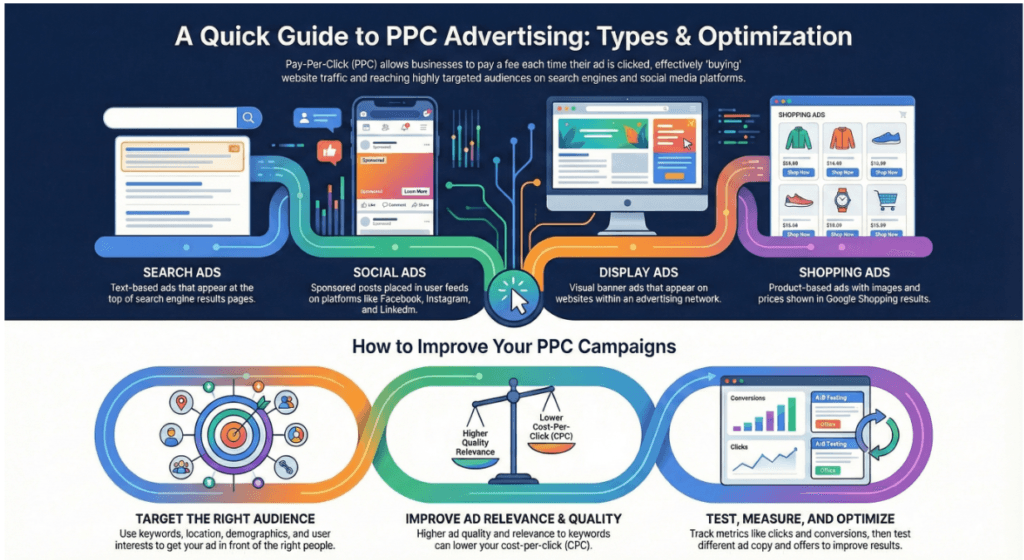
- Search Ads: These are text-based advertisements that respond to the “intent” of a user’s search query.
- Social Ads: These are in-feed ads on social media that capture a targeted audience based on demographics and interests and are often used to build awareness.
- Display Ads: Visual banners placed across a network of websites, expanding the reach of a campaign beyond search engines.
- Shopping Ads: Product-based ads that show images and prices directly in search results, ideal for e-commerce.
- Local Services Ads: Specifically designed to attract local customers for service-based businesses in context.
The Key Benefits of Paid Advertising
The benefits of incorporating PPC into a digital marketing strategy are numerous and impactful:
- Focused Accuracy: ads can be filtered by location, language, device, and even specific user behaviours.
- Immediacy: Unlike SEO, which is a long-term play, PPC drives leads and traffic instantly.
- Budget Control: managers have total control over their spending, setting daily or campaign-wide budgets to ensure they never overspend.
- Trackable Results: Every aspect of a campaign can be tracked, from impressions to the final sales revenue generated.
- Market Equality: PPC allows smaller businesses to appear alongside larger competitors in the arena.
Real-World Examples of PPC in Action
To understand how PPC functions, consider these examples:
- The Footwear Retailer: A retailer targeting the keyword “best running shoes” in a campaign on Google Ads. When a user searches this, the retailer’s ad appears at the top. The retailer is only charged when the user clicks, potentially gaining a customer who is ready to purchase.
- The Tech Company: A company selling wireless headphones bids on buying wireless headphones. This tactic places them in front of high-intent shoppers exactly when they are looking to buy.
- The Mobile App Developer: A company uses social media to promote an app that finds forgotten subscriptions. The user sees the ad in their feed, becomes aware of the problem, and clicks install. The company tracks this “install” as a key KPI of their success.
Understanding Quality Score and Ad Rank
In the sophisticated world of marketing, simply having the most money does not guarantee the top spot. A crucial additional topic is the Quality Score, a metric used by Google to ensure that ads remain helpful to users.
The Quality Score is a number between 1 and 10 assigned to every keyword in a campaign. It is determined by three primary factors:
- Keyword Relevance: How closely your chosen keywords match the user’s search.
- Ad Relevance: How well the text of your ad answers the user’s query.
- Landing Page Experience: The quality and utility of the website the user reaches after clicking the ad.
This score has an enormous influence on the cost and effectiveness ofefforts. A high Quality Score can actually allow a advertiser to pay less than a competitor for a higher ad position because the platform rewards relevance and quality.
The Need for Landing Page Alignment
A frequently overlooked aspect of PPC is the destination. It is a fundamental rule in digital marketing that an ad should never simply point to a homepage. Instead, a dedicated landing page should be created for each specific ad.
The landing page must perfectly match the offer advertised in the campaign. If a user clicks an ad for “50% off running shoes”, they should be taken directly to a page showing those shoes and that discount.
Understanding Analytics and Managing KPIs
To make a PPC campaign effective, strong analytics are needed. Marketers should monitor key metrics:
- Impressions: the number of times the ad was displayed.
- Click-Through Rate (CTR): The percentage of people who saw the ad and clicked it. A CTR above 2% is generally considered strong.
- Conversions: The number of clicks that resulted in a desired action, such as a sale or a lead.
- Cost Per Acquisition (CPA): The total cost of the campaign divided by the number of conversions.
- Return on Investment (ROI): The ultimate measure of success, comparing the revenue generated to the amount spent on ads.
By “reverse engineering” from an acceptable CPA, an expert can determine exactly how much they should be willing to pay for a click.
This data-driven approach allows for the constant fine-tuning of ads, such as testing different copy, graphics, or special offers to see what generates the best results.
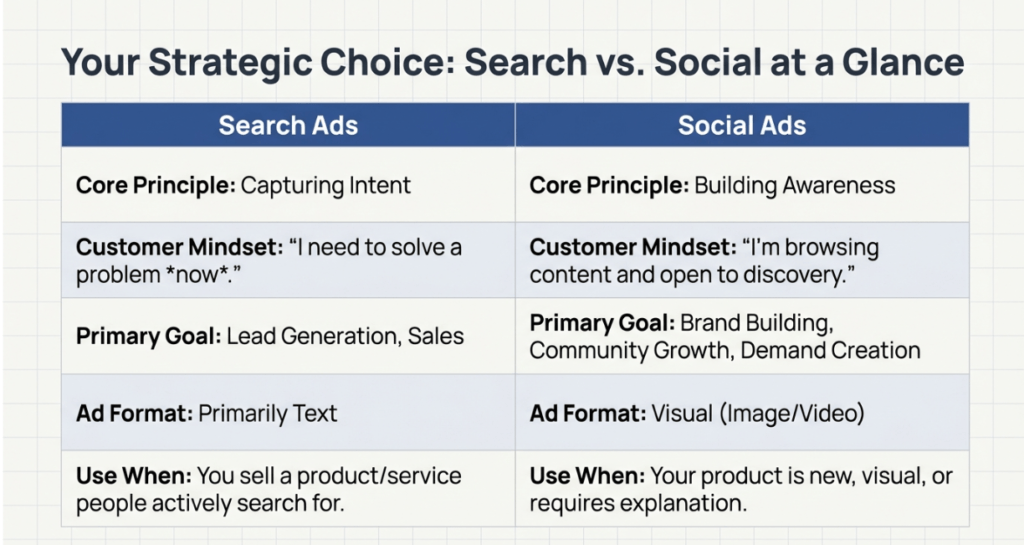
Understanding Audience Needs: Search vs. Social
A key strategic decision in marketing is determining whether to use search or social PPC. This decision is driven by the target audience’s psychological state.
Search Ads
These ads respond to active intent. The user is looking for something specific, and the ad provides the immediate answer. This is the “right place, right time” principle. It is frequently the first choice for new advertisers because search ads are simple to set up, requiring only text rather than high-end visual assets.
Social Ads (Awareness-Based)
These ads are required when a product has low search volume or when the goal is to create new demand. These are “in-feed” ads that interrupt a user’s social experience with something potentially interesting.
The ad must be engaging enough to capture a user who wasn’t actively looking for the product.
The Auction Mechanism and Ad Placement
The ad actually finds its way onto a screen through a complex, millisecond-long auction. Every time a search is initiated, the platform’s automated tools conduct an auction. The platform doesn’t just look at who has the most money; it evaluates the Ad Rank.
This Ad Rank is a combination of the advertiser’s bid and the relevance of their content. This ensures that the most helpful ads win the best positions, maintaining a high-quality experience for the user while generating revenue for the publisher.
This auction-based system makes PPC one of the most dynamic and competitive fields in the industry.
Final Thoughts
Finally, PPC is a critical component that requires ongoing monitoring and optimisation. To ensure success, every step, from initial keyword research with digital marketing tools to final ROI analysis, must be completed correctly.
Understanding the various models, benefits, and psychological factors at play allows a business to use PPC to drive immediate, measurable growth in an increasingly crowded online marketplace.
The beauty of PPC is that it is completely measurable and controlled. It enables businesses to reach the right people at the right time with a message that is specifically tailored to their requirements.
Whether it is a text-based search ad or a visual social media post, PPC remains one of the most powerful and scalable tools in the entire toolkit.
Frequently asked questions
1. How does pay-per-click advertising work?
PPC works by allowing advertisers to bid on specific keywords relevant to their business offerings. When a user searches for these terms, an automated auction evaluates the bid and ad quality to determine if the ad appears on the Search Engine Results Page (SERP). The advertiser pays a fee to the publisher, such as Google or Facebook, only when a user interacts with the ad by clicking it.
2. What is an example of a PPC ad?
A classic example is a Google Search Ad, where a company selling wireless headphones bids on the keyword “buy wireless headphones” to appear at the top of search results. Other forms include “sponsored links” on search engines, visual banners within the Google Display Network, or sponsored posts on social media feeds. In each case, the business is only charged when a user actively clicks the ad.
3. What is the difference between PPC and SEO?
PPC provides immediate visibility by allowing businesses to “buy” visits, ensuring ads appear at the top of results as soon as a campaign launches. Conversely, SEO focuses on earning traffic naturally by optimising content to rank organically, which takes longer but offers more sustainable, cost-effective results. Many specialists combine both into a unified Search Engine Marketing (SEM) strategy.
4. What is a good pay-per-click rate?
While “good” rates vary by industry and competition, a strong click-through rate (CTR) is typically considered to be above 2%. To determine if a cost is acceptable, advertisers often “reverse engineer” their cost-per-click (CPC) from their target cost per acquisition. Success is measured by ensuring the CPC aligns with overall ROI targets and positive bottom-line results.
5. How can PPC help a business grow?
PPC acts as a promoter for growth by providing a highly targeted way to reach the “right people” at the “right time” when they are actively searching for products. It allows for complete scalability, enabling businesses to increase or decrease budgets in real-time based on measurable performance data like conversions and ROI. This immediate impact on leads and sales makes it an essential tool for both new and established businesses.