

Top 15 End-to-End Machine Learning Projects for Beginners 2026
Want to master Machine Learning through hands-on practice? Explore 15 end-to-end projects that help beginners build skills, portfolios, and real-world experience.
Key Takeaways
- End-to-end machine learning projects provide hands-on experience with the complete ML workflow.
- Working on real-world datasets helps strengthen practical and analytical skills.
- Projects across domains such as healthcare, finance, retail, NLP, and computer vision build diverse expertise.
- A strong portfolio of machine learning projects improves internship and job opportunities.
- Consistent practice and continuous learning are essential for becoming proficient in machine learning.
What Is an End-to-End Machine Learning Project
An end-to-end machine learning project is a complete process that solves a problem from start to finish. It is not only about building a machine learning model. The project is completed by following every step, such as collecting data, cleaning the data, exploring the data (EDA), preparing features, training the model, testing its performance, and deploying it for real-world use.
Working on end- to-end machine learning projects helps beginners understand how machine learning is used in real-world applications. These projects also improve problem-solving skills, strengthen knowledge of ML algorithms and build a portfolio that can impress recruiters.
Whether the goal is to predict house prices, detect spam emails or recommend movies following the complete machine learning lifecycle gives learners experience and prepares them for industry roles.
Why Beginners Should Build Machine Learning Projects
Building machine learning projects is one of the most effective ways for beginners to turn theoretical knowledge into practical skills. While learning algorithms and concepts is important, applying them to real-world problems helps develop a deeper understanding of how machine learning works.
By working on end-to-end machine learning projects, beginners gain experience with every stage of the machine learning lifecycle, from collecting and cleaning data to training, evaluating, and deploying models. This hands-on approach strengthens technical skills and builds confidence in solving real-world challenges.
Machine learning projects also help create a strong portfolio that showcases practical experience to recruiters and hiring managers. A well-developed portfolio demonstrates problem-solving abilities, familiarity with industry tools, and the ability to work with real datasets.
- Some key benefits of building machine learning projects include:
- Developing hands-on experience with real-world datasets.
- Understanding the complete machine learning workflow.
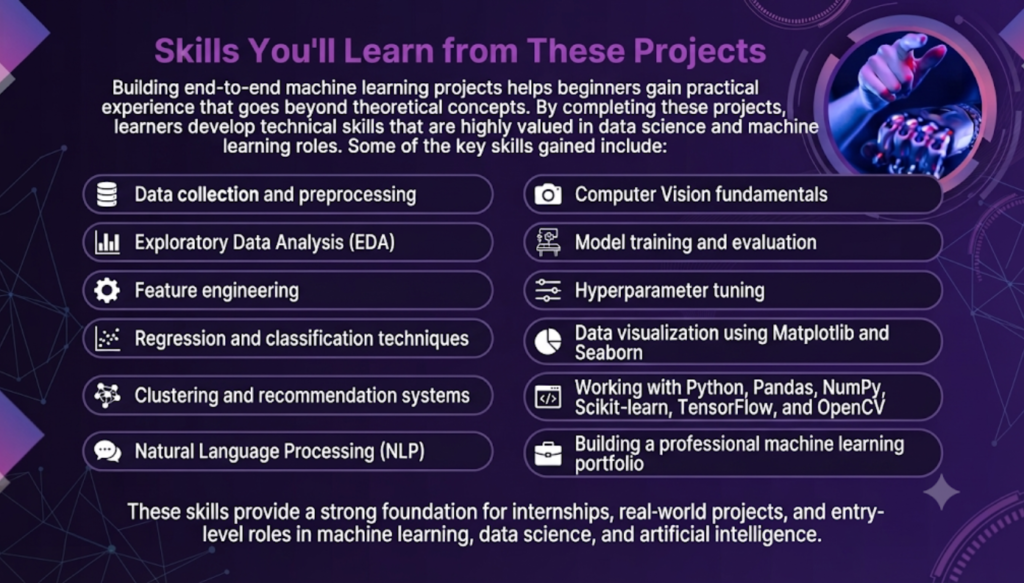
- Improving data preprocessing and feature engineering skills.
- Learning how to train, evaluate, and optimize ML models.
- Building a strong portfolio for internships and job opportunities.
- Gaining experience with popular tools such as Python, Pandas, NumPy, Scikit-learn, TensorFlow, and Jupyter Notebook.
- Enhancing analytical thinking and problem-solving abilities.
Consistently building machine learning projects for beginners not only improves technical expertise but also prepares aspiring data professionals for interviews and real-world industry roles.
1. House Price Prediction
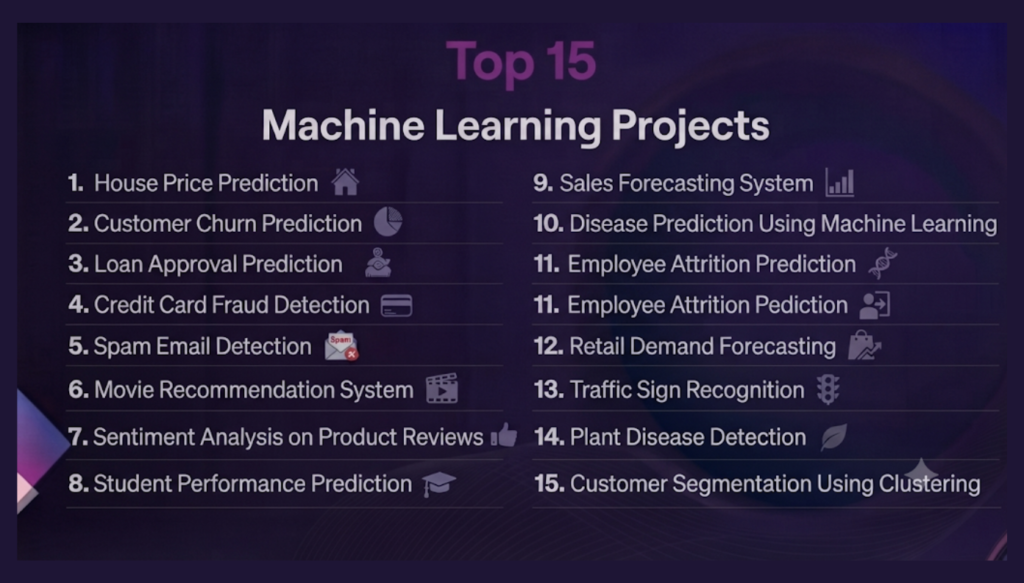
House Price Prediction is one of the best machine learning projects for beginners. It predicts the price of a house using features such as location, area, number of bedrooms, and amenities. This project helps beginners understand regression algorithms and the complete machine learning workflow, from data preprocessing to model evaluation.
Tools: Python, Pandas, NumPy, Scikit-learn, Matplotlib
Skills Learned: Data preprocessing, EDA, Feature engineering, Regression, Model evaluation
2. Customer Churn Prediction
Customer Churn Prediction helps businesses identify customers who are likely to stop using their services. This project uses customer data such as purchase history, subscription details, and engagement to predict churn. It introduces beginners to classification algorithms and real-world business analytics.
Tools: Python, Pandas, Scikit-learn, Matplotlib
Skills Learned: Data preprocessing, Classification, Feature engineering, Model evaluation
3. Loan Approval Prediction
Loan Approval Prediction determines whether a loan application is likely to be approved based on factors such as income, credit history, and employment status. This project helps beginners understand binary classification and predictive analytics.
Tools: Python, Pandas, Scikit-learn, NumPy
Skills Learned: Data cleaning, Classification, Feature selection, Model evaluation
4. Credit Card Fraud Detection
Credit Card Fraud Detection identifies fraudulent transactions using historical transaction data. It introduces beginners to anomaly detection, handling imbalanced datasets, and classification models commonly used in the financial industry.
Tools: Python, Pandas, Scikit-learn, Matplotlib
Skills Learned: Data balancing, Classification, Feature engineering, Model evaluation
5. Spam Email Detection
Spam Email Detection classifies emails as spam or legitimate using Natural Language Processing (NLP). This project helps beginners learn text preprocessing, feature extraction, and text classification techniques.
Tools: Python, NLTK, Scikit-learn, Pandas
Skills Learned: NLP, Text preprocessing, Classification, Feature extraction
6. Movie Recommendation System
A Movie Recommendation System suggests movies based on user preferences and viewing history. This project introduces beginners to recommendation algorithms and personalized content delivery.
Tools: Python, Pandas, Scikit-learn, Surprise
Skills Learned: Recommendation systems, Data preprocessing, Similarity analysis
7. Sentiment Analysis on Product Reviews
Sentiment Analysis predicts whether customer reviews express positive, negative, or neutral opinions. This NLP project helps beginners understand text analytics and opinion mining.
Tools: Python, NLTK, Scikit-learn, Pandas
Skills Learned: NLP, Text classification, Sentiment analysis, Feature extraction
8. Student Performance Prediction
Student Performance Prediction estimates academic performance using factors such as attendance, study hours, and previous grades. It demonstrates how machine learning supports educational decision-making.
Tools: Python, Pandas, Scikit-learn, Matplotlib
Skills Learned: Regression, Data preprocessing, Feature engineering, Model evaluation
9. Sales Forecasting System
Sales Forecasting predicts future sales using historical sales data and business trends. This project introduces beginners to forecasting models and business analytics.
Tools: Python, Pandas, Scikit-learn, Matplotlib
Skills Learned: Time series analysis, Regression, Data visualization
10. Disease Prediction Using Machine Learning
Disease Prediction uses patient information such as symptoms and medical records to predict the likelihood of diseases. It demonstrates how machine learning is applied in the healthcare industry.
Tools: Python, Pandas, Scikit-learn, NumPy
Skills Learned: Classification, Data preprocessing, Healthcare analytics, Model evaluation
11. Employee Attrition Prediction
Employee Attrition Prediction identifies employees who are likely to leave an organization. This project helps beginners understand HR analytics and predictive modeling.
Tools: Python, Pandas, Scikit-learn, Matplotlib
Skills Learned: Classification, Feature engineering, HR analytics, Data visualization
12. Retail Demand Forecasting
Retail Demand Forecasting predicts product demand based on historical sales and seasonal trends. It helps businesses improve inventory planning and reduce stock shortages.
Tools: Python, Pandas, Scikit-learn, Matplotlib
Skills Learned: Time series forecasting, Data analysis, Regression, Business analytics
13. Traffic Sign Recognition
Traffic Sign Recognition identifies road signs from images using computer vision techniques. This project introduces beginners to image classification and deep learning fundamentals.
Tools: Python, TensorFlow, OpenCV, Keras
Skills Learned: Computer vision, Image preprocessing, CNNs, Deep learning
14. Plant Disease Detection
Plant Disease Detection uses images of plant leaves to identify diseases at an early stage. This project demonstrates how deep learning can support smart agriculture.
Tools: Python, TensorFlow, OpenCV, Keras
Skills Learned: Image classification, Deep learning, Computer vision, CNNs
15. Customer Segmentation Using Clustering
Customer Segmentation groups customers based on purchasing behavior and demographics. This project introduces beginners to unsupervised learning and helps businesses create targeted marketing strategies.
Tools: Python, Pandas, Scikit-learn, Matplotlib
Skills Learned: Clustering, Unsupervised learning, Data visualization, Customer analytics
Tips to Build Better Machine Learning Projects
Building a machine learning project is not about training a machine learning model. It is about doing things the way so that your machine learning project is accurate and reliable. This way you can really learn from it. Show others what you can do with machine learning.
Here are some useful tips for people who are just starting out with machine learning:
- Choose datasets from life that come from sources you can trust like Kaggle or the UCI Machine Learning Repository.
- Take your time to clean up the data and get it ready before you start training your machine learning model.
- Look at the data to see if you can find any patterns or trends. This is called Exploratory Data Analysis or EDA for short.
- Start with machine learning algorithms and then move on to more complicated ones.
- When you are checking how well your machine learning model is doing, use the metrics. Do not just look at how accurate it is.
- Write down everything you do on your machine learning project so it is easy to understand. Include what you are trying to do, how you are doing it and what you found out.
- Use GitHub to share your machine learning project with others and show them what you can do.
- Keep making your machine learning project by trying out different algorithms and adjusting the settings on your model.
Following these tips will help people who’re new to machine learning build really good projects from start to finish and get better at solving problems and understanding data, with machine learning.
Conclusion
Building machine learning projects from start to finish is one of the best ways for beginners to gain practical experience and understand how machine learning is applied in real-world scenarios. These projects help develop essential skills such as data preprocessing, model training, evaluation, and deployment, while building the confidence to solve real-world problems.
The machine learning projects covered in this guide provide a solid foundation for creating a strong portfolio and improving technical expertise. With consistent practice and hands-on learning, aspiring professionals can strengthen their skills and prepare for internships and full-time roles in artificial intelligence and data science.
For those looking to deepen their knowledge through structured learning, exploring a Data Science Training in Hyderabad can be a valuable next step. Combining guided training from institutes like Whitescholars with hands-on machine learning projects helps learners build practical experience and stay better prepared for industry opportunities.
Frequently Asked Questions (FAQs)
1. Which machine learning project is best for beginners?
Projects like House Price Prediction, Spam Email Detection, and Customer Churn Prediction are excellent starting points because they cover fundamental machine learning concepts.
2. Do machine learning projects help in getting a job?
Yes. Real-world projects demonstrate practical skills, strengthen portfolios, and help candidates stand out during internships and job interviews.
3. Which programming language is commonly used for machine learning projects?
Python is the most widely used programming language because of its extensive ecosystem of machine learning libraries, including Pandas, NumPy, Scikit-learn, TensorFlow, and PyTorch.
4. Where can beginners find datasets for machine learning projects?
Beginners can explore datasets from platforms such as Kaggle, the UCI Machine Learning Repository, and government open data portals.
5. How many machine learning projects should a beginner build?
Completing 5 to 10 well-documented projects across different domains is generally enough to build a strong portfolio and demonstrate practical machine learning skills.
